
At A Glance
- Close the oven door immediately and turn off the heat – most oven fires die on their own within 60 seconds once you cut the oxygen.
- Never throw water on a grease fire. It turns the grease into an explosive vapor and makes the fire spread fast.
- Call 911 if the fire has spread outside the oven, if you see electrical arcing, or if a gas oven fire doesn’t go out within 90 seconds of shutting it off.
- Gas and electric oven fires need different responses – knowing which type you have before there’s a fire can save your life.
- Most oven fires are preventable with a simple cleaning routine and a few rules around foil, cookware, and broiler use.
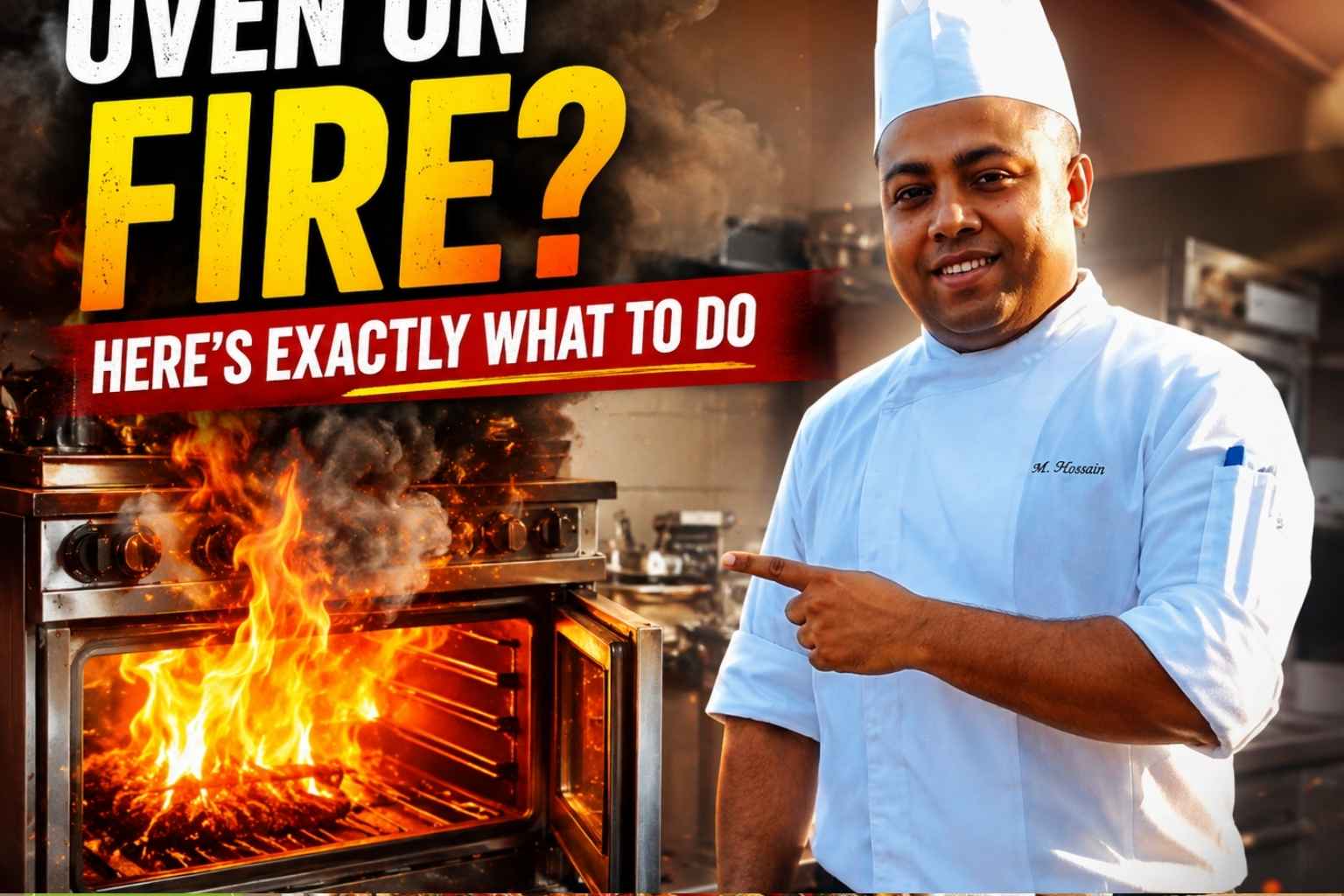
My oven burst into flames last winter, right in the middle of a Sunday roast. My heart dropped, but years in professional kitchens taught me to stay calm and act fast. An oven on fire is scary, but it’s more common than you think, and most causes are simple to fix. In this guide, I’ll walk you through why it happens and what to do the second you smell smoke. Grab a fire extinguisher and let’s get your kitchen safe again.
The Honest Truth About Oven Fires – Why Most People Panic for No Reason
Let me tell you something I’ve told every cook who has worked in my kitchens: oven fires are far more common than you think, and far less deadly than the movies make them look.
I’ve been a professional chef for 16 years. I’ve worked in high-volume restaurant kitchens, catering operations, and, for the past four years, a cooking school where I teach home cooks. I have watched a lot of ovens catch fire. I have set a few on fire myself. And in nearly every case, the biggest danger was not the fire – it was the person who panicked, opened the door, and turned a small grease flare into a kitchen emergency.
Here’s the number: cooking fires are the leading cause of home fires and home injuries in the United States (NFPA, 2023). But the majority of oven fires – specifically the kind that start inside the oven cavity – go out on their own when you simply leave the door shut and turn off the heat.
That’s the whole article in one sentence. Everything else is detail.
Types of Oven Fires and What Causes Each One
Not all oven fires are the same. The type of fire changes how you respond. This is the first thing I teach every new kitchen hire.
Grease Fires
A grease fire happens when fat or oil drips onto the oven floor or heating element and reaches its smoke point, then its flash point. This is the most common type of oven fire in home kitchens.
The cause is almost always a dish that overflowed, a roasting pan without a rack that let juices pool and splatter, or a dirty oven floor with built-up fat residue. Temperatures above 400°F (204°C) make grease fires far more likely with fatty meats like bacon, duck, or pork belly.
Food Debris Fires
These are small fires caused by sugar, crumbs, or food bits on the oven floor or element that catch and burn. You’ll often see a quick flame, a lot of smoke, and then nothing. These usually burn out fast.
This is the type of fire I see most often in student kitchens at my cooking school. Someone baked a pie that bubbled over, didn’t clean it, and the next time they ran the oven at 450°F (232°C), the leftover sugar ignited.
Broiler Fires
Broiler fires are the most aggressive type and the one most likely to need intervention. When food is too close to the broiler element – or when fat drips upward and hits the element directly – you can get a fast, hot flare.
The U.S. Fire Administration identifies broiler use as a top cause of oven fires in residential kitchens (USFA, 2022). The key variable here is distance and fat content. Keep food at least 4 inches (10 cm) from the broiler element. Fatty cuts need more distance.
Electrical Fires
Electrical fires come from a failing heating element, a short circuit in the oven’s wiring, or a damaged igniter in older models. These fires look different – you’ll often see sparking, arcing, or a bluish flame near the element itself rather than near food.
Electrical fires require you to cut power at the circuit breaker immediately. Do not rely on turning the oven dial to OFF. A shorted element can continue to arc even with the control set to off.
Gas Oven Fires
Gas fires are less common than electric oven fires but need a faster, more specific response. If the fire doesn’t go out within 60-90 seconds of shutting off the gas supply, turn off the gas at the main shutoff valve, leave the house, and call the fire department from outside.
The Quick-Reference Decision Table: Fire Type vs. Correct Action
| Fire Type | First Action | What NOT to Do |
|---|---|---|
| Grease fire | Close door, turn off oven | Open the door, use water |
| Food debris fire | Close door, turn off oven | Panic – these usually self-extinguish |
| Broiler fire | Close door, turn off broiler, watch for spread | Use water, leave the house unattended |
| Electrical fire | Cut power at breaker | Turn knob to “off” and assume it’s safe |
| Gas oven fire | Shut off gas supply, leave if fire persists | Stay in the kitchen if fire lasts past 90 seconds |
| Fire outside the oven | Call 911, leave immediately | Fight it with an extinguisher unless trained |
What to Do in the First 10 Seconds, First 60 Seconds, and Beyond
The First 10 Seconds
Close the oven door. That’s it. That is the single most important action you can take in the first 10 seconds of an oven fire.
Don’t grab a towel. Don’t open the door to check on the food. Don’t yell for someone else. Close the door and turn off the oven.
If the oven is already open, close it gently but firmly. If it’s a gas oven, turn the dial to OFF at the same moment.
The First 60 Seconds
Watch the oven from a safe distance. Most grease and food fires will die in under 60 seconds once you’ve cut the oxygen supply by closing the door and the heat supply by turning off the oven.
While you watch, assess:
- Is smoke coming from around the door seals only, or is fire coming through the seals?
- Can you smell gas? (If yes – leave immediately and call 911 from outside)
- Is the oven making a popping or sparking sound? (If yes – cut the breaker)
- Is the fire spreading visibly past the oven door?
If the fire is staying inside the oven and not growing – stay calm. You’re watching it go out.
After 60 Seconds
If the fire has not gone out after 60 seconds with the door closed and the oven off, call 911. Don’t try to fight it with an extinguisher at this point. Get everyone out of the kitchen.
If the fire is out, leave the door closed for at least 15 more minutes. The oven cavity is still hot. Opening it early re-introduces oxygen and can re-ignite residual grease.
The Golden Rule: Keep the Oven Door Closed
The science here is simple. Fire needs three things: heat, fuel, and oxygen. When you close the oven door, you cut off the oxygen supply. The fire consumes whatever oxygen remains in the cavity and then dies.
When you open the door, you introduce fresh oxygen. That turns a small flare into a large one, sometimes instantly.
I have seen this happen more times than I can count. Someone hears a sizzle and opens the door to look. The rush of air hits the grease fire, and suddenly they have a 12-inch flame coming at their face.
Keep. The. Door. Closed.
This applies even if the food is ruined. The food is already done. What you’re protecting now is the oven, the kitchen, and yourself.
When to Call 911 vs. When to Handle It Yourself
Here are the specific thresholds I use. This is not a gray area in my kitchens.
Call 911 immediately if:
- The fire has spread outside the oven – to the stovetop, range hood, cabinetry, or anywhere else in the kitchen
- You smell gas during or after the fire
- You see electrical arcing, sparking, or a persistent bluish flame near the element
- The fire has not gone out within 90 seconds of closing the door and shutting off the oven
- Anyone in the house has inhaled significant smoke or has burns
- You used a fire extinguisher inside the oven cavity (the chemical residue requires professional cleanup and the oven must be inspected before reuse)
Handle it yourself if:
- The fire stays inside the oven, goes out within 60 seconds of closing the door and turning off the heat, and leaves no smoke coming through the door seals
- The fire is clearly food debris (crumbs, spilled sugar) that burned off and left no residual flame
When in doubt – call. A false alarm costs you nothing. A delayed call can cost you everything.
Gas vs. Electric Oven Fires: Critical Differences
Electric Oven Fires
Electric oven fires are more forgiving because you can cut the power at the breaker and eliminate the heat source completely. The element stops generating heat the moment power is cut.
For a standard grease or food fire in an electric oven, turning the oven to OFF is usually enough. For anything involving the element itself – sparking, arcing, or a fire that looks like it’s coming from the element rather than the food – go to the breaker.
Gas Oven Fires
Gas ovens carry an added risk: the burner keeps supplying fuel as long as gas flows, even after you turn the dial to OFF, if there’s a valve failure or malfunction.
For a gas oven fire that doesn’t go out within 60-90 seconds:
- Turn off the gas supply valve behind or beneath the oven
- If you don’t know where that valve is, turn off the gas at the main shutoff valve for the house
- Leave the house
- Call 911 from outside
Do not try to troubleshoot a gas oven fire from inside the kitchen. Gas + heat + enclosed space is a combination that ends badly.
How to Use a Fire Extinguisher on an Oven Fire – and When NOT To
The PASS method applies to all fire extinguisher use (American Red Cross, 2024):
- Pull the pin
- Aim at the base of the fire, not the flames
- Squeeze the handle slowly
- Sweep side to side
But here’s what most guides don’t tell you: using a fire extinguisher inside an oven cavity is often the wrong call.
A standard ABC dry chemical extinguisher coats the interior of your oven with sodium bicarbonate or monoammonium phosphate powder. That powder is corrosive to oven components and nearly impossible to clean completely from a hot oven cavity, porous elements, and oven insulation.
If you discharge an extinguisher into your oven:
- Do not use the oven again until a certified appliance technician inspects and clears it
- Ventilate the kitchen immediately
- Contact your homeowner’s insurer – the damage is likely covered
Use a fire extinguisher on an oven fire only if: the fire has escaped the oven cavity, you cannot cut off the oxygen or fuel source, and you have a clear path to the exit. Otherwise – close the door and let the oven do the work.
Baking Soda vs. Water vs. Extinguisher: What Actually Works
Water
Never use water on a grease fire. Full stop.
Water and burning grease produce a violent steam explosion. The boiling water turns to vapor instantly, carries burning oil droplets into the air, and can turn a small fire into a fireball that fills the room (NFPA, 2023). This is how people get severe burns from what started as a minor oven fire.
Water is safe only on a fire that has already been completely extinguished and has cooled – and then only to cool surfaces, not to fight flames.
Baking Soda
Baking soda works on small grease fires by releasing CO2 when it heats, which smothers the flame. But it takes a significant quantity – far more than most people have on hand – and it works best on fires in a pan or on a flat surface where you can pour it directly.
On an oven floor fire that you can’t easily reach, baking soda is not reliable enough to count on. Close the door first.
Fire Extinguisher
As covered above – useful when the fire has left the oven, but costly to the oven itself and not worth it for a contained fire.
The best fire-fighting tool for an oven fire is the oven door.
What to Do After the Fire Is Out
Ventilation First
Open windows and run the kitchen exhaust fan. Smoke from a grease fire contains carbon particles and volatile organic compounds. The smell is also stubborn – ventilate early and for longer than you think you need to.
Leave the Door Closed for 15-30 Minutes
Even after the fire is out, the oven cavity stays hot enough to re-ignite grease. Wait until the oven has cooled to room temperature before opening it for inspection.
Inspect Before Reusing
Before using the oven again, check for:
- Damage to the heating element or burner (cracks, blistering, blackening beyond the element itself)
- Warped or discolored oven racks
- Damage to the door gasket (the rubber seal around the door edge)
- Any smell of burning plastic or rubber when the oven is warm – a sign of insulation damage
If any of these are present, or if the fire involved the element directly, call a certified appliance technician before using the oven again.
Cleaning After the Fire
Once the oven is fully cool:
- Remove racks and soak in hot soapy water
- Scrape out any solidified grease or debris from the oven floor with a plastic scraper
- Apply a paste of baking soda and water to grease residue and let it sit for 30 minutes
- Wipe clean with a damp cloth
- For stubborn residue, a dedicated oven cleaner applied per label instructions is safe once the oven is completely cold
Do not run the self-clean cycle immediately after a fire. The self-clean cycle heats the oven to 900°F (482°C) or higher. If there is any residual grease buildup, this can start another fire.
The Chef’s Personal Story: A Restaurant Kitchen Fire at 6:45 PM on a Saturday
I want to be direct with you about something. I almost panicked the first time I dealt with a serious kitchen fire. This was year three of my career, working the dinner service at a 90-seat Italian place in Chicago. A lamb rack had been in a convection oven at 400°F (204°C). A prep cook had placed the roasting pan directly on the oven floor – no rack. Fat pooled, dripped onto the element, and caught.
I heard a whump. I looked through the oven door window and saw a flame about the size of a fist.
My instinct was to open the door. Every instinct I had said: open the door and do something. My sous chef grabbed my arm, said “door stays closed,” and turned off the oven. We both stood there watching the window. Fourteen seconds later, the flame was gone.
Fourteen seconds. The lamb was fine. The oven was fine. The dinner service went on.
What I learned that night was that kitchen training isn’t about knowing what to do. It’s about being calm enough to do the thing you already know.
Close the door. Turn off the heat. Count to sixty.
Prevention: My Personal Routine for Avoiding Oven Fires
The best oven fire is the one that never starts. Here’s what I do – and what I tell every student and home cook who asks.
Clean the Oven Every 3-4 Uses
Don’t wait for visible buildup. Grease is invisible at first. By the time you see it, there’s already enough to ignite. I wipe down the oven floor and the area around the lower element or burner after every three or four heavy cooking sessions.
For the self-clean cycle: run it when the oven is at low residue levels, not after a major buildup event. A small, controlled burn-off is far safer than incinerating a thick layer of grease at 900°F (482°C).
Never Line the Oven Floor with Foil
This is the single most common mistake I see from home cooks. People put foil on the oven floor to “catch drips.” It blocks airflow, traps heat, and can melt to the oven floor at high temperatures. At worst, it can contact the heating element and cause an electrical short.
The oven manufacturer’s manual will tell you the same thing. Don’t do it. Use a rimmed baking sheet on the rack below your food instead.
Follow the 4-Inch Broiler Rule
Keep food at least 4 inches (10 cm) from the broiler element. Fatty cuts need 5-6 inches. Set a timer and stay near the oven during any broiling session. The broiler is the only oven function where fire risk scales with time – fat renders slowly, and what’s safe at 3 minutes can ignite at 8.
Check Cookware Temperature Limits
Most glass bakeware has a maximum rated temperature of 425-450°F (218-232°C) (Consumer Reports, 2023). Oven-safe skillets with silicone handles often top out at 400°F (204°C). Going above these limits doesn’t always cause an immediate fire, but it causes stress fractures that can shatter on future use or release compounds that ignite.
Check the bottom of every pan before it goes in the oven. If it says “stovetop only” or has no oven rating – it stays on the stovetop.
Common Mistakes People Make During Oven Fires
Mistake 1: Opening the oven door to check on the fire. Fix: Keep the door closed. Look through the window if you must check. Opening the door introduces oxygen and can triple the fire’s size in seconds.
Mistake 2: Using water to fight a grease fire. Fix: Close the door. If the fire has escaped the oven, use a Class K fire extinguisher (for grease fires) or a dry chemical ABC extinguisher. Never water.
Mistake 3: Assuming a turned-off gas oven is safe without checking the gas supply. Fix: If you smell gas after a gas oven fire, shut off the supply at the valve, leave the house, and call the fire department from outside.
Mistake 4: Running the self-clean cycle to “clean up” after a fire. Fix: Clean the oven manually first. Only run the self-clean cycle when the oven is at low grease levels.
Mistake 5: Reusing the oven after a fire without inspection. Fix: Inspect the element, gasket, and oven interior visually before reuse. Call a technician if the fire involved the element or if anything looks damaged.
Mistake 6: Not having a fire extinguisher in the kitchen at all. Fix: Mount a 2.5 lb ABC extinguisher within reach of the kitchen – ideally near the exit, not next to the stove. NSF International recommends all home kitchens have an accessible extinguisher rated for grease fires (NSF International, 2022).
Frequently Asked Questions About Oven Fires
Can I still use my oven after a small fire?
Yes, but only after a full inspection. If the fire was a brief food debris flare-up and there’s no visible damage to the element, door gasket, or oven interior, you can use the oven again after it’s cooled and cleaned. If the fire was grease-based, lasted more than 30 seconds, or involved the heating element directly – have a technician look at it first.
Is it safe to open the oven door during a fire?
No. Opening the door adds oxygen, which feeds the fire. Keep the door closed, turn off the oven, and wait. This is the single most important rule in oven fire response.
What if smoke keeps coming out after the fire is out?
This is normal for 5-15 minutes after a grease fire. The residual grease and food debris on the oven floor continue to smoke as the oven cools. Open windows, run the exhaust fan, and leave the door closed. If smoke continues past 20-30 minutes or you see any flame at all, call 911.
Does homeowner’s insurance cover oven fire damage?
In most cases, yes. Homeowner’s insurance generally covers kitchen appliance fires under the dwelling and personal property coverage of a standard HO-3 policy. Damage to the oven itself, cabinetry, and smoke damage to the kitchen are typically covered after your deductible. Call your insurer the same day and document all damage with photos before cleaning anything.
What’s the difference between a Class B and Class K fire extinguisher for kitchen fires?
Class B extinguishers cover flammable liquids, including grease – and are the minimum standard for kitchen fire extinguishers. Class K extinguishers are specifically designed for cooking oil fires at high temperatures and are required in commercial kitchens (NFPA 10, 2021). For home kitchens, an ABC extinguisher handles grease fires well enough and also covers other common fire types.
Should I use the oven’s self-clean function to deal with built-up grease?
Yes, but with limits. The self-clean function works by burning off residue at very high heat (800-900°F / 427-482°C). It’s safe for light-to-moderate grease buildup. For heavy buildup, self-cleaning can produce thick smoke, strong fumes, and in rare cases, a grease fire inside the oven during the cycle. Clean heavy buildup manually before running a self-clean cycle.
How do I know if my oven fire caused hidden damage?
Signs of hidden damage include: the oven takes longer than usual to reach temperature, the element or burner has visible cracks or blisters, the door doesn’t seal tightly, or you smell burning when the oven runs even after cleaning. Any of these means it’s time to call a technician.
What is the safest way to put out a grease fire that has spread to the stovetop?
Slide a metal lid over the pan to cut off oxygen, turn off the burner, and do not move the pan. If the fire is too large to cover with a lid, use a Class K or ABC extinguisher from a safe distance – aim at the base of the fire, not the top. Call 911 if you can’t control it within 10-15 seconds.
Key Takeaways
- Close the door and turn off the heat first – most oven fires go out in under 60 seconds once oxygen is cut.
- Know your oven type before there’s a fire: gas ovens need the gas supply shut off, electric ovens need the circuit breaker if the element is involved.
- Never use water on a grease fire. Close the door instead.
- Call 911 if the fire spreads outside the oven, if you smell gas, or if the fire doesn’t go out within 90 seconds.
- Inspect the oven fully before reusing it after any fire involving the heating element.
- Prevention beats response: clean the oven every 3-4 uses, never line the floor with foil, and keep food at least 4 inches from the broiler.
- Have an ABC fire extinguisher in your kitchen – mounted near the exit, not next to the stove.

I’m Mossaraof, a trained chef and the founder of OvenInsights.com. I spent years cooking at Larrupin’ Cafe and in kitchens across Chicago and Seattle. Now I test kitchen gear for a living. I moved to North Acton, London, and I test every tool I write about. I use real meals and real heat. No brand deals. No shortcuts. I cover 12 kitchen types and hundreds of recipes. I believe this: the right tools matter as much as the recipe.