At A Glance
- Most oven recipes fail solo cooks because heat, pan size, and cook time all change when you scale down a full recipe to one portion.
- The right pan is your single biggest lever: a 6-inch cast iron skillet, a quarter sheet pan, or a 6-oz ramekin will cook a single portion correctly where a 9×13 baking dish will destroy it.
- Drop oven temp by 25°F and start checking doneness 20-30% earlier when cooking one portion instead of four.
- Never halve baking powder or baking soda in baked goods by simple math – leavening agents do not scale linearly.
- A countertop convection oven is the single best investment a solo cook can make for oven meals.
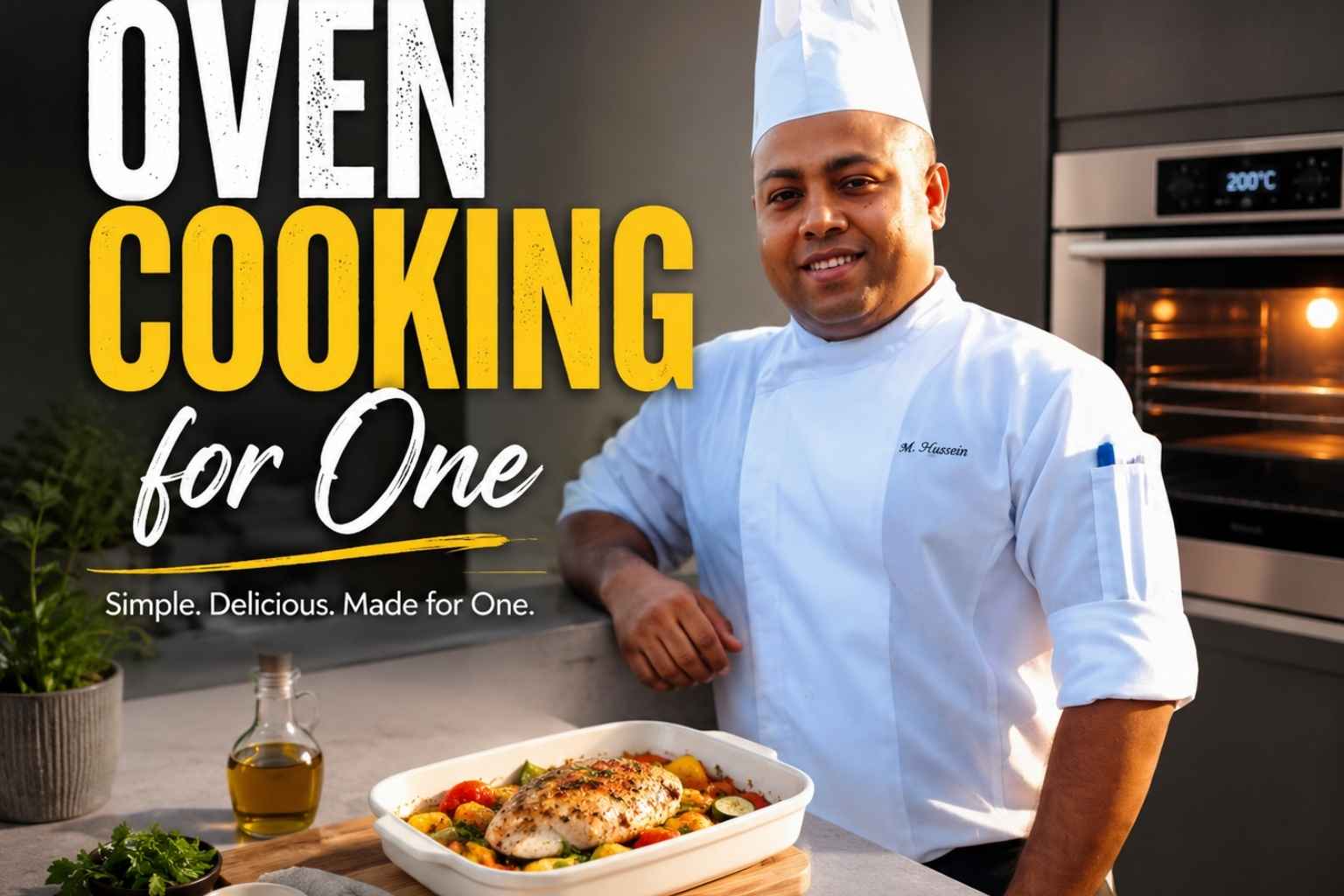
Oven cooking for one used to feel like a hassle. I’d stand there with a full-size roasting pan, cooking way too much food just for myself. Then I found smarter, simpler ways to make oven cooking for one actually enjoyable. As a chef, I’ve tested every trick in the book, and I’m sharing my best tips right here. Grab your favorite small dish, and let’s make dinner easy tonight.
Why Oven Cooking for One Is Harder Than Cooking for a Crowd
Cooking for a group is forgiving. One portion is not.
I spent 15 years in professional kitchens before I started cooking regularly for just myself. And I was genuinely surprised by how often I got it wrong. A chicken thigh that I could roast perfectly in a batch of eight came out dry and rubbery when I cooked it alone. A small bake of pasta dried out at the edges before the center was hot. Brownies came out dense and gummy.
The problem is not skill. The problem is physics.
A full oven loaded with food behaves completely differently from an oven with one small pan in it. A large roast holds moisture from surrounding dishes and its own mass. A single chicken thigh sitting in a big pan is essentially sitting in a hot wind tunnel, losing moisture fast from all sides with no thermal mass to protect it.
Per The Food Lab by J. Kenji López-Alt (2015), the ratio of surface area to mass is the core driver of how fast food loses moisture during dry-heat cooking. When you shrink a portion, that ratio gets worse. More surface, less mass. More moisture loss per minute.
Standard recipe writers do not think about this. They write for four to six people, test at full scale, and leave you to figure out the math yourself. Most of that math is wrong anyway.
The Single-Serving Scaling Problem: Heat, Pan Size, and Time
When you scale a recipe down to one portion, three things change – and most home cooks only think about one of them.
Ingredient amounts are the obvious one. Half the chicken, half the oil, half the salt. Simple.
Pan size is where people go wrong. If you use the same large roasting pan for one chicken thigh that you would use for eight, you have just created a problem. The empty pan surface radiates heat upward and dries out the food from below. The food is also too spread out to create any steam, so it dries even faster.
Cook time is the least understood. Smaller pieces of food cook faster, but not proportionally faster. A 6-oz chicken thigh does not take half the time of a 12-oz breast. It takes maybe 15-20% less time. The actual numbers depend on thickness, starting temperature, and your specific oven. Per America’s Test Kitchen’s The Complete Cooking for Two Cookbook (2014), single portions of proteins typically need 20-25% less time than the full recipe states, not 50% less.
The oven temperature itself also matters. A large batch of roasted vegetables creates its own humidity. One serving of vegetables in a big pan is immediately exposed to dry air and will shrivel instead of caramelize.
The Right Pans for Solo Oven Cooking
This is the most direct fix you can make. The right pan changes everything.
Quarter Sheet Pan (9×13 inches)
A quarter sheet pan is the workhorse for solo oven cooking. It is the right size for one portion of roasted vegetables, one chicken thigh, or a single fillet of fish. Sheet pans conduct heat evenly and give you enough space to spread food out without the excess empty space that a half sheet pan creates.
I own four of these. They cost about $10-15 each (Nordic Ware, 2024 pricing). That is the best $12 you will spend as a solo cook.
6-Inch Cast Iron Skillet
For anything that needs to go from stovetop to oven, a 6-inch cast iron skillet is the right tool. It holds heat well, browns food properly, and fits one portion of almost anything – a pork chop, a cornbread round, a small frittata. Lodge makes a reliable 6-inch skillet for around $15-20 (Lodge, 2024).
Do not use a 10-inch or 12-inch skillet for one portion. The exposed iron surface will overheat and burn the outside of your food before the inside is done.
6-oz and 8-oz Ramekins
Ramekins are the correct vessel for single-serving baked goods, egg dishes, and small casseroles. A 6-oz ramekin holds one portion of a molten chocolate cake, a single crème brûlée, or one serving of mac and cheese. An 8-oz ramekin works for heartier things like a small pot pie or a deeper pasta bake.
Per King Arthur Baking’s single-serving recipe guides (2023), ramekin-sized bakes need 15-25% more time than a full muffin or cake batch because the ceramic walls hold heat differently than a metal pan.
Small Loaf Pan (5.75 x 3-inch)
For single-serving quick breads, meatloaf, or banana bread, a mini loaf pan is the right size. Most recipes written for a 9×5 standard loaf pan can be halved and baked in a mini loaf pan with a 10-15 minute reduction in cook time (King Arthur Baking, 2023).
Temperature and Time: The Science Behind Single-Serving Adjustments
Here is the practical rule I use: drop your oven temperature by 25°F and start checking doneness about 20-30% earlier than the original recipe says.
Why lower the temperature? Because a single portion sitting in a larger oven gets hit with radiant heat from all sides, not just the bottom. With a full batch of food, the mass moderates this. With one piece of food, there is nothing to absorb excess heat except the food itself.
Why check earlier? Because smaller items have less thermal mass. They reach their target internal temperature faster than you expect. A single boneless chicken thigh at 400°F can hit 165°F internal in 18-20 minutes. A batch of four might take 28-32 minutes.
Per The Food Lab by J. Kenji López-Alt (2015), internal temperature is the only reliable doneness indicator for proteins. Buy a thermometer. The ThermoPop 2 from ThermoWorks runs about $29 (ThermoWorks, 2024). Use it every single time.
One more thing: let the oven fully preheat before the food goes in. This matters more for single portions than for large batches. A partially preheated oven is never consistent, and with one small item, even a 25°F temperature gap will change your result.
Quick-Reference Table: Single-Serving Oven Guide
| Dish | Temp (°F) | Cook Time | Pan Size | Notes |
|---|---|---|---|---|
| Bone-in chicken thigh | 400 | 28-32 min | Quarter sheet pan | Check at 25 min; 165°F internal |
| Salmon fillet (6 oz) | 400 | 10-13 min | Quarter sheet pan | Pull at 125°F for medium |
| Pork chop (1 inch) | 375 | 18-22 min | 6-inch cast iron | Sear 2 min stovetop first |
| Roasted vegetables | 425 | 20-25 min | Quarter sheet pan | Single layer only; toss in oil |
| Pasta bake (1 serving) | 375 | 20-25 min | 8-oz ramekin | Cover with foil first 15 min |
| Single brownie | 325 | 18-22 min | 6-oz ramekin | Toothpick test; fudgy at 20 min |
| Mini banana bread | 350 | 30-35 min | Mini loaf pan | Test at 30 min with toothpick |
| Single-serve frittata | 375 | 12-15 min | 6-inch cast iron | Stovetop start, oven finish |
| One-serving mac & cheese | 375 | 15-18 min | 6-oz ramekin | Breadcrumb top; broil 2 min to finish |
Category-by-Category Guide to Single-Serving Oven Cooking
Proteins: Chicken, Salmon, and Pork Chops
These three are my most-cooked solo oven meals, and each has a different best method.
Chicken thighs are the most forgiving protein for solo cooking. They have enough fat to protect against drying out, even in a hot oven. I cook bone-in, skin-on thighs at 400°F on a quarter sheet pan. Pat them completely dry before seasoning – moisture on the surface prevents browning. Pull them at 165°F internal. The whole process takes about 30 minutes including rest time.
Salmon fillets cook fast. Too fast, if you are not watching. I keep the oven at 400°F and pull the fillet at 125°F internal for medium doneness. At 6 oz, this takes about 10-12 minutes. A small amount of oil on the pan prevents sticking. If you want a crust on the skin, start skin-side down in a cold pan, put it in a cold oven, and let it heat up together – this renders the skin slowly without scorching.
Pork chops need a two-step method: 2 minutes of hard searing in the cast iron on the stovetop, then transfer to the oven at 375°F. This gives you a proper crust without overcooking the center. A 1-inch boneless chop takes about 18-20 minutes total. Pull it at 145°F internal and rest for 5 minutes. Per The Food Lab (2015), the rest period for pork is as important as the cook time – it redistributes juices that would otherwise run out when you cut.
Roasted Vegetables
The single biggest mistake solo cooks make with roasted vegetables is using too much pan. If you spread 2 cups of broccoli across a half sheet pan, you will steam it, not roast it. You need the vegetables close together but still in a single layer.
For one serving, use a quarter sheet pan. Toss the vegetables in just enough oil to coat (about 1 tablespoon per 2 cups of veg). Season with salt. Roast at 425°F. That high heat is what creates caramelization. Lower temperatures just dry the vegetables out without the browning.
Most cut vegetables at this temperature take 20-25 minutes. Denser things like carrots and beets take 30-35 minutes. Tender things like asparagus take 12-15 minutes. Turn everything once at the halfway mark.
Baked Goods: Where Solo Cooking Gets Genuinely Tricky
Baking for one is harder than cooking proteins or vegetables. The reason is leavening.
Baking powder and baking soda do not scale linearly. If a full brownie recipe calls for 1/2 teaspoon of baking powder and you divide by four to get one serving, you get 1/8 teaspoon. But that small amount often does not create enough lift in a small mass of batter. Per King Arthur Baking (2023), single-serving baked goods usually need slightly more leavening per gram of flour than the full-batch recipe implies – about 10-15% more. Start there and adjust.
Also: eggs do not divide easily. A recipe that uses one egg for eight portions cannot simply give you one-eighth of an egg for one serving. Most single-serving baked goods use either one whole egg yolk, one whole egg, or a combination. Serious Eats (2022) has a good set of tested single-serving baked good ratios if you want a reliable reference point.
For single-serving brownies, I use a 6-oz ramekin, 325°F, and 18-22 minutes depending on how fudgy I want them. For a single muffin, a standard muffin tin works fine with just one cup filled. For a quick bread, use a mini loaf pan at 350°F.
Casseroles and Pasta Bakes
These are the hardest single-serving oven dishes. The reason is moisture management.
A full 9×13 pasta bake holds steam well because there is so much of it. One serving in a ramekin loses moisture through the surface fast. The fix: cover with foil for the first two-thirds of the cook time, then remove the foil to brown the top.
For mac and cheese in an 8-oz ramekin at 375°F: cover with foil for 15 minutes, remove foil, add breadcrumbs, and broil on high for 2-3 minutes to crisp. Total time: about 20 minutes.
For pasta bakes with tomato sauce, the same approach works. The foil traps steam and keeps the pasta from drying out before it heats through.
Batch Cooking vs. True Single-Serving: When to Cook Once and Eat Twice
I do both, and I am selective about which approach I use.
True single-serving cooking – making exactly one portion from scratch – is the right call for fresh fish, eggs, and anything where texture matters on day one and degrades badly on day two. A salmon fillet is never as good reheated. A frittata is fine cold from the fridge but loses something. Roasted vegetables, in my opinion, are better fresh from the oven.
Batch cooking makes more sense for proteins that reheat well. A bone-in chicken thigh reheats beautifully in a 325°F oven for 12-15 minutes. Pasta bakes reheat fine with a splash of water and foil. Meatballs and braised meats are often better on day two.
My general rule: if the dish takes more than 30 minutes of active prep, I make two portions and refrigerate the second. If it comes together in under 20 minutes of prep, I go solo. The oven is on either way, so the energy cost is roughly the same.
Using a Toaster Oven or Countertop Convection Oven for Single Servings
A countertop convection oven is the best single investment a solo cook can make. I say this as someone who spent years dismissing them as glorified toasters.
The reason: a standard full-size oven is 5-6 cubic feet. A countertop convection oven is 0.6-1.5 cubic feet. When you cook one portion, the smaller space means the food is closer to the heating elements, the air circulates faster, and the oven reaches temperature faster. Per America’s Test Kitchen’s appliance testing (2023), a countertop convection oven preheats in 5-8 minutes versus 15-20 minutes for a full-size range oven.
The practical adjustments for a countertop convection oven:
Reduce the temperature by 25°F compared to a standard oven recipe. The convection fan moves hot air actively, which cooks food faster than still heat. Start checking doneness 15-20% earlier than the recipe states.
Watch for hot spots. Most countertop ovens have one. Rotate your pan halfway through the cook time.
The Breville Smart Oven Air Fryer Pro is the one I use at home. It runs about $250-280 (Breville, 2024). For serious solo cooks, it is worth it. Less expensive options like the Cuisinart TOA-70 ($150-180, Cuisinart, 2024) work well for most tasks.
One limitation: tall items like a stuffed chicken breast or a thick cut of meat may cook unevenly because the heating element is close to the food. For tall proteins, a full-size oven is still better.
The Biggest Single-Serving Oven Mistakes
Using the wrong pan size. This is number one. A single chicken thigh in a 9×13 baking dish will be dry and pale. In a quarter sheet pan, it will be properly browned and juicy. Match the pan to the portion.
Opening the oven too early. Every time you open the oven door, you drop the temperature by 25-50°F (America’s Test Kitchen, 2014). For a full batch of 12 muffins, this barely matters – the thermal mass of the batter keeps things stable. For one muffin, it can collapse the structure. Do not open the oven before 80% of the cook time has passed.
Incorrectly scaling leavening agents. Covered above, but worth repeating: never simple-divide baking powder or baking soda. Go slightly heavy on leavening when scaling down. Test before you commit to a recipe.
Skipping the rest period for proteins. A single chicken thigh or pork chop needs 5 minutes of rest after coming out of the oven. The interior is still cooking during this time, and the juices redistribute. Cutting immediately loses you a lot of moisture in a small piece of meat.
Not patting proteins dry. Moisture on the surface of meat prevents browning. Paper towels, thoroughly, every time.
My Personal Single-Serving Routine
Here is what I actually cook for myself on a regular basis, and why.
My default weeknight dinner is a bone-in chicken thigh on a quarter sheet pan with whatever vegetables I have. I prep it in about 5 minutes, roast at 400°F, and eat in under 40 minutes from cold fridge to table. It works every time.
For a faster meal, I do a salmon fillet with roasted asparagus at 400°F. Both go on the same quarter sheet pan. The asparagus takes about 12 minutes; the salmon takes 10-12 minutes. I start them together and pull the salmon 2-3 minutes after the asparagus goes in. Total active time: 8 minutes.
For baking, I make single-serving brownies in a ramekin about once a week. I use a ratio I have tested: 2 tablespoons butter, 3 tablespoons sugar, 1 egg yolk, 2 tablespoons cocoa powder, 2 tablespoons flour, a pinch of salt. 325°F for 20 minutes. Fudgy every time.
What I do not bother making solo: full-size lasagna, pizza from scratch, or whole roasted birds. The prep-to-payoff ratio is wrong for one person. I make those when I have people over, or I make a full batch and freeze portions.
My most-used pan: the quarter sheet pan. My most-used tool: the ThermoWorks ThermoPop 2. My biggest lesson: matching pan size to portion size matters more than any other single adjustment.
Frequently Asked Questions About Oven Cooking for One
How do I stop single-serving food from drying out in the oven?
Use the right pan size, keep the temperature 25°F lower than the full recipe states, and check doneness early. For baked dishes, cover with foil for the first half of the cook time. For proteins, pat completely dry before seasoning and roast at high heat quickly rather than low heat slowly.
Can I use a regular recipe and just cook less of it?
You can scale the ingredients, but you cannot simply scale the time or temperature. Use a smaller pan, reduce the oven temperature by 25°F, and start checking doneness about 20-25% earlier than the recipe states. Per America’s Test Kitchen (2014), ingredient ratios scale well but time and temperature adjustments require testing.
What is the best oven temperature for single-serving cooking?
It depends on what you are cooking. For proteins, 375-400°F works well. For vegetables, 425°F gives you better caramelization. For baked goods, stay at or below 350°F and consider dropping to 325°F for ramekin-sized items. Lower temperatures give smaller items more time to cook through before the outside overcooks.
Is a toaster oven good enough for single-serving oven meals?
A countertop convection oven handles 90% of single-serving oven tasks well, and preheats much faster than a full-size oven. It is good enough for proteins, vegetables, and small bakes. The one exception is tall or dense items, where the proximity to heating elements can cause uneven browning.
How do I scale baking recipes down to one serving?
Scale the main ingredients (flour, sugar, butter, chocolate) by the portion ratio. Do not scale leavening agents (baking powder, baking soda) by the same ratio – use about 10-15% more than a straight division would give you. Egg substitutions are often needed: use one egg yolk for richness-heavy recipes, or one whole egg for lighter cakes and muffins.
Why do my single-serving roasted vegetables turn out steamed instead of crispy?
The pan is too large, or the vegetables are too crowded, or both. Use a quarter sheet pan, spread the vegetables in a single layer with a small amount of space between them, and roast at 425°F. If the pan is too big, the vegetables spread out, release moisture, and that moisture pools on the empty pan surface and steams everything instead of letting it brown.
How do I know when a single-serving protein is done without cutting into it?
Use an instant-read thermometer. Chicken thighs: 165°F. Salmon: 125°F for medium. Pork chops: 145°F. These are the targets regardless of portion size. A thermometer is the only accurate way to know, and at $29 for a ThermoWorks ThermoPop 2, there is no reason not to own one.
Can I cook a single serving in a full-size oven without wasting energy?
Yes, though a countertop convection oven is more energy-efficient for single portions. If you use a full-size oven, place the rack in the center, preheat fully, and use a properly sized pan so the food is not lost in a large, empty space. You can also use the residual heat – for proteins, turn off the oven when the food is within 5-10°F of target temperature and let it coast to done.
Key Takeaways
- Match pan size to portion size. A quarter sheet pan, a 6-inch cast iron skillet, and a 6-oz ramekin cover most single-serving oven tasks.
- Drop the oven temperature by 25°F compared to the full-recipe recommendation. Start checking doneness 20-25% earlier.
- Use an instant-read thermometer for all proteins. Internal temperature is the only reliable doneness signal.
- Do not scale baking powder or baking soda by simple division. Use about 10-15% more than a straight calculation gives you.
- Cover baked casseroles and pasta dishes with foil for the first two-thirds of cook time, then uncover to brown.
- A countertop convection oven preheats in 5-8 minutes versus 15-20 minutes for a full-size oven, and handles 90% of single-serving oven tasks well.
- Batch cook proteins that reheat well (chicken thighs, braised meats). Cook fresh items (salmon, eggs, asparagus) as true single portions.

I’m Mossaraof, a trained chef and the founder of OvenInsights.com. I spent years cooking at Larrupin’ Cafe and in kitchens across Chicago and Seattle. Now I test kitchen gear for a living. I moved to North Acton, London, and I test every tool I write about. I use real meals and real heat. No brand deals. No shortcuts. I cover 12 kitchen types and hundreds of recipes. I believe this: the right tools matter as much as the recipe.