At A Glance
- Standard recipes fail for large families because scaling up ingredients does not scale up heat transfer – you need different temperatures, rack positions, and timing.
- A full oven running multiple sheet pans drops internal temperature by 25-50°F at the door open moment and needs 10-15 minutes to recover (America’s Test Kitchen, 2024).
- Convection ovens beat gas and conventional electric for batch cooking because the fan keeps heat even across all racks.
- The holding method – 170°F oven with a loose foil tent – keeps finished food safe and moist for up to 90 minutes without drying it out (USDA Food Safety Guidelines, 2025).
- Your biggest time-saver is not cooking faster – it is sequencing proteins, casseroles, and breads so each batch goes in and comes out without a gap.
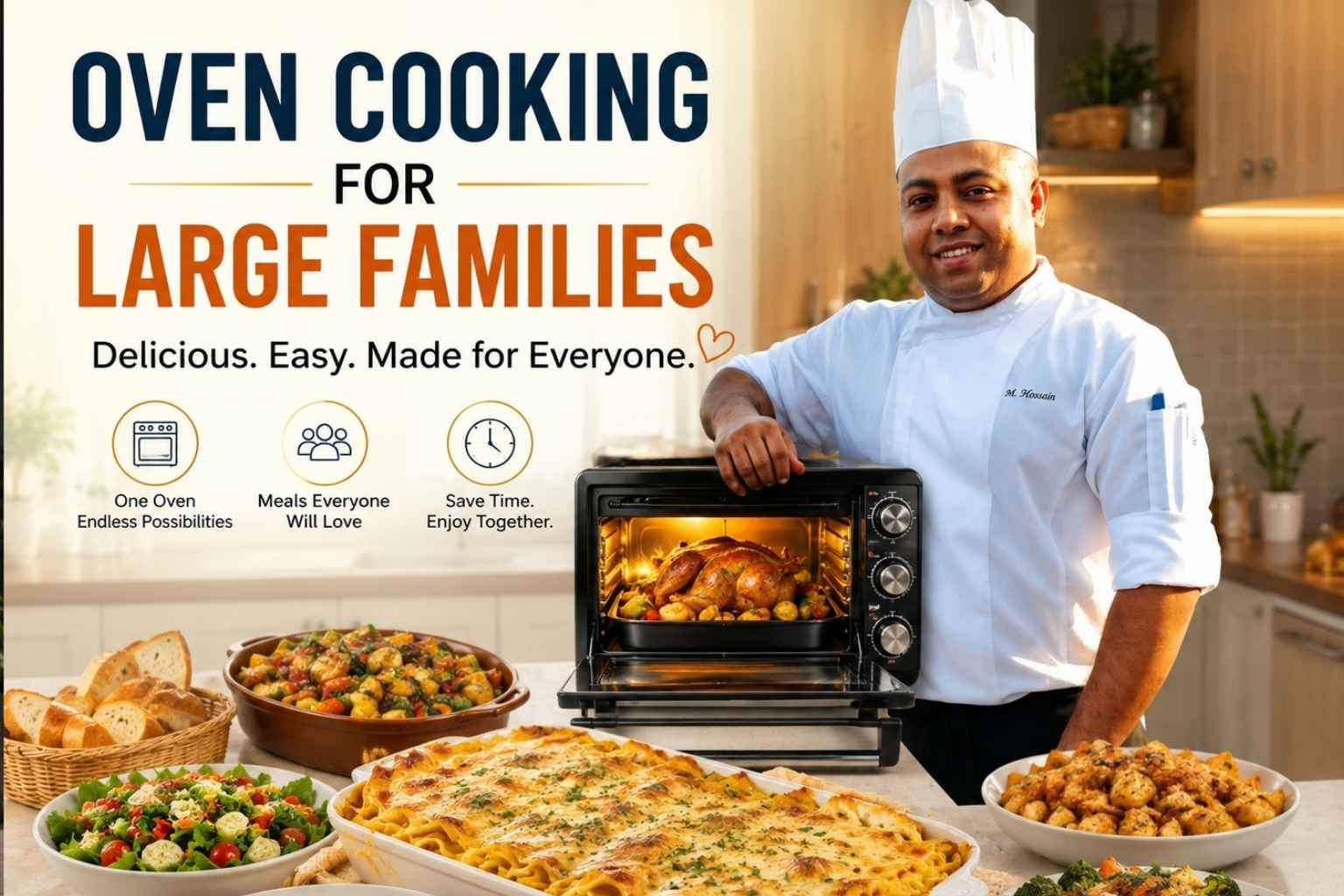
I still remember the chaos of my first big family dinner. Six hungry kids, three trays, and one poor oven that just couldn’t keep up. That’s when I learned the real secret to oven cooking for large families: it’s not about a bigger oven, it’s about smarter timing.
As a chef, I’ve cooked for crowds more times than I can count. I know the tricks that turn one small oven into a meal machine for a full house. In this guide, I’ll share my best tips so your family dinners feel easy, not stressful.
Ready to feed your whole crew without the kitchen meltdown? Let’s dig in.
Why Standard Recipes Fall Apart When You Cook for a Crowd
Standard recipes are written for four people. When you cook for ten, twelve, or sixteen, you do not just multiply the recipe – you change the physics of cooking entirely.
I learned this the hard way during my third year as a line cook, when a catering job for 80 guests exposed every flaw in my thinking about scaling. I doubled the sheet pans of roasted chicken thighs, stacked them three racks high, and pulled out pale, steamed meat that had shed half a cup of liquid per pan. The oven had turned into a sauna.
Here is what goes wrong at scale, and why.
The Scaling Math Problem
Doubling a recipe does not double cook time. It also does not keep cook time the same. The actual time shifts based on mass, surface area, and how much moisture your food releases into a closed oven.
A single 9×13 casserole dish takes about 45 minutes at 375°F. Two identical dishes side by side take 50-55 minutes. Three dishes across two racks can push to 65 minutes – that is a 44% increase for a 200% increase in volume (Serious Eats, 2023).
The reason is simple: more food means more steam, more thermal mass absorbing heat, and less hot air circulating freely.
Heat Distribution and the Loaded Oven Effect
Every oven has hot spots. Most home ovens run 15-25°F hotter at the back than the front (America’s Test Kitchen, 2024). When you add multiple pans, you block the natural convection currents that even out those hot spots.
The result: the pan closest to the heating element browns fast and burns at the edges. The pan two racks up sits in a pocket of humid, trapped air and barely colors at all.
Moisture Buildup Ruins Texture
Vegetables, proteins, and casseroles all release steam as they cook. In a loaded oven, that steam has nowhere to go. It recirculates and lands back on your food as condensation. Sheet pan vegetables that should roast into caramelized, slightly crisp bites come out soft and wet instead.
The fix is not just oven temperature – it is airflow management, pan spacing, and knowing when to crack the door for 30 seconds to vent.
How to Calculate Your Real Oven Capacity
Before you load a single pan, you need to know what your oven can actually hold and how to use every cubic inch of it.
How Many Pans Fit
Most home ovens have three rack positions and an interior width of 24-26 inches. A standard half-sheet pan is 18×13 inches. Two half-sheet pans fit side by side in most home ovens if you push one slightly toward the back.
Three racks with two pans each gives you six pans running simultaneously. That is the theoretical maximum. In practice, I recommend running no more than four pans at a time in a conventional oven and five in a convection oven.
The rule I use: leave at least 2 inches of clearance on all sides of each pan. Air needs to move. If a pan touches the oven wall or another pan, that edge will steam instead of roast.
Rack Positioning for Airflow
Position racks in the upper-third, middle, and lower-third slots. Never use the very bottom position for anything other than a pizza stone or a Dutch oven that needs direct bottom heat.
For multiple pans of the same food, rotate pans halfway through cooking – top rack to bottom, front to back. This single step is the most underused fix in home batch cooking. It takes 20 seconds and evens out the results dramatically.
Staggering Batches by Cook Time
Not everything needs to go in at once. I stagger batches so they finish in sequence rather than all at once. Proteins go in first. Vegetables go in 15-20 minutes later. Bread rolls go in last, after the proteins come out and the oven can recover to full temperature.
Temperature and Time Adjustments for a Loaded Oven
When you open a cold oven door and slide in four heavy pans of dense food, the internal temperature drops. For a conventional oven, that drop can be 50°F or more. For convection, it is closer to 25°F because the fan recovers heat faster (Cook’s Illustrated, 2024).
The Loaded Oven Compensation Method
- Preheat 25°F higher than the recipe calls for. Once the food goes in, the oven settles to the right temperature.
- Add 15-20% to the cook time when running three or more pans simultaneously.
- Use a probe thermometer, not the clock. Internal temperature tells you when food is done. The clock tells you when to start checking.
- Rotate pans at the halfway mark without fail.
When to Drop the Temperature
For casseroles and breads that go longer than 45 minutes, I start at 375°F for the first 20 minutes to get the crust going, then drop to 350°F. This prevents the top from browning before the center cooks through – a problem that gets worse with every extra dish you add to the oven.
Batch Cooking Reference Table: Large-Family Dishes
| Dish | Pan Size | Temperature | Cook Time (1 batch) | Servings per Batch | Notes |
|---|---|---|---|---|---|
| Roasted chicken thighs | Half-sheet | 425°F | 35-40 min | 8-10 | Skin-side up, no overlap |
| Baked salmon fillets | Half-sheet | 400°F | 12-15 min | 6-8 | One layer only |
| Sheet pan sausage and peppers | Half-sheet | 400°F | 30-35 min | 6-8 | Rotate at 15 min |
| Mac and cheese casserole | 9×13 | 375°F | 45-50 min | 10-12 | Cover first 30 min, then uncover |
| Lasagna | 9×13 | 375°F | 55-65 min | 10-12 | Rest 15 min before cutting |
| Roasted broccoli and cauliflower | Half-sheet | 425°F | 20-25 min | 6-8 | Single layer is non-negotiable |
| Roasted root vegetables | Half-sheet | 400°F | 35-40 min | 8-10 | Cut uniform pieces |
| Dinner rolls | Half-sheet | 375°F | 18-22 min | 12-15 rolls | Golden top = done |
| Banana bread | 9×5 loaf | 350°F | 55-65 min | 8-10 slices | Toothpick test at 55 min |
| Sheet pan brownies | Half-sheet | 325°F | 25-30 min | 24 pieces | Pull when center is just set |
Best Oven-Friendly Dishes for Large Batches
Proteins: What Works and What Does Not
Bone-in, skin-on chicken pieces are the best large-batch protein you can run through an oven. They are forgiving, they benefit from high heat, and they do not suffer from sitting in a warm oven for 20 minutes while you finish other dishes.
Bone-in pork shoulder works beautifully for big groups. Low and slow at 300°F for 4-5 hours gives you pull-apart meat that actually improves with resting time.
Whole fish or thick salmon fillets cook fast – 12-15 minutes at 400°F – which makes them ideal for a final batch slot.
Avoid boneless, skinless chicken breasts for batch cooking unless you brine them first. They dry out fast, and timing is unforgiving when you have three other dishes to manage.
Casseroles: One Pan, Many Mouths
Casseroles are the most efficient format for feeding large families. You prep everything into the dish ahead of time, slide it in, and walk away.
The best performers: mac and cheese, lasagna, enchiladas, shepherd’s pie, and baked ziti. All of them hold well at 170°F after cooking and reheat without significant quality loss.
The rule with casseroles is cover first, uncover last. Cover with foil for the first two-thirds of cook time to trap steam and cook through. Remove the foil for the final 15-20 minutes to brown the top.
Sheet Pan Vegetables: The Airflow Problem
Roasted vegetables fail for one reason more than any other: too much food on one pan. One layer, with space between pieces, is not a suggestion – it is the difference between caramelized and steamed.
For a family of ten, you need two full half-sheet pans of vegetables. Do not try to crowd one pan. The moisture released from twelve cups of broccoli on a single pan will turn your oven into a steam room.
Best vegetables for batching: broccoli, cauliflower, Brussels sprouts, sweet potatoes, root vegetables, and zucchini cut thick.
Breads and Rolls: Timing Is Everything
Dinner rolls and quick breads go in last. By the time proteins and casseroles are done, the oven has been open multiple times. Letting it recover for ten minutes before sliding in bread ensures the initial burst of heat that gives rolls their spring.
For larger families, I bake rolls two half-sheets at a time – one on the upper-third rack, one on the middle. Swap them at the ten-minute mark. Both sheets come out evenly golden.
Desserts: Low Temperature, Patient Timing
Sheet pan brownies and bar cookies are the most practical large-batch desserts. A single half-sheet pan of brownies yields 24 pieces and requires almost no attention.
Drop the temperature to 325°F for baked desserts when running multiple pans. A higher temperature browns the edges before the center sets, giving you a pan that is burned at the border and raw in the middle.
Gas vs. Electric vs. Convection: Which Oven Wins for Batch Cooking
Convection ovens win for batch cooking. The fan is the deciding factor.
A convection fan circulates hot air continuously, which means every rack sees consistent heat. In a conventional oven – gas or electric – the heating element cycles on and off and heat rises in columns. Upper racks run hotter. Lower racks lag behind.
Gas Ovens
Gas provides moist heat because combustion produces water vapor. That is excellent for bread but less ideal for roasting, where you want a dry environment to encourage browning. For large families who bake a lot of bread and rolls alongside proteins, gas is acceptable but not optimal.
Conventional Electric Ovens
Electric ovens hold temperature more steadily than gas because there is no combustion cycle, but without a fan, heat distribution is uneven across multiple racks. You need to rotate more aggressively and check each pan individually.
Convection (Fan-Assisted) Electric Ovens
This is the batch cooking workhorse. The fan keeps temperature even across all racks, reduces cook time by about 20-25% compared to conventional settings (America’s Test Kitchen, 2024), and handles multiple pans with the least babysitting.
One adjustment: reduce recipe temperatures by 25°F when using convection mode, or reduce cook time by 20-25%. Doing both will undercook your food.
How to Keep Early Batches Warm Without Drying Them Out
The holding method is the professional kitchen secret that home cooks rarely use.
Set your oven to exactly 170°F after all batches are done. Place finished dishes inside, loosely tented with foil. At 170°F, food stays above the USDA safe zone of 140°F without cooking further. Food held this way stays in good condition for up to 90 minutes (USDA Food Safety Guidelines, 2025).
The tent matters. Foil pressed tight against food traps moisture and creates condensation. A loose tent lets steam escape slightly while blocking the dry oven air from hitting the food directly.
For roasted meats, I pull them from the oven at 5°F below target temperature, tent them, and let carry-over cooking finish the job while the next batch runs. By the time everything is done, the first proteins have rested properly and are at the right temperature.
Meal Prep vs. Same-Day Batch Cooking
These are two different strategies with different strengths.
When to Cook Ahead
Cook ahead when your week is too busy for active kitchen time. Casseroles, soups, braised proteins, and grain-based dishes all refrigerate well and reheat without major quality loss. Sunday meal prep for a family of eight can cover three weeknight dinners if you plan the sequence right.
Dishes that hold well for 3-4 days refrigerated: lasagna, baked ziti, roasted chicken (shredded), sheet pan sausage, roasted root vegetables, and most soups.
Dishes that do not hold well: roasted vegetables lose their texture overnight. Bake those fresh or accept that they will be softer the next day.
When to Cook Same-Day
Same-day batch cooking makes sense for weekend gatherings, holiday meals, and nights when you have two hours available. The advantage is quality: everything is fresh, textures are right, and you are not reheating anything.
The trick to same-day batch cooking for large families is the sequence. Map out which dishes need the most oven time and start those first. Build your sequence backward from the serving time.
Must-Have Tools for Large-Batch Oven Cooking
Half-sheet pans are the foundation of batch cooking. You need at least four. Thin pans warp at high heat and create uneven cooking. Nordic Ware commercial half-sheet pans are the standard recommendation among professional cooks because of their rigidity and heat distribution (Serious Eats, 2023).
Roasting racks lift proteins off the pan surface so heat circulates underneath. Without a rack, the bottom of a roast sits in its own liquid and braises instead of roasting.
A probe thermometer – specifically one with an oven-safe cable and an external display – lets you monitor internal temperature without opening the oven door. Every door open drops oven temperature. A probe thermometer saves you from opening the oven five times to check a roast.
Insulated carriers keep finished dishes hot during transport or during the gap between cooking and serving. For family meals served in a different room from the kitchen, these pay for themselves on the first use.
Heavy-duty aluminum foil in the wide format (18 inches). Standard 12-inch foil does not cover a half-sheet pan edge to edge.
Common Large-Batch Cooking Mistakes and How to Fix Them
Overcrowding pans is the most common mistake, and the consequences are predictable: steamed food, no browning, and soft texture. The fix is simple – use more pans, not bigger piles.
Undercrowding pans is less discussed but equally real. A single chicken thigh on a full half-sheet pan means the exposed pan surface gets scorching hot and the drippings burn. Fill pans reasonably – one layer, with small gaps between pieces.
Wrong rack order matters more than most home cooks realize. Putting a dense, wet casserole on the top rack and delicate rolls on the bottom means the casserole steams the rolls from above. Dense, wet dishes go on the lower rack. Drier dishes that need top browning go higher.
Foil trapping steam is a specific mistake in casserole cooking. Pressing foil tight against the surface of a casserole creates a sealed environment where steam pools and re-condenses. The top layer of your lasagna comes out wet and pale. Always crimp foil around the dish edges, not across the food.
Skipping the preheat when switching from a high-temperature batch to a lower one. After pulling chicken at 425°F, if you immediately slide in brownies set for 325°F, the oven is still radiating retained heat from the walls and floor. Wait ten minutes, or use an oven thermometer to confirm the actual temperature before loading the next batch.
Cutting before resting releases all the juice at once. Proteins need 5-10 minutes of rest before cutting. For large batches, this resting window is your opportunity to get everything else plated.
My Sunday Batch Cooking Routine
Sunday is my reset day. With a family of seven plus frequent guests, I treat Sunday afternoon like a short professional service – two and a half hours, planned sequence, minimum chaos.
Here is the exact routine I use:
12:00 PM – Preheat oven to 400°F. Pull cold proteins from the fridge to take the chill off.
12:15 PM – Load two half-sheet pans of bone-in chicken thighs on the middle and lower racks. Set a timer for 20 minutes.
12:20 PM – Assemble one 9×13 lasagna and two pans of roasted root vegetables. Vegetables go in at 12:35 when the oven door opens for the chicken rotation.
12:35 PM – Rotate chicken pans. Slide in vegetable pans on the upper rack. Lasagna goes on the lower rack, covered with foil.
12:55 PM – Pull chicken. Internal temp reads 170°F. Tent with foil and place in a 170°F holding oven (I use my countertop oven for this). Main oven drops to 375°F for lasagna’s remaining 20 minutes.
1:10 PM – Pull vegetable pans and lasagna. Remove foil from lasagna for final 10 minutes of browning.
1:20 PM – Pull lasagna. Slide in two half-sheet pans of dinner rolls at 375°F. Twelve minutes, swap racks at six minutes.
1:35 PM – Rolls done. Everything has been cooked in 95 minutes, in sequence, with no wasted oven time.
The key to this routine is that no step waits for a previous one to fully finish. The oven is never idle. Every batch overlaps slightly with the preparation of the next.
Frequently Asked Questions About Batch Cooking in the Oven
How many people can I realistically feed from one oven in one session?
A standard home oven can feed 12-16 people comfortably in a single two-hour session if you sequence batches correctly. Beyond 16 people, you either need a second oven, a large countertop oven running in parallel, or dishes that can be fully prepped the day before and reheated.
Do I need to adjust temperature when using convection mode?
Yes. Reduce the recipe temperature by 25°F when switching to convection mode, or reduce the cook time by 20-25%. Do not do both at once unless you are familiar with your specific oven. Different convection fans vary in strength (Cook’s Illustrated, 2024).
What is the safest way to reheat multiple dishes at once?
Reheat everything at 325°F, covered with foil, until the internal temperature reaches 165°F throughout. This temperature reheats without over-browning. A probe thermometer in the thickest part of each dish is the only reliable check (USDA Food Safety Guidelines, 2025).
Can I bake bread and roast meat in the oven at the same time?
You can, but the temperatures often conflict. Most roasted proteins want 400-425°F. Most breads want 350-375°F. If you need to do both simultaneously, cook at the middle ground of 375°F, expect your protein to take slightly longer, and put the bread on the upper rack where heat rises.
How do I prevent casseroles from drying out during a long hold?
Hold at 170°F in the oven, covered loosely with foil. If you need to hold longer than 90 minutes, add two tablespoons of broth or water to the dish before covering – it creates just enough moisture to keep the surface from drying without making the dish watery.
What is the best way to handle different dietary needs in one batch session?
Designate one pan per dietary variation. Label the pans with masking tape before they go in. Keep vegetarian pans on a separate rack from meat pans to prevent drip contamination. Cook them at the same temperature if possible to simplify the session.
Should I use parchment paper or aluminum foil to line my pans?
Parchment paper for anything that should not brown heavily on the bottom – rolls, cookies, fish. Aluminum foil for roasted meats and vegetables where you want high-heat contact and easy cleanup. Do not use parchment above 425°F – it can scorch at the edges (King Arthur Baking, 2024).
How do I stop my sheet pan vegetables from turning soggy?
Three things: dry the vegetables completely before seasoning (pat with paper towels after washing), use enough oil to coat without pooling at the bottom of the bowl, and never crowd the pan. If you solve those three problems, soggy vegetables become rare.
Key Takeaways
- A loaded oven needs 25°F more preheat temperature and 15-20% more time than a recipe written for one pan – plan for this every time.
- Convection mode is the best setting for batch cooking because the fan equalizes heat across all racks and reduces cook time.
- The 170°F holding method keeps finished food safe and moist for up to 90 minutes without additional cooking.
- Sequence your batches by cook time – proteins first, vegetables second, bread last – so the oven is never idle and nothing sits at room temperature waiting for oven space.
- Moisture is the main enemy of texture at scale. Use more pans, keep food in a single layer, and vent casseroles in the final cooking phase by removing the foil.
- A probe thermometer is the single most valuable tool for batch cooking. It removes the guesswork that causes either undercooked centers or overdone edges.
- Rest proteins before cutting. The resting window is not wasted time – use it to finish plating, pull bread, and organize the hold oven.

I’m Mossaraof, a trained chef and the founder of OvenInsights.com. I spent years cooking at Larrupin’ Cafe and in kitchens across Chicago and Seattle. Now I test kitchen gear for a living. I moved to North Acton, London, and I test every tool I write about. I use real meals and real heat. No brand deals. No shortcuts. I cover 12 kitchen types and hundreds of recipes. I believe this: the right tools matter as much as the recipe.