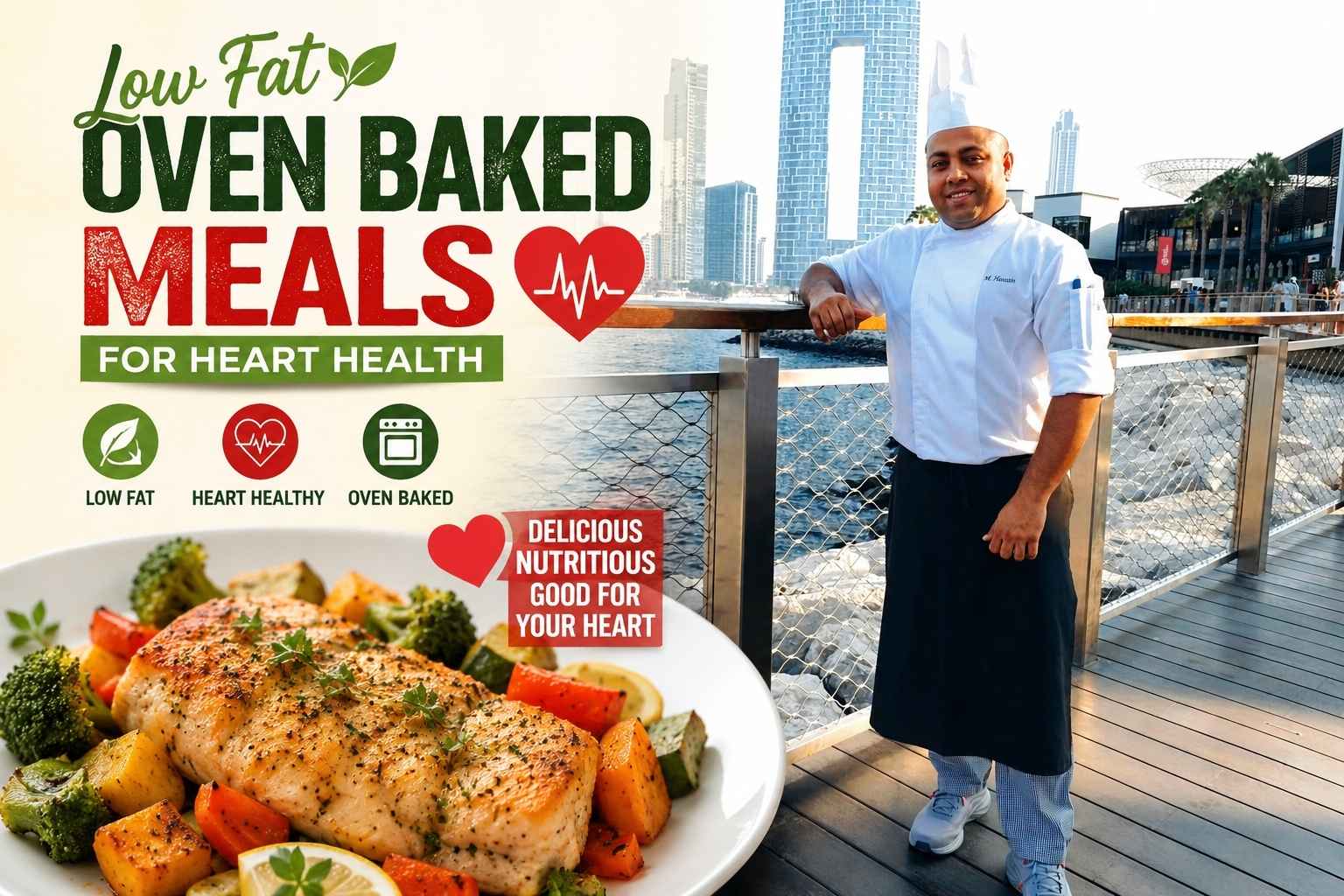
At A Glance
- The oven is the single most useful tool for low-fat cooking because dry heat builds flavor without added oil.
- “Low fat” on a label means under 3g of fat per serving (FDA definition) – but in a chef’s kitchen, it means choosing technique over fat to carry flavor.
- Rack-roasting, steam-baking, and parchment cooking (en papillote) cut fat by 40-60% compared to pan-frying the same ingredients (USDA FoodData Central, 2024).
- Chicken breast, cod, turkey tenderloin, and lentils are the four lowest-fat proteins you can oven-bake, all under 4g of fat per 100g raw (USDA FoodData Central, 2024).
- The sweet spot for most heart-healthy roasting is 400°F (204°C) – high enough to caramelize and build flavor, low enough to keep proteins moist.
Good food can help your heart and still taste great. Low Fat Oven Baked Meals for Heart Health made a big change in my own kitchen because they are simple, full of flavor, and easy to enjoy every day. I have spent years testing healthy oven recipes, and I know that small cooking changes can make a real difference. In this guide, I will share easy meal ideas, smart cooking tips, and simple ways to make heart-friendly meals your whole family will love, so let’s get started.
Why the Oven Is the Heart-Healthy Cook’s Best Friend
The oven does something no other cooking method matches: it surrounds food with dry, even heat on all sides. That means you do not need fat to transfer heat. Fat is a heat conductor. When you fry, you need oil or butter to carry the pan’s heat into the food. The oven skips that entirely.
I have been cooking professionally for 18 years – first in hospital kitchens designing menus for cardiac recovery wards, then in my own restaurants. The shift I made early was simple: stop using fat as a cooking medium. Start using it as a finishing flavor. One teaspoon of good olive oil drizzled over a finished dish does more for flavor than three tablespoons heated to smoke point in a pan.
Here is the science: when fat heats to high temperatures, much of its flavor compounds break down before they reach the food. Oven-roasted food, by contrast, browns via the Maillard reaction – a chemical process between amino acids and sugars that creates hundreds of flavor compounds at temperatures above 280°F (138°C). That browning is flavor. You get it with almost no fat at all.
The American Heart Association recommends keeping saturated fat below 6% of daily calories – roughly 13g per day on a 2,000-calorie diet (American Heart Association, 2025). Oven cooking is one of the most reliable ways to stay inside that target without eating bland food.
What “Low Fat” Actually Means on a Plate
The FDA defines a food as “low fat” when it contains 3g of fat or less per serving. “Reduced fat” means at least 25% less fat than the original product. These are label definitions – they do not always translate to what lands on your plate.
In my kitchen, low-fat cooking means two things:
First: choosing ingredients that are naturally lean. Skin-on chicken thigh has roughly 15g of fat per 100g. Skinless chicken breast has 3.6g. The swap is free – no technique change needed (USDA FoodData Central, 2024).
Second: choosing methods that do not add fat unnecessarily. A standard breaded pan-fry absorbs 8-12g of oil per 100g of protein (Nutrition Journal, 2023). The same protein baked on a rack with a seasoned breadcrumb crust absorbs less than 1g.
The goal is not zero fat. Your body needs fat for vitamin absorption, hormone production, and brain function. The Harvard T.H. Chan School of Public Health recommends 20-35% of daily calories from fat, with the emphasis on unsaturated sources (Harvard T.H. Chan School of Public Health, 2024). The target is less saturated fat, more strategic fat use.
High-Fat vs. Low-Fat Cooking Methods: A Quick Reference
| Cooking Method | Avg. Fat Added per 100g | Saturated Fat Risk | Heart-Health Rating |
|---|---|---|---|
| Deep-frying | 12-18g | High | Poor |
| Pan-frying (butter) | 8-12g | Very High | Poor |
| Pan-frying (olive oil) | 5-8g | Moderate | Fair |
| Oven-roasting (lightly oiled) | 1-2g | Low | Good |
| Rack-roasting (no added oil) | 0-0.5g | Very Low | Excellent |
| Steam-baking / en papillote | 0g | None | Excellent |
| Air frying | 0.5-1g | Very Low | Very Good |
Fat estimates based on average absorption rates. Sources: USDA FoodData Central, 2024; Nutrition Journal, 2023.
The Four Best Oven Techniques for Low-Fat Cooking
Dry Roasting on a Wire Rack
Place your protein or vegetable on a wire rack set inside a sheet pan. Air circulates underneath, so the food does not sit in its own rendered fat or released moisture. For a chicken breast, this alone cuts the fat in the finished dish by roughly 30% compared to roasting flat in a baking dish (USDA FoodData Central, 2024).
No oil required. Season aggressively with salt, pepper, garlic powder, smoked paprika, and lemon zest. The dry rub forms a light crust as moisture evaporates.
Steam-Baking
Add 1/2 cup of water, broth, or white wine to the bottom of a covered roasting pan. The steam keeps proteins moist without any fat at all. I use this for turkey breast and whole fish. The internal temperature climbs slowly and evenly. You get juicy results with zero oil.
Parchment Cooking (En Papillote)
Fold a piece of parchment paper into a sealed packet around your protein and vegetables. The food steams in its own moisture and the aromatics you add – herbs, citrus slices, a splash of white wine. No oil. No added fat. This is one of the oldest tricks in French cooking and it works because steam is an excellent heat conductor.
A 6oz cod fillet cooked en papillote with lemon, capers, and fresh dill comes in at under 150 calories and 2g of fat total (USDA FoodData Central, 2024).
Mist-and-Roast for Vegetables
Use a small spray bottle filled with water or very lightly diluted olive oil. A one-second mist over a full sheet pan of broccoli or cauliflower delivers roughly 0.3g of fat per serving – compared to 3-4g if you coat the pan by hand. Season heavily after misting. This technique is how I get deep caramelization on vegetables in the cardiac ward menus without ever touching the fat budget.
Low-Fat Oven Proteins: Temperature Guide and Chef Notes
Chicken Breast and Turkey
Skinless chicken breast and turkey tenderloin are two of the leanest animal proteins available. Chicken breast averages 3.6g of fat per 100g raw; turkey tenderloin averages 1.7g (USDA FoodData Central, 2024).
The biggest mistake people make with these is overbaking. Both proteins have almost no fat to keep them moist once they pass internal temperature. Pull chicken breast at 165°F (74°C) and turkey at 165°F (74°C) – no higher.
My method: brine in cold salted water for 30 minutes before baking. Salt draws moisture into muscle fibers through osmosis, then that moisture stays locked during cooking. You get a juicy, moist breast at zero added fat. Bake at 400°F (204°C) on a wire rack, roughly 22-26 minutes for a 6oz breast.
Fish: Cod, Halibut, and Salmon
White fish like cod and halibut are almost entirely fat-free – cod has 0.86g of fat per 100g (USDA FoodData Central, 2024). Salmon is higher in fat (13g per 100g) but that fat is predominantly omega-3 fatty acids – EPA and DHA – which actively reduce triglycerides and lower cardiovascular risk (Mayo Clinic, 2025).
For white fish: bake at 400°F (204°C), 12-15 minutes depending on thickness. The flesh is done when it flakes cleanly with a fork and the center has turned from translucent to opaque.
For salmon: bake at 375°F (190°C) to protect the omega-3 fats, which degrade above high heat. 15-18 minutes for a 6oz fillet. A squeeze of lemon and fresh dill – no oil needed.
Legumes: Lentils and Chickpeas
Baked lentil dishes and roasted chickpeas are the most overlooked heart-healthy proteins in most home kitchens. Cooked lentils contain 0.4g of fat per 100g and 9g of protein per 100g (USDA FoodData Central, 2024). They also carry soluble fiber, which Mayo Clinic links directly to lower LDL cholesterol (Mayo Clinic, 2025).
Roast canned chickpeas at 425°F (218°C) on a dry sheet pan for 30-35 minutes until they are crispy and dry throughout. Season with cumin, coriander, and chili flakes. Eat as a snack or add to salads. Zero added fat required.
How to Get Deep Flavor from Oven-Roasted Vegetables Without Oil
Most people under-season vegetables when they cut the fat. Fat carries flavor – specifically fat-soluble flavor compounds. When you remove fat, you need to compensate with acid, heat, and umami.
Here is my four-step approach:
Step 1 – Cut for surface area. Smaller cuts mean more exposed surface to caramelize. Halve Brussels sprouts. Cut broccoli into small florets. Slice beets thin.
Step 2 – Mist, don’t pour. Use a spray bottle for a micro-thin coating. Just enough for the seasonings to stick.
Step 3 – Season before and after. Salt before roasting draws moisture to the surface. A second seasoning of acid (lemon juice, red wine vinegar) and fresh herbs after roasting wakes up the flavors that high heat dulled.
Step 4 – Roast at 425°F (218°C). Higher heat means faster Maillard browning and less time for moisture to escape. Spread vegetables in a single layer with space between each piece – crowding steams instead of roasts.
This method produces deeply browned, caramelized vegetables with virtually no added fat.
Grains and Sides: Oven-Baked Whole Grains for Heart Health
Oven-Baked Brown Rice
Brown rice baked in the oven is more reliable than stovetop. Use a 2:1 ratio of water to rice, cover tightly with foil, and bake at 375°F (190°C) for 60 minutes. The result is separate, fluffy grains – no sticking, no scorching.
Brown rice has 2.7g of fat per 100g cooked, almost all of it unsaturated (USDA FoodData Central, 2024). It also carries 1.8g of fiber per 100g – fiber that Harvard T.H. Chan School of Public Health links to reduced cardiovascular risk (Harvard T.H. Chan School of Public Health, 2024).
Quinoa Casseroles
Quinoa bakes beautifully in a covered casserole dish. Combine 1 cup of rinsed quinoa with 2 cups of low-sodium vegetable broth, diced tomatoes, black beans, and spices. Cover and bake at 350°F (177°C) for 40 minutes. The quinoa absorbs the broth and swells. No added fat, 14g of complete protein per cup cooked (USDA FoodData Central, 2024).
Quinoa is one of the few plant foods that contains all nine essential amino acids – which matters when you are reducing animal protein to manage saturated fat intake.
Heart-Healthy Fat Swaps: When You Do Need Fat, Use the Right One
Sometimes a little fat is the right call – for browning a crust, for a dressing, for a sauce. Here is how I rank the options:
| Fat | Saturated Fat % | Smoke Point | Best Use |
|---|---|---|---|
| Avocado oil | 12% | 520°F (271°C) | High-heat roasting |
| Extra-virgin olive oil | 14% | 375°F (190°C) | Finishing, low-heat baking |
| Butter | 63% | 302°F (150°C) | Avoid for heart-health cooking |
| Coconut oil | 82% | 350°F (177°C) | Avoid – high saturated fat |
Source: Harvard T.H. Chan School of Public Health, 2024
My rule: use avocado oil when the oven is above 400°F (204°C). Use extra-virgin olive oil as a finishing drizzle after cooking – it tastes better that way anyway, because heat destroys its delicate polyphenols. Never cook with butter if you are managing heart health.
One teaspoon of oil per sheet pan is almost always enough. That is roughly 4.5g of fat across the entire pan – less than 1g per serving for a family of four.
Common Low-Fat Baking Mistakes That Kill Flavor
Mistake 1: Over-drying the protein. Lean proteins cook fast. A 6oz chicken breast is done at 22 minutes at 400°F. At 35 minutes it is a hockey puck. Use a meat thermometer. Pull at 165°F. Rest for 5 minutes before slicing – the carry-over cooking adds another 3-5 degrees.
Mistake 2: Skipping acid. Fat and acid both brighten flavor. When you cut fat, double the acid. Squeeze lemon over fish before serving. Add a splash of sherry vinegar to roasted vegetables. The acid makes your palate perceive more flavor from less fat.
Mistake 3: Under-seasoning. People assume low-fat food needs to be bland. The opposite is true. Lean proteins need more seasoning, not less. Salt aggressively. Add aromatics – garlic, onion, ginger. Use spice blends. Dry rubs build a crust that replaces the textural and flavor role that a seared fat coating used to play.
Mistake 4: Crowding the pan. Crowded vegetables steam instead of roast. Steam does not brown. Browning is flavor. Use two sheet pans if needed. Leave at least 1 inch between pieces.
Mistake 5: Ignoring umami. Umami is the fifth taste – savory depth. Low-sodium soy sauce, miso paste, tomato paste, and nutritional yeast all add umami with minimal fat. A teaspoon of white miso stirred into a marinade for chicken does more flavor work than a tablespoon of butter.
Why 400°F Is the Sweet Spot for Most Heart-Healthy Roasting
At 350°F (177°C), proteins cook through but rarely brown well – the surface moisture evaporates too slowly. You get pale, steamed-looking results.
At 450°F (232°C) and above, the outside of lean proteins can scorch before the inside reaches safe temperature. With no fat to buffer the heat, the margin narrows.
At 400°F (204°C), the Maillard reaction runs efficiently. The surface browns in the time it takes the interior to reach 165°F. Vegetables caramelize without burning. Fish develops a light crust while staying moist inside.
There are exceptions: crispy chickpeas and very thin vegetable slices do better at 425°F (218°C). Delicate fish like sole or tilapia do better at 375°F (190°C). But for 80% of heart-healthy oven cooking, 400°F is the default I return to every time.
My Personal Heart-Healthy Meal Prep Routine
Every Sunday I run three oven racks simultaneously for about 90 minutes total. Here is the system:
Rack 1 (400°F): Two sheet pans of sheet-pan proteins – usually 4 chicken breasts on one pan and one full salmon fillet on another. Both on wire racks, both brine-seasoned and dry-rubbed.
Rack 2 (400°F): Two sheet pans of roasted vegetables – one with broccoli and cauliflower, one with sweet potatoes cut into cubes. Mist-and-roast, heavily seasoned.
Rack 3 (375°F): A covered casserole of oven-baked brown rice and a separate covered dish of quinoa casserole.
Total added fat for the entire prep: roughly 1 tablespoon of avocado oil across everything. That is 14g of fat spread across 8-10 meals.
From that one session I have proteins, vegetables, and grains ready for five days. I portion them into glass containers in combinations – chicken and brown rice and broccoli, salmon and quinoa and sweet potato – and reheat in the oven at 325°F for 12 minutes to avoid the microwave texture problem.
The whole system took me three months of trial and error to build. The results were consistent enough that I now teach it in my cooking classes for clients managing cardiovascular conditions.
Frequently Asked Questions About Low-Fat Oven Baking for Heart Health
Can I use non-stick cooking spray instead of oil?
Yes, but read the label carefully. Most aerosol non-stick sprays (like Pam) are almost entirely propellant, delivering less than 1 calorie per 0.2-second spray. A short mist on a pan is effectively zero fat and does not meaningfully affect heart health. Avoid sprays that list butter or coconut oil as the base fat – those add saturated fat back in.
Is air frying the same as oven baking for heart health?
Very similar, yes. Air fryers are small convection ovens that circulate hot air rapidly. The fat content outcomes are nearly identical to rack-roasting in a full oven. The main difference is speed – air fryers preheat in 2 minutes and cook 20-30% faster due to the smaller chamber and higher air speed. For heart-healthy cooking, either method works. Use whichever is more convenient.
How do I keep chicken breast moist without the skin?
Brine it first. Dissolve 1 tablespoon of salt in 2 cups of cold water. Submerge the breast for 30-60 minutes in the refrigerator. Rinse, pat dry, and bake. The salt pulls moisture into the muscle via osmosis, and that moisture stays locked during baking. Pull at exactly 165°F – not a degree higher. Rest for 5 minutes before cutting.
What is the lowest-fat protein I can bake?
Cod fillet. At 0.86g of fat per 100g raw, it is one of the leanest animal proteins you can buy (USDA FoodData Central, 2024). Shrimp (0.9g per 100g), egg whites (0.2g per 100g), and lentils (0.4g per 100g cooked) are close competitors. All bake well with the right technique.
Does baking destroy the omega-3s in salmon?
Partially, yes. High heat above 400°F (204°C) degrades some EPA and DHA – the two most heart-protective omega-3 fatty acids. Bake salmon at 375°F (190°C) to minimize this loss. Even after baking at that temperature, a 3oz serving of Atlantic salmon retains roughly 1.5-2g of omega-3s, well above the American Heart Association’s recommended minimum of 0.5g per day (American Heart Association, 2025).
Can I oven-bake legumes from dried (not canned)?
Yes, but pre-cook them first. Dried lentils can go directly into a covered casserole with broth at 350°F (177°C) for 45-55 minutes. Dried chickpeas and beans need soaking overnight and a stovetop boil first – oven heat alone is not reliable for cooking hard dried legumes from raw. Once pre-cooked, spread on a dry sheet pan and roast at 425°F (218°C) for the crispy texture.
How do I add richness to heart-healthy oven dishes without butter or cream?
Several approaches work well. Pureed white beans stirred into sauces add creaminess with 1g of fat per tablespoon. Tahini (sesame paste) adds richness and healthy fat at 8g per tablespoon – use sparingly. Avocado sliced over a finished dish adds the fat-mouth-feel that people miss. Reduced vegetable broth or citrus juice adds depth with zero fat. These are the swaps I use daily in my kitchen.
What oven temperature is best for roasting fish?
For delicate white fish (cod, tilapia, sole): 375°F (190°C), 12-15 minutes. For thicker white fish (halibut, mahi-mahi): 400°F (204°C), 15-20 minutes. For oily fish (salmon, mackerel, trout): 375°F (190°C), 15-18 minutes. The lower temperature protects heat-sensitive omega-3 fatty acids. The internal target for all fish is 145°F (63°C) (USDA Food Safety Guidelines, 2024).
Key Takeaways
- The oven builds flavor through the Maillard reaction – browning that requires almost no fat. Use this to your advantage.
- Rack-roasting, steam-baking, and en papillote are the three highest-impact low-fat techniques you can adopt today.
- Pull lean proteins at exactly 165°F. A meat thermometer is not optional in heart-healthy cooking – it is the difference between juicy and dry.
- Replace fat with acid, umami, and seasoning. The flavor gap is smaller than you think.
- 400°F (204°C) is your default oven temperature for most heart-healthy roasting.
- Batch cook on Sundays. One 90-minute oven session produces five days of heart-healthy meals with roughly 1 tablespoon of total added fat.
- The goal is not zero fat – it is strategic fat. Use the right fat (avocado oil, extra-virgin olive oil) in the smallest amount that does the job.

I’m Mossaraof, a trained chef and the founder of OvenInsights.com. I spent years cooking at Larrupin’ Cafe and in kitchens across Chicago and Seattle. Now I test kitchen gear for a living. I moved to North Acton, London, and I test every tool I write about. I use real meals and real heat. No brand deals. No shortcuts. I cover 12 kitchen types and hundreds of recipes. I believe this: the right tools matter as much as the recipe.