At A Glance
- A toaster oven costs roughly $0.03–$0.05 per hour to run, versus $0.32–$0.80 per hour for a standard electric oven – based on the U.S. average electricity rate of $0.16/kWh (U.S. EIA, 2024).
- For meals that feed 1–2 people, the toaster oven almost always wins on cost — by a wide margin.
- A full oven pays off when you cook for 4 or more people, use multiple racks, or work with items over 3 lbs.
- Convection mode (in either appliance) cuts cook time 20–25% and lowers your energy draw – use it by default.
- Gas ovens cost less per hour than electric ovens in most U.S. regions, but the gap is shrinking as gas prices rise (U.S. EIA, 2024).
- The five biggest mistakes that inflate your oven bill: preheating a full oven for single servings, skipping convection, opening the door mid-cook, mismatching appliance size to task, and ignoring standby draw.
- My personal rule: if it fits in my toaster oven and feeds 2 or fewer people, I never fire up the full oven. Period.
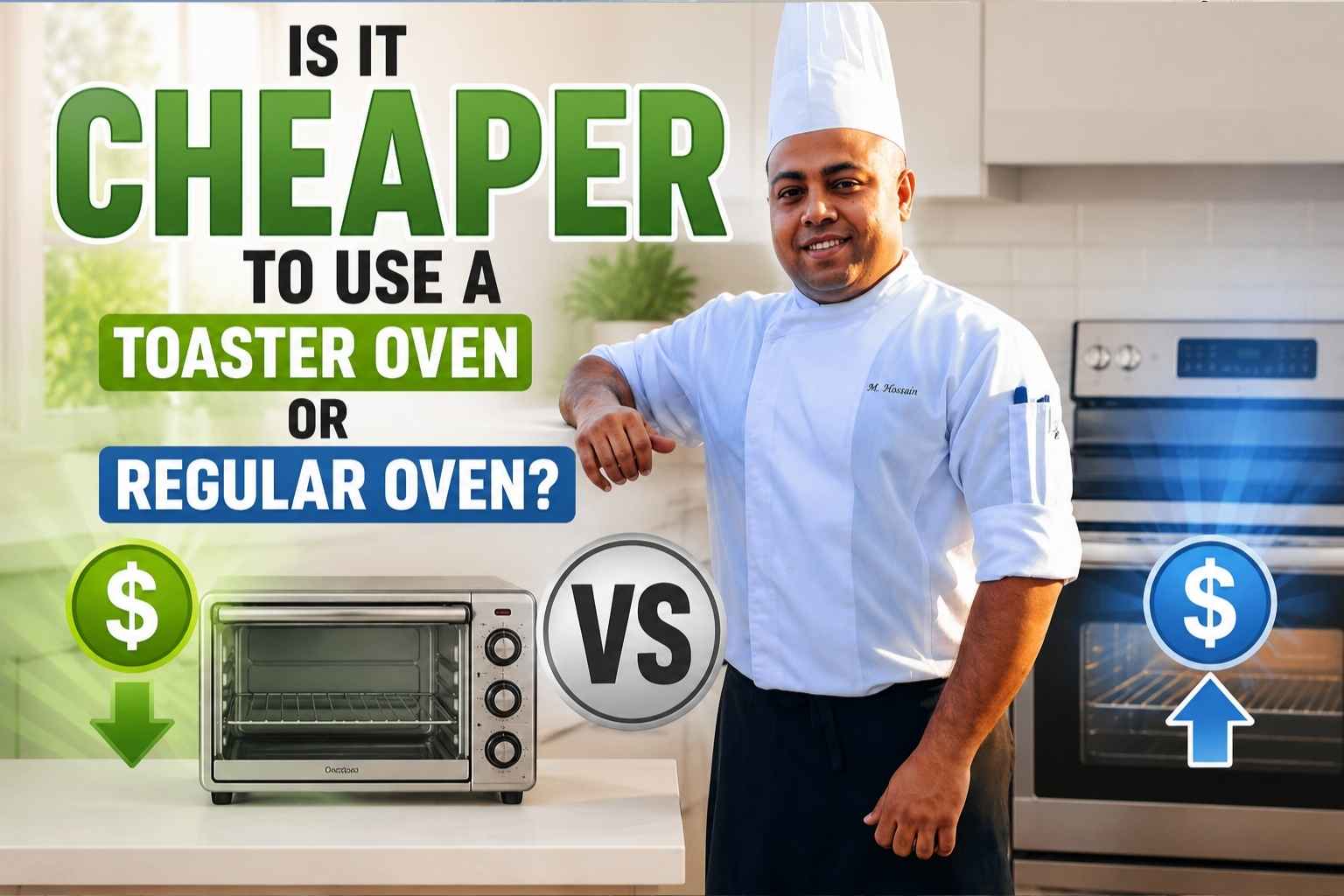
Is it cheaper to use a toaster oven or regular oven? I asked myself that exact question last winter, staring at my electric bill. My toaster oven sat right next to my big oven, and I wondered why I kept using both. As a chef, I’ve tested this in real kitchens, not just on paper. Let’s break down the real costs, so you can save some cash too.
Why This Question Actually Matters
Your electricity bill already told you something was off. Mine did too.
A few years back I started tracking my kitchen energy use after a particularly brutal August utility bill. I cook professionally – 15 years between restaurant kitchens and my own home – and I had assumed I knew how to run a kitchen efficiently. I was wrong about one thing: I was firing up a full 5,000-watt electric oven to reheat leftover pasta for lunch. Every day.
The average U.S. household spends about $115 per month on electricity (U.S. EIA, 2024). Cooking accounts for roughly 4–5% of that. It sounds small until you do the daily math over a year.
For small households – couples, singles, people working from home – oven choice is one of the fastest ways to cut a real number off your bill without changing what you eat. And with residential electricity prices up 14% since 2021 (U.S. EIA, 2024), this question has a sharper answer than it did five years ago.
How Each Oven Uses Energy – The Real Difference
The short answer: wattage times run time equals cost. But the full picture is more useful.
A standard toaster oven pulls 1,200–1,800 watts. A full-size electric oven pulls 2,000–5,000 watts. That gap alone explains most of the cost difference. But wattage is only part of the story.
A full oven has a large cavity to heat – often 5 cubic feet or more. On a cold morning or in a poorly insulated kitchen, it cycles on and off repeatedly to hold temperature. Every cycle draws power. A toaster oven has a 0.5–1.0 cubic foot cavity. Less air to heat, thinner walls, faster thermal response.
Preheat time also matters. A full electric oven takes 10–20 minutes to reach 350°F (Department of Energy, 2024). A toaster oven reaches the same temp in 3–5 minutes. That 15-minute difference at 3,000–5,000 watts adds up fast.
One more factor: toaster ovens sit on your counter and lose some heat to the room. Full ovens are insulated more heavily. But at their scale difference, the toaster oven still wins almost every time for small jobs.
Cost Comparison: Toaster Oven vs. Full Oven at a Glance
Based on U.S. average electricity rate of $0.16/kWh (U.S. EIA, 2024) and average natural gas rate of $1.17/therm (U.S. EIA, 2024).
| Appliance | Wattage Range | Avg. Preheat Time | Est. Cost Per Hour | Best Use Case |
|---|---|---|---|---|
| Toaster oven (standard) | 1,200–1,500W | 3–5 min | $0.19–$0.24 | Toast, reheating, small casseroles |
| Countertop convection oven | 1,500–1,800W | 4–6 min | $0.24–$0.29 | Roasting, baking for 1–3 people |
| Standard electric oven | 2,000–5,000W | 10–20 min | $0.32–$0.80 | Family meals, multi-rack baking |
| Gas oven | 18,000–25,000 BTU | 8–12 min | $0.10–$0.17 | Any task – cheapest per hour in most U.S. regions |
| Convection mode (either) | -15–20% draw | -5 min avg | Saves 15–25% | Default for most baking and roasting |
Note: “Cost per hour” reflects active heating at full wattage. Actual cost is lower because ovens cycle off to hold temp. Convection savings apply when the feature is available and active.
When the Toaster Oven Wins
The toaster oven is the right tool for most weekday cooking in a small household.
Reheating leftovers is the single biggest win. A full oven uses 10–20x more wattage to rewarm a slice of pizza or a bowl of rice than a toaster oven. The food tastes better too – no rubbery microwave texture.
Single servings and small casseroles are the toaster oven’s home turf. Anything in a 9×9 pan or smaller, a single chicken breast, a few vegetables, one or two potatoes – these cook perfectly in a countertop unit at a fraction of the cost.
Summer cooking is where I noticed the biggest difference personally. Last August, I switched entirely to my Breville Smart Oven for lunch prep. The kitchen stayed 4–6 degrees cooler on hot days, and my lunch electric cost dropped to under $0.10 per session. When you account for what your AC pays to counteract oven heat, the full oven’s real cost in summer is higher than the wattage alone suggests.
Toast and breakfast items should never touch a full oven. Bagels, English muffins, frozen waffles – the toaster oven wins every time.
When the Full Oven Wins
The full oven earns its place when the job is too big for a countertop unit.
Large roasts need the full oven. A 5-lb prime rib, a whole chicken, a leg of lamb – these need even heat from all sides and enough clearance to sit without touching the element. Trying to cram them into a toaster oven compromises airflow and cook quality.
Holiday cooking is obvious – you need multiple racks. A full Thanksgiving spread with a 14-lb turkey, two side dishes, and rolls requires the space of a full oven. No toaster oven fixes that.
The crossover point on cost-per-serving is around 3–4 people. If you’re cooking for 6 and you do it in two batches in the toaster oven versus one pass in the full oven, you may actually spend more in time and energy on the toaster. Run the math: two 45-minute sessions at 0.24/hr versus one 60-minute session at $0.48/hr. The full oven wins when your batch size is big enough.
Anything over 3 lbs, or anything that needs to brown evenly on all sides at once, belongs in the full oven.
Gas vs. Electric Full Oven – Does It Change the Math?
Yes, in most U.S. regions a gas oven is cheaper per hour to run than an electric oven.
At the national average of $1.17/therm (U.S. EIA, 2024), a gas oven running at 18,000 BTU costs roughly $0.25/therm-hour. That works out to about $0.10–$0.17 per hour of actual cooking – roughly half what a standard electric oven costs.
But there are three things to keep in mind.
First, gas prices vary more by region than electricity. In New England, gas can run $2.00–$2.50/therm in winter. In the South and Midwest, it’s often under $1.00. Check your own bill before assuming gas is cheaper in your area.
Second, gas ovens preheat faster in most conditions – 8–12 minutes versus 10–20 for electric. That saves a meaningful amount per session.
Third, if you’re on an electric toaster oven versus a gas full oven, the toaster oven is still cheaper for small jobs. The math shifts only when the full oven is gas and the job is large enough to justify the bigger cavity.
Convection Mode: The Hidden Savings
Turn convection on. Every time it’s available. This is the single easiest way to cut oven costs without buying a new appliance.
Convection works by circulating hot air with a fan, stripping away the cool air boundary that forms around food. The result: food cooks 20–25% faster at 25°F lower temperature (America’s Test Kitchen, 2023). Both factors reduce energy draw.
If a recipe calls for 400°F for 40 minutes in a standard oven, convection gets you there at 375°F in about 30 minutes. On a 2,400-watt oven at $0.16/kWh, that’s a savings of about $0.06 per session. Small per session, but over 200 cooking sessions a year, it adds up to real money.
Convection is available on most countertop ovens made after 2018 and on mid-range to high-end full ovens. If your oven has a convection setting and you never use it, you’re leaving savings sitting on the dial. See our guide to [convection vs conventional oven] for a full breakdown of how to adjust recipes.
My Personal Rule of Thumb
I’ve cooked in cramped NYC restaurant kitchens, home kitchens the size of a closet, and open-plan spaces with every gadget available. After all of it, I landed on one rule:
If the food fits in my toaster oven and I’m cooking for 2 or fewer people, I never touch the full oven.
That covers about 60–70% of my weekday cooking. Lunch every day. Weeknight dinners for myself and my partner most nights. Saturday breakfast. All of it goes through my countertop unit.
I fire up the full oven for Sunday roasts, when I have guests, or when I need two racks at once. That’s it.
The discipline that made this stick: I stopped treating the full oven as the default and started treating it as the tool you reach for when nothing else fits. That mindset shift cut my cooking energy use noticeably in the first month.
Common Mistakes That Cost You More (With Fixes)
Preheating a full oven for a single slice of pizza. This is the most expensive habit in the home kitchen. A full electric oven uses 2,000–5,000 watts for 10–20 minutes just to reach temperature – before the food even goes in. Use a toaster oven. It preheats in 3–5 minutes and does the job just as well.
Skipping convection mode. If your oven has it, use it. You’ll cut cook time by 20–25% and temperature by 25°F. That directly reduces how long your heating element runs. There’s no downside on most foods.
Opening the oven door mid-cook. Every time you open the door, the oven loses 25–50°F of heat and the element kicks back on to recover it (Department of Energy, 2024). Use the oven light and window instead. If your oven doesn’t have a window, buy an oven thermometer and set a timer.
Using the wrong appliance for the task. A 2-lb casserole in a full oven is a waste of energy. A 6-lb roast in a small toaster oven is a fire hazard and a cooking failure. Match the appliance size to the job.
Ignoring standby energy draw on full ovens. Most electric ovens with digital clocks and displays draw 3–5 watts continuously (Lawrence Berkeley National Laboratory, 2022). It’s minor – about $2–$4 per year – but on older models with less efficient electronics, it can be higher. If your oven has a manual clock option, use it.
Cooking at altitude without adjusting time. Above 3,500 feet, water boils at a lower temperature and oven performance shifts. Recipes often need 15–25% more time (USDA, 2023). That extended run time costs more energy. Adjust your time estimates so you’re not running the oven longer than needed.
Frequently Asked Questions About Toaster Oven vs. Oven Energy Cost
Is a toaster oven cheaper to run than a microwave?
No. A microwave is the cheapest cooking appliance per minute of use. A standard microwave pulls 600–1,200 watts and heats food in 1–3 minutes. A toaster oven pulls 1,200–1,800 watts and takes longer. For reheating, the microwave wins on cost. The toaster oven wins on food quality – especially for anything you want to be crispy.
Can a convection toaster oven fully replace a full oven?
For 1–2 person households, yes – almost entirely. A quality countertop convection oven handles roasting, baking, broiling, and reheating. Where it falls short: large cuts of meat over 4–5 lbs, multi-rack baking (cookies for a crowd, full sheet pans), and anything that needs 6+ inches of clearance.
How much money can I save per year by using a toaster oven?
It depends on how often you cook, but the math is real. If you replace one full oven session per day with a toaster oven session – saving roughly $0.25–$0.55 per session – you save $90–$200 per year. For a two-person household that cooks at home most nights, savings on the higher end are realistic.
Does oven size affect energy cost?
Yes, directly. A larger oven cavity requires more energy to heat and more energy to hold temperature. A standard 5-cubic-foot electric oven costs significantly more per hour than a 0.8-cubic-foot toaster oven. For small tasks, the size mismatch is pure waste.
Is it worth buying a high-end toaster oven to save on electricity?
A quality countertop convection oven ($150–$350) typically pays for itself within 12–18 months for a household that cooks daily, based on energy savings alone. Look for models with true convection (a fan plus a third heating element) rather than basic fan-only convection – the true convection models are more consistent and faster.
What is the most energy-efficient way to reheat food?
Microwave first for speed and lowest energy cost. Toaster oven second for quality. Full oven last – only if you’re reheating a large volume that fills at least half the cavity. Never preheat a full oven just to rewarm leftovers.
Does leaving the oven door open after cooking save or waste heat?
It wastes energy in summer and barely helps in winter. In summer, the excess heat forces your air conditioning to work harder, which costs more than the residual warmth is worth. In winter, it adds marginal heat to the kitchen but doesn’t do it efficiently. Let the oven cool with the door closed, or vent it into a utility space if you have one.
Does a full oven cost more to run in summer than in winter?
Not directly – the oven itself costs the same per hour regardless of season. But in summer, every degree of heat your oven dumps into the kitchen has to be removed by your air conditioner, which adds to your total energy cost. That indirect cost is real. A toaster oven on the counter produces less heat and is easier to vent. In hot climates, this is a meaningful reason to use the smaller appliance during summer months.
Key Takeaways
- A toaster oven costs $0.03–$0.05 per hour versus $0.32–$0.80 per hour for a standard electric oven, based on U.S. average electricity rates (U.S. EIA, 2024).
- For 1–2 person households, the toaster oven covers 60–70% of weekday cooking at a fraction of the cost.
- The full oven pays off at 3–4+ servings, with large cuts of meat, or when you need two racks at once.
- Convection mode cuts cook time 20–25% and temperature by 25°F – use it every time it’s available (America’s Test Kitchen, 2023).
- Gas ovens cost roughly half as much per hour as electric ovens in most U.S. regions, though regional gas prices vary widely (U.S. EIA, 2024).
- The five habits that inflate your bill the most: full oven preheat for small tasks, no convection, door opening mid-cook, wrong appliance for the job, and ignoring standby draw.
- Check your [oven preheat times] and [best oven thermometers] to dial in accuracy and cut unnecessary run time.
The bottom line: The full oven is a power tool. Use it like one – only when the job actually calls for it. For everything else, the toaster oven is faster, cheaper, and plenty capable. I haven’t reheated leftover pasta in a full oven since 2021, and I’m not going back.

I’m Mossaraof, a trained chef and the founder of OvenInsights.com. I spent years cooking at Larrupin’ Cafe and in kitchens across Chicago and Seattle. Now I test kitchen gear for a living. I moved to North Acton, London, and I test every tool I write about. I use real meals and real heat. No brand deals. No shortcuts. I cover 12 kitchen types and hundreds of recipes. I believe this: the right tools matter as much as the recipe.