At A Glance
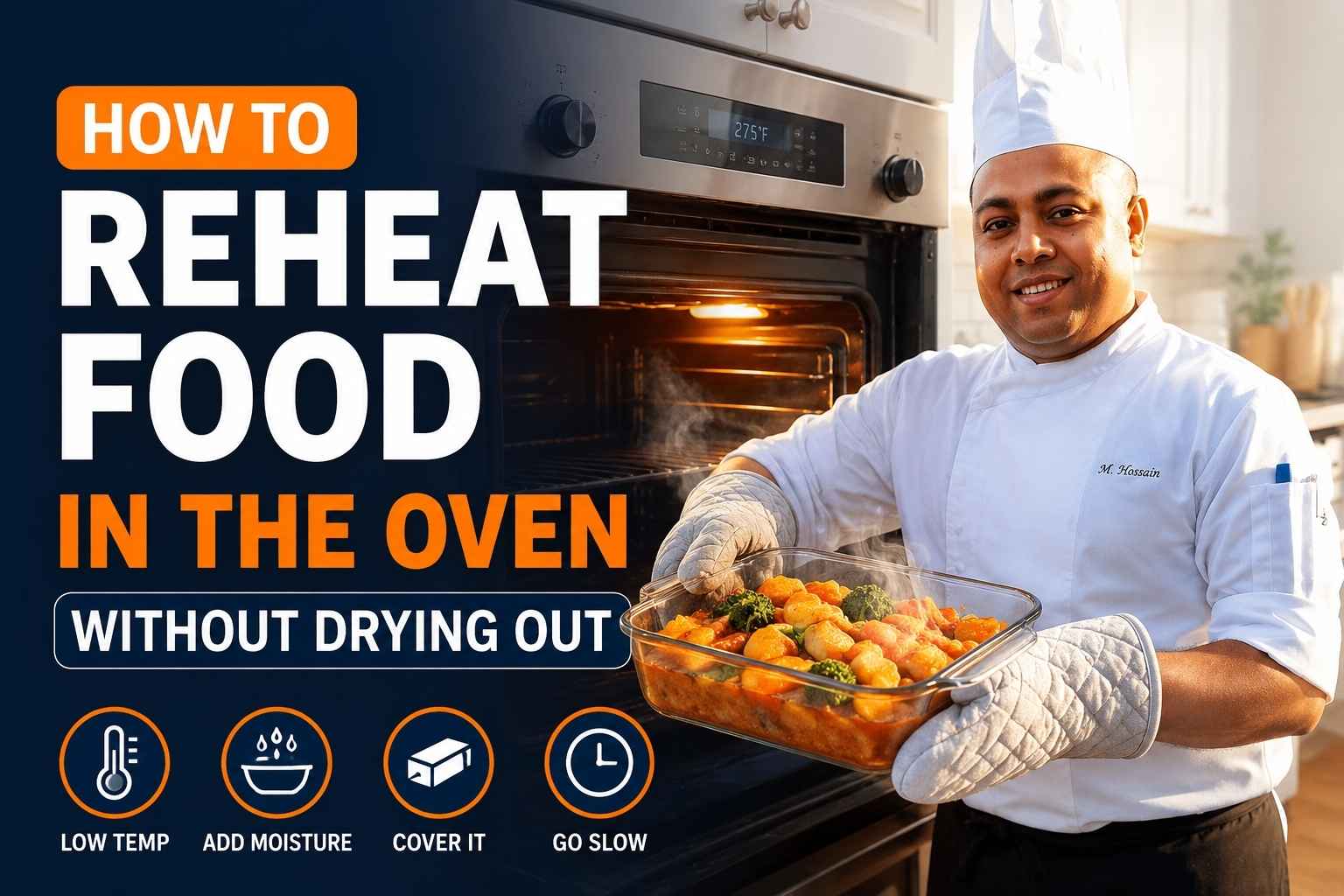
- Cover almost everything with foil to trap steam — the single most effective way to prevent dryness
- Use a probe thermometer, not a timer, to know when food is actually ready
- Low-and-slow wins for proteins (275-325°F); high heat is reserved for pizza, bread, and fried foods
- Add a tablespoon of water, broth, or butter before covering — it creates the steam that saves your leftovers
- Never reheat food from cold to hot in one shot; let it rest at room temperature for 20-30 minutes first
You’ve been there. You pull last night’s dinner from the fridge, and your heart sinks a little. Nobody wants sad, rubbery leftovers. I’ve spent 15 years testing every trick in the book, and I finally cracked how to reheat food in the oven without drying out your favorite meals. Stick with me, and I’ll show you my simple method for warm, juicy leftovers every single time.
Why Ovens Dry Food Out: The Science You Need to Know
The oven dries food because it moves hot, dry air across the surface of your food, pulling moisture out through evaporation. The longer food stays in that environment — especially uncovered — the more moisture it loses. At temperatures above 300°F, the surface of food can reach a point where the rate of moisture loss outpaces the rate of internal heating, meaning the outside dries and toughens before the inside even warms through.
Three things happen simultaneously when you reheat food incorrectly:
Evaporation strips surface moisture fast. Every degree of oven temperature above the boiling point of water (212°F) accelerates this. A 400°F oven evaporates surface moisture roughly four times faster than a 300°F oven (America’s Test Kitchen, 2023).
Protein contraction is the hidden villain. When proteins in meat, poultry, and eggs heat up past their initial cooking temperature, they contract further and squeeze out moisture they were holding. Chicken breast reheated to 180°F internal temp loses almost twice the moisture it loses at 160°F (Cook’s Illustrated, 2022).
Steam loss is the difference between moist and dry. When food releases steam and that steam escapes freely into your oven, you lose it forever. When you trap that steam — with foil, a lid, or a tight baking dish — it condenses back onto the food and keeps it moist. This is the entire logic behind covering food when you reheat it.
The fix is not complicated. It’s about managing your oven temperature, trapping moisture, and pulling food off heat before it overshoots.
The Most Important Tool for Reheating: A Probe Thermometer
A probe thermometer is not optional. It is the single piece of equipment that separates great reheated food from dry, sad leftovers. Timers are guidelines at best. A probe thermometer tells you what is actually happening inside your food.
Here’s how I use it: I insert the probe into the thickest part of whatever I’m reheating before it goes into the oven. I set the target temperature 10-15°F below the food-safe minimum, because carryover heat will finish the job after I pull it out. I let the probe alert me instead of watching the clock.
The USDA food safety minimum internal temperatures are (USDA Food Safety and Inspection Service, 2024):
| Food Type | Safe Internal Temp | My Pull Temp |
|---|---|---|
| Poultry (chicken, turkey) | 165°F | 155°F |
| Ground meat (beef, pork) | 160°F | 150°F |
| Whole cuts of beef/pork/lamb | 145°F | 135°F |
| Fish and seafood | 145°F | 135°F |
| Casseroles and leftovers | 165°F | 155°F |
| Rice and grains | 165°F | 155°F |
Pull it at the lower number, tent it loosely with foil, and let it rest five minutes. The carryover heat will bring it the rest of the way.
A good instant-read thermometer like the ThermoWorks Thermapen costs around $100 and will outlast every other kitchen gadget you own. A basic leave-in probe model from the same brand runs $35. Either works. No thermometer is the one mistake I cannot help you recover from.
Quick-Reference Table: Reheating by Food Type
| Food | Oven Temp | Time | Cover? | Moisture Tip |
|---|---|---|---|---|
| Chicken breast/thigh | 300°F | 20-25 min | Yes, foil | Splash of chicken broth before covering |
| Steak (medium-rare) | 250°F | 20-30 min | Yes, foil | Pat dry first; add nothing |
| Pork chops | 300°F | 15-20 min | Yes, foil | 1 tbsp water or apple juice |
| Pizza | 425°F | 8-10 min | No | None needed |
| Bread/rolls | 325°F | 10-12 min | Damp paper towel | Wet hand, quick pass under water |
| Pasta (sauced) | 350°F | 20-25 min | Yes, foil | Extra splash of sauce or water |
| Mac and cheese | 325°F | 20-25 min | Yes, foil | Splash of milk stirred in |
| Casserole | 325°F | 25-35 min | Yes, foil first, off for last 10 | Add 1-2 tbsp water around edges |
| Roasted vegetables | 400°F | 10-15 min | No | Light coat of oil |
| Fried chicken | 400°F | 15-20 min | No | Rack over sheet pan |
| French fries | 425°F | 8-12 min | No | Single layer on dry sheet pan |
| Rice | 300°F | 15-20 min | Yes, foil | 1 tbsp water per cup of rice |
| Fish fillets | 275°F | 15-20 min | Yes, foil | Lemon slice, 1 tsp butter |
How to Reheat Meats and Poultry Without Drying Them Out
The right approach for all meats and poultry is low heat, covered, with a small amount of added liquid. Anything above 325°F risks overshooting the internal temperature before the heat distributes evenly.
Chicken: The Trickiest Reheat
Chicken breast is unforgiving. It goes from perfectly reheated to dry in about four minutes. My method: pull cold chicken from the fridge 20 minutes before reheating. Place it in a baking dish, add two tablespoons of chicken broth, cover tightly with foil, and put it in a 300°F oven. Pull it when the probe reads 155°F — usually 20-25 minutes. Rest it five minutes under the foil before serving.
Chicken thighs are more forgiving because of the higher fat content. They can handle 325°F and will still come out juicy.
Steak: Low and Slow, Then Sear
Reheating steak well is a two-step job. The oven handles gentle warming. The cast iron handles the sear. Set the oven to 250°F. Place the steak on a wire rack over a sheet pan (not directly on the pan — the rack keeps airflow even). Cover loosely with foil. Pull at 110°F for medium-rare, 120°F for medium. Then get a cast iron pan screaming hot, add a thin film of oil, and sear the steak for 60 seconds per side. You get a hot crust and a warm center. This method — called reverse sear reheating — is J. Kenji López-Alt’s approach, and it is the correct one (Serious Eats, 2023).
Roast Pork, Brisket, and Braised Meats
These are the easiest to reheat well because they were cooked low and slow in the first place. Put them in a dish with a spoonful or two of their original braising liquid or pan drippings. Cover with foil. Heat at 300°F until the probe reads 155°F. If you don’t have the original liquid, beef or chicken broth works fine. The key is that liquid. Without it, braised meats turn fibrous and dry.
How to Reheat Pizza and Bread
High heat, no cover, and a preheated surface are the three rules for great reheated pizza. Low heat softens the crust and makes it limp. A cold pan produces the same result.
Pizza: The Right Way
Preheat your oven to 425°F. Put your baking sheet, pizza stone, or cast iron pan in the oven while it heats. When the oven is ready, slide the pizza directly onto the hot surface. Eight to ten minutes gives you a crispy bottom crust and melted cheese. No foil. No water. No covering. The hot surface under the pizza is what crisps the bottom — a cold pan will never get you there.
The stovetop also works well for single slices. Set a dry skillet over medium heat, lay the slice in, cover with a lid for two minutes, then remove the lid for another 60 seconds. Perfect every time.
Bread and Rolls
The goal with bread is to reintroduce the moisture that was lost during storage without making the crust wet and soggy. Here is what I do: run the roll or bread under cold water for two seconds — literally a quick pass under the tap — then place it directly on the oven rack at 325°F for 10-12 minutes. The water on the surface steams as it heats, rehydrating the crumb from the outside in. The crust comes back with a proper crackle.
For sliced bread or softer rolls, wrap them in a slightly damp paper towel and heat at the same temperature for 8-10 minutes.
How to Reheat Pasta, Casseroles, and Rice
Every starchy dish needs moisture added before reheating — always. Pasta absorbs its sauce as it sits. Casseroles dry out at the edges. Rice hardens into grains that bounce off the plate. All three problems have the same solution: add liquid before covering and heating.
Pasta With Sauce
Add a splash of water (two tablespoons per serving) or a spoonful of extra sauce directly to the pasta. Stir to coat. Cover the dish tightly with foil. Heat at 350°F for 20-25 minutes. When you take the foil off, the sauce should be loose and the pasta should have absorbed just enough liquid to be pliable again. If the pasta is cream-based, use a splash of cream or milk instead of water.
Casseroles
The edges of a casserole always reheat faster than the center. To even this out: cover with foil for the first two-thirds of the cooking time, then remove the foil for the last ten minutes to re-crisp the top. Add a tablespoon or two of water around the edges before covering — not on top of the food, but at the edges where it will create steam without dissolving your topping.
Rice
Cold, stored rice gets dense because the starch molecules recrystallize (a process called retrogradation). The fix is steam. Add one tablespoon of water per cup of rice, cover the dish with foil, and heat at 300°F for 15-20 minutes. The steam reopens the starch structure. Stir once halfway through.
How to Reheat Vegetables
Roasted and sautéed vegetables need high heat and no cover. Covering them traps steam and turns a previously caramelized surface into something limp and pale. The goal is to restore the texture that made them good the first time.
Toss leftover roasted vegetables in a very light coat of oil, spread them in a single layer on a sheet pan — never overlapping — and roast at 400°F for 10-15 minutes. They come out hot with their edges back.
Steamed or boiled vegetables are the exception. They have no crust to restore. Wrap them in foil with a small pat of butter and heat at 325°F for 10 minutes. Gentle heat and a little fat are all they need.
How to Reheat Fried Foods Without Losing the Crunch
The enemy of reheated fried food is steam. Steam is what turns a crispy crust into a soggy one. So the reheating method must allow steam to escape, not trap it.
Set a wire rack over a sheet pan. Place the fried food on the rack — not touching — and heat at 400°F. The rack keeps the bottom of the food off the pan, so hot air circulates all around it. The sheet pan catches drips. This is how I reheat fried chicken, egg rolls, onion rings, and spring rolls in a restaurant setting.
For french fries and anything very thin, 425°F for 8-12 minutes works better. They need aggressive heat fast, otherwise they just get warm and soft.
No cover. No added moisture. No foil. Ever.
The Foil vs. No-Foil Debate: When to Cover and When Not To
Cover food when you want to trap moisture and steam. Skip the foil when you want a crispy surface. That is the entire rule. Everything else is a detail.
Cover these: meats, poultry, fish, pasta, rice, casseroles, bread, and anything that started out moist.
Do not cover these: pizza, fried foods, roasted vegetables, anything with a crispy top you want to restore.
There is a third option: start covered, then finish uncovered. This works well for casseroles, gratins, and dishes with a cheese or breadcrumb topping. The foil traps moisture for the first two-thirds of the reheat, then you pull it off and let the top crisp up in the final minutes. Best of both approaches.
Low-and-Slow vs. High Heat: When Each One Wins
Low heat (250-325°F) wins for proteins, starches, and anything that was cooked gently the first time. High heat (375-425°F) wins for anything with a crust, a crispy exterior, or a surface that needs to be restored.
The logic: proteins cooked at low temperatures stay within a safe internal temperature range without overshooting. High heat moves the surface temperature up fast, which is what creates crust and crunch, but it also risks drying the inside before the outside is done — the opposite of what you want for a chicken thigh.
Low heat is more forgiving. If your probe alarm doesn’t go off and you forget something is in the oven for an extra five minutes, a 300°F environment is far less likely to ruin it than a 400°F one.
High heat is more precise. Pizza at 425°F for 10 minutes is perfect. At 12 minutes it starts burning. Use a timer when you use high heat, even if you also use a thermometer.
Convection vs. Conventional Oven for Reheating
Convection is better for almost everything except covered dishes. A convection oven uses a fan to circulate hot air, which speeds heating, increases browning, and reduces cooking time by 20-25% compared to a conventional oven at the same temperature (Cook’s Illustrated, 2024).
For uncovered reheating — pizza, fried foods, roasted vegetables, bread — convection is the clear winner. The moving air crisps surfaces faster and more evenly.
For covered reheating — meats, pasta, casseroles — convection offers almost no advantage. When food is covered with foil, the circulating air cannot reach it. The reheat is driven by the trapped steam, and a conventional oven does that just as well.
If you’re using convection, reduce the stated temperature in this guide by 25°F or reduce the time by about 20% — whichever the manufacturer recommends for your specific oven.
When the Oven Is the Wrong Tool
The oven is not always the right answer. Some foods reheat better on the stovetop or in the microwave, and knowing which is which will save you time and produce better results.
Use the stovetop instead of the oven for:
- Soups, stews, and chilis — the stovetop heats them evenly with stirring, which prevents hot spots
- Stir-fries and sautéed dishes — a hot wok or skillet restores the sear and texture the oven cannot replicate
- Scrambled eggs — gentle stovetop heat keeps them soft; the oven makes them rubbery
- Grains like quinoa and farro — a covered pot with a splash of water on low heat works faster
Use the microwave instead of the oven for:
- Small portions of anything — microwaving one serving of pasta takes three minutes vs. 25 minutes in an oven
- Fish in a shared space — a sealed microwave-safe container limits the smell; the oven spreads it
- Delicate vegetables — broccoli, spinach, and zucchini can hold moisture in a covered microwave container
- Soups and anything fully liquid
The oven shines when you have time, volume (multiple servings), or a specific texture to restore. For speed and small portions, reach for the microwave or stovetop first.
Common Reheating Mistakes — and How to Fix Them
Mistake 1: Reheating Straight from the Fridge
Cold food takes longer to heat evenly, which means the outside overcooks before the inside warms through. Pull whatever you’re reheating out of the fridge 20-30 minutes before it goes in the oven. This one habit makes a bigger difference than almost anything else.
Mistake 2: Using the Wrong Temperature
Most home cooks default to 350°F for everything. That temperature is too high for most proteins and too low for pizza and fried foods. Use the quick-reference table above and match the temperature to the food.
Mistake 3: Overcrowding the Pan
When food overlaps, steam gets trapped between pieces and you lose the crispy surfaces you were trying to restore. Give every piece of food its own space on the pan. If you have too much food to fit in a single layer, use two sheet pans.
Mistake 4: Skipping Rest Time
Carryover heat is real. When you pull food from the oven, it keeps cooking internally for three to five minutes. If you serve it immediately, you either pull it before it’s hot enough, or it overshoots during the rest you didn’t give it. Always tent food loosely with foil and rest it three to five minutes before plating.
Mistake 5: Not Adding Moisture Before Covering
Covering dry food with foil just traps dry air. Add water, broth, butter, sauce, or cream before you cover. Even half a tablespoon creates enough steam to make a real difference.
Mistake 6: Reheating Twice
Every reheat cycle reduces moisture and texture. Reheat once, portion correctly, and don’t put leftovers of leftovers back in the fridge to reheat again. Food safety aside (each reheat cycle increases bacterial risk), the quality drops sharply after the second pass.
My Personal Reheating Routine
When I have leftovers to deal with at home, this is exactly what I do — no winging it, no timers I forget about.
Step 1: I take everything out of the fridge 20-30 minutes before I want to eat.
Step 2: I decide: is this a “cover it” item or a “crisp it” item? Proteins, starches, and braised things get covered. Pizza, fried things, and vegetables get uncovered.
Step 3: For covered items, I add liquid. A splash of broth for meat, a splash of water for pasta and rice, a thin scrape of butter for fish. I press the foil tightly over the dish.
Step 4: I insert my probe thermometer and set the target temperature 10°F below the pull temp I want. I set the oven to the correct temperature from the table above.
Step 5: When the probe alarm goes off, I pull the food, tent it loosely, and let it rest five minutes.
Step 6: I taste it before I plate it. If something seems off — too dry, not hot enough — I fix it now, not at the table.
That is it. No secret technique. Just consistent execution of a few simple rules.
Frequently Asked Questions About Reheating Food in the Oven
How do I reheat food in the oven without drying it out?
Cover it with foil, add a small amount of liquid (water, broth, or butter depending on the food), and use a lower temperature than you think you need — 275-325°F for most proteins and starches. Use a probe thermometer to pull the food at the right internal temperature rather than relying on a timer.
What temperature should I use to reheat leftovers in the oven?
It depends on what you’re reheating. Proteins and starches do best between 275-325°F. Pizza and fried foods need 400-425°F to restore their crust. Roasted vegetables reheat well at 400°F. There is no single correct temperature for everything — use the food type as your guide.
How long does it take to reheat food in the oven?
Most foods take 15-30 minutes at the right temperature. Pizza takes 8-10 minutes at 425°F. A thick chicken breast takes 20-25 minutes at 300°F. A large casserole can take 35-40 minutes at 325°F. The only reliable way to know when food is done is a probe thermometer — not a clock.
Should I cover food with foil when reheating in the oven?
Yes, for most foods. Foil traps steam and prevents moisture loss, which is the main cause of dry reheated food. The exceptions are pizza, fried foods, and roasted vegetables — those need exposed heat to restore their crispy surfaces.
What is the USDA safe temperature for reheating leftovers?
The USDA recommends reheating all leftovers to a minimum internal temperature of 165°F (USDA Food Safety and Inspection Service, 2024). This applies to poultry, casseroles, rice, pasta, and any previously cooked food. Whole cuts of beef, pork, and lamb can safely be served at 145°F.
Can I reheat food directly from the freezer in the oven?
Yes, but it requires more time and a covered dish with added moisture. A frozen protein reheated from frozen will take roughly double the time compared to thawed. Start at a lower temperature (275°F) and keep it covered throughout. The USDA recommends this approach over thawing at room temperature when you’re short on time (USDA Food Safety and Inspection Service, 2024).
Is convection oven better for reheating?
For uncovered foods like pizza, fried foods, and roasted vegetables, yes — convection circulates hot air and crisps surfaces faster and more evenly. For covered foods like meats in foil or covered casseroles, convection offers no real advantage. If you use convection, reduce your oven temperature by 25°F or shorten the cooking time by about 20%.
Why does my reheated chicken always come out dry?
Three most common reasons: you’re using too high a temperature (above 325°F), you’re not covering it with foil, and you’re not adding any liquid before reheating. Use 300°F, add two tablespoons of chicken broth, cover tightly with foil, and pull when the probe reads 155°F. Rest for five minutes before cutting.
Key Takeaways
- Cover almost everything with foil to trap steam — the foil is doing more work than the oven temperature
- Use a probe thermometer, not a timer; pull food 10-15°F below your target temperature and let carryover heat finish it
- Add liquid before covering: water, broth, sauce, or butter depending on the food
- Pull food from the fridge 20-30 minutes early so heat distributes evenly from the start
- Match temperature to food type: 275-325°F for proteins and starches; 400-425°F for pizza, fried foods, and vegetables
- Convection is better for uncovered reheating; conventional and convection are equal for covered dishes
- Rest all food for three to five minutes after pulling from the oven before serving
- Some foods belong on the stovetop: soups, stews, stir-fries, and eggs all reheat better there than in the oven

I’m Mossaraof, a trained chef and the founder of OvenInsights.com. I spent years cooking at Larrupin’ Cafe and in kitchens across Chicago and Seattle. Now I test kitchen gear for a living. I moved to North Acton, London, and I test every tool I write about. I use real meals and real heat. No brand deals. No shortcuts. I cover 12 kitchen types and hundreds of recipes. I believe this: the right tools matter as much as the recipe.