At A Glance
- Shepherd’s pie is made with ground lamb. If you use beef, it is cottage pie – two different dishes with different fat levels and cooking times.
- Bake the filled dish at 375°F (190°C) for 25 minutes covered, then uncover and broil at 425°F for 8-10 minutes to get a proper golden crust on the potato topping.
- The mashed potato topping needs at least 4 tablespoons of butter per pound of potato to pipe and brown correctly – anything less and you get a grey, gummy lid.
- Make-ahead works well: assemble the dish up to 48 hours ahead, refrigerate covered, and add 10-12 minutes to your covered bake time.
- The single most common mistake home cooks make is a watery filling – cook the filling down until no liquid pools when you drag a spoon through it, then add the potato topping.
The first time I made shepherd’s pie in the oven, I burned the top and underdid the filling. It was a mess. But I learned fast — and now it’s my go-to cold-weather dish.
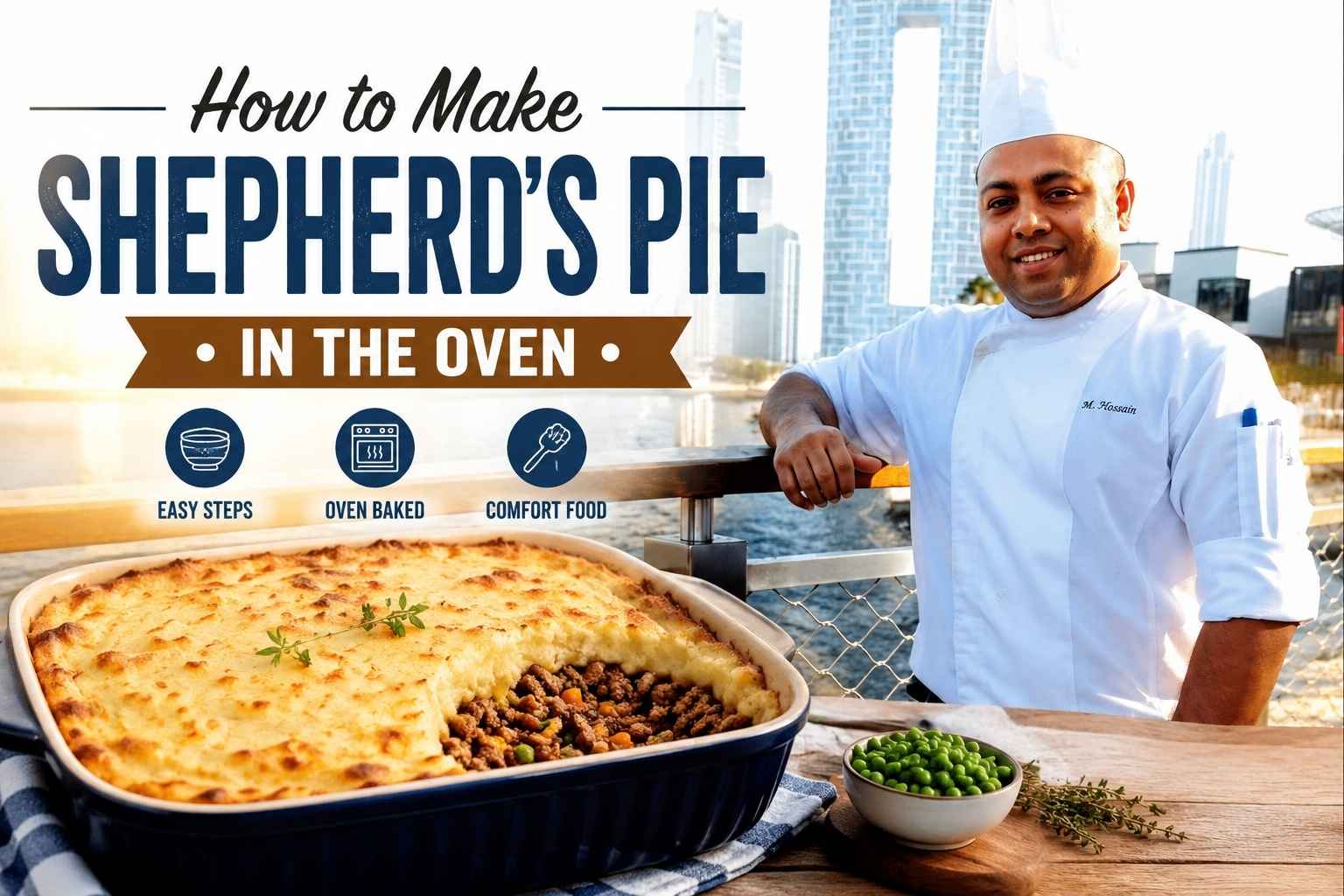
Learning how to make shepherd’s pie in the oven doesn’t have to be hard. It’s just layers — meat, veg, and mash — baked until golden and bubbling. Simple as that.
I’ve made this dish more times than I can count. I know what works and what ruins it. You’ll get both here — the tips and the traps.
This guide walks you through every step. From browning the lamb to getting that mash crust just right. Ready to make the best shepherd’s pie of your life? Let’s get into it.
Ingredient Quantities for Shepherd’s Pie (4, 6, and 8 Servings)
Scale your shopping using this table before you start. All weights are in grams or standard US cup measurements.
| Ingredient | 4 Servings | 6 Servings | 8 Servings |
|---|---|---|---|
| Ground lamb | 450g (1 lb) | 680g (1.5 lb) | 900g (2 lb) |
| Yellow onion, diced | 1 medium | 1 large | 2 medium |
| Carrots, diced | 2 medium | 3 medium | 4 medium |
| Celery stalks, diced | 2 stalks | 3 stalks | 4 stalks |
| Garlic cloves, minced | 3 cloves | 4 cloves | 6 cloves |
| Frozen peas | 1/2 cup | 3/4 cup | 1 cup |
| Tomato paste | 2 tbsp | 3 tbsp | 4 tbsp |
| Worcestershire sauce | 1 tbsp | 1.5 tbsp | 2 tbsp |
| Lamb or beef stock | 1 cup (240ml) | 1.5 cups (360ml) | 2 cups (480ml) |
| Fresh thyme sprigs | 4 sprigs | 6 sprigs | 8 sprigs |
| Rosemary sprigs | 2 sprigs | 3 sprigs | 4 sprigs |
| Russet potatoes | 680g (1.5 lb) | 1 kg (2.25 lb) | 1.35 kg (3 lb) |
| Unsalted butter | 4 tbsp | 6 tbsp | 8 tbsp |
| Whole milk or cream | 1/3 cup | 1/2 cup | 2/3 cup |
| Egg yolk (for crust) | 1 | 1 | 2 |
| Salt and black pepper | To taste | To taste | To taste |
What Shepherd’s Pie Actually Is – and Why Most People Get It Wrong
Shepherd’s pie is a baked British dish with a seasoned ground lamb filling covered by a mashed potato crust, cooked together in the oven until the top browns. That definition matters because the lamb is not optional. If you substitute ground beef, you are making cottage pie – a related but distinct dish that British cooks have always kept separate (BBC Good Food, 2024). Both are good. They are not the same thing.
I’ve been cooking both versions professionally for 15 years, and the terminology question still trips up about half the home cooks I teach. The practical reason to care: ground lamb has a higher fat content than most ground beef blends, typically around 20-25% fat (USDA, 2023). That fat melts into the filling during the oven bake and carries the herb flavor in a way beef simply does not. If you want shepherd’s pie to taste the way it does in a good British pub, use lamb.
The other thing most people get wrong is treating the dish as a “leftover casserole” with a potato hat slapped on top. The filling has its own technique – a proper braise with stock reduction – and the potato topping has a recipe within the recipe. Get both right and the result is one of the most satisfying things you can pull from an oven.
The Right Oven Temperature for Shepherd’s Pie: Why One Number Isn’t Enough
Shepherd’s pie needs two temperatures: 375°F (190°C) for the main bake and 425°F (220°C) for the final browning phase. Using a single temperature for the whole cook leads to either an undercooked filling or a scorched potato top.
Here’s the logic. At 375°F, the filling heats through gently and the starches in the potato topping set without seizing. If you try to brown at this temperature, you’ll be waiting 25 minutes for color while the filling overcooks and dries out. Jumping to 425°F at the end (or switching on the broiler) gives you the Maillard reaction on the potato peaks in 8-10 minutes with the filling already done (America’s Test Kitchen, 2023).
For a gas oven, the broiler is usually directly above the oven cavity. Move your rack to the second position from the top for the browning phase – not the top rack, or the peaks char before the valleys color.
For an electric oven, the broil element is also overhead, but electric broilers cycle on and off rather than burning continuously. This means uneven spots are more common. Rotating the dish 180 degrees at the 4-minute mark during broiling fixes most of it.
How Convection Affects the Crust
Convection mode (also called “fan-forced” or “fan-assist”) circulates hot air around the dish. For shepherd’s pie, this is useful during the covered bake – it speeds up the filling heat-through by roughly 15% (Serious Eats, 2022). For the browning phase, turn convection off or reduce the temperature by 25°F to avoid blasting the potato top too fast. The goal is a golden-brown crust with some soft interior in the peaks, not a dried-out shell.
How to Build the Filling: Meat, Aromatics, Vegetables, and the Right Liquid Ratio
The filling for shepherd’s pie is made in a wide, heavy pan on the stovetop, then transferred to the baking dish. This two-step process matters because you cannot reduce a liquid properly inside a deep casserole dish.
Start with the lamb. Get a 12-inch skillet or wide Dutch oven over medium-high heat – no oil, because the lamb has enough fat. Add the ground lamb and break it up with a wooden spoon. Cook until the pink is gone and you see genuine browning on at least some of the meat, about 8 minutes. Do not rush this step. Browning creates flavor compounds that a quick steam-cook cannot replicate (Kenji López-Alt, The Food Lab, 2015). Drain excess fat if more than 2 tablespoons remain in the pan.
Lower the heat to medium. Add diced onion, carrot, and celery – the classic mirepoix (French for the combination of onion, carrot, and celery used as an aromatic base). Cook until the onion is translucent, about 6 minutes. Add garlic and cook 1 more minute. Push the mixture to the edges, add tomato paste to the center, and cook the paste for 2 minutes until it darkens slightly. This step removes the raw, sharp edge from the tomato paste.
Add Worcestershire sauce and stir everything together. Pour in the stock. Add fresh thyme and rosemary sprigs. Bring to a simmer and cook uncovered until the liquid reduces by about two-thirds, roughly 12-15 minutes. When you drag a spoon through the mixture, no liquid should rush back to fill the gap. That is your consistency test. Add the frozen peas in the last 2 minutes – they need no cooking, just heat-through.
Season aggressively with salt and black pepper before transferring to your baking dish. The potato topping will mute some seasoning, so the filling should taste slightly saltier than you’d eat on its own.
Mashed Potato Topping Secrets: Butter Content, Consistency, and Getting the Golden Crust
The potato topping is where most shepherd’s pie recipes go wrong. A properly made topping has enough fat to pipe, holds its shape in the oven, and develops a genuinely golden crust with some crunch on the peaks. A poorly made topping turns grey, weeps water, and sits flat.
Potato choice matters. Use Russet potatoes (also called Idaho potatoes). Their high starch content makes a fluffy, pipeable mash. Waxy potatoes like red bliss or Yukon Golds hold their shape well for other applications, but for shepherd’s pie they produce a sticky, dense topping that doesn’t brown properly (King Arthur Baking, 2023). Peel and cut Russets into even 1-inch chunks, then boil in heavily salted water from cold. Starting from cold ensures even cooking from edge to center.
Drain well and return the potatoes to the hot dry pan for 1-2 minutes to steam off excess water. This is called drying out the potatoes and it’s the difference between a fluffy mash and a wet one. Rice the potatoes (using a potato ricer or food mill) while still hot. Add room-temperature butter first, then warm milk or cream. Cold dairy tightens the starch and produces glue.
The ratio I use: 4 tablespoons of unsalted butter per pound of potato, plus enough warm whole milk to bring the mash to a thick, slow-dropping consistency. It should hold a peak when you lift a spoon. If it pours, add more riced potato. If it stiffens too much, add milk one tablespoon at a time.
Add one egg yolk per 1.5 pounds of potato. The yolk encourages browning via the Maillard reaction and adds richness. Stir it in quickly off the heat so it doesn’t scramble.
Transfer the mash to a piping bag fitted with a large star tip (a 1M tip works well), or just spread it with a spoon and fork the surface to create ridges. Those ridges are not decoration – the peaks brown faster and give you textural contrast between crisp top and soft center.
Step-by-Step Oven Method: Times and Temperatures at Every Stage
This is the full shepherd’s pie method from cold ingredients to table. The process works for 4-8 servings with the baking dish scaled accordingly (use a 9×9 inch dish for 4 servings, 9×13 for 6-8).
Step 1: Make the Filling (30-35 Minutes)
Follow the stovetop process described above. Get the filling to proper consistency before it goes in the baking dish – no pooling liquid. Let the filling cool slightly, about 5 minutes, before adding the potato topping. A screaming-hot filling melts the butter in the mash before it even goes in the oven.
Step 2: Assemble the Dish (5 Minutes)
Spread the filling evenly in the baking dish. Pipe or spoon the mashed potato topping from the edges inward, making sure to seal the edges all the way to the dish walls. Unsealed edges let the filling bubble up over the potato, which looks messy and dries out the filling edges.
Step 3: Covered Bake at 375°F (25 Minutes)
Tent the dish loosely with aluminum foil. Place it on the center rack of a preheated oven. Bake for 25 minutes. The filling will be fully heated and the potato topping will be set. Do not skip the foil – it prevents the potato top from drying out before the filling is done.
Step 4: Uncover and Brown at 425°F (8-10 Minutes)
Remove the foil. Either increase the oven temperature to 425°F and bake until the peaks are golden brown, or switch on the broiler. Broiling is faster (8-10 minutes versus 15-18 minutes at 425°F), but watch it. Broilers vary by 50-75°F across most home models (Consumer Reports, 2022). Check at 6 minutes the first time you make this recipe in a new oven.
Step 5: Rest Before Serving (5-10 Minutes)
Pull the dish from the oven and let it sit on a wire rack for at least 5 minutes. The filling is near boiling inside and will flow out if you serve it immediately. Resting gives the starches time to re-gel slightly, so portions hold their shape on the plate.
Gas vs. Electric Oven Differences for Browning the Topping Evenly
Gas and electric ovens produce different browning patterns on shepherd’s pie, and understanding which type you have affects where you position the dish.
Gas ovens heat from a burner below and tend to have hot spots at the back. For shepherd’s pie, this means the back of the dish browns faster than the front. Position the dish slightly off-center toward the front of the rack, or rotate it 180 degrees at the halfway point of your browning phase.
Electric ovens heat more evenly overall but have a slow thermal recovery time – meaning if you open the door to check the dish, the temperature drops noticeably and takes 3-5 minutes to recover. Keep checks to a minimum. Electric broilers also cycle (turn on and off) rather than burn continuously, so hot and cool zones shift during broiling.
The most reliable approach for either oven type: use an oven thermometer rather than trusting the dial. Per America’s Test Kitchen (2023), home ovens are off by an average of 25°F from their set temperature, with some off by as much as 75°F. A $10 oven thermometer removes this variable completely.
Make-Ahead and Freezing Tips for Shepherd’s Pie
Shepherd’s pie is a strong make-ahead dish. You can assemble it up to 48 hours before baking, refrigerate it covered with plastic wrap, and bake from cold.
When baking from refrigerator temperature, add 10-12 minutes to the covered bake time and check the center of the filling with an instant-read thermometer before uncovering. You’re looking for 165°F (74°C) in the center. Only then move to the browning phase.
For freezing, the best approach is to freeze before baking, not after. Assemble the dish fully, wrap tightly in two layers of plastic wrap and one layer of aluminum foil, and freeze for up to 3 months. Thaw overnight in the refrigerator before baking.
Avoid freezing a fully baked shepherd’s pie. The mashed potato topping absorbs water from the filling during thawing and becomes wet and grainy on the second bake (Serious Eats, 2023). The texture is noticeably worse than a dish baked fresh from assembled-and-frozen state.
If you freeze individual portions after baking (for meal prep purposes), accept that the topping texture changes. Reheat in a 350°F oven covered with foil for 20 minutes, uncover for 5, and the topping will be fine – just different from fresh.
Common Shepherd’s Pie Mistakes and How to Fix Them
Most shepherd’s pie problems fall into five categories. Here is what causes each one and how to correct it.
| Mistake | Likely Cause | Fix |
|---|---|---|
| Watery filling that soaks the topping | Filling not reduced enough before assembly | Cook filling uncovered until no liquid pools when you drag a spoon through it. |
| Grey, flat potato topping that won’t brown | Not enough butter in the mash, or too much moisture in the potatoes | Dry the potatoes after draining, use at least 4 tbsp butter per lb, add an egg yolk. |
| Filling too salty or too bland | Underseasoning before the topping goes on, or over-reducing the stock | Season the filling assertively before assembly – the topping mutes salt. Taste before transferring. |
| Topping slides off during serving | Filling was too hot when topping was added, or too liquidy | Cool filling 5 minutes before topping. Ensure filling is properly thickened. |
| Uneven browning on the potato crust | Oven hot spots or rack position | Use an oven thermometer, rotate the dish halfway through browning, or add the egg yolk to the mash. |
| Bubbling sides mess up the dish appearance | Topping not sealed to the dish edges | Press the topping firmly to the inside edges of the dish all the way around. |
What to Do at High Altitude
At elevations above 3,500 feet, water boils at a lower temperature – around 200°F instead of 212°F at sea level (Colorado State University Extension, 2022). This means your potatoes take 20-25% longer to cook through. Test them with a fork rather than timing. For the filling, the liquid also reduces faster due to lower boiling point, so watch the consistency closely and reduce your stock by about 20% to start.
Oven temperatures are unaffected by altitude, so your bake times remain the same.
My Shepherd’s Pie Routine: How I Actually Cook This Dish
After 15 years of making shepherd’s pie in restaurant kitchens and at home, this is my actual process – not the ideal version, but the one I use on a Tuesday.
I buy lamb shoulder mince from the butcher, not the pre-packed supermarket stuff. Butcher lamb shoulder mince has more connective tissue and fat variation, which adds body to the sauce as it cooks. If you can only find the pre-packed version, it still works – just watch the fat level and drain more aggressively.
I make the filling the day before. A day in the fridge lets the flavors meld. When I pull it out the next evening, the fat has solidified on top – I skim most of it off, which makes the filling less greasy. Then I warm the filling gently, taste and re-season, and proceed with the assembly.
For the potato topping, I add a handful of finely grated Parmesan – about 25 grams per pound of potato – into the mash. This is not traditional. The Parmesan adds umami and helps the crust brown faster and with more crunch. Nobody who eats it has ever complained.
I always pipe the topping. A disposable piping bag with a star tip takes 4 minutes and creates more surface area for browning than a flat-spread topping. More surface area means more crunch per bite.
The dish goes in the oven about 35 minutes before I want to eat. 25 minutes covered, 10 minutes under the broiler, 5 minutes resting. I put a sheet pan under the baking dish because fillings bubble over, and cleaning a baked-on mess off the oven floor at 10 PM is a problem I’ve solved exactly once.
Frequently Asked Questions About Making Shepherd’s Pie in the Oven
What is the difference between shepherd’s pie and cottage pie?
Shepherd’s pie uses ground lamb and cottage pie uses ground beef. The name “shepherd’s pie” refers to sheep farmers, so the sheep’s meat (lamb) is the correct base. Both dishes use the same mashed potato topping and similar aromatics, but the fat content and flavor profile differ. Use lamb for shepherd’s pie and beef for cottage pie – using the wrong meat doesn’t ruin the dish, but it changes it enough that it’s worth using the right name (BBC Good Food, 2024).
What temperature do you bake shepherd’s pie at?
Bake shepherd’s pie at 375°F (190°C) covered for 25 minutes, then uncover and increase to 425°F (220°C) or switch on the broiler for 8-10 minutes to brown the potato topping. A single temperature of 375°F for the whole cook will not brown the topping properly. A single high temperature risks drying out the filling before the topping sets.
How do you keep the mashed potato topping from sinking into the filling?
Two things prevent sinking: thickened filling and a stiff mash. The filling must be reduced until no liquid pools when you drag a spoon through it. The mash must be stiff enough to hold a peak – not pourable. Use Russet potatoes (high starch, low moisture), dry them after draining, and use at least 4 tablespoons of butter per pound. A wet filling or a loose mash will produce a sunken topping every time.
Can you make shepherd’s pie ahead of time and refrigerate it?
Yes. Assemble the dish fully, cover it with plastic wrap, and refrigerate for up to 48 hours before baking. When baking from cold, add 10-12 minutes to the covered bake time and verify the filling center reaches 165°F (74°C) with an instant-read thermometer before uncovering for the browning phase.
Why is my shepherd’s pie watery?
A watery shepherd’s pie comes from one of two causes: the filling wasn’t reduced enough before assembly, or the topping was added while the filling was still at a full boil and the steam condensed back into the dish. Reduce the filling until a spoon dragged through it leaves a dry channel for at least 2-3 seconds. Let it cool for 5 minutes off the heat before adding the topping.
How long does shepherd’s pie take to cook in the oven?
Total oven time is 33-35 minutes: 25 minutes covered at 375°F plus 8-10 minutes uncovered at 425°F or under the broiler. Add 10-12 minutes if baking from refrigerator temperature. After the oven, rest the dish for 5-10 minutes before serving – this is part of the cook, not optional.
Can you freeze shepherd’s pie after baking?
You can freeze baked shepherd’s pie in individual portions for meal prep, but the topping texture changes. Freezing before baking produces a much better result. If you freeze after baking, wrap portions tightly and reheat at 350°F covered for 20 minutes, then uncovered for 5 minutes. Expect a slightly softer topping on the second bake.
Does shepherd’s pie work in a convection oven?
Yes, with one adjustment. Use convection for the covered bake to speed up filling heat-through, then switch off convection (or reduce by 25°F) during the browning phase. Convection on high heat can over-dry the potato peaks before the valleys color, giving you uneven browning.
Key Takeaways
- Use ground lamb, not beef. Ground beef makes cottage pie, not shepherd’s pie. The lamb’s fat content carries herb flavor in a way beef does not.
- Two-temperature baking is the method. 375°F covered for 25 minutes, then 425°F uncovered for 8-10 minutes. One temperature does not do both jobs.
- Reduce the filling until it holds. A properly reduced filling shows no pooling liquid when you drag a spoon through it. This is the single most reliable quality test.
- Butter and egg yolk are what make the topping brown. Use at least 4 tablespoons of butter per pound of potato and add an egg yolk. These are not optional for a golden crust.
- Make it the day before for the best flavor. The filling improves overnight and you can skim excess fat before the final assembly.
- Use an oven thermometer. Home ovens are often off by 25°F or more. A $10 thermometer removes the single biggest variable in the whole recipe.

I’m Mossaraof, a trained chef and the founder of OvenInsights.com. I spent years cooking at Larrupin’ Cafe and in kitchens across Chicago and Seattle. Now I test kitchen gear for a living. I moved to North Acton, London, and I test every tool I write about. I use real meals and real heat. No brand deals. No shortcuts. I cover 12 kitchen types and hundreds of recipes. I believe this: the right tools matter as much as the recipe.