
At A Glance
- A whole turkey needs 13 to 15 minutes per pound at 325°F when unstuffed, and 15 to 17 minutes per pound when stuffed (USDA, 2024).
- The clock is a starting guess. The only number that tells you the bird is done is internal temperature: 165°F in the breast and thigh (USDA, 2024).
- A 14-pound unstuffed turkey at 325°F takes roughly 3 to 3.75 hours. A 20-pound bird takes 4 to 5 hours.
- Convection ovens cook turkey about 25% faster, so check doneness 30 to 45 minutes earlier than the standard chart suggests (America’s Test Kitchen, 2023).
- Rest the turkey for 20 to 30 minutes after pulling it. Carryover cooking will raise the internal temp another 5 to 10 degrees.
Knowing how long to cook a turkey in the oven per pound can make or break your holiday meal. One wrong guess and you’re left with dry meat or a raw center — neither is fun. I’ve been there, and it’s a stressful spot to be in. Trust me, a little know-how goes a long way.
Turkey cooking times aren’t random. They follow a simple pattern based on weight, oven temp, and whether your bird is stuffed or not. Once you understand that, the whole process feels much less scary. It’s like finally learning the rules of a game you’ve been playing blind.
I’ve roasted dozens of turkeys over the years — big ones, small ones, stuffed and bare. That hands-on time taught me what charts alone never could. You’ll get all of that hard-won insight here. No fluff, just what actually works.
In this guide, you’ll find exact cook times, a clear per-pound breakdown, and tips to keep your turkey juicy. Whether it’s your first bird or your fifteenth, this will help. Let’s get your turkey right — scroll down and let’s dig in.
How Long Does It Take to Cook a Turkey Per Pound?
At 325°F, plan on 13 to 15 minutes per pound for an unstuffed turkey and 15 to 17 minutes per pound for a stuffed one (USDA, 2024). That’s the number most recipe cards give you, and it’s a fine place to start.
But here’s the thing. I’ve pulled two turkeys from the same oven, same size, same brand, and had one finish 25 minutes ahead of the other. Per-pound math gets you in the right neighborhood. It won’t get you to the front door.
Use the chart below to plan your day. Then use a thermometer to actually decide when the bird comes out.
Turkey Cooking Time Chart by Weight
This table gives you a starting point for any size bird, at the two most common oven temps. Treat the high end of each range as your real target. Ovens run hot, run cold, and lie to your face.
| Weight | 325°F Unstuffed | 325°F Stuffed | 350°F Unstuffed | 350°F Stuffed | Notes |
|---|---|---|---|---|---|
| 8-10 lbs | 2.5 – 3 hrs | 3 – 3.5 hrs | 2.25 – 2.75 hrs | 2.75 – 3.25 hrs | Small birds dry out fast. Watch the breast closely. |
| 10-12 lbs | 3 – 3.5 hrs | 3.5 – 4 hrs | 2.75 – 3.25 hrs | 3.25 – 3.75 hrs | Good size for a tight oven and a quick weeknight feast. |
| 12-14 lbs | 3 – 3.75 hrs | 3.75 – 4.25 hrs | 3 – 3.5 hrs | 3.5 – 4 hrs | The most common size for a family of 6 to 8. |
| 14-16 lbs | 3.75 – 4 hrs | 4.25 – 4.75 hrs | 3.5 – 3.75 hrs | 4 – 4.25 hrs | Start checking temp at the low end of the range. |
| 16-18 lbs | 4 – 4.25 hrs | 4.75 – 5.25 hrs | 3.75 – 4 hrs | 4.25 – 4.75 hrs | Big enough that the legs may finish well before the breast. |
| 18-20 lbs | 4.25 – 4.75 hrs | 5.25 – 5.75 hrs | 4 – 4.5 hrs | 4.75 – 5.25 hrs | Tent the breast with foil if it browns too fast. |
| 20-22 lbs | 4.75 – 5.25 hrs | 5.75 – 6.25 hrs | 4.5 – 5 hrs | 5.25 – 5.75 hrs | Make sure your oven actually fits this bird with room for air to move. |
| 22-24 lbs | 5.25 – 5.75 hrs | 6.25 – 6.75 hrs | 5 – 5.5 hrs | 5.75 – 6.25 hrs | Consider spatchcocking or splitting the bird for even cooking. |
These ranges are based on standard USDA guidance for whole turkeys cooked at a consistent oven temperature with the door staying shut (USDA, 2024). Times will run longer if your oven door gets opened often, your bird sits in a cold draft near a window, or your turkey wasn’t fully thawed before it went in.
Why Per-Pound Timing Is Only a Starting Estimate
Per-pound timing gives you a planning number, not a finish line. The actual cook time depends on the bird’s shape, your oven’s real temperature, and whether it started cold or at room temp.
I learned this the hard way during my second Thanksgiving as a line cook. Two 16-pound turkeys, same oven, same rack position. One finished at 3 hours 40 minutes. The other needed almost 4 hours 20 minutes. The difference? One turkey had been sitting at room temperature for an hour before going in, and the other came straight from a walk-in fridge that ran a few degrees colder than it should have.
A few things that throw off the per-pound math every single time:
- Starting temperature of the bird. A turkey straight from the fridge cooks slower than one that’s rested at room temp for 30 to 60 minutes.
- Shape and bone structure. A short, compact bird cooks faster than a long, narrow one of the same weight, because heat has less distance to travel to the center.
- Oven calibration. Most home ovens run 10 to 25 degrees off from their display, and that gap compounds over a 4-hour cook (Taylor Precision Products, 2023).
- How often you open the door. Every peek drops the oven temp by 25 to 30 degrees, and it takes several minutes to recover.
None of these factors show up in a per-pound chart. That’s why the chart gets you close, but a thermometer gets you right.
Internal Temperature vs. Cook Time: Which One Actually Matters
Internal temperature matters more than cook time, full stop. The USDA’s safe minimum for poultry is 165°F, measured in the thickest part of the breast and the innermost part of the thigh (USDA, 2024). Time is just a guess at when you’ll hit that number.
I tell every new cook on my line the same thing: the clock tells you when to start checking. The thermometer tells you when to stop cooking. Those are two different jobs, and conflating them is how turkeys end up dry.
Why Time-Based Cooking Fails So Often
Time-based cooking fails because no two ovens, and no two turkeys, behave exactly alike. A recipe writer tested their bird in their oven, with their thermometer, on their specific turkey. You’re working with different variables every time.
Stick a turkey in the oven for “4 hours” because a chart said so, and you might pull out a bird that’s at 158°F in the thigh, still technically unsafe, or one that’s been sitting at 180°F for 20 minutes and turned to shoe leather. Both are common. Both are avoidable.
The Two-Thermometer Approach I Use
I run two thermometers on every turkey I cook for a holiday meal. One is a leave-in probe thermometer that stays in the bird the whole time and gives a running readout. The other is an instant-read digital thermometer for spot-checking the thigh, wing joint, and stuffing cavity near the end.
The leave-in probe (Taylor Precision Products makes a solid one) lets you walk away and still know what’s happening inside the bird (Taylor Precision Products, 2023). The instant-read confirms the reading in a second spot, because a single probe in the wrong place can read 10 degrees off from reality.
Cooking Times by Weight Range: What Changes and Why
Cooking times don’t scale in a straight line as turkeys get bigger. A heavier bird takes proportionally less time per pound than a lighter one, because the ratio of surface area to mass drops as size goes up.
8 to 12 Pound Turkeys
Small turkeys in the 8 to 12 pound range cook in about 2.5 to 3.5 hours at 325°F, depending on whether they’re stuffed. These birds are most at risk of drying out, because the breast is proportionally larger relative to the whole bird and the cook time is short enough that there’s little margin for error.
Start checking the breast temperature at the 2-hour mark. If you’re cooking a turkey this size, consider a lower oven temp like 300°F with a slightly longer cook, which gives the connective tissue more time to soften without overcooking the breast.
12 to 16 Pound Turkeys
This is the sweet spot for most home cooks, and it’s the size I recommend for a table of 8 to 10 people. At 325°F, expect 3 to 4.75 hours depending on stuffing and exact weight.
Begin checking internal temp around the 2.5-hour mark for a 12-pounder, or closer to 3 hours for a 16-pounder. This is also the size range where a foil tent over the breast for the first half of cooking makes the biggest visible difference in evenness.
16 to 20 Pound Turkeys
Turkeys in this range take 4 to 5.75 hours at 325°F. At this size, the gap between when the legs finish and when the breast finishes gets noticeable, sometimes 20 to 30 minutes apart.
I start checking the thigh around the 3.5-hour mark and the breast around the 3.75-hour mark. If the legs are done well before the breast, that’s normal. It’s also the main reason spatchcocking (cutting the bird flat) becomes worth considering at this size.
20 to 24+ Pound Turkeys
Birds over 20 pounds take 4.75 to 6.75 hours depending on stuffing, and they come with a real logistics problem: many home ovens can’t fit a turkey this large with enough clearance for heat to circulate (America’s Test Kitchen, 2023).
If you’re cooking a turkey this big, measure your oven’s interior before you buy the bird. Start checking temp at 4.5 hours, and have a backup plan (a second oven, or splitting the bird into parts) if your equipment can’t handle it.
Stuffed vs. Unstuffed: How Stuffing Changes Cook Time and Safety
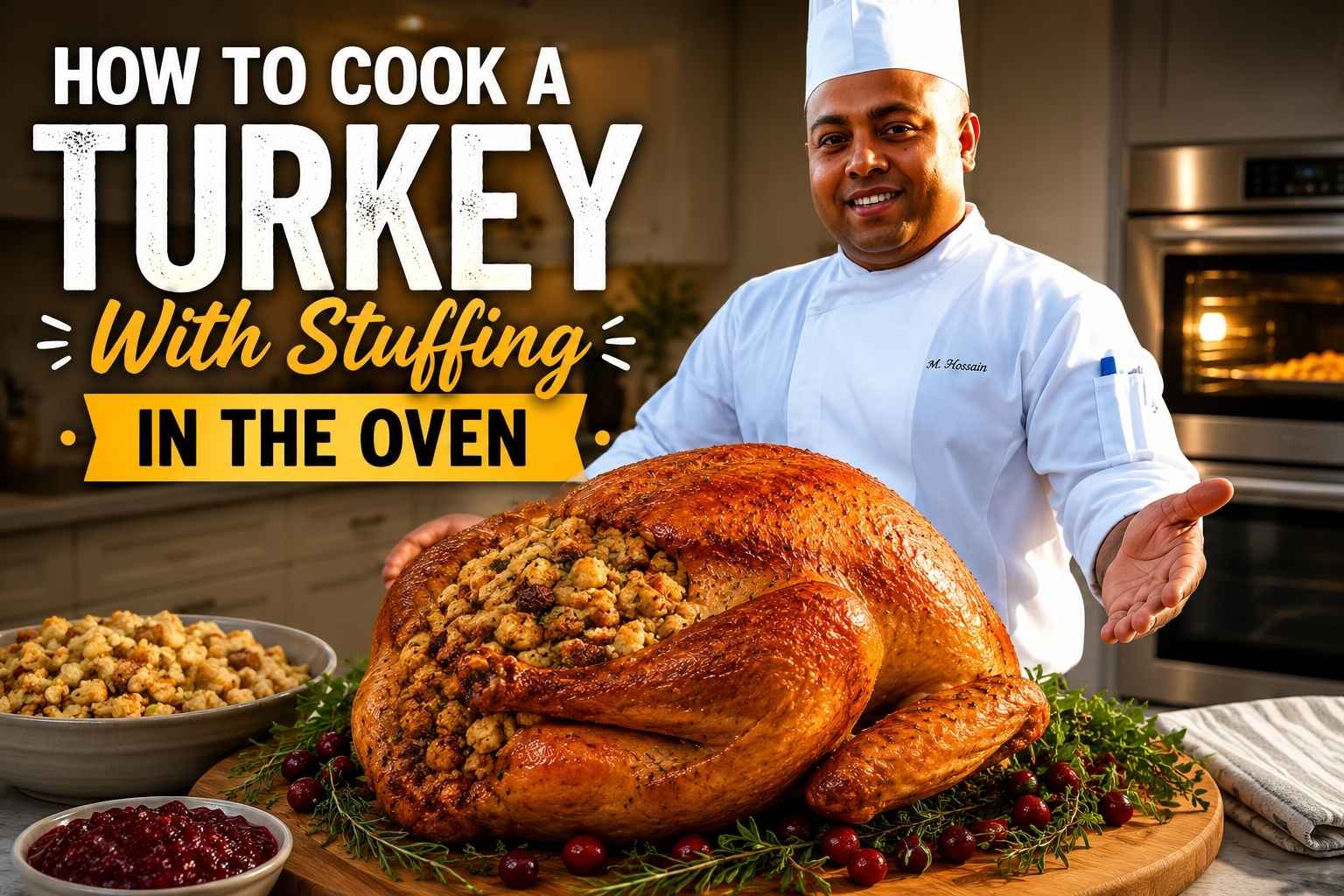
A stuffed turkey takes 15 to 17 minutes per pound versus 13 to 15 minutes per pound unstuffed, because the stuffing acts as an insulating mass that the oven’s heat has to penetrate before the bird’s interior can reach a safe temperature (USDA, 2024).
That extra time isn’t optional. It’s a food safety requirement, not a suggestion.
The Food Safety Risk With Stuffing
The stuffing itself must reach 165°F, just like the meat (USDA, 2024). The center of a packed stuffing cavity is one of the slowest spots in the entire bird to heat up, because it’s insulated on all sides by meat that’s also absorbing heat.
I’ve seen home cooks pull a turkey at the “right” time based on the breast temperature, only to find the stuffing sitting at 140°F. That’s squarely in the temperature danger zone where bacteria multiply fastest (USDA, 2024).
My Honest Take on Stuffing the Bird
I don’t stuff the bird at my own table anymore, and I haven’t for years. I cook the stuffing separately in a casserole dish. It gets crispier on top, it cooks faster, and I’m not gambling on whether the center of the cavity hit a safe temperature.
If you do stuff the turkey, pack it loosely. A tightly packed cavity slows heat transfer even further and pushes your cook time toward the high end of every range in this guide.
Oven Temperature: 325°F vs. 350°F vs. Higher Heat
325°F is the standard recommendation because it cooks the bird evenly without drying out the breast before the legs finish (USDA, 2024). 350°F shaves 15 to 30 minutes off the total time for most sizes, but it also browns the skin faster, sometimes before the interior catches up.
Why 325°F Is the Default
At 325°F, the temperature gradient between the outside and the center of the bird is gentle enough that the breast doesn’t overshoot while the thighs are still catching up. This is the temperature most cookbooks and the USDA settle on for a reason: it’s forgiving.
When 350°F Makes Sense
350°F works well for smaller birds, 8 to 14 pounds, where the shorter cook time means there’s less risk of the skin overcooking before the interior is done. It also helps if you’re short on time and need to shave 20 to 30 minutes off a 14-pound bird.
High-Heat and Reverse-Sear Methods
Some recipes call for blasting the oven at 425°F to 450°F for the first 30 to 45 minutes, then dropping to 325°F to finish (Serious Eats, 2024). This gives you crisp, deeply browned skin fast, then lets the interior catch up at a gentler pace.
I’ve used this method for smaller turkeys (under 14 pounds) and it works well, but it demands a reliable oven thermometer. If your oven runs hot to begin with, that initial high-heat blast can tip into burnt skin before you ever drop the temperature.
Convection Ovens: How They Change Per-Pound Timing
Convection ovens cook turkey roughly 25% faster than conventional ovens because the circulating fan moves hot air across the bird’s surface continuously, eliminating the layer of cooler air that normally insulates the skin (America’s Test Kitchen, 2023).
The Temperature and Time Adjustment
If a recipe calls for 325°F in a conventional oven, drop to 300°F to 310°F in convection mode, or keep the temperature the same and start checking for doneness 30 to 45 minutes earlier than the chart says.
A 14-pound turkey that would normally take 3.5 hours at 325°F conventional might be done in 2.75 to 3 hours in convection mode. That’s not a small difference. It’s enough to ruin a turkey if you walk away and trust the original number.
Skin Texture in Convection
Convection ovens produce noticeably crispier skin because the moving air dries the surface faster and more evenly than still air. If you like very crisp skin and your oven has a convection setting, this is the easiest way to get it without raising the oven temperature.
How to Use a Meat Thermometer Correctly
Insert the thermometer into the thickest part of the breast and the innermost part of the thigh, avoiding bone, and look for a reading of 165°F in both spots (USDA, 2024). Bone conducts heat differently than meat, so a probe touching bone gives a false high reading.
Breast Placement
For the breast, insert the probe horizontally from the side, aiming for the thickest part roughly in the center. Push it in until you feel it stop, then pull back slightly so the tip isn’t resting against the breastbone.
Thigh Placement
For the thigh, insert the probe from the side near where the leg meets the body, angling toward the bone but not touching it. The thigh is denser and typically finishes a few degrees behind the breast, so it’s worth checking both.
Target Temperatures
- Breast: 165°F minimum, measured in the thickest part (USDA, 2024)
- Thigh: 165°F minimum, measured at the innermost point near the bone (USDA, 2024)
- Stuffing (if cooked inside the bird): 165°F, measured at the center of the cavity (USDA, 2024)
I personally pull my turkey at 161°F to 162°F in the breast, because carryover cooking will push it past 165°F during the rest. More on that next.
Resting Time and Carryover Cooking
Rest the turkey for 20 to 30 minutes after pulling it from the oven, tented loosely with foil. During this time, the internal temperature will continue to rise by 5 to 10 degrees from residual heat, a process called carryover cooking (Butterball, 2023).
Why Pulling Early Matters
If you wait until the breast reads exactly 165°F before pulling the turkey, carryover cooking will likely push it to 170°F to 175°F by the time you carve it. That’s the difference between juicy and dry for white meat.
Pulling at 161°F to 163°F and letting carryover do the rest is, in my experience, the single biggest fix for dry turkey breast. It costs nothing and takes no extra time.
What’s Happening During the Rest
While the turkey rests, the muscle fibers relax and the juices that were pushed toward the center during cooking redistribute back through the meat. Carve too early, and most of that moisture ends up on the cutting board instead of in the meat.
When to Start Checking for Doneness
Start checking the internal temperature at roughly 75% of the estimated cook time from your weight chart, then check every 20 to 30 minutes after that. For a 14-pound turkey estimated at 3.75 hours, that means your first check happens around the 2.75 to 3-hour mark.
Checking early costs you nothing but a few seconds with a thermometer. Checking late, after the estimated time has already passed, means you’re working with no margin if the bird needs more time and your side dishes are timed around it being done.
Common Turkey-Roasting Mistakes (and How to Fix Them)
Most turkey problems trace back to a handful of repeated mistakes, and nearly all of them are fixable with small changes to your routine.
Mistake 1: Cooking by time alone. Fix: Use the per-pound chart only as a starting point, and pull the turkey based on internal temperature, not the clock.
Mistake 2: Not accounting for oven calibration or altitude. Most home ovens run 10 to 25 degrees off from their display, and at elevations above 3,000 feet, food takes longer to cook because water boils at a lower temperature and heat transfer slows down (Taylor Precision Products, 2023). Fix: Buy a $10 oven thermometer and place it on the rack next to the turkey. At high altitude, add 5 to 10% more time and don’t rely on the standard chart without checking temp early.
Mistake 3: Cooking a turkey straight from the freezer. A partially frozen turkey cooks unevenly, with the outside drying out while the inside stays in the danger zone too long. Fix: Thaw fully in the fridge, allowing 24 hours per 4 to 5 pounds of turkey (USDA, 2024).
Mistake 4: Tying the legs too tightly. Tightly trussed legs trap heat near the cavity and slow down even cooking in the thighs. Fix: Leave the legs loosely tied or untied entirely. The slight loss in presentation is worth the more even cook.
Mistake 5: Opening the oven door repeatedly. Every time you open the door, the oven loses 25 to 30 degrees and takes several minutes to recover. Fix: Rely on a leave-in probe thermometer so you don’t need to open the door to check progress.
Mistake 6: Carving immediately after pulling the turkey from the oven. Fix: Rest for 20 to 30 minutes minimum. Use that time to finish gravy and reheat side dishes.
My Personal Turkey-Roasting Routine
Here’s exactly what I do, every year, no exceptions.
The night before, I take the turkey out of its packaging, pat it dry inside and out, and let it sit uncovered on a tray in the fridge overnight. This dries the skin and helps it crisp up.
About an hour before cooking, I pull the turkey out and let it sit at room temperature. A cold bird straight into the oven cooks unevenly, with the outside racing ahead of the center.
I set the oven to 325°F and roast the turkey breast-side up on a rack, which lets air circulate underneath and keeps the bottom from steaming in its own juices.
I insert a leave-in probe into the thickest part of the breast before the bird goes in, and I don’t open the oven door for at least the first 2 hours. At the 75% mark on my time estimate, I start checking the thigh with an instant-read thermometer too.
When the breast probe hits 161°F to 162°F, the turkey comes out, gets tented loosely with foil, and rests for 25 to 30 minutes while I finish the gravy. By the time I carve it, the breast is sitting right around 165°F to 168°F, and the meat is still juicy.
That’s it. No basting (it does almost nothing for moisture and just lets heat escape every time you open the door), no flipping, no fuss. Just a thermometer, a rack, and patience.
Frequently Asked Questions
How long does it take to cook a turkey per pound?
At 325°F, plan on 13 to 15 minutes per pound for an unstuffed turkey and 15 to 17 minutes per pound for a stuffed one (USDA, 2024). Use this as a starting estimate and confirm doneness with a meat thermometer.
How do I know when my turkey is done without a thermometer?
You can’t reliably know without one. Visual cues like clear juices or loose leg joints are not accurate enough to confirm food safety. A thermometer reading of 165°F in the breast and thigh is the only reliable check (USDA, 2024).
Is it better to cook a turkey at 325°F or 350°F?
325°F is better for most whole turkeys because it cooks the bird more evenly, giving the legs and breast time to finish closer together. 350°F works fine for smaller birds under 14 pounds where the shorter total time reduces the risk of uneven cooking.
Should I cover my turkey with foil while it cooks?
A loose foil tent over the breast for the first half of cooking helps prevent the breast from overcooking before the legs catch up, especially on larger birds. Remove the foil for the final hour or so to let the skin brown.
Why is my turkey always dry?
The most common cause is pulling the turkey too late and skipping the rest. Pull the breast at 161°F to 163°F, rest for 20 to 30 minutes, and carryover cooking will bring it to a safe, juicy finish around 165°F to 168°F.
Does a stuffed turkey really take that much longer to cook?
Yes. A stuffed turkey takes 15 to 17 minutes per pound versus 13 to 15 minutes unstuffed, because the stuffing insulates the cavity and slows heat penetration to the center (USDA, 2024). The stuffing itself must also reach 165°F.
How long should a turkey rest before carving?
Rest for 20 to 30 minutes, tented loosely with foil. During this time, carryover cooking raises the internal temperature another 5 to 10 degrees, and the juices redistribute through the meat (Butterball, 2023).
Do convection ovens cook turkey faster?
Yes, convection ovens cook turkey about 25% faster than conventional ovens because the moving air removes the insulating layer of still air around the bird (America’s Test Kitchen, 2023). Start checking for doneness 30 to 45 minutes earlier than a conventional-oven chart suggests.
Key Takeaways
- Per-pound timing (13-15 minutes unstuffed, 15-17 minutes stuffed, at 325°F) is a planning tool, not a finish line (USDA, 2024).
- The only number that matters at the end is internal temperature: 165°F in the breast, thigh, and any stuffing (USDA, 2024).
- Pull the turkey at 161°F to 163°F in the breast and let carryover cooking finish the job during a 20 to 30 minute rest.
- Convection ovens cook about 25% faster. Adjust your checking schedule, not just the temperature (America’s Test Kitchen, 2023).
- Stuffing the bird adds time and food safety risk. Cooking stuffing separately is faster and safer.
- Oven calibration and altitude both throw off cook times in ways a per-pound chart can’t account for (Taylor Precision Products, 2023).

I’m Mossaraof, a trained chef and the founder of OvenInsights.com. I spent years cooking at Larrupin’ Cafe and in kitchens across Chicago and Seattle. Now I test kitchen gear for a living. I moved to North Acton, London, and I test every tool I write about. I use real meals and real heat. No brand deals. No shortcuts. I cover 12 kitchen types and hundreds of recipes. I believe this: the right tools matter as much as the recipe.