At A Glance
- Most home cooks avoid the oven because they think it takes too long – the fix is batch-cooking two or three dishes in a single session, not cooking one thing at a time.
- Sheet pan meals are the fastest way to build the habit: one pan, one cleanup, and dinner is ready in under 45 minutes.
- A weekly oven schedule built around your actual life (not an ideal one) is what separates people who use their oven from people who use their air fryer for everything.
- Stacking dishes at different temperatures in a single oven session can cut your weekly active cooking time by 30-40% (America’s Test Kitchen, 2023).
- Mise en place the night before – portioned proteins, cut vegetables, measured spices – is the single habit that makes everything else work.
I used to order takeout four nights a week until my oven felt like a stranger in my own kitchen. Then I found a simple trick, and everything changed fast. As a chef, I’ve tested dozens of routines with home cooks just like you. Today, I’ll show you how to make oven cooking a weekly habit that sticks. Grab your favorite pan, and let’s get your oven working for you.
Why Most Home Cooks Avoid the Oven (And What Actually Changes When You Stop)
The oven gets avoided for one reason above all others: it feels like a commitment. You have to preheat it. You have to wait around. And if you’re making just one thing for one meal, the math doesn’t feel worth it.
I spent my first seven years cooking in professional kitchens where the oven ran twelve hours a day. Nothing went in there for a single meal. We’d load it with six sheet pans of vegetables at 425°F, pull one tray for service, rotate another, and have the third ready for family meal. The oven was a production tool, not a one-shot appliance.
That thinking changed everything for me when I moved to cooking at home. The mistake most home cooks make is treating the oven like a microwave: one item in, one item out. The moment you start treating it like a station – something you load strategically – the habit clicks.
What changes when you commit to weekly oven cooking isn’t the food. It’s your relationship to prep. You start thinking ahead by 24 hours instead of 30 minutes. You stop opening the fridge at 6 PM wondering what to cook and start opening it knowing exactly what’s already prepped and ready to go in.
According to a 2022 home cooking survey by the Food Marketing Institute, 67% of Americans say they want to cook more at home but cite “lack of time” as the main barrier. The oven doesn’t create that time problem. Poor planning does.
How to Batch-Cook Using One Oven Session
Batch cooking is cooking multiple portions – or multiple dishes – in a single session so you eat from that work for two to four days.
Here’s how I run a Sunday batch session in my own kitchen. I’m in the oven for about 90 minutes total, and I come out with proteins, roasted vegetables, and a grain. That covers four weeknight dinners with minimal reheating.
The framework is simple:
- Pick one protein that holds well cold or reheated (bone-in chicken thighs, pork shoulder, salmon portions, or a whole roasted cauliflower for plant-based weeks).
- Pick two vegetables that roast at the same temperature (root vegetables and brassicas both work at 400-425°F).
- Pick one grain that can go in a covered dish in the oven at the same time (farro, brown rice, and freekeh all work at 375°F with a 1:2 grain-to-water ratio, 45-50 minutes covered).
The grain goes in first because it takes longest. The vegetables go in on the middle rack 20 minutes later. The protein goes on the top rack for the last 25-30 minutes. You pull everything roughly together, and you’re done.
Per Serious Eats’ guide to grain cookery (Kenji López-Alt, 2021), oven-baked grains produce a more even result than stovetop because the heat is consistent from all sides, not just the bottom.
Building a Weekly Oven Schedule Around Your Real Life
A weekly oven schedule only works if it fits around the life you actually have – not the one where you have two hours free every evening.
Here’s a reference table I use with home cook clients:
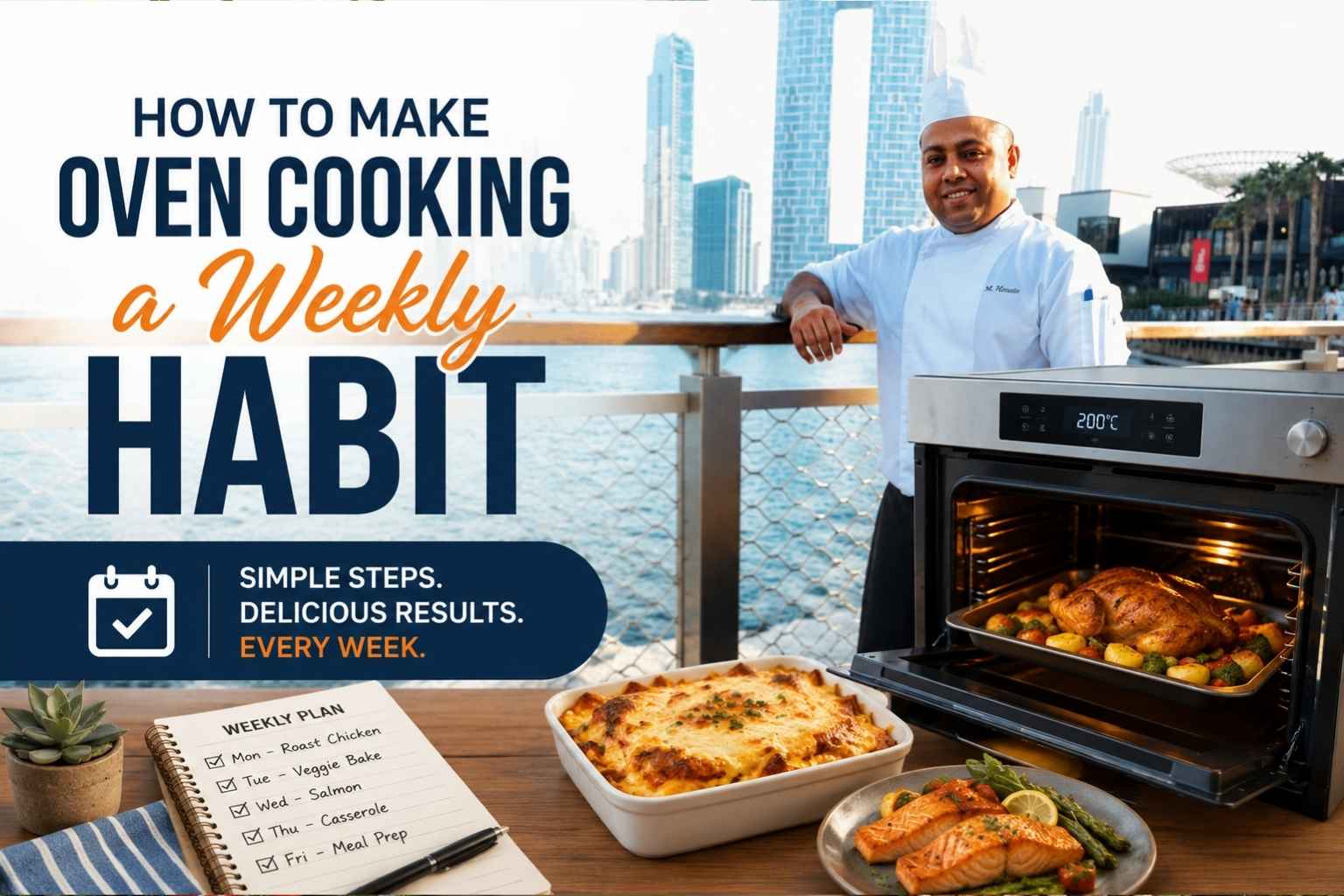
| Day | Dish Type | Oven Temp | Prep Time | Cook Time |
|---|---|---|---|---|
| Sunday | Batch session: protein + 2 veg + grain | 375-425°F | 30 min | 90 min |
| Monday | Sheet pan meal (use Sunday veg) | 425°F | 10 min | 25 min |
| Tuesday | Leftover remix (grain bowl, wrap, soup) | No oven | 10 min | 0 min |
| Wednesday | Baked pasta or frittata | 375°F | 15 min | 30 min |
| Thursday | Sheet pan meal (fresh protein + veg) | 425°F | 15 min | 30 min |
| Friday | Slow roast or hands-off braise | 325°F | 15 min | 2-3 hr |
| Saturday | Baking or freestyle (pizza, flatbread) | 475-500°F | 20 min | 15-20 min |
Sunday is your engine. Everything else runs off that fuel. If Sunday doesn’t happen, Wednesday and Thursday get harder – but they’re still doable with a 15-minute sheet pan meal.
The real mistake is trying to make every night a full oven session. That’s not cooking; that’s punishing yourself. Two proper oven sessions per week plus one slow hands-off cook on Friday is how most people I’ve worked with actually sustain this.
Sheet Pan Meals: The Gateway Habit
Sheet pan meals are where most people should start. They are low-risk, fast to clean up, and teach you the most important oven skill you’ll ever use: reading visual doneness cues.
A sheet pan meal is one pan with a protein and at least one vegetable, all cut to sizes that finish cooking at roughly the same time. That’s it. There’s no sauce to watch, no pot to stir, no risk of burning the bottom.
The rules that make sheet pan meals work every time:
- Cut proteins and vegetables to even sizes. Uneven cuts mean uneven cooking. A 1-inch cube of sweet potato and a 1-inch cube of zucchini will not finish together – the potato takes twice as long. So you either cut the potato smaller, or you start it alone for 10 minutes before adding zucchini.
- Dry your protein before it goes on the pan. Moisture is the enemy of browning. Pat chicken thighs dry with paper towels, season them, and let them sit uncovered in the fridge for at least 20 minutes if you can. The Maillard reaction – the browning that creates flavor – needs surface moisture gone (America’s Test Kitchen, 2022).
- Don’t crowd the pan. A crowded pan steams instead of roasts. Use two pans if you need to. Spacing ingredients at least half an inch apart keeps air circulating and gets you a proper caramelized edge on vegetables.
Start with this once a week for a month. Just once. Pick Thursday or Monday – whichever is your least chaotic evening. After four weeks, you’ll reach for the sheet pan without thinking.
How to Stack and Layer Dishes in One Oven Session
Stacking multiple dishes in one oven session is the skill that collapses your weekly cooking time. Done right, you can run two or three dishes simultaneously with one preheat.
The practical rules:
Temperature windows are wider than you think. Most roasted vegetables, proteins, and grains work somewhere in the 325-425°F range. A 25-degree difference between what one recipe says and another says almost never ruins either dish. Roasting chicken thighs at 400°F instead of 425°F adds about 8 minutes. That’s a reasonable trade-off when it means your grain is done at the same time.
Use rack position deliberately. The top third of your oven is hotter and better for browning. The bottom third is better for even, slower cooking. I put proteins on the top rack when I want crispy skin. I put covered dishes (grains, braises, casseroles) on the lower rack where the temperature is more stable.
Covered dishes are your buffer. A covered Dutch oven of braised lentils or a covered baking dish of farro doesn’t care if you open the oven door three times to check other things. The lid traps moisture and heat. Use covered dishes for the items that need the longest time, and give the last 10-15 minutes of oven time to uncovered items that need browning.
According to testing by Cook’s Illustrated (2023), stacking two sheet pans of vegetables in a standard 30-inch oven extends total roast time by 10-15% but produces equivalent results when pans are rotated once at the halfway point.
Oven-Friendly Proteins, Vegetables, and Grains Worth Rotating Weekly
The weekly oven habit is easier when you work from a short list of reliable options instead of reinventing every week. Here are my personal rotation picks after 15 years in professional and home kitchens.
Proteins That Hold Well After Oven Cooking
Bone-in chicken thighs are the most forgiving protein for weekly batch cooking. They reheat without drying out, they work in a dozen cuisines, and they cost less per portion than boneless breasts. I cook a batch of six every Sunday.
Salmon portions work well for a midweek cook – 12-15 minutes at 400°F, and they’re done. They don’t reheat as well as chicken, so cook them the day you eat them.
A whole roasted leg of lamb or pork shoulder at 325°F on Friday gives you 2.5-3 hours of completely hands-off cooking. The USDA recommends an internal temperature of 145°F for pork and 145°F for lamb roasts, with a 3-minute rest (USDA Food Safety and Inspection Service, 2023). Pull it at temperature, rest it, and that roast covers three meals.
Vegetables That Roast Reliably
Root vegetables (carrots, parsnips, beets, sweet potatoes) hold well in the fridge for four days after roasting. Roast them at 400°F, tossed in oil and salt, for 30-35 minutes.
Brassicas (broccoli, cauliflower, Brussels sprouts) get better at higher heat – 425°F for 20-25 minutes gives you charred edges that make even resistant vegetable-eaters reach for seconds. Per King Arthur Baking’s roasting guide (2022), brassicas caramelize fastest when spread at least an inch apart on a preheated sheet pan.
Zucchini, tomatoes, and peppers roast fast and go soft, so use them same-day instead of storing.
Grains for Oven Baking
Farro is my first choice: nutty, holds texture after refrigeration, and goes with almost anything. Bake at 375°F in a 2:1 liquid-to-grain ratio, covered, for 45 minutes.
Brown rice works the same way. White rice is too fast for oven cooking to make sense.
Freekeh – cracked green wheat – is worth finding at a Middle Eastern grocery. It bakes in 40 minutes, has more protein than rice, and stays chewy even on day four (Whole Grains Council, 2022).
Mise en Place for Oven Cooking: What to Prep the Night Before
Mise en place (French for “everything in its place”) is a restaurant concept that translates directly to home oven cooking. It means you do all your prep before you start cooking, not during.
For oven cooking, the most productive 20 minutes you can spend is the night before a cook session.
What to do the night before:
- Portion your proteins and season them. Salt draws moisture to the surface and then reabsorbs into the meat, which seasons it from inside. Per America’s Test Kitchen’s salt-brining guide (2021), salting chicken thighs 8-24 hours ahead produces noticeably juicier results than salting right before cooking.
- Cut your vegetables and store them in containers or zip bags. Cut brassicas keep well overnight. Root vegetables do too. Cut zucchini weeps a little, so do those same-day.
- Measure your grain and the liquid it’ll cook in. Put them in separate containers so the morning or evening of, you pour and go.
- Pre-mix any dry spice rubs or sauces. These take 2 minutes now and save 5 minutes when you’re tired after work.
This is the single habit that makes everything else in this guide actually work. Twenty minutes the night before replaces 45 minutes of scattered, stressed cooking the next day.
How Seasonal Ingredients Shift Your Oven Routine
Your oven routine should look different in February than it does in July – not because of rules, but because seasonal produce is cheaper, better, and more available.
In winter, I’m running the oven four or five times a week. Root vegetables are at peak quality, brassicas are sweet from cold weather, and slow braises and roasts feel right for cold nights. This is when I do my most ambitious oven cooking: whole roasts, overnight braises at 250°F, thick gratins.
In summer, I drop to two or three oven sessions per week. I use the oven early in the morning before the kitchen heats up, or late evening. I roast summer squash, cherry tomatoes (which become sweet and concentrated at 400°F), and corn cut off the cob with butter.
Spring is for asparagus, peas, and new potatoes – all fast-roasting vegetables that need 15-20 minutes at 425°F, not the long sessions of winter roots.
Autumn is my favorite oven season. Winter squash, fennel, apples, and pears all go in the oven together in ways that feel accidental and taste deliberate. A sheet pan of cubed butternut squash, sliced fennel, and red onion at 400°F with olive oil and thyme is a side dish I’ve made 200 times in October.
Seasonal shopping also cuts your grocery bill. The USDA Economic Research Service (2024) found that in-season produce costs 20-35% less than out-of-season equivalents at standard grocery stores.
Common Reasons People Fall Off the Habit (and the Fixes)
Most people who try to build a weekly oven routine quit within the first month. Here’s what I’ve seen go wrong, and what actually fixes it.
The oven seems too slow for weeknights. The fix is preheating before you do anything else. The moment you walk in the door, turn the oven to 425°F. By the time you’ve changed clothes and pulled ingredients from the fridge, it’s ready. This saves 10-15 minutes of perceived waiting time.
Sunday batch cooking gets skipped and the whole week falls apart. The fix is a scaled-down version: if Sunday doesn’t happen, do a 30-minute batch on Monday evening instead of a full 90-minute session. Roast one protein and one vegetable. That’s enough to anchor Tuesday and Wednesday.
Recipes are too complicated. I’ve watched home cooks choose sheet pan recipes with twelve ingredients and three steps involving timing precision they don’t have. The fix: stick to recipes with five or fewer main ingredients for at least the first month. Salt, oil, one spice blend, protein, vegetable. That’s a complete sheet pan meal.
Cleanup feels like too much work. Line your sheet pans with parchment paper or foil. Every time. I know some recipes say not to – ignore that for now. Lined pans mean cleanup takes 30 seconds, and that removes the biggest psychological barrier to using the oven regularly.
The food gets boring after three weeks. This happens when you use the same five spice combinations on repeat. The fix is one new spice blend per month. Buy one new spice in January (smoked paprika), one in February (za’atar), one in March (gochugaru). Your oven output changes completely with the same proteins and vegetables just by changing the seasoning.
My Personal Weekly Oven Routine (Specific, Opinionated, and Actionable)
I’ll tell you exactly what I do, and you can take what fits.
Saturday evening: I look at what’s in the fridge and decide on Sunday’s batch. I season whatever protein I’m using – usually six bone-in chicken thighs or a 2-pound pork shoulder – and leave it uncovered in the fridge overnight. I also pick my grain and decide which two vegetables I’m roasting.
Sunday at 3 PM: I preheat to 400°F. The grain goes in covered at 3:15. Vegetables go in at 3:35. Protein goes on the top rack at 3:50. Everything comes out between 4:15 and 4:30. I let it all cool on the counter, then portion into containers. That’s dinner Sunday night and the base for Monday and Tuesday.
Monday: Sheet pan meal. Fresh protein or reuse Sunday’s chicken. 15 minutes of prep, 25 minutes in the oven.
Tuesday: I use Sunday’s grain and vegetables to build something – a bowl, a wrap, a quick soup. No oven.
Wednesday: Baked frittata or a pasta bake. I make frittatas when I have leftover vegetables and eggs to use. A frittata at 375°F for 20-22 minutes is one of the most useful things an oven does.
Thursday: Another sheet pan meal, but I use different seasoning than Monday. Same structure, different feel.
Friday: I put something on at 2 PM or 3 PM if I’m working from home – a braise, a slow-roasted shoulder, a pot of beans in the oven with aromatics. Low heat, long time, zero attention. By dinner, the kitchen smells like I spent all day cooking.
Saturday: I bake something. Pizza on a preheated cast iron, a loaf of bread, or focaccia. This is the day I cook for pleasure, not efficiency.
That’s it. It took me about six weeks to lock that rhythm in when I first moved to cooking primarily at home. It’s not a rigid schedule – I shift it when life shifts. But the Sunday batch and the two sheet pan nights are the non-negotiables.
Frequently Asked Questions About Weekly Oven Cooking
What is the best oven temperature for batch cooking multiple dishes at once?
400°F is the most flexible temperature for batch cooking. It works for most proteins (bone-in chicken pieces, salmon, pork tenderloin), root vegetables, and brassicas. You can push to 425°F for crispier results or drop to 375°F for covered grain dishes. When stacking dishes at different suggested temperatures, splitting the difference at 400°F and adjusting cook time slightly works for the vast majority of combinations.
How far ahead can I prep vegetables for oven cooking?
Most hard vegetables (carrots, sweet potatoes, beets, parsnips, cauliflower, broccoli) can be cut and stored refrigerated for up to 48 hours before roasting with no quality loss. Softer vegetables like zucchini, eggplant, and tomatoes are best cut same-day, as they weep and lose texture overnight. Store cut vegetables in airtight containers or zip bags with the air pressed out.
How do I stop roasted vegetables from getting soggy?
Soggy vegetables come from two causes: too much moisture on the surface before roasting, and overcrowding the pan. Dry your vegetables after washing – use a clean kitchen towel or paper towels and press firmly. Space them at least half an inch apart on the pan. Use a preheated pan when possible – a hot pan gives an immediate sear to the bottom surface before moisture releases (Serious Eats, 2022).
Can I reheat oven-cooked food without drying it out?
For most proteins, reheat covered in the oven at 300°F with a tablespoon of water or broth in the dish. This creates steam and prevents drying. The microwave works for grains and vegetables. Chicken thighs specifically reheat well in a covered skillet over medium-low heat with a splash of water – about 5 minutes. Never reheat salmon in the oven; eat it cold or at room temperature.
What should a complete beginner cook first to build the oven habit?
Start with bone-in chicken thighs on a sheet pan with whatever vegetables you already have in your fridge. Season with salt, pepper, olive oil, and garlic powder. Roast at 425°F – chicken thighs for 35-40 minutes on the top rack, vegetables on the bottom rack for 25-30 minutes. This is forgiving, affordable, and gives you immediate results worth repeating.
Is it safe to cook multiple proteins in the same oven session?
Yes, with one rule: proteins must reach their respective safe internal temperatures regardless of what else is in the oven. Use a probe thermometer. The USDA recommends 165°F for poultry, 145°F for whole cuts of pork, beef, and lamb, and 145°F for fish (USDA Food Safety and Inspection Service, 2023). Never use the same cutting board or utensils for raw poultry and other proteins without washing between uses.
How do I know when to use convection versus regular oven settings?
Use convection (fan-assisted) for roasting vegetables, sheet pan meals, and anything where you want browning and crispness. The circulating air removes surface moisture faster and browns food 20-25% quicker. Use regular bake (no fan) for baked goods like cakes, custards, and breads where even, calm heat produces better texture. If your oven has a convection roast setting, use it for all savory batch cooking (King Arthur Baking, 2023).
How long does it take to actually build the weekly oven habit?
Behavior research from University College London (2010) found that new habits take an average of 66 days to become automatic – not the widely-cited 21 days. For oven cooking specifically, I’ve watched home cooks go from uncertain to automatic in six to eight weeks when they commit to one fixed weekly session (Sunday or Monday) before adding more days. Start with one session per week, hold it for six weeks, then add a second.
Key Takeaways
- Treat the oven as a production station, not a single-meal appliance. Load it with two or three things every session.
- The Sunday batch session – one protein, two vegetables, one grain – is the engine of the whole week. Two to three dinners run off that 90-minute investment.
- Sheet pan meals are the right starting point for beginners: low stakes, fast cleanup, and they teach visual doneness cues faster than any recipe instruction will.
- Mise en place the night before (seasoned proteins, cut vegetables, measured grains) cuts your active cooking time almost in half the next day.
- 400°F is your everyday batch-cooking temperature. It works across most proteins, most vegetables, and most covered grain dishes.
- Seasonal produce shifts your oven routine naturally and cuts grocery spend by 20-35% compared to out-of-season buying (USDA Economic Research Service, 2024).
- Lined sheet pans, a probe thermometer, and a reliable spice rotation are the three tools that make this habit stick. Everything else is optional.

I’m Mossaraof, a trained chef and the founder of OvenInsights.com. I spent years cooking at Larrupin’ Cafe and in kitchens across Chicago and Seattle. Now I test kitchen gear for a living. I moved to North Acton, London, and I test every tool I write about. I use real meals and real heat. No brand deals. No shortcuts. I cover 12 kitchen types and hundreds of recipes. I believe this: the right tools matter as much as the recipe.