
At A Glance
- Focaccia is a high-hydration flatbread (75–80% water) from Liguria, Italy. It is the most forgiving bread a home baker can make because the dough is too wet to knead and too oily to stick.
- Bake at 425–450°F (218–232°C) on a rimmed sheet pan or cast iron pan coated with at least 3 tablespoons of olive oil.
- The cold overnight rise in the fridge is the single biggest upgrade you can make — it builds flavor and makes the dough easier to work.
- Focaccia is done when the crust is deep golden brown, the bottom sounds hollow when tapped, and the internal temperature reads 190–200°F (88–93°C).
- Finish with flaky sea salt and fresh rosemary the moment it comes out of the pan — not before it goes in.
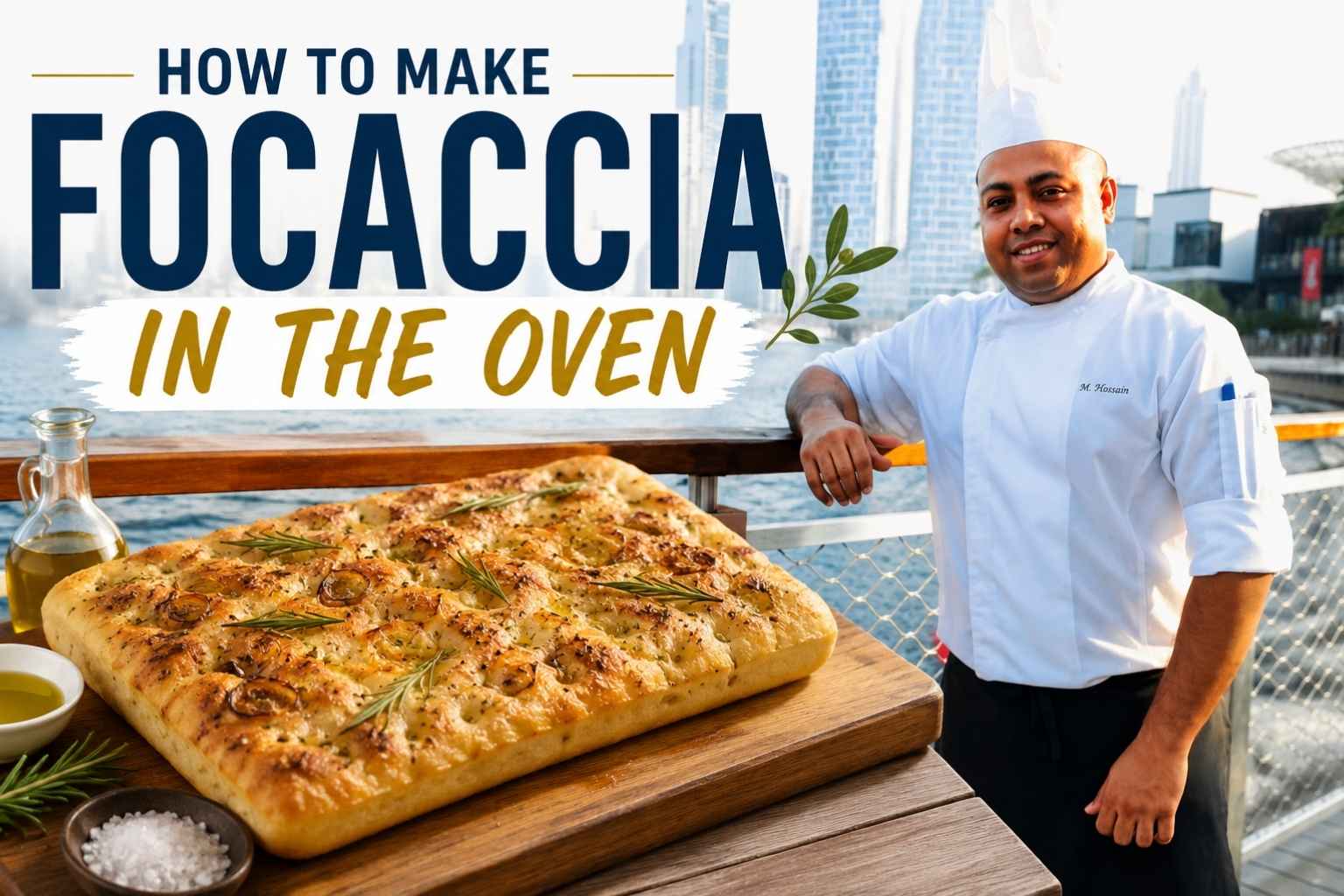
The first time I tried to make focaccia in the oven, I burned the edges and ended up with a sad, flat slab. But I kept at it, and now it’s my favorite thing to bake. This bread is forgiving, fun, and so rewarding once you get it right. I’ve tested dozens of batches in my own kitchen, and I’m here to share what truly works.
Focaccia has been a staple in Italian homes for centuries, and for good reason. It’s soft inside, crispy outside, and full of rich olive oil flavor. You don’t need fancy tools or skills to pull it off. All you need is a hot oven and a little patience.
In this guide, I’ll walk you through how to make focaccia in the oven step by step. You’ll learn the right dough hydration, the best pan to use, and my top tips for that golden crust. Whether you’re a first-timer or trying to improve, this guide has you covered. Let’s get that oven preheated and start baking!
What Is Focaccia and Why It Is the Best Bread for Home Bakers
Focaccia is a flatbread baked in an oiled pan. The dough is wetter than any bread you have probably made before, and that high water content — combined with generous amounts of olive oil — is exactly what makes it work. There is no shaping. There is no scoring. You do not need a Dutch oven, a pizza stone, or a bread lame. You need a bowl, a pan, and time.
The bread comes from Liguria, the narrow coastal region of northwestern Italy where Genoa sits. Ligurian focaccia — called focaccia genovese — is thin, crisp-bottomed, airy inside, and eaten at every meal. Bakeries in Genoa open before 7 a.m. and sell it by the slab, warm and glistening with oil.
I have made focaccia in professional bakeries with deck ovens and in apartment kitchens with ovens that run 50 degrees hot. The bread is honest and generous in both places. That is what I love about it. It does not punish you for imprecision the way a baguette does.
Quick-Reference: Focaccia Baking Variables at a Glance
| Variable | Standard Range | My Preference |
|---|---|---|
| Dough hydration | 75–80% | 78% |
| First rise (room temp) | 1–2 hours | 1.5 hours |
| Cold proof (fridge) | 8–18 hours | 12–14 hours |
| Second rise (in pan) | 45–90 minutes | 60 minutes |
| Oven temperature | 425–450°F (218–232°C) | 450°F (232°C) |
| Bake time (sheet pan) | 20–25 minutes | 22 minutes |
| Bake time (cast iron) | 18–22 minutes | 19 minutes |
| Pan type (best options) | Sheet pan, cast iron, quarter sheet | Cast iron 10-inch or half sheet |
| Olive oil in pan | 3–4 tablespoons | 4 tablespoons |
| Internal temperature | 190–200°F (88–93°C) | 195°F (91°C) |
The Science of Focaccia: Why High Hydration and Olive Oil Change Everything
Focaccia dough works because of three things happening at once: gluten structure from high hydration, steam from water, and fat from olive oil.
High hydration — typically 75 to 80 percent water relative to flour — creates a dough that is more batter than dough. That loose structure allows carbon dioxide from the yeast to form large, open bubbles. The result is a crumb that is airy and irregular, not dense or tight. (King Arthur Baking, 2024)
Olive oil does two things. Inside the dough, fat coats gluten strands and makes them more extensible, which is why focaccia stretches instead of snapping when you press it into the pan. On the outside of the dough — where it meets the hot oiled pan — the fat conducts heat fast and creates a fried crust on the bottom. This bottom crust is the defining feature of good focaccia. It should be golden, slightly crisp, and audible when you tap it.
Oven temperature controls the race between crumb setting and crust browning. Too low (below 400°F) and the crust goes pale while the inside dries out. Too high (above 475°F) and the crust burns before the center cooks. The sweet spot is 425 to 450°F. I use 450°F because I want that deep, burnished crust — the color people describe as “caramel” but is really closer to mahogany.
The steam that comes from the dough’s high water content also matters. In the first 10 minutes of baking, steam keeps the surface soft enough to expand. After that, the surface dries and browns. This is the same principle behind hearth breads — steam early, dry heat late. (The Perfect Loaf, 2024)
Focaccia Ingredients: What Each One Does and Why Quality Matters
You need six ingredients. Each one has a job.
Flour: Bread Flour vs. All-Purpose Flour
Use bread flour if you have it. Bread flour has more protein (12–14%) than all-purpose (10–12%), which means more gluten, which means better structure. The crumb holds its bubbles instead of collapsing.
All-purpose flour works fine. The crumb will be slightly softer and less chewy. I have made excellent focaccia with all-purpose many times. Do not let the flour stop you from baking.
Do not use cake flour or self-rising flour.
Yeast: Instant vs. Active Dry
Instant yeast (also called rapid-rise or bread machine yeast) is what I use. You add it straight to the dry ingredients — no proofing in water required. It acts faster and is more reliable.
Active dry yeast works too. Dissolve it in warm water (100–110°F / 38–43°C) for 5 minutes before adding to the flour. If it does not bubble after 10 minutes, the yeast is dead — start over. (America’s Test Kitchen, 2023)
Both yeasts produce identical results in the final bread. The difference is convenience.
Salt: When to Add It and How Much
Salt strengthens gluten and controls fermentation speed. Too much slows the yeast. Too little gives you flat, lifeless bread.
Standard ratio: 2% of flour weight. For 500g flour, that is 10g of salt — about 1.75 teaspoons of fine sea salt, or 2.25 teaspoons of Diamond Crystal kosher salt.
Add salt to the flour before the water goes in. Do not pour salt directly onto dry yeast — direct contact deactivates it.
Olive Oil: This Is Not the Time for Budget Oil
Focaccia has olive oil in the dough, in the pan, and on top. You will taste it. Use an oil you would put on salad — something with flavor. I use a mid-range Ligurian or Tuscan extra-virgin olive oil. The peppery, grassy notes matter here. (Serious Eats, 2023)
Budget oils are fine for sautéing. For focaccia, spend a little more.
Water Temperature: The One Variable Most Bakers Ignore
Use warm water — 90 to 100°F (32 to 38°C). Cold water slows yeast activity and extends your rise time unpredictably. Water above 110°F kills yeast.
I use tap water that runs warm, then check it with an instant-read thermometer. No thermometer? The water should feel comfortably warm on your wrist, not hot.
How to Make Focaccia: The Full Step-by-Step Method
Step 1: Mix the Dough
In a large bowl, whisk together 500g bread flour, 10g fine sea salt, and 4g instant yeast. Add 390g warm water (78% hydration) and 2 tablespoons of extra-virgin olive oil. Mix with a wooden spoon or your hand until no dry flour remains. The dough will look shaggy and rough. That is correct.
Cover the bowl and let it rest for 15 minutes. The flour absorbs the water during this rest — a process called autolyse (or in this context, simply a rest period) — and the dough becomes easier to work with.
Step 2: Stretch and Fold
Instead of kneading, you will do three rounds of stretch and fold over 90 minutes. With wet hands, grab one edge of the dough, stretch it up, and fold it over the center. Rotate the bowl 90 degrees and repeat. Do this four times per round.
Wait 30 minutes between each round. After three rounds, the dough will feel noticeably smoother and more elastic.
This technique — used widely in modern bread baking — builds gluten structure without the mess of kneading a wet dough. (Samin Nosrat, Salt Fat Acid Heat, 2017)
Step 3: The Cold Rise (The Step Most People Skip)
After the third fold, cover the bowl tightly with plastic wrap or a lid and refrigerate it for 8 to 18 hours.
The cold slows fermentation to a near-stop, which forces the yeast to develop flavor compounds — the same acids and alcohols responsible for that complex, slightly tangy taste in good bread. It also firms the dough, making it easier to handle in the pan.
I make dough the night before and bake the next morning. This is the single best habit change a focaccia baker can make. The difference in flavor is not subtle — it is the difference between bread that tastes good and bread people ask you for the recipe.
Step 4: Prepare the Pan and Transfer the Dough
Pour 3 to 4 tablespoons of olive oil into your pan. Use your hand to spread it into every corner and up the sides.
Remove the dough from the fridge and use a bowl scraper to ease it out onto the oiled pan. Do not punch it down. Do not deflate it. Fold it once in thirds (like a letter), then flip it so the seam side is down. Cover loosely and let it rest for 30 minutes at room temperature.
After 30 minutes, gently stretch the dough toward the corners of the pan. It will resist. That is fine. Let it rest 10 more minutes, then stretch again. Do not fight it. It will fill the pan.
Step 5: The Second Rise — 45 to 60 Minutes
Cover the pan loosely and let the dough rise at room temperature until it is puffed, jiggly, and about 1 inch thick. This takes 45 to 60 minutes, depending on your kitchen temperature.
A warm kitchen (75°F+) cuts the time to 40 minutes. A cool kitchen (65°F) may take 75 minutes. Watch the dough, not the clock.
Step 6: Dimple and Top
Set your oven to 450°F (232°C) and place a rack in the lower third. Let the oven preheat for at least 20 minutes. A fully preheated oven matters.
Drizzle 2 more tablespoons of olive oil over the surface of the dough. Oil your fingers and press straight down into the dough to create deep dimples — every inch or so, across the whole surface. Press all the way down to the pan. The oil will pool in the dimples. This is exactly what you want.
Scatter 1 teaspoon of flaky sea salt and fresh rosemary leaves over the top. Do not add garlic or cheese yet if you are using them — they will burn. Add those toppings in the final 5 minutes of baking.
Step 7: Bake
Slide the pan onto the lower rack and bake for 20 to 25 minutes. Do not open the oven in the first 15 minutes.
At the 20-minute mark, check the color. You want deep golden brown on top and, if you can see it, dark golden on the bottom. If the top looks pale, move the pan to the upper rack for 3 to 4 minutes.
Oven Setup: Rack Position, Pan Type, and Convection
Rack Position
Lower third of the oven. This puts the bottom of the pan closer to the heating element, which drives the bottom crust. If your oven runs hot on top, stay in the middle.
Pan Type — Sheet Pan vs. Cast Iron vs. Quarter Sheet
Each pan produces a different focaccia:
- Half sheet pan (18×13 inches): The standard choice. Produces a thinner, crispier focaccia. Oil spreads easily, bottom crust is excellent, easy to cut and serve.
- Cast iron skillet (10 or 12 inches): Produces a thicker focaccia with an exceptionally crisp, almost fried bottom crust. This is my personal preference. The heat retention of cast iron gives the bottom crust texture you cannot replicate on a sheet pan.
- Quarter sheet pan (13×9 inches): Good for smaller batches. Produces a thicker focaccia than the half sheet. The edges get particularly good — browned and a little crunchy.
Avoid nonstick pans with light-colored surfaces. Dark pans — anodized aluminum or cast iron — absorb heat faster and produce better bottom crusts.
Convection vs. Standard Bake
Convection fans circulate hot air and brown food faster. If your oven has a convection setting, use it and drop the temperature by 25°F (to 425°F). Convection gives you a slightly more even, quicker brown.
Standard bake works just as well. Just keep the temperature at 450°F and do not rush.
How to Tell When Focaccia Is Done
Focaccia is done when three things are true at the same time.
Color: The top is deep golden brown — not pale yellow, not just gold, but a rich brown with some darker edges. If it looks like a cracker, you went too far. If it looks like biscotti, back off 3 minutes next time.
Sound: Lift one edge of the focaccia with a spatula and tap the bottom. It should sound hollow — a dull thud, not a flat thwack. A flat thwack means the bottom is still doughy.
Internal temperature: An instant-read thermometer inserted into the center should read 190 to 200°F (88 to 93°C). Below 185°F, the crumb is undercooked and gummy. Above 205°F, you have dried it out.
If the top is brown but the center reads below 185°F, cover the top loosely with foil and bake another 5 minutes.
Common Focaccia Mistakes and Exactly How to Fix Them
- Dense, tight crumb with no bubbles: The dough did not ferment long enough, or you pressed out the gas before baking. Let the second rise go longer — you need the dough visibly puffed before it goes in. Handle the dough gently when transferring.
- Pale crust on top: Oven temperature too low, or rack too far from the top element in the final minutes. Move the pan to the upper rack for the last 4 minutes. If the problem persists, calibrate your oven — an inexpensive oven thermometer tells you the truth.
- Soggy or pale bottom crust: Not enough oil in the pan, or a light-colored pan that does not conduct heat well. Use at minimum 3 tablespoons of oil and a dark pan. If the bottom is still pale after 22 minutes, set the pan directly on the stovetop burner over medium heat for 2 minutes. This works every time.
- Over-salted, blotchy top: Salt added to the dimples too early — before the second rise — draws moisture out and dissolves unevenly. Add all finishing toppings right before the bread goes into the oven, not during the second rise.
- Dough tears when stretching into the pan: The gluten is tight. Do not force it. Rest the dough for 10 minutes and try again. Tight gluten almost always relaxes with rest.
- Bread sticks to the pan: Insufficient oil, or the pan was not adequately coated. Be generous — you are not sautéing; you are frying the bottom of the bread.
Focaccia Topping Ideas: Classic and Creative
The bread is a platform. Keep toppings sparse — the dough should be the main event.
Classic rosemary and sea salt: Fresh rosemary leaves pressed lightly into the dimples, flaky sea salt scattered on top. This is the original and still the best. Do not use dried rosemary here — it goes bitter in the oven.
Caramelized onion and thyme: Slowly caramelized onions (cooked 45 minutes over low heat until jammy) spread over the dough before baking. Add fresh thyme leaves. The sweetness of the onion against the olive oil is extraordinary.
Cherry tomato and olives: Halved cherry tomatoes pressed cut-side down into the dimples, Castelvetrano olives scattered between them. The tomatoes burst and slightly char. Add fresh basil after the bread comes out.
Potato and rosemary: Thinly sliced potato (1/8 inch, on a mandoline) layered over the dough before baking. Brush the potato slices with olive oil so they crisp instead of drying out. Salt heavily. This is Ligurian-style and underrated.
Gruyère and black pepper: Grated Gruyère scattered over the top in the final 5 minutes of baking. Crack a generous amount of black pepper over the cheese the moment it melts. Serve warm, cut into squares.
How to Store Focaccia, Reheat It, and Use It the Next Day
Same day: Focaccia is at its best 15 to 30 minutes out of the oven, when the crust is still crisp. Serve it warm, cut into squares or rectangles.
Storage: Once fully cooled, wrap the bread in a clean kitchen towel (not plastic) and keep it at room temperature. It stays good for 24 to 36 hours. Plastic wrap traps moisture and softens the crust into something unpleasant.
Reheating: Place leftover focaccia directly on the oven rack at 375°F (190°C) for 5 to 7 minutes. This revives the crust. Microwaving makes it rubbery. Do not microwave it.
Next-day uses: Day-old focaccia is better for certain things than fresh focaccia. Cut it in half horizontally and use it for sandwiches — the crumb holds up to fillings without getting soggy. Tear it into chunks and toast them in olive oil for panzanella or a soup topper. Cut it into cubes and bake at 350°F until crisp for croutons that will make you rethink every crouton you have ever eaten.
My Personal Focaccia Routine: What I Actually Do Every Time
I have been making focaccia for 15 years, in bakeries and home kitchens, and my routine is now nearly automatic. Here is what it looks like on a Saturday morning bake:
Friday night, 9 p.m. — I mix the dough in under 10 minutes. Flour, yeast, salt, water, olive oil. Mix until combined. Set a timer for 30 minutes.
9:30, 10:00, and 10:30 p.m. — Three rounds of stretch and fold, 30 minutes apart. I am watching television. The dough asks nothing of me except time.
10:45 p.m. — Cover the bowl, put it in the fridge.
Saturday, 8 a.m. — Preheat the oven to 450°F. Pour olive oil in my 10-inch cast iron skillet. Retrieve the dough from the fridge, fold it gently into the pan. Let it rest.
8:30 a.m. — Stretch the dough to fill the pan. Cover. Set a timer for 60 minutes.
9:30 a.m. — Dimple, oil, salt, rosemary. Into the oven on the lower rack.
9:52 a.m. — Out of the oven. Rest for 10 minutes. Cut. Eat warm.
The actual hands-on time is about 25 minutes total. Everything else is waiting, which the dough handles without any help from me.
One thing I will not compromise on: I always use a cast iron pan, and I always use more olive oil than seems right. When in doubt, add another tablespoon. The oil is not excess — it is the point.
Frequently Asked Questions About Making Focaccia in the Oven
Can I make focaccia without a stand mixer?
Yes. This recipe requires no mixer at all. You mix the dough by hand in a bowl and build strength through stretch-and-fold. A stand mixer with a dough hook works if you have one, but it offers no real advantage here given the high hydration.
Can I skip the overnight cold rise and bake the same day?
You can, but the bread will taste less complex. For a same-day bake, let the dough rise at room temperature for 2 hours after mixing (instead of 1.5 hours + overnight), then transfer to the pan and proceed. The texture will be similar. The flavor will be simpler.
What is the difference between focaccia and pizza dough?
Both are yeasted flatbreads, but focaccia uses more water (75–80% hydration vs. 60–65% for most pizza doughs), more olive oil, and a longer rise. Focaccia is baked in an oiled pan, not on a stone or steel. Pizza dough is made to stretch thin; focaccia dough is made to be thick and airy.
Why does my focaccia come out flat and dense?
Two common causes: the yeast was old or dead (always proof active dry yeast before using), or the second rise was cut short. The dough must be visibly puffed and jiggly before it goes into the oven. If you press it lightly with a finger and the indent springs back slowly, it is ready.
Should I use a baking stone or pizza steel under the sheet pan?
It helps, but it is not necessary. A preheated baking steel or stone under the sheet pan adds bottom heat and produces a crispier bottom crust. If you have one, use it. Preheat it in the oven for at least 45 minutes.
Can I freeze focaccia?
Yes. Let it cool completely, cut it into portions, and wrap each piece in plastic wrap, then foil. Freeze for up to 2 months. Reheat from frozen at 375°F (190°C) for 10 to 12 minutes directly on the oven rack.
Why does focaccia need so much olive oil in the pan?
The oil serves two purposes: it prevents sticking, and it fries the bottom of the bread. Focaccia’s signature bottom crust comes from direct contact between the dough and the hot oil in the pan. Skimping on oil gives you a bread that sticks and a bottom that is pale and underdeveloped.
Can I make focaccia gluten-free?
You can use a gluten-free bread flour blend (Bob’s Red Mill 1-to-1, King Arthur Measure for Measure). The crumb will be less open and slightly more dense, but the bread is still good. Add 1 teaspoon of xanthan gum if your blend does not already contain it.
Key Takeaways
- Focaccia is a high-hydration (75–80%), olive-oil-rich flatbread from Liguria, Italy. High water content creates an open, airy crumb; olive oil creates the characteristic crisp bottom crust.
- Cold overnight fermentation is the single biggest flavor upgrade. Plan ahead — mix the night before, bake in the morning.
- Use a dark pan (cast iron or dark aluminum) and at least 3 to 4 tablespoons of olive oil. The oil is not excess — it is what fries the bottom crust.
- Bake at 450°F (232°C) on the lower rack for 20 to 25 minutes. The bread is done when the top is deep golden brown, the bottom sounds hollow, and the internal temperature reads 190 to 200°F (88 to 93°C).
- Add finishing toppings (salt, rosemary, cheese) right before baking — not during the second rise.
- Day-old focaccia is excellent for sandwiches, panzanella, croutons, and soup. Reheat on the oven rack at 375°F — never in the microwave.

I’m Mossaraof, a trained chef and the founder of OvenInsights.com. I spent years cooking at Larrupin’ Cafe and in kitchens across Chicago and Seattle. Now I test kitchen gear for a living. I moved to North Acton, London, and I test every tool I write about. I use real meals and real heat. No brand deals. No shortcuts. I cover 12 kitchen types and hundreds of recipes. I believe this: the right tools matter as much as the recipe.