At A Glance
- Baking pasta in the oven works because steam, starch gelatinization, and Maillard browning all happen at once — you get a dish a stovetop can’t replicate.
- Use 1.5 to 2 cups of sauce per 8 oz of dry pasta — more than you think you need, because the pasta absorbs liquid as it bakes.
- 350°F (177°C) is the all-purpose sweet spot for most baked pasta dishes; go higher only when you want a fast crust.
- Bake covered for two-thirds of the time, then uncover to brown the top — this is the single most reliable rule for good baked pasta.
- To know when it is truly done, check for bubbling at the edges and an internal temperature of at least 165°F (74°C) at the center.
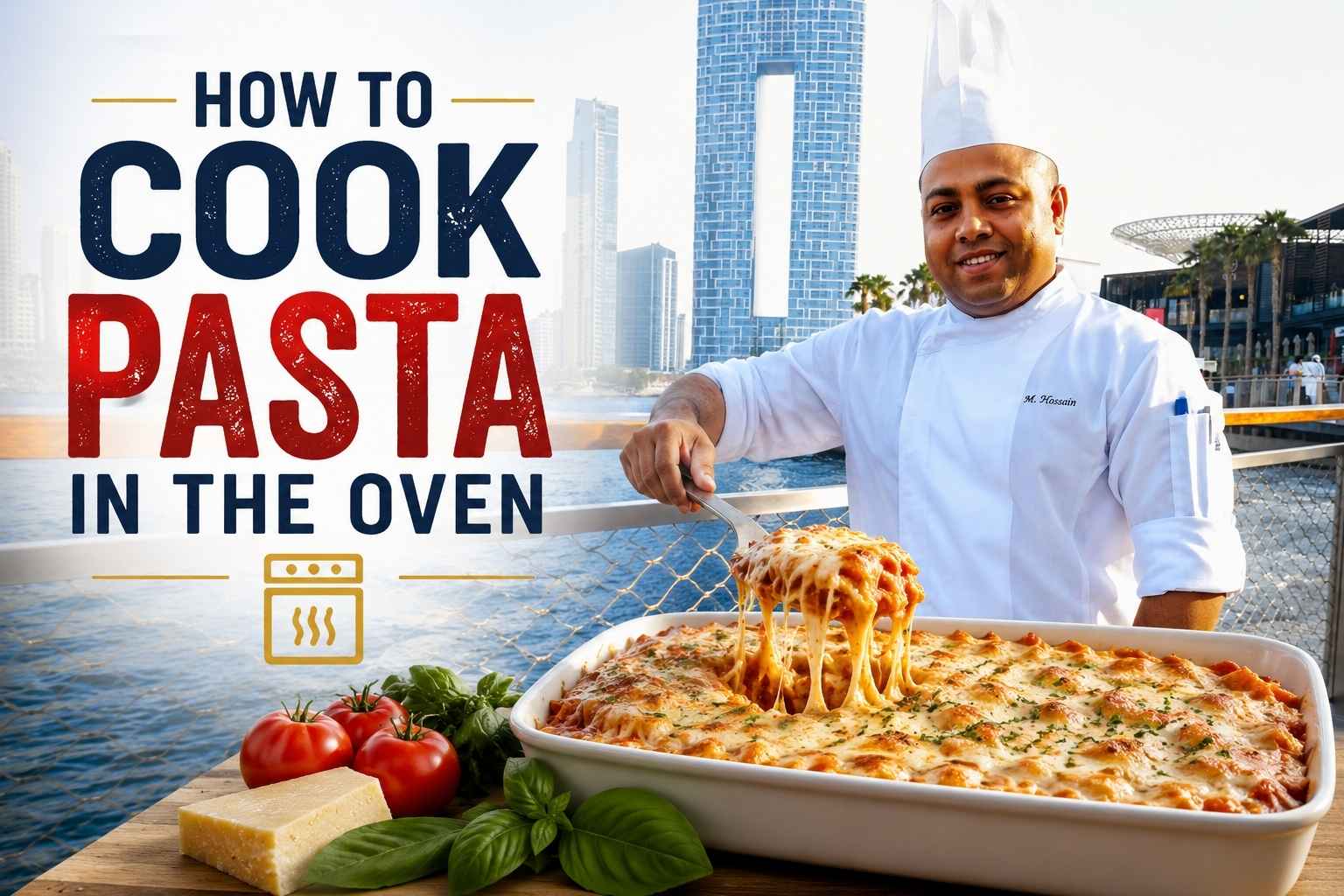
I still remember the first time I learned How to Cook Pasta in the Oven. I thought it would be hard, but it turned out to be one of the easiest ways to make a warm, filling meal. The oven did most of the work, and the pasta came out rich, soft, and full of flavor.
Over the years, I have tested many baked pasta recipes in my own kitchen. I have learned what works, what to avoid, and the small tips that make every dish better. In this guide, I will show you each step in a simple way, share my favorite tricks, and help you make perfect oven-baked pasta with confidence. Let’s get started and cook a pasta dish your whole family will love.
The Baked Pasta Reference Table
| Dish | Oven Temp | Total Bake Time | Covered? | Key Notes |
|---|---|---|---|---|
| Lasagna | 375°F (190°C) | 45-55 min | Yes, then uncover last 15 min | Rest 15 min before cutting |
| Baked Ziti | 375°F (190°C) | 30-35 min | Yes, then uncover last 10 min | Fully cook pasta first |
| Mac and Cheese | 350°F (177°C) | 25-30 min | Uncovered throughout | Bechamel base holds moisture |
| Stuffed Shells | 375°F (190°C) | 35-40 min | Yes, then uncover last 10 min | Use no-boil shells for firmer texture |
| Baked Rigatoni | 400°F (204°C) | 25-30 min | Yes, then uncover last 8 min | Slightly undercook pasta first |
| Pastitsio | 350°F (177°C) | 50-60 min | No | Custard top sets firm — do not cover |
| Baked Orzo | 375°F (190°C) | 25-30 min | Yes throughout | Raw orzo absorbs broth directly in pan |
| Pasta al Forno | 400°F (204°C) | 20-25 min | Uncover last 5 min only | Best with chunky, rustic sauce |
Why Cooking Pasta in the Oven Actually Works
Baking pasta in the oven does three things at the same time that stovetop cooking cannot. First, steam trapped under foil or a lid finishes cooking the pasta and keeps moisture even throughout the dish. Second, starch gelatinization happens as the pasta absorbs sauce and liquid under heat, which creates that thick, bound, cohesive texture you only get in a baked dish. Third, Maillard browning – the same reaction that creates a crust on bread – hits the top layer of cheese and exposed pasta, giving you color, flavor, and that slightly crisp edge everyone fights over.
The Maillard reaction starts around 280°F (138°C) at the surface (America’s Test Kitchen, 2023). Your oven runs at 350-400°F, so as long as the top is exposed to dry heat, browning happens fast. Cover the dish for most of the bake to trap steam, then uncover to trigger browning. That two-phase approach is the foundation of every good baked pasta I have ever made.
To Pre-Cook or Not to Pre-Cook: When Raw Pasta Works and When It Doesn’t
The short answer: use raw (no-boil) pasta when the dish has enough liquid to absorb during baking. Use parboiled pasta when the dish is dry or thick. Use fully cooked pasta only for quick gratins and mac and cheese.
Here are the three cases, spelled out:
Raw (dry) pasta works in dishes with high liquid content – think lasagna with a thin tomato sauce, baked orzo in broth, or pasta e fagioli baked in a Dutch oven. The pasta absorbs the liquid directly in the oven. Serious Eats found that no-boil lasagna noodles produce a denser, slightly chewier texture that many people actually prefer (Serious Eats, 2022). I use them in 80% of my lasagnas.
Parboiled pasta (cooked to 50-60% of its normal time) is the right call for baked ziti, stuffed shells, and rigatoni bakes where the sauce is thick and there is not enough liquid to fully hydrate raw pasta. Drain it well, toss it immediately in sauce so it doesn’t stick, then bake.
Fully cooked pasta goes into dishes that bake for under 20 minutes – mac and cheese, pasta gratins, or reheated bakes. Anything longer and you get mush.
The Sauce-to-Pasta Ratio Most Home Cooks Get Wrong
Most home cooks use too little sauce. That is the number one reason baked pasta comes out dry and clumped.
The rule is: 1.5 to 2 cups of sauce per 8 oz (225g) of dry pasta. For dishes using parboiled pasta, go with 2 cups minimum. For raw pasta baked in sauce, you may need up to 2.5 cups because the pasta pulls moisture aggressively while it cooks (The Food Lab, J. Kenji López-Alt, 2015).
Why does this happen? Dry pasta can absorb up to 1.75 times its own weight in liquid (King Arthur Baking, 2021). So an 8 oz box of pasta can soak up nearly 14 oz of liquid before the dish looks dry on the plate. If your sauce was already thick, you just ran out of moisture in the first 20 minutes of baking.
My fix in the restaurant kitchen: I always thin my sauce with a splash of pasta water or chicken stock before assembling the dish. The extra starch in pasta water also helps the sauce cling to the pasta as it sets.
Oven Temperature Breakdown for Baked Pasta: What Each Setting Does
The temperature you pick changes the texture, crust, and moisture level of your final dish. Here is what each common setting actually does:
325°F (163°C) – Slow and Gentle This is for delicate, custard-based dishes like pastitsio or pasta soufflés. The low heat lets eggs set without curdling and keeps moisture inside. Bake time runs long – 55 to 70 minutes. Use this when the topping is egg-based, not cheese-based.
350°F (177°C) – The All-Purpose Setting This is where I put 70% of my baked pasta dishes. It is slow enough to let the center cook through before the edges dry out, but hot enough to brown cheese in the final uncovered stretch. Mac and cheese, classic lasagna, and cannelloni all go in at 350°F.
375°F (190°C) – The Workhorse Temperature Most baked ziti, stuffed shells, and pasta al forno recipes land here. The higher heat creates a better crust on the cheese and shortens bake time by about 10-15 minutes compared to 350°F. The risk is that thin edges dry out faster, so foil coverage is more important at this temperature.
400°F (204°C) – Fast Bake with Strong Crust Use 400°F when you want aggressive browning and you have a fully sauced, moisture-rich dish. Baked rigatoni with a chunky meat sauce does well here. Watch the edges carefully – they can overcook while the center catches up.
425°F (218°C) – Crust Only I almost never run a full bake at 425°F. I use it for the last 5 minutes only, after the dish is already cooked through, when I want a fast, dark cheese crust. If you start at 425°F, the top burns before the center is hot.
Covered vs. Uncovered Baking: When to Use Foil and When to Pull It
Cover your pasta for the first two-thirds of the bake time, then uncover for the last third. That is the rule (Bon Appétit, 2023).
Foil traps steam. Steam keeps the pasta from drying out and lets the center cook evenly. Without foil, the top layer sets too fast, forms a dry crust, and insulates the center – so the bottom third of the dish stays undercooked while the top looks done.
The moment you pull the foil matters a lot. Pull it too early and the top browns before the center heats through. Pull it too late and you lose the browning window entirely. For a 45-minute lasagna at 375°F, that means foil on for 30 minutes, foil off for 15 minutes.
One practical note: spray the underside of the foil with cooking spray before you cover the dish. Cheese sticks to foil if you don’t, and you’ll tear off half your topping when you remove it. I learned this the hard way during a 200-person catering event in 2014.
Cheese Selection and Layering: Which Cheeses Melt, Which Brown, and Which Turn Rubbery
Mozzarella melts because it has a high moisture content and a moderate fat level. Low-moisture, part-skim mozzarella melts cleanest and browns well. Fresh mozzarella is too wet – it releases water that pools on top of your dish.
Parmesan browns because it has low moisture and high salt content. It forms that golden, slightly crisp crust on the top layer. Always put Parmesan as the final layer, on top of everything else.
Ricotta holds its shape and gets creamy, not melted. It is a filling, not a melt cheese. Put it in the middle layers, never on top.
Gruyère and Fontina melt smoothly and are great in mac and cheese or white lasagna where you want a creamy, stringy interior with no rubbery texture.
Cheeses that turn rubbery: pre-shredded mozzarella with cellulose coating, American cheese above 400°F for more than 10 minutes, and high-protein cheeses like aged cheddar added too early. Shred your own cheese for best results (Cook’s Illustrated, 2022).
The layering rule: put your melt cheese in the middle, your creamy filling (ricotta, béchamel) in the layers, and your browning cheese (Parmesan, Pecorino) on top.
Gas vs. Electric Oven: How Your Oven Type Changes Baked Pasta Results
Gas ovens run moister than electric ovens because burning gas produces water vapor as a byproduct. That extra moisture is actually helpful for baked pasta – it slows surface drying and gives you a slightly longer window before the top overcooks.
Electric ovens run drier. The upside is more even browning. The downside is that pasta dishes can dry out faster, especially on the edges.
Practical adjustments:
- In a gas oven, you can often skip the foil for the first 10-15 minutes of a short bake (under 30 min) without serious drying.
- In an electric oven, always cover with foil for at least the first half of the bake. Consider adding 2-3 tablespoons of extra liquid to your sauce before assembly.
- Gas ovens have hot spots near the back – rotate your dish halfway through the bake.
- Electric ovens produce more even heat but the broiler element at the top can over-brown dishes on the top rack. Use the middle rack.
I have cooked on both for 15 years. My preference for baked pasta is a gas oven. The added moisture gives more margin for error.
Convection vs. Conventional: Speed, Crust Quality, and Temperature Offset
Convection uses a fan to circulate hot air around the dish. It bakes faster, browns more evenly, and produces a crispier crust on top. Conventional bakes with still air – slower, with more variation between the top and center of the dish.
For baked pasta, convection has one clear advantage: the top browns faster and more evenly. It has one clear risk: the sides and bottom can overcook before the center is done if the dish is deep.
Rules for convection baked pasta:
- Reduce temperature by 25°F (14°C). A recipe calling for 375°F in a conventional oven runs at 350°F in convection.
- Reduce time by 10-15%. A 40-minute lasagna may be done in 33-35 minutes.
- Use the foil rule even more strictly – convection’s moving air evaporates surface moisture fast.
- Check doneness 10 minutes before the recipe’s stated time.
America’s Test Kitchen found that convection mode reduced bake time by an average of 18% across 12 baked pasta recipes tested (America’s Test Kitchen, 2024).
How to Tell When Baked Pasta Is Truly Done
A bubbling top does not mean the center is cooked. Here is how to know for sure:
The edge bubble test. Look at the edge of the dish where it meets the pan. When the sauce is actively bubbling at that edge – not just steaming, but visibly bubbling – the dish has reached a temperature above 200°F (93°C) at the edges. That usually means the center is close.
The internal temperature test. Insert an instant-read thermometer into the center of the dish. You want at least 165°F (74°C). For dishes with raw egg (like pastitsio or pasta frittata), the minimum is 160°F (71°C) (USDA Food Safety, 2023). I check temperature every time. Guessing is how you serve cold lasagna.
The knife test. Insert a thin knife into the center, hold it there for 5 seconds, then touch the blade to the inside of your wrist. If it’s hot, the center is hot. This works but the thermometer is more reliable.
The rest time rule. Baked pasta keeps cooking for 10-15 minutes after it comes out of the oven. Do not cut immediately. Let it rest on a wire rack (not the hot stovetop) so heat can escape from the bottom.
Make-Ahead and Freezer Tips for Baked Pasta
To make baked pasta ahead: assemble the dish fully, cover tightly with plastic wrap and then foil, and refrigerate for up to 48 hours. When ready to bake, remove the plastic wrap, re-cover with foil, and add 10-15 minutes to the bake time since the dish starts cold.
To par-bake and freeze: bake the dish covered for two-thirds of the usual time (so a 45-minute lasagna bakes for 30 minutes). Let it cool completely – at least 2 hours at room temperature, then 2 hours in the fridge before freezing. Wrap tightly in plastic wrap, then foil. Label with date and final bake instructions. Freeze up to 3 months.
To reheat from frozen: thaw overnight in the refrigerator. Bake covered at 350°F for 30-35 minutes, then uncover for 15 minutes to re-crisp the top.
One mistake to avoid: do not freeze dishes with fresh mozzarella on top. The cheese releases too much water during thawing. Add fresh mozzarella only during the final uncovered bake. Use shredded low-moisture mozzarella in any dish you plan to freeze.
Common Baked Pasta Mistakes and How to Fix Them
Mistake: The center is cold, the edges are overcooked. Cause: Dish is too cold going into the oven, or the oven was too hot. Fix: Let the assembled dish sit at room temperature for 30 minutes before baking. Drop the oven temp by 25°F and add 5-8 minutes.
Mistake: The top is burnt but the pasta is underdone. Cause: Foil removed too early, or oven temperature too high. Fix: Cover with a fresh sheet of foil and continue baking. Next time, keep foil on longer and check internal temp before removing it.
Mistake: The dish is dry and the pasta is clumped. Cause: Not enough sauce, or pasta was fully cooked before going in. Fix: Add 1/4 cup of hot water or stock around the edge of the dish, re-cover with foil, and bake 10 more minutes. Next time, use more sauce and parboil pasta rather than fully cooking it.
Mistake: Watery pool at the bottom of the dish. Cause: Fresh vegetables not pre-cooked, fresh mozzarella on top, or too much sauce that is too thin. Fix: Pre-cook vegetables before layering. Use low-moisture mozzarella. Thicken your sauce until it coats a spoon before assembly.
At high altitude (above 3,500 ft / 1,067 m): Water boils at a lower temperature, so pasta takes longer to hydrate and sauces reduce faster. Add 10-15% more liquid to your sauce and increase covered bake time by 10 minutes (Colorado State University Extension, 2022).
Dish size matters: A deeper dish (like a 4-inch hotel pan) needs lower heat and longer time than a standard 2-inch 9×13 baking dish. Drop to 325°F and add 15-20 minutes for deep dishes.
My Personal Baked Pasta Routine: How I Actually Do It
I have cooked thousands of baked pasta dishes – in restaurant kitchens for 200 people and at home on a Tuesday night. Here is what my actual routine looks like.
I always start with a sauce that is thinner than I think I need. I make my tomato sauce, then add a full cup of pasta cooking water before I even think about assembling. When the sauce looks almost too loose, it’s right.
I parboil my pasta for exactly 4 minutes, regardless of what the box says. I want it stiff, almost chalky in the center. I drain it, toss it immediately with a ladle of sauce to stop clumping, and let it sit while I prep the layers.
I build layers in this order: sauce on the bottom of the pan (this prevents sticking more reliably than oil), pasta, filling, melt cheese, sauce, repeat. Parmesan goes on the very top, followed by a drizzle of olive oil. The oil helps the Parmesan brown faster and prevents it from drying into a dusty powder.
I bake at 375°F, foil on, for 25 minutes. Then foil off for 15 minutes. I check the internal temp before pulling. I rest it for 10 minutes on a wire rack. Then I cut it.
That’s it. No mystery. Every step has a reason.
Frequently Asked Questions About Cooking Pasta in the Oven
What is the best oven temperature for cooking pasta in the oven?
350°F to 375°F (177-190°C) works for most baked pasta dishes. Use 350°F for dishes with egg-based sauces or béchamel, and 375°F for tomato-based dishes with cheese toppings. Go up to 400°F only for short bakes (under 30 minutes) where you have plenty of sauce.
Can you cook pasta in the oven without boiling it first?
Yes, if the dish has enough liquid. Dry pasta absorbs approximately 1.75 times its own weight in liquid during baking (King Arthur Baking, 2021). Lasagna with a thin sauce, baked orzo in broth, and pasta baked in a Dutch oven with plenty of stock all work well with raw pasta. Thick, chunky, or low-liquid sauces require parboiled pasta.
How long does it take to cook pasta in the oven?
Most baked pasta dishes take 30 to 55 minutes at 350-375°F. Simple rigatoni bakes run 25-30 minutes. Layered lasagna with thick filling takes 45-55 minutes. Deep-dish casseroles and pastitsio can run up to 60-70 minutes. Always check with a thermometer – the center should reach 165°F.
Why is my baked pasta dry?
The most common cause is too little sauce. Use at least 1.5 to 2 cups of sauce per 8 oz of dry pasta. The second most common cause is removing the foil too early, which lets surface moisture escape before the center is done. The third cause is using fully cooked pasta that has no capacity to absorb sauce.
Can you make baked pasta ahead of time and refrigerate it?
Yes. Assemble the dish fully, cover with plastic wrap and then foil, and refrigerate up to 48 hours. When baking from cold, add 10-15 minutes to the covered phase and check the center temperature before removing the foil.
How do you keep baked pasta from getting hard on top?
Keep the dish covered with foil for at least the first two-thirds of the bake time. Only uncover for the final 10-15 minutes. If the top starts to over-brown before the center is done, tent a fresh piece of foil loosely over the dish without pressing it down onto the cheese.
Does convection bake pasta faster?
Yes. Convection bakes pasta approximately 15-18% faster than conventional mode (America’s Test Kitchen, 2024). Set your convection oven 25°F lower than the recipe states, and start checking for doneness about 10 minutes before the recipe’s stated time.
What is the difference between baked pasta and pasta casserole?
The terms are often used interchangeably. Traditionally, baked pasta (pasta al forno) refers to Italian-style dishes where pasta is layered with sauce and cheese and baked until the top browns. A pasta casserole is a broader American category that includes any pasta baked in a dish with added protein, vegetables, and sauce. The cooking method is the same.
Key Takeaways
- Baking pasta works because steam, starch absorption, and Maillard browning all happen together – you cannot replicate this on the stovetop.
- Use more sauce than you think – at least 1.5 to 2 cups per 8 oz of pasta, and thin it slightly before assembly.
- 350-375°F handles 90% of baked pasta recipes; adjust up or down based on how much moisture your dish has.
- Foil on for the first two-thirds, foil off for the final third – this is the single rule that separates good baked pasta from dry baked pasta.
- Check internal temperature at the center of the dish – 165°F means it’s done, regardless of what the timer says.
- Parboil pasta for 4 minutes (to about 50-60% doneness) for dishes with thick, low-liquid sauces, and use raw pasta only when there is enough liquid in the dish to hydrate it fully.
- Shred your own cheese for better melt and browning – pre-shredded cheese has cellulose coating that affects texture.
- Rest the dish for 10-15 minutes after pulling it from the oven – it continues cooking during that time and holds together better when you cut it.

I’m Mossaraof, a trained chef and the founder of OvenInsights.com. I spent years cooking at Larrupin’ Cafe and in kitchens across Chicago and Seattle. Now I test kitchen gear for a living. I moved to North Acton, London, and I test every tool I write about. I use real meals and real heat. No brand deals. No shortcuts. I cover 12 kitchen types and hundreds of recipes. I believe this: the right tools matter as much as the recipe.