
At A Glance
- Overnight turkey roasting uses a low oven (I hold mine at 250°F, never lower) so the bird cooks slowly while you sleep and is ready by morning.
- The USDA’s official rule is that an oven should never be set below 325°F, and it names slow overnight cooking at 190°F-200°F as unsafe (USDA FSIS, Countdown to a Food-Safe Thanksgiving Day, 2020). I’ll show you how I manage the real risk if you still want to try this method.
- A 12-14 lb turkey at 250°F needs roughly 9-10 hours. A 20-24 lb bird needs 11-12 hours. Full chart below.
- A leave-in probe thermometer is not optional here. It’s the only thing standing between you and a turkey that sat in the danger zone too long.
- Never cook a frozen or partially frozen bird overnight, and never stuff it before a long, slow roast.
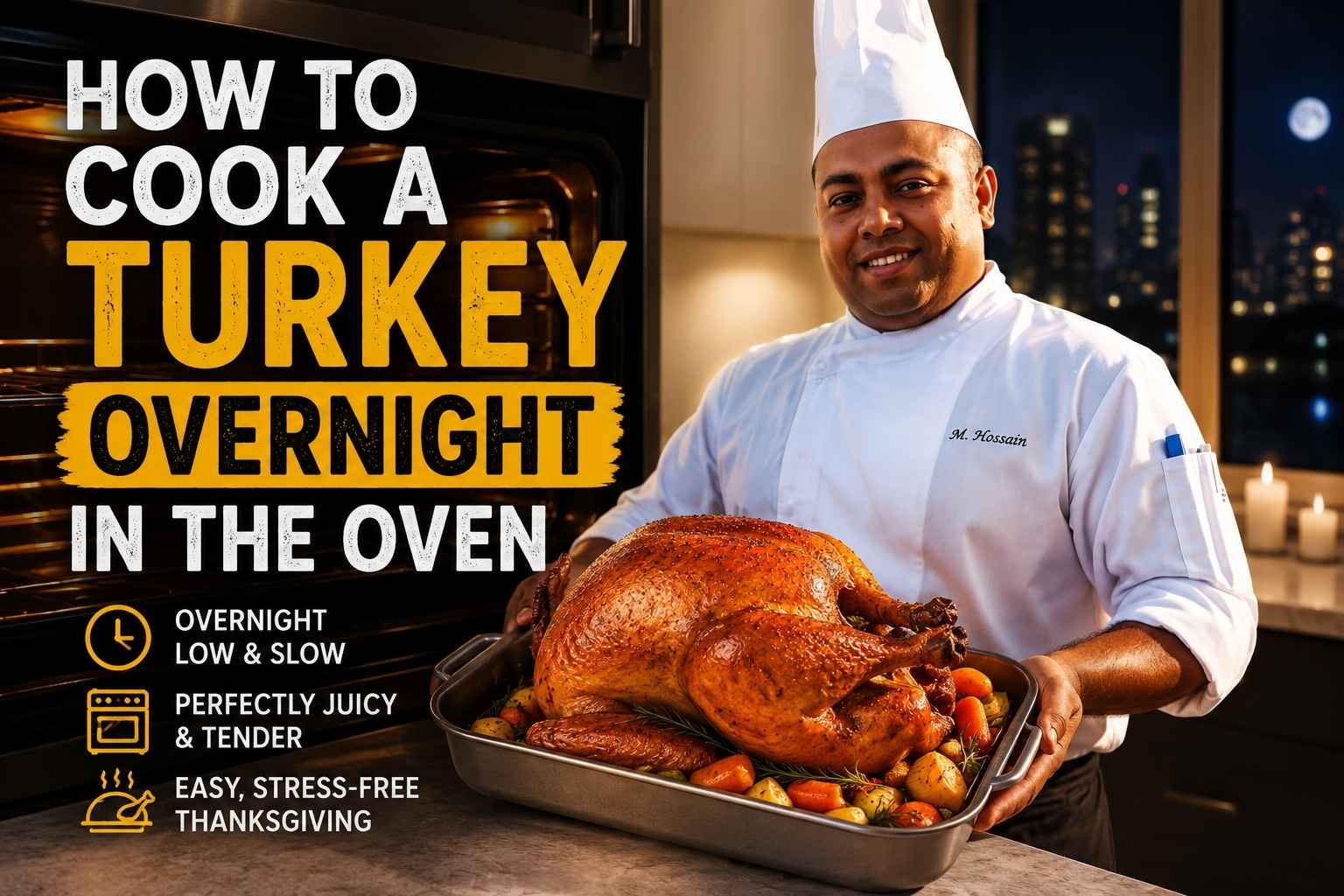
Have you ever wished dinner could cook while you sleep? How to Cook a Turkey Overnight in the Oven is one of my favorite ways to make a juicy, tender turkey without spending the whole day in the kitchen. I have used this slow, low-heat method for family meals, and it has saved me more than once during busy holidays.
In this guide, I will show you each step in a simple way. You will learn the best oven temperature, safe cooking tips, and easy tricks for moist, flavorful meat with crispy skin. By the end, you will feel ready to cook your own overnight turkey with confidence.
Why Overnight Roasting Works (And Where It Gets Risky)
Overnight roasting drops the oven temperature and stretches the cook time across many hours instead of a few. The turkey heats gradually, so the muscle fibers tighten less than they do at high heat, and the meat holds more of its own juice.
Here’s the part most articles skip: a low oven also means the turkey spends more time between 40°F and 140°F, the range where bacteria multiply fastest (USDA FSIS, Let’s Talk Turkey, 2024). Every extra hour in that zone is an extra hour of risk. That’s the actual trade you’re making for a juicier bird and a free oven at dinner time.
I’ve cooked hundreds of turkeys in restaurant kitchens and my own. Low and slow can produce a genuinely great bird. It can also go wrong fast if you skip steps. This guide gives you both sides so you can decide with real information, not marketing copy.
The Danger Zone: Why Time Matters as Much as Temperature
Food safety isn’t only about hitting 165°F at the end. It’s about how long the meat spent getting there.
The danger zone is 40°F to 140°F. Bacteria like Salmonella and Clostridium perfringens double roughly every 20 minutes in this range under the right conditions. A turkey that lingers here for six or seven hours carries a real chance of bacterial growth that a final 165°F reading won’t undo, since some toxins survive cooking.
This is exactly why the USDA states plainly: “It is not safe to cook any poultry in an oven set lower than 325 degrees Fahrenheit. At lower temperatures, poultry stays in the Danger Zone… for too long” (USDA, Countdown to a Food-Safe Thanksgiving Day FAQs, 2020). Michigan State University Extension goes further, calling the classic 190°F-200°F overnight method “dangerous” outright (MSU Extension, Downright Unsafe Ways to Cook Your Turkey, 2024).
I’m not going to soften that. It’s the official line, and it exists for a reason.
So Why Do Chefs Still Do This?
Plenty of home cooks and some professionals run ovens lower than 325°F overnight anyway, usually between 225°F and 275°F rather than the riskier 170°F-200°F range you’ll see in older recipes. The logic: a higher floor than the old-school method, full-time thermometer monitoring, and a bird that starts ice-cold from the fridge rather than at room temperature.
I want to be direct about where I land. I never go below 250°F, I never do this with a bird that isn’t fully thawed and well-chilled, and I treat the probe thermometer as mandatory, not optional. If any of those three things aren’t in place, I roast at 325°F like the USDA recommends and skip the overnight method entirely. That’s the deal I’m offering you in this guide: the real technique, with the real guardrails, and the honest acknowledgment that 325°F is still the official safe floor.
If you want zero risk, stop reading the “how,” skip to the “When Not To” section below, and roast at 325°F instead. There’s no shame in that. A 325°F turkey is done in a quarter of the time and still comes out great.
Ideal Overnight Oven Temperature Range
The workable range for overnight roasting sits between 225°F and 275°F. I keep mine at 250°F for every bird, every time. It’s low enough to cook gently overnight and high enough to move the turkey through the danger zone faster than a 170°F or 190°F oven ever could.
Going lower than 250°F buys you almost nothing in texture and adds real hours of risk. Going higher than 275°F starts to defeat the purpose. You’d finish faster, but then you’re just roasting at a slightly slow conventional temperature, not doing a true overnight cook.
Prep Before an Overnight Roast
Thaw It Completely
A turkey needs to be fully thawed before it goes anywhere near a slow overnight roast. A partially frozen bird cooks unevenly, which means parts of it sit in the danger zone even longer while the center catches up. Budget one day of refrigerator thawing for every 4-5 lbs of turkey. A 16-pound bird needs about 4 full days in the fridge.
Brine or Dry-Brine
I dry-brine every turkey I roast overnight. Salt the bird all over, including under the skin, 24 to 48 hours ahead, then leave it uncovered on a rack in the fridge. The salt pulls moisture out, then draws it back in seasoned, and the open-air fridge time dries the skin for better browning. America’s Test Kitchen has found dry-brining outperforms wet brining for texture on long roasts (America’s Test Kitchen, The Science of Good Cooking, 2023).
Truss Loosely
Tie the legs together loosely, or don’t truss at all. A tightly trussed bird cooks unevenly because the thighs are pressed against the breast, which slows heat penetration into the exact area that needs the most time.
Start Cold, Not at Room Temperature
Take the turkey straight from the fridge to the oven. Do not let it sit out to “come to room temperature” first, which is common advice for a fast roast but a mistake here. Every minute at room temperature is a minute already spent in the danger zone before the oven even starts working.
Overnight Turkey Cooking Time Reference Table
All times assume a fully thawed, unstuffed turkey held at a constant oven temperature, checked with a leave-in probe thermometer.
| Turkey Weight | Oven Temperature | Estimated Total Time | Notes |
|---|---|---|---|
| 10-12 lbs | 250°F | 8-9 hours | Smaller birds finish faster; check breast temp starting at hour 7 |
| 13-16 lbs | 250°F | 9-10 hours | The most common overnight weight class; tent breast at hour 6 |
| 17-20 lbs | 250°F | 10-11 hours | Rotate the pan once around the halfway mark for even heat |
| 21-24 lbs | 250°F | 11-12 hours | Very large birds; confirm oven can hold temp this long before committing |
These are estimates, not guarantees. Oven calibration, how often you open the door, and pan material all shift the actual time. The thermometer decides when it’s done, not the clock.
Time and Temperature Breakdown by Weight
10-12 Pound Turkey: In by 10 PM, Out by 7 AM
This is the easiest weight class for an overnight cook. At 250°F, plan for about 8.5 hours. Put it in at 10 PM and you’re pulling it around 6:30-7 AM, well before most people are awake for coffee.
13-16 Pound Turkey: In by 9 PM, Out by 7 AM
The standard Thanksgiving-size bird. Budget 9.5-10 hours at 250°F. Going in at 9 PM lines up with a 7 AM pull time, leaving the whole morning free for sides, gravy, and resting the bird properly.
17-20 Pound Turkey: In by 8 PM, Out by 7 AM
A bird this size needs the full 11 hours some nights. I start these before 8 PM so I have a built-in buffer. If it finishes an hour early, it rests longer, wrapped and holding at a safe serving temperature, which only helps the final result.
21-24 Pound Turkey: In by 7 PM, Out by 7 AM
At this size, I want a 12-hour cushion, minimum. This is also the weight class where I’d most carefully weigh whether overnight roasting makes sense at all. Longer time in the oven means longer time for something to go wrong unattended while you sleep. Read the “When Not To” section before you commit to a bird this big.
The Leave-In Probe Thermometer Is Not Optional
A leave-in probe thermometer stays in the turkey the entire cook and reads the internal temperature continuously, often with an alarm you can set. This is the single most important tool for an overnight roast, full stop.
Here’s why: you’re asleep, or at least not standing at the oven, for 8-12 hours. You have no way to visually check color or texture during that stretch. The probe is your only real-time signal that something is progressing normally, running hot, or stalling out.
Set the alarm for 161°F so you catch the finish before it overshoots, then confirm with a separate instant-read thermometer in three spots: the thickest part of the breast, the innermost thigh, and the wing joint. All three need to hit 165°F (USDA FSIS, Is the Turkey Done Yet?, 2025). Taylor Precision Products, which makes most of the probe thermometers you’ll find at any kitchen supply store, recommends calibrating your probe in ice water before the season starts, since a thermometer that reads even 3-4 degrees off can mean pulling a turkey that isn’t actually safe (Taylor Precision Products, Thermometer Calibration Guide, 2024).
If you don’t own a leave-in probe thermometer, don’t attempt this method. That’s not me being dramatic. It’s the one piece of equipment with no workaround.
Gas vs. Electric Ovens for Overnight Roasting
Gas Ovens
Gas ovens cycle the burner on and off to maintain temperature, which can cause wider temperature swings at low settings. Many gas ovens also struggle to hold a stable 250°F for 8+ hours without drifting. Test yours first: set it to 250°F, put an independent oven thermometer inside, and watch it for an hour before you trust it with a turkey overnight.
Electric Ovens
Electric ovens generally hold low, steady temperatures better than gas, which makes them a better fit for this method. Even so, don’t assume your dial is accurate. Oven thermostats can be off by 25°F or more in either direction (Butterball, Turkey Cooking Times, 2024). An independent oven thermometer, the kind that sits on the rack, is a five-dollar tool that tells you the truth your dial won’t.
Whichever type you have, the rule is the same: verify the actual temperature before you commit a turkey to it for 8-12 unattended hours.
Convection vs. Conventional for Overnight Turkey
Convection ovens use a fan to circulate hot air, which cooks food faster and more evenly than a conventional oven at the same dial setting. For an overnight roast, that means two things.
First, drop your set temperature by about 25°F if you’re using convection, so a “250°F” overnight roast actually runs closer to 225°F on a convection dial. Second, convection shortens your total cook time, sometimes by an hour or more on a large bird, so check the probe earlier than the chart above suggests.
Convection also dries the skin faster, which sounds good until the breast finishes browning at hour 5 with 4 more hours to go. Tent the breast loosely with foil as soon as it reaches a deep golden color, regardless of what the clock says.
Conventional ovens without a fan are more forgiving and closer to the times in the chart above. If you’re unsure which you have, check your oven’s manual or look for a fan icon on the convection setting.
Preventing Overcooking and Dryness During a Long Roast
- Tent the breast, not the whole bird. Once the breast hits a deep golden color, usually around the halfway point, lay a loose sheet of foil over just the breast. This slows further browning without slowing the internal cook.
- Skip the basting. Opening the oven door every hour to baste drops the internal temperature and adds time, which is the opposite of what you want on a long, slow roast. I don’t baste overnight turkeys at all. The dry brine and slow heat do the work instead.
- Rest it properly. Pull the turkey once the probe confirms 165°F in all three spots, then let it rest tented loosely for 20-30 minutes before carving. This is true for any turkey, but it matters even more here since the bird has had many hours to build up internal moisture that needs a few minutes to redistribute.
- Don’t chase a lower finish temperature. Some cooks pull poultry a few degrees under 165°F and rely on carryover heat during the rest to finish the job. That’s a technique for experienced cooks with a calibrated thermometer and a real understanding of hold times. If you’re not already doing this deliberately, pull at 165°F, no exceptions.
Common Overnight Turkey Mistakes (And How to Fix Them)
Mistake: Not accounting for altitude. Above 3,000 feet, ovens run less efficiently and food takes longer to cook. Fix: add 10-15% to your estimated cook time and lean harder on the probe thermometer rather than the clock.
Mistake: Trusting the oven dial. Most home oven thermostats drift over years of use. A dial set to 250°F might actually be running at 225°F or 280°F. Fix: buy a $6 oven thermometer and check it before every overnight cook, not just the first time.
Mistake: Stuffing the bird before an overnight cook. Stuffing adds density that slows heat penetration into the cavity, which means the center of the stuffing spends even more extra time in the danger zone than the meat around it. Fix: cook stuffing separately in a casserole dish, always, but especially for a long overnight roast.
Mistake: Skipping the independent thermometer check. A pop-up timer or the oven’s built-in probe alone isn’t reliable enough for a method that already carries more risk than standard roasting. Fix: always confirm with a second instant-read thermometer in three spots before serving.
Mistake: Walking away without setting an alarm. Eight to twelve hours is a long time to trust that nothing changes. Fix: set your probe’s high-temp alarm and, if your oven has one, its own timer as a backup.
When NOT to Cook a Turkey Overnight
Skip this method entirely if any of the following is true:
- The turkey is frozen or even partially frozen. Uneven ice inside the bird means uneven cooking, and uneven cooking means parts of it sit in the danger zone far longer than the chart accounts for.
- Your oven can’t hold a steady low temperature. If your test run showed swings of more than 15-20°F, don’t trust it with 8-12 unattended hours.
- You don’t own a leave-in probe thermometer. There’s no safe substitute for real-time monitoring on a method that already runs below the USDA’s recommended 325°F floor.
- You want zero added risk. Roast at 325°F instead. It’s the officially recommended temperature, it’s faster, and it still produces a genuinely good turkey when you don’t overcook it.
My Actual Overnight Routine
I’ll be honest about how this plays out in my own kitchen, because the theory only matters if it survives a real Thanksgiving morning.
I dry-brine the turkey two days ahead and leave it uncovered on a rack in the fridge. The night before, I set the oven to 250°F, verify it with an oven thermometer I’ve owned for years, and get the bird in by 9 PM for a standard 14-pounder. I set the probe alarm for 161°F and go to bed.
One Thanksgiving, my oven’s thermostat had drifted low without my noticing, and the turkey was still at 130°F by 6 AM instead of the mid-150s I expected. I bumped the temperature to 325°F for the final stretch to get it through the danger zone faster and finished it in about 90 minutes instead of panicking or serving it late. That’s the actual value of the probe: it told me the truth in time to fix the plan, instead of finding out at noon that something had gone wrong for hours.
I’ve also had it go perfectly, more often than not. A 250°F overnight bird, pulled at 7 AM, rested while I made the gravy, and carved at noon with the moistest breast meat I get all year. The method works. It just needs the respect I’m asking you to give it here.
Frequently Asked Questions
Is it safe to cook a turkey overnight at a low temperature?
The USDA states plainly that it is not safe to cook poultry in an oven below 325°F, since lower temperatures keep the bird in the 40°F-140°F danger zone too long (USDA FSIS, 2020). Some experienced cooks still do a supervised version at 250°F with a leave-in thermometer, a fully thawed bird, and no stuffing, but 325°F remains the official safe recommendation.
What internal temperature does the turkey need to reach?
165°F in the thickest part of the breast, the innermost thigh, and the wing joint, confirmed with a food thermometer (USDA FSIS, Is the Turkey Done Yet?, 2025).
Can I cook a frozen turkey overnight?
No. A frozen or partially frozen turkey cooks unevenly, which extends the time parts of it spend in the danger zone. Thaw it completely in the refrigerator first, budgeting about a day for every 4-5 lbs.
How long does a 15-pound turkey take overnight?
At 250°F, plan for roughly 9-10 hours. Going in around 9 PM typically means pulling it out around 6:30-7 AM, though the probe thermometer, not the clock, makes the final call.
Do I need to baste the turkey during an overnight roast?
No. Basting means opening the oven repeatedly, which drops the internal temperature and slows the cook. Skip it and rely on a dry brine for moisture instead.
Can I stuff the turkey before an overnight cook?
No. Stuffing slows heat penetration into the cavity and keeps the stuffing itself in the danger zone longer. Cook stuffing separately in its own dish.
What if my oven can’t hold a steady low temperature?
Don’t use this method. Test your oven with an independent oven thermometer first. If it swings more than 15-20°F, roast at the standard 325°F instead.
Is convection or conventional better for an overnight roast?
Convection cooks faster and more evenly but dries the skin sooner and shortens total time, so drop the set temperature by about 25°F and check the probe earlier. Conventional ovens track closer to the times in the chart above.
Key Takeaways
- Overnight turkey roasting works by stretching the cook across 8-12 hours at a low, steady oven temperature, usually 250°F.
- The USDA’s official position is that ovens should never go below 325°F, and this method carries real added risk that 325°F roasting doesn’t (USDA FSIS, 2020).
- A leave-in probe thermometer, a fully thawed bird, and skipping stuffing are non-negotiable if you choose to do this anyway.
- Always confirm 165°F in the breast, thigh, and wing with a second instant-read thermometer before serving.
- If your oven can’t hold a steady low temperature, or you don’t own a probe thermometer, roast at 325°F instead. It’s faster, official, and still produces a great turkey.
Sources : USDA Food Safety and Inspection Service (Let’s Talk Turkey, Countdown to a Food-Safe Thanksgiving Day, Is the Turkey Done Yet?), Michigan State University Extension (Downright Unsafe Ways to Cook Your Turkey), Butterball (Turkey Cooking Times).