
At A Glance
- Brining works because salt pulls water into the turkey through osmosis and loosens the muscle proteins so they hold onto that water during roasting (USDA FSIS, 2025).
- Wet brine uses a salt-water soak and adds moisture. Dry brine uses a salt rub and pulls out moisture first, then draws it back in as a concentrated, well-seasoned liquid.
- Use 1 cup of kosher salt per gallon of water for a wet brine, or 1 tablespoon of kosher salt per 5 pounds of turkey for a dry brine. Never brine longer than 24 hours for wet, or 3 days for dry.
- Roast at 325°F. Pull the turkey when the breast hits 157-160°F and the thigh hits 170°F, then rest it for at least 30 minutes before carving (ThermoWorks, 2026).
- The two mistakes I see most in home kitchens: over-brining the bird until it turns spongy, and using table salt instead of kosher salt, which makes the meat too salty by a wide margin.
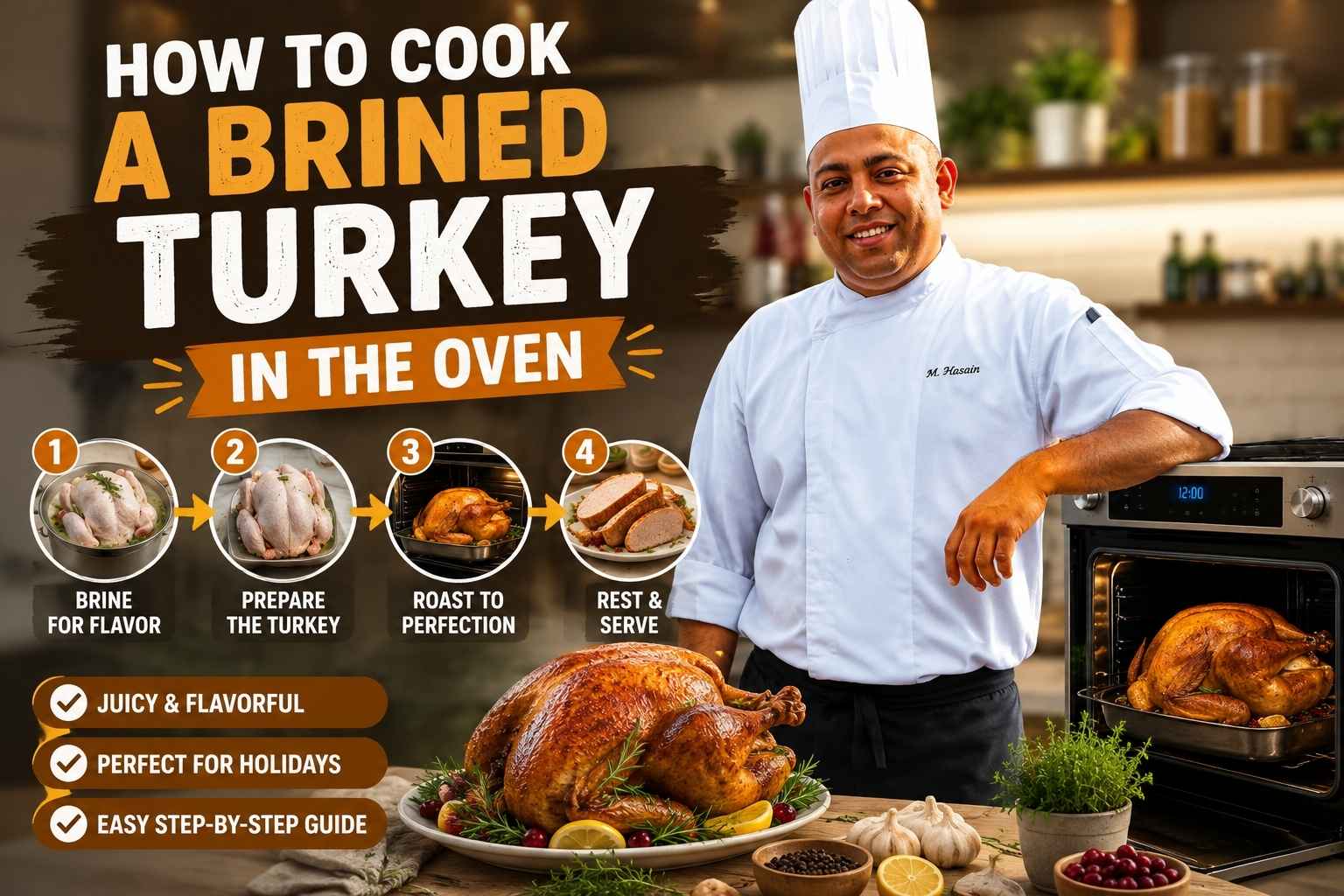
The first time I learned How to Cook a Brined Turkey in the Oven, I was nervous that all the extra work would not be worth it. One bite changed my mind. The turkey came out juicy, tender, and full of rich flavor that made everyone ask for seconds.
Since then, I have tested different oven temperatures, cooking times, and simple tricks to get the best results every time. In this guide, I will show you How to Cook a Brined Turkey in the Oven, avoid common mistakes, and serve a turkey with crispy skin and moist meat. Let’s get started and make your next holiday meal one to remember.
Why Brining Works: What’s Actually Happening Inside the Meat
Brining is not magic. It is chemistry, and once you understand it, you will never skip the step again. A turkey soaked or rubbed in salt goes through two separate processes: osmosis and protein denaturation. Both work in your favor.
Osmosis: How Salt Pulls Water Into the Meat
Salt water outside the turkey is more concentrated than the water inside its muscle cells. Water always moves toward the saltier solution to balance things out. That is osmosis. So when you submerge a turkey in brine, water moves from the brine into the meat.
At the same time, salt ions move into the muscle fibers. That salt changes the structure of the muscle proteins, which is the second part of the process, and it is the more important part.
Protein Denaturation: The Real Reason Brined Turkey Stays Juicy
Salt unwinds and loosens the tightly coiled muscle proteins, myosin and actin. Once loosened, these proteins can no longer squeeze out as much moisture during cooking. This is called denaturation, and it is why brined turkey stays juicy even after 165°F, while an unbrined turkey dries out fast once it crosses that same mark.
I tested this side by side more times than I can count in a restaurant kitchen. Two turkeys, same oven, same time, same thermometer. The brined bird came out noticeably juicier every single time. The difference is not subtle. You can taste it in the first bite.
Wet Brine vs. Dry Brine: Which One Should You Use
The direct answer: dry brine gives you crispier skin and a more concentrated turkey flavor. Wet brine gives you a slightly juicier result but a milder, more diluted taste. I use dry brine for holiday turkeys and wet brine when I want extra insurance against a dry bird.
| Factor | Wet Brine | Dry Brine |
|---|---|---|
| Method | Submerge turkey in salt water | Rub turkey with dry salt |
| Equipment needed | Large container or brining bag, fridge space | Rimmed sheet pan and a rack |
| Skin texture | Softer, harder to crisp | Crispier, drier skin surface |
| Flavor | Slightly diluted by added water | More concentrated, deeper flavor |
| Space required | A lot (bucket or cooler) | Minimal (one sheet pan) |
| Best for | Home cooks worried about dryness | Cooks who want better skin and flavor |
J. Kenji López-Alt, Serious Eats’ longtime food science writer, has argued for years that dry brining is the better method for home cooks because it avoids the diluted flavor that comes with a wet brine (Serious Eats, 2025). I agree with him for turkey specifically. The bird is too big to fully benefit from wet brining without losing some flavor to the water.
Brine Ratios and Timing by Turkey Weight
Get the ratio wrong and you either waste your time or ruin the bird. Here is what actually works, based on years of doing this in both restaurant and home settings.
Wet Brine Ratio
Use 1 cup of kosher salt per 1 gallon of cold water. For a 12-16 pound turkey, you need roughly 2 gallons of brine to fully submerge it, so that means 2 cups of kosher salt total. Add sugar if you like (½ cup per gallon softens the salt’s bite), but salt is the only ingredient that actually matters for texture.
Dry Brine Ratio
Use 1 tablespoon of kosher salt per 5 pounds of turkey. A 15-pound bird needs about 3 tablespoons total, spread over the skin, under the skin, and inside the cavity.
Timing by Weight
| Turkey Weight | Wet Brine Time | Dry Brine Time |
|---|---|---|
| 8-10 lbs | 8-12 hours | 12-24 hours |
| 10-14 lbs | 12-18 hours | 24-36 hours |
| 14-18 lbs | 18-24 hours | 36-48 hours |
| 18-24 lbs | 24 hours (max) | 48-72 hours (max) |
Do not exceed 24 hours for a wet brine. Past that point, the salt breaks down muscle structure too much, and the meat turns mushy and spongy instead of tender. Dry brine has more room to breathe because the salt penetrates more slowly, but 3 days is still the ceiling.
How to Safely Brine a Turkey
Food safety comes first, always. The turkey and the brine both need to stay below 40°F the entire time (USDA FSIS, 2025). Bacteria grow fast between 40°F and 140°F, so any time spent in that range is time working against you.
Use a food-safe container. Stainless steel, food-grade plastic, glass, or a dedicated brining bag all work. Never use a container that once held anything non-food related, and never use reactive metals like aluminum, since salt corrodes them.
Keep it cold. If your fridge cannot fit a turkey-sized container, use a cooler packed with ice, and check the temperature with a thermometer every few hours. This is exactly the setup I used during my first solo Thanksgiving in a cramped New York apartment with a fridge the size of a dorm mini-fridge. I brined the turkey in a cooler on my fire escape in December, checked the temperature obsessively, and it worked fine.
Never brine at room temperature. I have seen this mistake in a restaurant kitchen during a holiday rush: someone left brine on the counter “just for a minute” that turned into forty-five minutes. We tossed the turkey. It is not worth the risk.
Dry brine goes uncovered in the fridge, not sealed in a bag. Air circulation helps the salt do its job and dries the skin at the same time, which sets you up for crispier skin later.
Rinsing and Drying the Turkey Before Roasting
Here is where a lot of home cooks lose the crispy skin they worked so hard for. After a wet brine, rinse the turkey under cold water to remove surface salt, then pat it completely dry with paper towels, inside and out. After a dry brine, there is nothing to rinse, but drying still matters.
Skin that goes into the oven wet steams instead of crisping. Water on the surface has to evaporate before the skin can start browning, which wastes valuable oven time and leaves you with pale, rubbery skin.
My trick: after patting the bird dry, I set it uncovered on a rack in the fridge for at least 4 hours, and up to overnight if I have the time. This is sometimes called an “air dry” and it pulls even more moisture off the skin. The drier the surface, the crispier the finished skin.
Oven Temperature Strategy for a Brined Turkey
The direct answer: roast at 325°F the whole way through, or use a high-heat start followed by a step-down to 325°F if you want deeper browning early on. Both work. I use the step-down method for holiday turkeys because it gives the skin a head start.
The Step-Down Method
- Preheat the oven to 425°F.
- Roast the turkey for 30-45 minutes to kick-start browning and rendering.
- Drop the oven to 325°F for the remainder of the cook.
- Tent the breast loosely with foil if it browns too fast before the thigh catches up (USDA FSIS, 2025).
Why Not Just Blast It at High Heat the Whole Time?
Because a brined turkey already holds more moisture, and high heat the entire way through will overcook the breast before the thigh reaches a safe temperature. Turkey breast and thigh cook at different rates. The breast is lean and cooks fast. The thigh has more connective tissue and needs more time and heat to become tender (America’s Test Kitchen, 2025). A steady 325°F oven, or a short high-heat start followed by a drop, gives both parts of the bird time to catch up to each other.
Roasting Time Reference Table by Turkey Weight (325°F Oven)
These times are for an unstuffed turkey at 325°F, based on USDA FSIS roasting guidance (2025). A brined turkey typically finishes 10-15% faster than an unbrined bird of the same weight, because the added moisture and loosened proteins conduct heat more efficiently.
| Turkey Weight | Unbrined Roast Time | Brined Roast Time (approx.) |
|---|---|---|
| 8-12 lbs | 2¾ to 3 hours | 2½ to 2¾ hours |
| 12-14 lbs | 3 to 3¾ hours | 2¾ to 3¼ hours |
| 14-18 lbs | 3¾ to 4¼ hours | 3¼ to 3¾ hours |
| 18-20 lbs | 4¼ to 4½ hours | 3¾ to 4 hours |
| 20-24 lbs | 4½ to 5 hours | 4 to 4½ hours |
Treat these numbers as a starting point, not a countdown timer. Your oven, your turkey’s actual shape, and whether it’s fully thawed all change the math. The thermometer is what tells you the truth, not the clock.
How to Use a Meat Thermometer Correctly
Skipping the thermometer is the single riskiest shortcut in turkey roasting. Color and juice clarity are not reliable doneness tests (ThermoWorks, 2026). Here’s where to check and why it matters.
Breast Placement
Insert the probe horizontally into the thickest part of the breast, entering near the neck cavity, keeping the tip about ½ to 1 inch from the cavity to avoid the bone (ThermoWorks, 2026). Bone conducts heat differently than meat, so touching it gives you a false reading.
Thigh Placement
Insert the probe into the innermost part of the thigh, where the leg meets the body, again avoiding bone. The thigh should read at least 170-175°F for the connective tissue to fully render into tender, silky meat.
Target Temperatures
The USDA’s official minimum is 165°F throughout the bird (USDA FSIS, 2025). In my kitchen, I pull the breast around 157-160°F and let carryover cooking (the residual heat that keeps cooking the meat after it leaves the oven) carry it up to 165°F during the rest. This keeps the breast noticeably juicier than pulling it at 165°F directly from the oven. The thigh, meanwhile, needs to hit 170-175°F on its own, since collagen does not fully break down until that higher range.
Check the wing too. It is thin and can finish safely even when other parts have not.
Resting Time After Roasting: Why Skipping It Ruins a Brined Bird
Rest the turkey for at least 30 minutes, tented loosely with foil, before carving. This is not optional, and it matters even more for a brined bird than an unbrined one.
During roasting, muscle fibers tighten and push juices toward the center of the meat. Resting lets the fibers relax and reabsorb those juices evenly. Cut into a brined turkey straight out of the oven and you will watch a puddle of well-seasoned liquid drain onto the cutting board instead of staying in the meat where it belongs. All that brining work, gone in sixty seconds.
I learned this the hard way during a Thanksgiving service years ago, plating turkey the moment it hit the pass because we were behind schedule. The plates looked dry within minutes because the juice had already run out onto the cutting board before service even started. Now I build the rest time into my schedule the same way I build in roasting time. It’s not a bonus step. It’s part of the cook.
Common Brining and Roasting Mistakes (and How to Fix Them)
Over-brining the turkey. Past 24 hours for a wet brine, salt breaks down too much muscle structure and the texture turns spongy and mushy instead of tender. Fix: set a timer the moment you start brining, and pull the turkey out on schedule, even if your plans shift.
Using table salt instead of kosher salt. Table salt is far denser than kosher salt by volume. A cup of table salt has roughly twice the salt content of a cup of Diamond Crystal kosher salt. Follow a kosher-salt recipe with table salt and you will end up with an unpleasantly salty turkey. Fix: always use kosher salt for brining, and if you must substitute, cut the volume roughly in half and adjust from there.
Skipping the dry step before roasting. Wet skin steams instead of browning. Fix: pat the bird bone-dry, then air-dry uncovered in the fridge for a few hours.
Not checking multiple spots with the thermometer. One reading in one spot does not tell you the whole story. Fix: check breast, thigh, and wing separately, and go with the lowest reading.
Carving immediately after roasting. This drains the juice you worked to lock in. Fix: rest for a minimum of 30 minutes, up to 45 for a larger bird.
Brining a pre-basted or “kosher” turkey. Many store-bought turkeys, including some Butterball products, are already injected with a salt solution (Butterball, 2026). Brining one of these on top of that injection leads to an oversalted bird. Fix: check the label for words like “enhanced” or “contains up to X% solution.” If you see that language, skip the brine, or use a much lighter dry rub instead.
My Turkey Routine: What I Actually Do Every Year
After 15 years in professional kitchens, plus a lot of home Thanksgivings that started rough and got better, here is my actual routine, no fluff.
Three days out, I dry brine. One tablespoon of Diamond Crystal kosher salt per 5 pounds of bird, rubbed under the skin and inside the cavity, plus black pepper and a little rubbed sage. The turkey sits uncovered on a rack in the fridge the whole time.
The morning of, I pull the turkey out an hour before roasting to take the chill off. I preheat the oven to 425°F, roast for 40 minutes, then drop it to 325°F for the rest of the cook. I put my probe thermometer in the breast right at the start so I am not guessing later.
Around the estimated finish time, I start checking the thigh with an instant-read thermometer every 15 minutes. When the breast hits 158°F and the thigh is at 172°F or higher, it comes out. Then it rests, tented with foil, for a full 35 minutes while I finish the gravy and get the sides plated.
The one thing I never skip: writing the exact brine start time on a sticky note on the fridge. I forgot to track it one year at a family Thanksgiving and ended up guessing whether we were at hour 20 or hour 30. We erred on the side of pulling it early, and the turkey was fine, but I do not like leaving food safety to a guess. Now it’s written down every single time.
Frequently Asked Questions
Can I brine a frozen turkey?
No. The turkey must be fully thawed before brining. A partially frozen bird will not absorb salt evenly, and the surface can sit in the danger zone (40-140°F) too long while the interior is still thawing.
Do I need to rinse a turkey after a dry brine?
No. Unlike a wet brine, dry brine salt should stay on the bird. Simply pat the skin dry before roasting; there is no liquid brine to remove.
Can I brine and stuff the turkey?
You can, but the USDA recommends cooking stuffing separately for safety, since stuffing inside a brined bird heats more slowly and must still reach 165°F at its center (USDA FSIS, 2025).
What happens if I brine for too long?
The meat texture turns spongy and overly soft, sometimes described as “hammy.” The fix at that point is prevention, not correction. There is no way to reverse over-brining once it happens.
Is kosher salt required, or can I use sea salt?
Coarse sea salt can work, but salt crystal size varies by brand, which changes how much salt fits in a cup. Weigh your salt if you are substituting, or stick with a named kosher salt brand like Diamond Crystal or Morton to match tested ratios.
Should I truss the turkey before roasting?
Trussing (tying the legs together) makes for a neater presentation but can slow down even cooking, since it pulls the thighs closer to the body where they retain heat longer. I leave the legs loose for faster, more even roasting.
Can I brine a pre-basted or enhanced turkey like some Butterball products?
Check the label first. If it lists a salt solution percentage, skip the brine entirely or use a very light dry rub instead, since the bird has already been salted (Butterball, 2026).
How do I know if my turkey is done without cutting into it?
Use a meat thermometer in the breast, thigh, and wing. The USDA’s safe minimum is 165°F throughout (USDA FSIS, 2025). Color and juice clarity are not reliable indicators of doneness.
Key Takeaways
- Brining works through osmosis and protein denaturation, which is why brined turkey holds onto moisture even after it passes 165°F.
- Dry brine gives crispier skin and more concentrated flavor. Wet brine is simpler insurance against dryness but dilutes flavor slightly.
- Stick to 1 cup kosher salt per gallon of water for wet brine, or 1 tablespoon per 5 pounds of turkey for dry brine, and never exceed 24 hours wet or 3 days dry.
- Keep the turkey below 40°F the entire brining process, use food-safe containers, and never brine at room temperature.
- Dry the skin thoroughly before roasting for real crispiness, and consider an uncovered fridge rest to dry it further.
- Roast at 325°F, or use a 425°F start followed by a drop to 325°F for better browning.
- Pull the breast at 157-160°F and the thigh at 170-175°F, then rest for at least 30 minutes before carving.
- The two most common mistakes are over-brining until the texture turns spongy, and using table salt in place of kosher salt.
Sources :
- USDA Food Safety and Inspection Service, “Turkey Basics: Safe Cooking” (2025)
- USDA Food Safety and Inspection Service, “Let’s Talk Turkey” (2025)
- ThermoWorks, “How to Cook a Turkey: Temperature Tips” (2026)
- ThermoWorks, “Proper Thermometer Probe Placement in Turkeys” (2026)
- Butterball, “How to Brine a Turkey” (2026)
- Bon Appétit, “Very Classic Dry-Brined Roast Turkey“