At A Glance
- Bake phyllo at 350°F-375°F (175°C-190°C) for most recipes. Too low makes it soggy. Too high burns the edges before the center sets.
- Always thaw phyllo in the fridge overnight. Never rush it on the counter.
- Brush every single layer with melted butter or oil. Skipping even one layer gives you dry, papery patches.
- Golden brown and audibly crisp when tapped is the doneness cue. Internal temperature matters less than color and sound.
- Convection baking cuts 10-15% off cook time and gives more even browning than conventional heat.
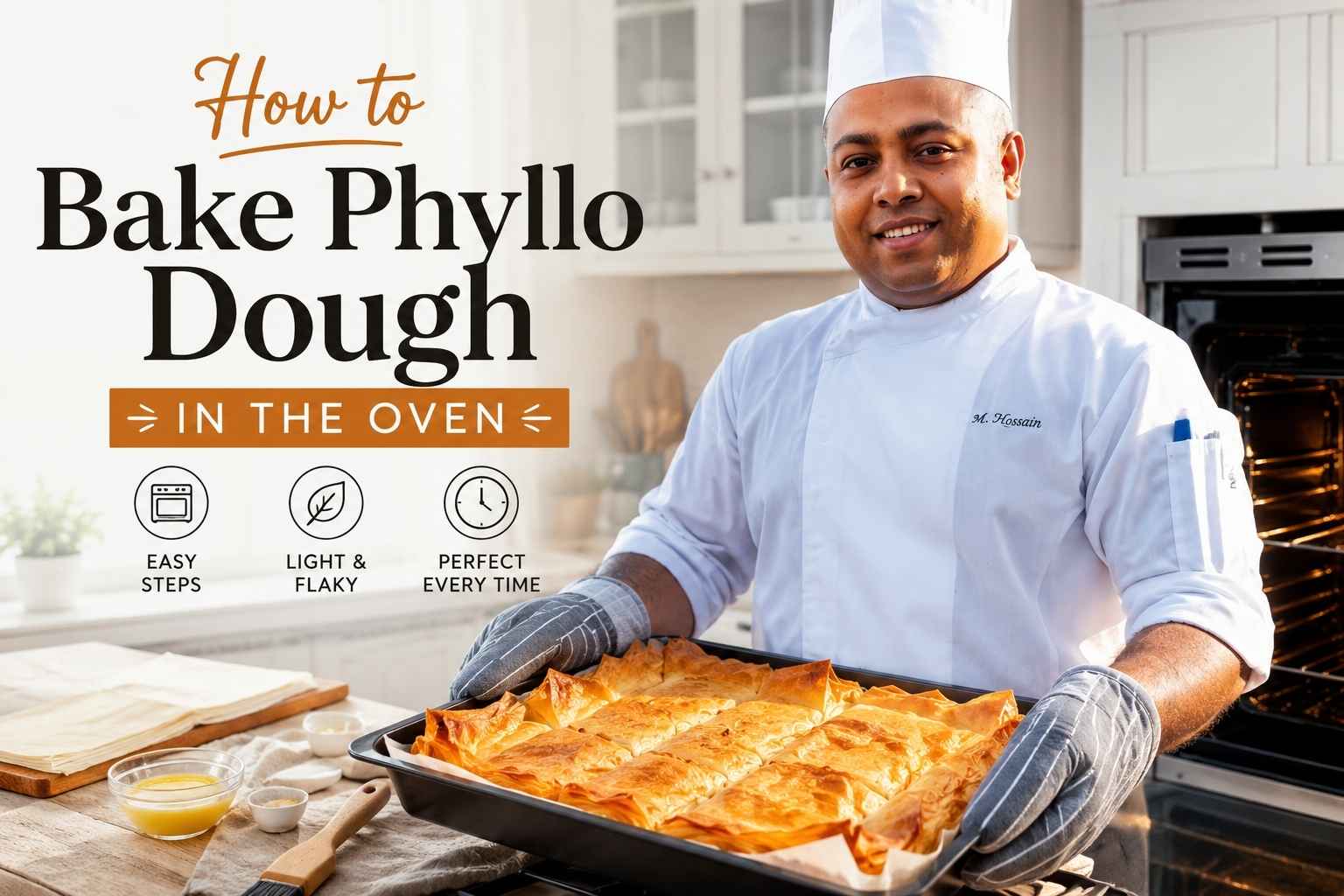
My phyllo dough used to rip every single time I baked it. Then I found a few simple tricks that changed everything for me. Now I want to show you how to bake phyllo dough in the oven the easy way. I’ve made this flaky, golden pastry more times than I can count in my own kitchen. Grab your butter brush, and let’s get those layers crisp and light together.
What Phyllo Dough Actually Is — and Why It Behaves Differently Than Other Pastry
Phyllo dough (also spelled filo) is paper-thin unleavened dough made from flour, water, and a small amount of oil. Each sheet is roughly 0.5 mm thick. A standard package has 20 to 40 sheets.
The magic in the oven comes from steam and fat working together. When heat hits a buttered sheet, moisture in the dough turns to steam. That steam pushes the layers apart. The fat left behind after the steam escapes is what crisps and browns each layer. This is why fat coverage matters so much: anywhere you skip butter, you get a pale, limp patch instead of a flaky, golden layer.
Phyllo has no leavening, no eggs, and almost no fat on its own. Every bit of richness, color, and texture comes from what you add between the sheets. That makes it one of the most technique-dependent pastries in any kitchen.
How to Thaw and Prep Phyllo Before It Touches the Oven
Thawing: Fridge First, Every Time
The number-one thing I see home cooks get wrong is thawing phyllo on the counter. I did it once in culinary school and spent an hour trying to peel apart sheets that had fused together at the edges. Never again.
Pull the package from the freezer and move it to the fridge 8-12 hours before you plan to bake. Overnight is ideal. The slow thaw keeps condensation from forming on the sheets (America’s Test Kitchen, 2023). Condensation is what makes the layers stick together and tear.
If you genuinely forgot and need to thaw fast, leave the dough in its sealed packaging at room temperature for no more than 2 hours. Once it’s pliable, get to work immediately.
Keeping Phyllo from Drying Out While You Work
Phyllo dries out in about 60 seconds when exposed to air. I’m not exaggerating. Lay a clean, slightly damp kitchen towel over the sheets you’re not actively using. Not wet, damp. A wet towel makes the sheets soggy and they tear.
Work fast. Have your butter melted, your filling ready, and your pan prepped before you open the package. The whole assembly process should move without stopping.
The Right Oven Temperature for Phyllo — What Happens at Each Range
350°F-375°F (175°C-190°C) is the target for almost every phyllo baked good. Here’s why the numbers on either side of that range cause problems.
Below 325°F, the butter never gets hot enough to properly brown the layers. The steam from the dough escapes slowly. Instead of crisping, the layers stay soft and the bottom gets greasy and dense. I’ve eaten soggy baklava from a well-meaning host. It’s not great.
Above 400°F, the outside layers brown too fast. By the time the top is golden, the edges are overcooked and the middle layers are still pale and underbaked. Thin pastry on the edges — where there’s less filling insulation — burns before the center is done.
The 350°F-375°F range gives the steam time to separate layers, the fat time to do its job, and the sugars time to caramelize evenly. It’s a patient bake.
Quick-Reference Baking Guide for Common Phyllo Dishes
| Dish | Temperature | Time | Doneness Cue |
|---|---|---|---|
| Baklava | 325°F-350°F (163°C-175°C) | 45-55 min | Deep amber color, syrup sizzles on contact |
| Spanakopita (whole) | 375°F (190°C) | 35-45 min | Golden brown top, crisp when pressed, filling reaches 165°F |
| Spanakopita triangles | 375°F (190°C) | 20-25 min | Golden on all sides, bottoms fully set |
| Börek (rolled) | 375°F (190°C) | 30-40 min | Uniformly golden, no pale patches |
| Apple phyllo tart | 375°F (190°C) | 25-35 min | Edges deep brown, center bubbling |
| Phyllo cups (premade) | 350°F (175°C) | 8-12 min | Light gold, firm to the touch |
| Tiropita (cheese pie) | 350°F-375°F (175°C-190°C) | 35-45 min | Deep gold top, cheese set, no jiggle |
Note: Baklava bakes at a slightly lower temp because the heavy sugar syrup adds to browning. You want slow, even color, not fast caramelization.
Butter vs. Oil: Which Fat to Use and How It Affects the Bake
Both work. They behave differently. Your choice should match the dish.
Clarified butter (ghee) gives the richest flavor and the deepest golden color. It has a higher smoke point than whole butter (around 450°F vs. 350°F), so it handles oven heat well without burning. For baklava, any Greek or Turkish pastry, and any dish where flavor is front and center, use clarified butter or ghee. Per Serious Eats (2022), clarified butter browns phyllo 20-30% faster than whole butter because the milk solids — which burn first — have been removed.
Whole butter works fine at standard phyllo baking temperatures (350°F-375°F). It adds flavor from the milk solids, but watch your edges. If they’re getting too dark early in the bake, cover them loosely with a small strip of foil.
Olive oil is standard in many savory Turkish and Greek recipes, especially börek. It gives a slightly lighter texture and a more neutral (sometimes grassy, depending on the oil) flavor. Oil-brushed phyllo comes out crisper and a bit dryer than butter-brushed. I use olive oil for savory börek and butter for everything sweet.
Vegetable or neutral oil is a good dairy-free option. The texture is similar to olive oil. The flavor is flat, so season your filling accordingly.
Whichever fat you use: brush generously. You want coverage, not pools. A silicone pastry brush works better than a foam brush. Foam brushes drag and tear the sheets.
Layering Technique and How It Changes the Final Bake
The number of layers you use directly affects how the pastry bakes.
Most baklava recipes use 8-10 sheets on the bottom, a nut filling, and 8-10 sheets on top. That thickness means longer bake times and a slightly chewier bottom base.
Spanakopita typically uses 6-8 sheets on each side. The thinner build bakes faster and gives a lighter, crispier result.
The brush-every-layer rule is not optional. I’ve worked with home cooks who brush every other layer to save time. The result is always the same: dry layers that don’t brown and have a papery texture. Each sheet needs direct fat contact.
Alignment tip: offset each sheet by about a half-inch from the one below. Staggering the sheets means the edges don’t all line up in one spot, which prevents thick edge seams that bake unevenly.
For rolled shapes like börek, roll tightly but not so tight that the filling has nowhere to expand. A loose roll gives you air pockets and an uneven bake. A too-tight roll can split.
Gas vs. Electric Oven: What Changes When You Bake Phyllo
Gas and electric ovens bake phyllo differently, and knowing which you have saves you from confused results.
Gas ovens have moist heat because combustion produces water vapor. That extra moisture is good for bread but not great for phyllo. The bottom of your pan will be fine since it sits on a rack above the heat source. But the top layers may take longer to crisp. In a gas oven, I position the rack in the lower third and let the base of the pan get direct radiant heat from below.
Electric ovens run drier and tend to be more consistent from front to back and top to bottom. Phyllo performs very well in electric ovens. The heat is steady, the air is dry, and browning is even. Use the center rack for most phyllo bakes in an electric oven.
One difference that catches people: electric ovens often run 15-25°F hotter or cooler than the dial says (The Food Lab, J. Kenji López-Alt, 2015). Get an oven thermometer. It costs about $10 and will fix more baking problems than any technique tip.
Convection vs. Conventional: When to Use Each for Phyllo
Use convection when you want even, fast browning. The fan circulates hot air around the pan, so every surface of the phyllo gets consistent heat. Convection is particularly good for large pans (like a full sheet of baklava) and for savory pies where even color matters.
When using convection, drop the temperature by 25°F from what the recipe says. So a 375°F recipe becomes 350°F. Also start checking 10-15 minutes before the recipe’s minimum time. Convection bakes about 20-25% faster than conventional (King Arthur Baking, 2024).
Use conventional (no fan) when your phyllo is thin and delicate — like phyllo cups or small triangles. Convection can blow the thin sheets before they set, causing them to lift off the pan or shift.
For baklava, I prefer conventional heat with a low-and-slow approach. The controlled, still heat gives the syrup time to work into the layers without burning the top before the base is done.
Savory vs. Sweet Phyllo: How the Baking Approach Differs
Sweet and savory phyllo pastries bake differently because of what’s inside them.
Baking Sweet Phyllo (Baklava and Similar)
Sweet phyllo — especially baklava — has nuts and sugar syrup, both of which add to browning. Sugar caramelizes, which means sweet pastries color faster than savory ones. Bake sweet phyllo at the lower end of the range (325°F-350°F) and watch it closely in the last 10 minutes.
A note on syrup for baklava: always pour cool syrup over hot pastry, or hot syrup over cool pastry. Never hot on hot. If both are hot, the phyllo goes soggy. The temperature difference helps the syrup absorb into the layers instead of pooling on the surface (America’s Test Kitchen, 2023).
Baking Savory Phyllo (Spanakopita, Börek, Tiropita)
Savory fillings like spinach and feta or meat and cheese carry a lot of moisture. That moisture turns to steam during baking and can make the bottom layers soggy if the bake temperature is too low.
For savory phyllo, preheat your pan. Put the empty baking dish in the oven while it preheats. Then lay your assembled pastry straight into the hot pan. The shock of heat on the bottom layers immediately starts crisping the base before the filling moisture can soak through. I’ve done this for 15 years. The bottom of the spanakopita is always properly crisp.
Score the top layers of savory pies before baking. Use a sharp knife to cut partway through (not all the way). This lets steam escape during the bake so the top layers stay crisp instead of puffing up and shattering when you serve it.
How to Know When Phyllo Is Done: Visual and Sound Cues
Color and sound tell you more than a timer.
Color is the most reliable cue. You want deep golden brown — not pale yellow and not amber-going-on-dark-brown. The edges and corners always color first because they’re the thinnest. Check the center. If the center is still pale while the edges are gold, the pastry needs more time.
Sound is the cue most home cooks ignore. Tap the top layer lightly with a fingernail or the flat of a knife. Properly baked phyllo sounds hollow and crisp, like tapping a cracker. Underbaked phyllo sounds dull and flat.
The shake test works for large pans. The pan should feel set and stable when you shake it gently. If the filling sloshes or the pastry shifts, keep baking.
For savory pies with filling (spinach, cheese, meat), check the internal temperature of the filling. It should reach at least 165°F (74°C) for food safety (USDA Food Safety Guidelines, 2024).
Common Phyllo Baking Mistakes and How to Fix Them
Soggy Bottom
What went wrong: Too much moisture from the filling seeped into the bottom layers before they could crisp.
The fix: Preheat the pan as I described above. Also, if using spinach, squeeze it dry in a clean towel until almost no liquid comes out. More moisture in the filling means a wetter bottom.
Burnt Top, Raw Center
What went wrong: The oven was too hot, or the rack was too high.
The fix: Drop the temperature to 350°F and move the rack to the lower third of the oven. If the top is browning too fast, lay a sheet of foil loosely over it — don’t press down, just set it on top — for the last 15 minutes of the bake.
Layers Separating or Lifting Off
What went wrong: The phyllo dried out during assembly, or there wasn’t enough fat between the layers.
The fix: Keep the damp towel over unused sheets at all times. Brush generously. If sheets tear, just layer another sheet on top. Double-layering a torn spot won’t ruin the pastry.
Filling Leaking Out
What went wrong: The filling was too wet, or the edges weren’t sealed properly.
The fix: Dry your filling ingredients first. For cheese fillings, drain in a strainer for 30 minutes before assembling. For triangles and rolls, fold the edges in before rolling so the ends are sealed.
Pale, Soft, and Not Crisp
What went wrong: Oven temperature was too low, or the bake time was too short.
The fix: Trust color over time. If the color isn’t there, keep baking. A phyllo pastry that looks done after 25 minutes but doesn’t look golden is not done.
My Personal Phyllo Routine: What I Actually Do in the Kitchen
I’ve made spanakopita for a kitchen feeding 200 people, and I’ve made baklava on a Tuesday night for myself. The routine is the same either way.
I pull the phyllo from the freezer the night before. In the morning, I make my filling and set it aside to cool completely. I never put warm filling on phyllo. Warm filling makes the butter melt off the sheets and the layers go slack.
I clarify my butter fresh each time I bake phyllo. I melt a full stick, let the foam settle, and spoon off the solids. It takes 5 minutes and the flavor difference is real.
I set up my station before I open the package: baking dish brushed with butter, filling in a bowl, clarified butter in a separate bowl with a brush resting in it, and my damp towel folded next to the stack of sheets.
I work fast and don’t stop to answer messages. Phyllo assembly is a 15-minute commitment of full attention.
For spanakopita, I preheat the oven to 375°F with the baking dish inside. I use 8 sheets on the bottom, add filling, then 8 sheets on top. I brush the top generously, score it in diamond or square portions, and slide it into the hot pan.
I bake it on the lower-middle rack. I start checking color at 30 minutes. I pull it at 40-45 minutes when the top is deep gold and the tap sounds hollow.
Then I wait 15 minutes before cutting. This is the hardest part. Cutting phyllo straight from the oven tears the layers and the filling spills. 15 minutes of rest and every piece comes out clean.
Frequently Asked Questions About Baking Phyllo Dough
What temperature should I bake phyllo dough at?
Most phyllo recipes bake at 350°F-375°F (175°C-190°C). Use the lower end for sugar-heavy sweet pastries like baklava, which brown faster. Use the higher end for savory pies where you need the filling to cook through quickly. Going below 325°F results in soft, greasy layers. Going above 400°F causes the edges to burn before the center bakes through.
Can I bake phyllo dough without butter?
Yes. Olive oil or any neutral vegetable oil works in place of butter. Olive oil is traditional in many Greek and Turkish savory pastries. Oil-brushed phyllo comes out slightly crispier and drier than butter-brushed. For sweet pastries, butter gives a better flavor. For dairy-free baking, neutral oil is a clean substitute.
How do I stop phyllo from drying out while I assemble?
Cover the unused sheets with a clean, slightly damp kitchen towel at all times. Work fast and have your filling and butter ready before you open the package. If a sheet tears, layer another one on top. Tears in the middle of the stack do not show in the finished bake.
Why does the bottom of my phyllo pastry always come out soggy?
The most common cause is excess moisture from the filling soaking into the bottom layers before they crisp. Two fixes: preheat your baking pan in the oven before adding the pastry, and make sure your filling is fully drained and cooled before assembly. Warm or wet filling is the main cause of a soggy base.
Can I bake phyllo in a convection oven?
Yes, and convection works very well for phyllo. Reduce the recipe temperature by 25°F and start checking doneness about 10-15 minutes earlier than the recipe says. Convection circulates heat evenly around the pan, which gives more uniform browning. For very thin, delicate phyllo shapes, use conventional heat instead — the fan can shift the sheets before they set.
How do I know when phyllo is fully baked?
Look for deep golden brown color across the surface, not just at the edges. Tap the top with a fingernail or knife — properly baked phyllo sounds hollow and crisp. For savory pies, the internal temperature of the filling should reach 165°F (74°C). A pale, soft top means more time in the oven regardless of what the clock says.
Can I freeze baked phyllo pastry?
Yes. Let it cool completely first. Wrap tightly in plastic wrap, then foil, and freeze for up to 2 months. Reheat from frozen in a 350°F oven for 15-20 minutes until warmed through and the top re-crisps. Do not microwave baked phyllo. The microwave turns the layers soft and chewy.
How do I reheat leftover spanakopita or baklava?
For spanakopita: place on a rack over a baking sheet in a 350°F oven for 10-12 minutes. The rack keeps air circulating under the base so the bottom doesn’t go soft. For baklava: room temperature is fine for up to 3 days. If you prefer it warm, 5 minutes in a 300°F oven is enough. Baklava should never go in the fridge — the humidity softens the layers.
Key Takeaways
- Phyllo bakes at 350°F-375°F for most recipes. Sweet pastries go lower; savory pies go higher.
- Thaw phyllo in the fridge overnight. Counter thawing causes sheets to fuse and tear.
- Brush every single layer with clarified butter, whole butter, or oil. No exceptions.
- Keep unused sheets covered with a damp towel. Exposed phyllo dries in about a minute.
- Preheat your baking pan for savory pies. It crisps the bottom layers before filling moisture can soak through.
- Doneness is about color and sound, not just time. Golden brown and hollow-sounding when tapped means it’s done.
- Rest the pastry for at least 15 minutes before cutting. It slices clean and the filling sets properly.
- For convection ovens, drop the temperature 25°F and check 10-15 minutes earlier than the recipe says.

I’m Mossaraof, a trained chef and the founder of OvenInsights.com. I spent years cooking at Larrupin’ Cafe and in kitchens across Chicago and Seattle. Now I test kitchen gear for a living. I moved to North Acton, London, and I test every tool I write about. I use real meals and real heat. No brand deals. No shortcuts. I cover 12 kitchen types and hundreds of recipes. I believe this: the right tools matter as much as the recipe.