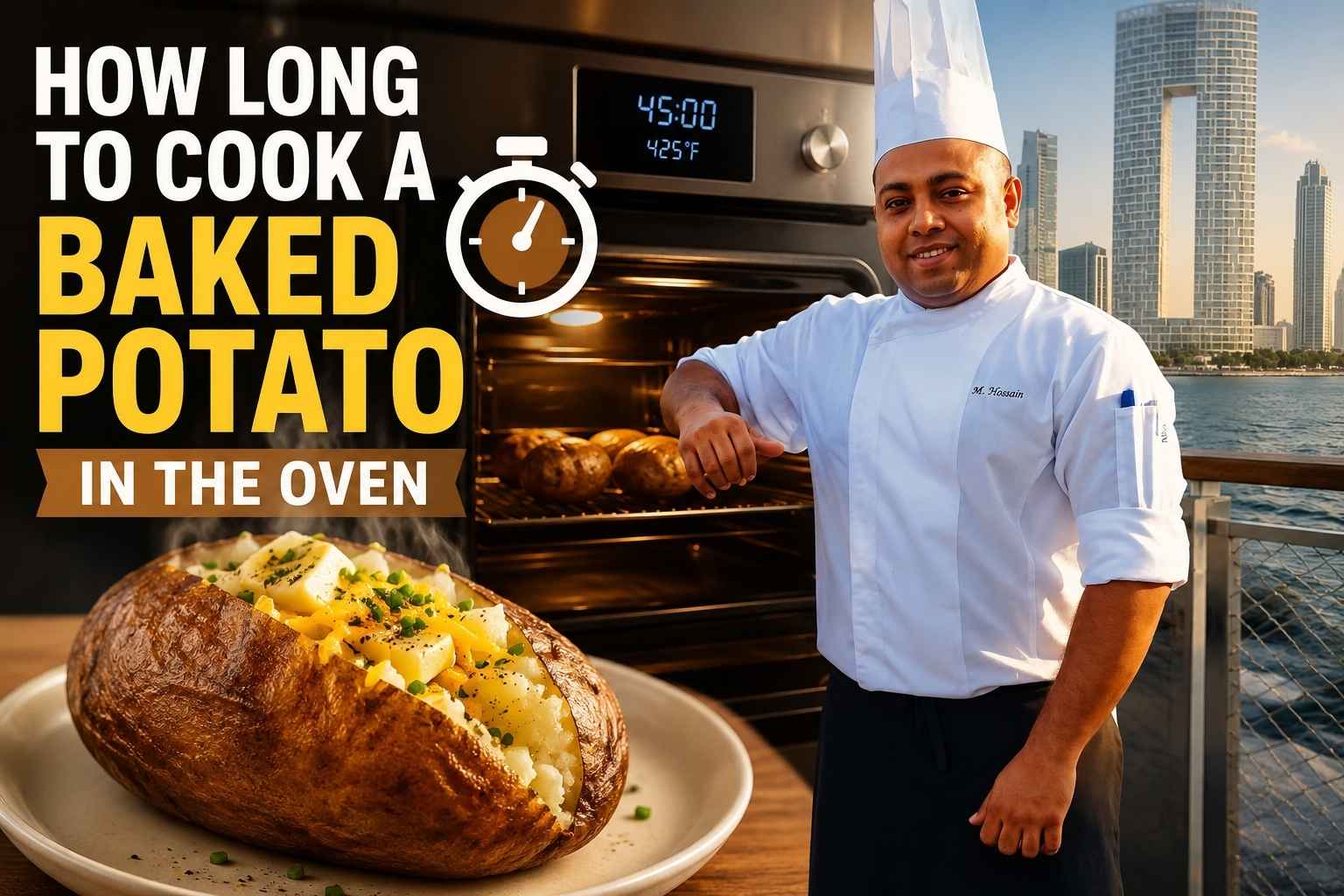
Here’s how long to cook a baked potato in the oven, and trust me, I learned this the hard way. My first try left me with a hard, sad potato after 20 rushed minutes. Turns out, time and temp really matter here.
Now I bake potatoes all the time, and I always get that soft, fluffy inside with crispy skin. It’s simple once you know the right steps.
In this guide, I’ll share my exact method, plus tips on size and temp. Grab a potato and let’s get baking!
At A Glance
- A medium russet (8–10 oz) bakes at 400°F in 55–65 minutes — that’s the number I tell home cooks to memorize.
- Internal temperature is the only reliable doneness test: pull the potato at 210°F (Idaho Potato Commission, 2024).
- Always poke holes before baking. Skipping this step risks a potato explosion inside your oven.
- Foil traps steam and makes skin soft — skip it if you want a crispy shell.
- Convection ovens cut bake time by roughly 20% at the same temperature.
Why Oven-Baked Beats Microwave Every Time
I’ve worked in restaurant kitchens for 17 years. I’ve cooked thousands of baked potatoes — for steakhouse menus, banquet lines, and my own dinner table. The microwave version is not a baked potato. It’s a steamed potato in disguise.
Here’s what actually happens inside the oven. When heat hits a russet, the starch granules absorb water and swell — this is starch gelatinization. It starts around 140°F and completes near 212°F (Harold McGee, On Food and Cooking, 2004). That slow, dry heat from the oven lets the interior turn fluffy and dry, not gummy.
At the same time, moisture in the skin evaporates. The skin tightens, blisters slightly, and becomes that crispy shell you want. A microwave blasts moisture outward too fast. You get a soft, wet skin and a dense interior. Not the same dish.
The oven also allows the Maillard reaction on the skin’s surface when you oil and salt it — that’s the browning that adds flavor. A microwave can’t do that.
Choosing the Right Potato (It Changes Your Bake Time)
Not all potatoes bake the same way, and the variety you pick changes both texture and timing.
Russet Burbank is the standard for a reason. It’s high in starch and low in moisture. That ratio produces a dry, fluffy interior and a skin that crisps well. The Idaho Potato Commission (2024) points to russets as the best variety for oven baking. Most weigh between 6 and 12 ounces. This is what I use 90% of the time.
Yukon Gold potatoes have more moisture and a waxy texture. They bake fine, but the interior comes out creamier and denser — less “steakhouse baked potato” and more “fancy side dish.” They also take about 5–10 minutes longer to reach the same internal temp because the moisture content holds heat differently.
Red potatoes are small and thin-skinned. They don’t bake well as a standalone dish — the thin skin burns before the interior finishes. Use them roasted, not baked.
For this guide, all times refer to russet potatoes unless noted.
Baked Potato Cook Time Reference Table
This is the table I wish every food site published. Times below assume a conventional oven (not convection), preheated fully, with oiled and salted skin, placed directly on the oven rack.
| Size | Approximate Weight | 350°F | 375°F | 400°F | 425°F | 450°F |
|---|---|---|---|---|---|---|
| Small | 4–6 oz | 65–75 min | 55–65 min | 45–55 min | 40–50 min | 35–45 min |
| Medium | 8–10 oz | 80–90 min | 70–80 min | 55–65 min | 50–60 min | 45–55 min |
| Large | 12–14 oz | 90–105 min | 80–90 min | 70–80 min | 65–75 min | 55–65 min |
| Jumbo | 16+ oz | 105–120 min | 90–105 min | 85–95 min | 75–85 min | 65–75 min |
Notes:
- 350°F: Low and slow. Use when your oven is already running for something else. Skin gets fully crisp but takes patience.
- 375°F: A good middle-ground for weeknight cooking alongside a roast.
- 400°F: My default temperature. Best balance of speed and texture. Skin gets genuinely crispy.
- 425°F: Faster, slightly more aggressive browning on the skin. Good when you’re short on time.
- 450°F: Steakhouse-style. The skin gets very dark and crackling-crisp. Watch closely after the 40-minute mark.
The Prep Steps That Actually Affect Cook Time
Washing and Drying the Skin
Scrub the potato under cold water to remove dirt. Then — and most home cooks skip this — dry it completely. I use a clean kitchen towel and pat each potato dry before oiling.
A wet skin takes longer to crisp because the surface moisture has to evaporate first. This can add 5–10 minutes to your bake time. Dry the skin before you do anything else.
Oiling and Salting
Coat the skin in a thin layer of neutral oil — I use avocado oil at high temps because it handles 450°F without smoking. Olive oil works fine at 400°F and below. Brush or rub the entire surface, then hit it with coarse kosher salt.
The oil conducts heat to the skin surface. It’s not just for flavor — it physically speeds up the crisping process by filling the micro-gaps in the potato’s skin and creating better contact with the hot air. Serious Eats (2023) tested oiled vs. unoiled baked potatoes and found oiled skins reached target crispness 12 minutes faster at 400°F.
Poking Holes — Never Skip This
Poke 8–12 holes around the potato with a fork before it goes in the oven. This is not optional.
As the interior heats, steam pressure builds inside. Without a release, that pressure can crack the potato — or in extreme cases, burst it. I’ve seen it happen twice in professional kitchens. It’s a mess. Poke the holes.
Foil — When to Use It and When to Ditch It
Foil traps steam. If you wrap a potato in foil, you’re essentially steaming it inside a metal wrapper. The skin comes out pale and soft, and the interior gets gummy. That’s why restaurant baked potatoes wrapped in foil as a “presentation” move disappoint you every time.
Skip the foil if you want a proper baked potato with a crispy skin. Use foil only if you need to hold a finished potato warm for 20–30 minutes before service — it slows moisture loss after cooking.
Convection Oven vs. Conventional Oven
If you have a convection setting, use it. The fan circulates hot air around the potato evenly, which speeds up both moisture evaporation and surface browning.
The general rule: reduce bake time by 20% or reduce temperature by 25°F when switching to convection. I prefer the time reduction — I keep my temp at 400°F and check for doneness at the 45-minute mark instead of 55.
America’s Test Kitchen (2022) found convection baking produced a 15–20% improvement in skin crispness compared to conventional baking at equivalent temperatures and times. If crispy skin is your goal, turn on the fan.
One caution: convection ovens have hot spots near the fan. Rotate the potatoes halfway through baking if you’re cooking more than two at once.
How to Test for Doneness the Right Way
The Internal Temperature Method
This is the most accurate method. A properly baked russet potato should reach 205°F–215°F at the center (Idaho Potato Commission, 2024). I pull mine at 210°F. At that temp, the starch has fully gelatinized and the interior is completely fluffy.
Use an instant-read thermometer — I use a ThermoWorks Thermapen — and insert it into the thickest part of the potato, avoiding the center cavity if there is one.
The Squeeze Test
Wearing an oven mitt, squeeze the potato gently. A done potato gives easily — it should feel soft with no firm resistance at the center. If it feels dense or rigid anywhere, put it back for 10 more minutes.
The Fork Test
Pierce the potato at its thickest point with a fork. It should slide in with zero resistance, the way a fork goes into soft butter. If you feel any grittiness or resistance, the starch hasn’t fully cooked through. Give it more time.
The Skewer Method for Large Potatoes
For potatoes over 14 oz, I use a thin metal skewer inserted lengthwise through the center before baking. The skewer conducts heat to the core and cuts bake time by 8–12 minutes on large potatoes. Pull the skewer out before serving. This is a professional kitchen trick that works just as well at home.
My Personal Baked Potato Routine
Here’s exactly what I do when I make baked potatoes at home. No shortcuts except the ones that don’t matter.
I start with two large russets from Idaho — if the bag says Idaho, it’s almost certainly a Russet Burbank (Idaho Potato Commission, 2024). I scrub them under cold water with a vegetable brush, then dry them completely with a kitchen towel.
I preheat the oven to 400°F — conventional, center rack. While it heats, I rub each potato with about a teaspoon of avocado oil, then roll them in coarse kosher salt over a sheet pan. I poke 10–12 holes with a fork, going about half an inch deep.
I set them directly on the oven rack, no pan, no foil. The open rack lets hot air hit all sides. I bake for 55 minutes, then check with the Thermapen. Most hit 210°F between 58 and 65 minutes.
When they come out, I cut a cross in the top, push the ends in to open it up, and add: unsalted butter, full-fat sour cream, sharp cheddar, chives, and a healthy crack of black pepper. That’s it. I stopped adding bacon after working in a steakhouse for three years and getting tired of the smell, but I won’t judge you if you add it.
Common Baked Potato Mistakes (And How to Fix Them)
Mistake 1: Pulling the potato too early.
The skin looks done before the inside is. Always verify with a thermometer. If the skin is browning fast at 450°F, tent loosely with foil after 40 minutes and keep going.
Mistake 2: Wrapping in foil from the start.
This makes the skin soft and steamed. If you want a crispy shell, the potato must bake uncovered the entire time.
Mistake 3: Skipping the drying step.
A wet skin slows crisping and extends bake time. Dry every potato thoroughly before oiling.
Mistake 4: Not preheating the oven.
Putting a cold potato in a cold oven and letting both heat up together gives you uneven cooking. Preheat fully — at least 20 minutes — before the potato goes in.
Mistake 5: Baking at too low a temperature to save time.
350°F takes 80–90 minutes for a medium potato. If you’re in a rush, raise the temperature — don’t lower it and cut the time. You’ll get an undercooked center.
Mistake 6: Altitude adjustments.
If you’re cooking above 3,500 feet, water boils at a lower temperature and starch gelatinizes more slowly. Add 10–15 minutes to your bake time and verify with a thermometer rather than timing alone. Colorado State University Extension (2023) confirms this adjustment for potato cookery at high elevation.
Mistake 7: Using the wrong size potato for your timeline.
A 16-oz jumbo at 400°F takes 85–95 minutes. If you have 60 minutes, grab smaller potatoes. Match your potato size to your actual schedule.
Frequently Asked Questions About Baking Potatoes in the Oven
How long does a baked potato take at 400°F?
A medium russet (8–10 oz) takes 55–65 minutes at 400°F in a conventional oven. Large potatoes (12–14 oz) need 70–80 minutes. Always confirm with an instant-read thermometer — you’re looking for 205°F–215°F at the center.
Can I bake a potato at 350°F?
Yes, but it takes longer. A medium russet at 350°F needs 80–90 minutes. The lower temperature gives you a fully cooked potato, but the skin won’t be as crispy as it is at 400°F or higher. Use 350°F when you’re cooking something else in the oven at that temp and don’t want to adjust.
Should I wrap baked potatoes in foil?
No — not if you want crispy skin. Foil traps steam and softens the skin. Bake uncovered directly on the oven rack. Use foil only after baking to hold the potato warm for up to 30 minutes before serving.
What temperature is a fully baked potato?
A done baked potato reads 205°F–215°F at the center with an instant-read thermometer. I aim for 210°F. Below 200°F, the starch hasn’t fully gelatinized and the inside will still feel dense.
Why is my baked potato still hard inside after an hour?
Three likely reasons: the potato was larger than you expected, the oven wasn’t fully preheated, or you started with a cold potato straight from the refrigerator. Potatoes taken directly from a cold fridge can add 10–15 minutes to bake time. Let potatoes come to room temperature for 20–30 minutes before baking.
Can I bake a potato in a convection oven?
Yes — and I recommend it. Use the same temperature (400°F) but reduce bake time by 20%. Check for doneness at the 45-minute mark for a medium potato. Convection circulates hot air and speeds up skin crisping. America’s Test Kitchen (2022) found convection produced noticeably crispier skin than conventional baking at the same temperature.
Is it safe to eat the skin of a baked potato?
Yes. Potato skin is high in fiber and potassium — the USDA (2023) lists a medium potato skin at roughly 4g of fiber. Scrub it well before baking and use unwaxed potatoes when possible. The skin is the best part of a properly baked potato. Don’t throw it away.
How do I reheat a baked potato without making it soggy?
Skip the microwave for reheating. Put the leftover potato on an oven rack at 400°F for 15–20 minutes until the skin crisps back up and the center reads at least 165°F. This restores most of the original texture. The microwave reheats the interior fine but turns the skin rubbery.
Key Takeaways
- 400°F is the sweet spot for a medium russet — 55–65 minutes, crispy skin, fluffy interior.
- Pull the potato at 210°F internal temperature — this is more reliable than timing alone.
- Dry the skin before oiling. Wet skin slows crisping.
- Poke holes. Always. No exceptions.
- Skip the foil if you want crispy skin. Use it only to hold cooked potatoes warm.
- Convection ovens cut bake time by ~20% — rotate potatoes halfway through if baking more than two.
- At altitude above 3,500 feet, add 10–15 minutes and rely on temperature, not time.
- Potatoes from the fridge add 10–15 minutes — let them rest at room temp before baking.

I’m Mossaraof, a trained chef and the founder of OvenInsights.com. I spent years cooking at Larrupin’ Cafe and in kitchens across Chicago and Seattle. Now I test kitchen gear for a living. I moved to North Acton, London, and I test every tool I write about. I use real meals and real heat. No brand deals. No shortcuts. I cover 12 kitchen types and hundreds of recipes. I believe this: the right tools matter as much as the recipe.