At A Glance
- A Dutch oven sears, browns, and braises in one pot. A slow cooker only simmers – it can’t build fond or get a good crust.
- Dutch ovens cost $70-$400 and last decades with care. Slow cookers cost $30-$150 and often die after 5-8 years.
- For pot roast, chili, and chicken thighs, the Dutch oven version has deeper flavor because of the Maillard reaction during searing (Cook’s Illustrated, 2023).
- Slow cookers use less power for long cooks and are safer to leave on all day (America’s Test Kitchen, 2022).
- Beginners often do better with a slow cooker first. Cooks who want full control over texture and flavor should learn the Dutch oven.
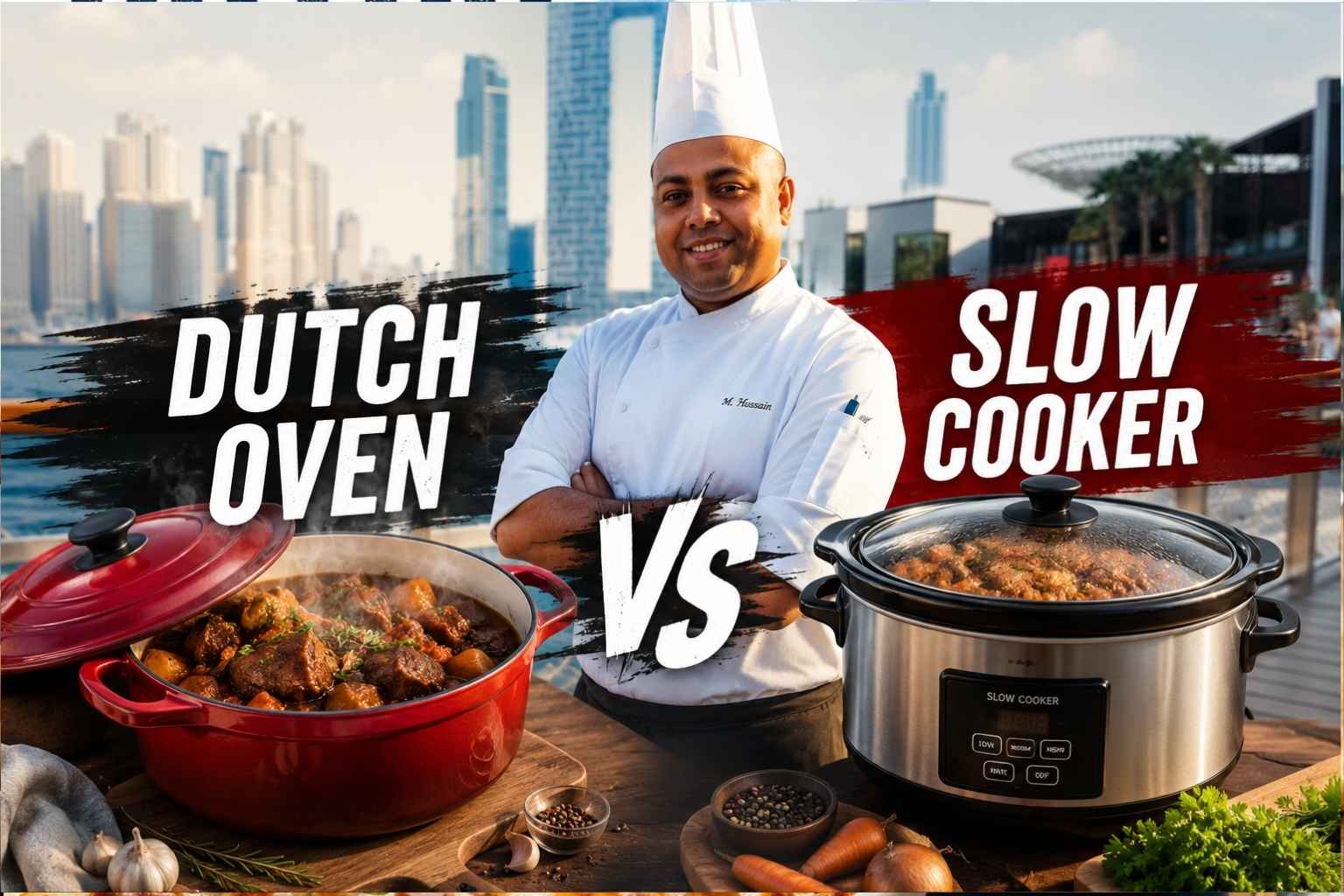
I still remember the day I had to pick just one pot for a tiny kitchen move. My hands hovered between my heavy Dutch oven and my trusty slow cooker, and my heart just sank. That’s the real fight behind Dutch Oven vs Slow Cooker: two kitchen heroes, one hard choice. I’ve cooked with both for years, tested them side by side, and burned a few dinners along the way to learn what works. Stick with me, and I’ll help you pick the right pot so your next meal turns out just right.
What Is the Real Difference Between a Dutch Oven and a Slow Cooker?
A Dutch oven is a heavy pot, usually cast iron with an enamel coating, that you can use on the stovetop and in the oven. A slow cooker is an electric appliance with a ceramic insert that holds a low, steady heat for hours.
I’ve used both almost every week for over 15 years, in restaurant kitchens and at home. The short version: a Dutch oven gives you control. A slow cooker gives you time back.
The Dutch oven can hit high heat for searing, then drop to a slow braise in the oven. The slow cooker can only do the slow part. That single fact drives almost every decision in this guide.
What’s Actually Happening Inside Each Pot While You Cook
Heat Retention and How Each Pot Holds Temperature
A Dutch oven holds heat because cast iron is dense and thick. Once it’s hot, it stays hot, even after you open the oven door (Lodge Cast Iron, 2024).
A slow cooker’s ceramic insert heats more slowly and holds a lower, gentler temperature. Most models sit between 170°F and 280°F depending on the setting (America’s Test Kitchen, 2022).
This matters because cast iron can recover heat fast after you add cold ingredients. A slow cooker can’t. Add a bag of frozen vegetables to a slow cooker and the whole cook slows down.
Evaporation and Why Your Sauce Thickens (or Doesn’t)
A Dutch oven, especially with the lid cracked or off, lets steam escape. That means liquid reduces, flavors concentrate, and sauces thicken on their own.
A slow cooker is a sealed system. The lid traps almost all the moisture, so liquid doesn’t reduce much. That’s why slow cooker recipes often call for less liquid than you’d expect, or ask you to thicken with a cornstarch slurry at the end (Serious Eats, 2023).
I learned this the hard way early in my career. I used a slow cooker recipe but cooked it in a covered Dutch oven in the oven. The dish came out watery because too much liquid evaporated… wait, actually the opposite happened. The Dutch oven, tightly lidded, behaved more like the slow cooker and didn’t reduce as planned. The lesson: lid position and pot type both change your results.
Browning and Searing: The Step a Slow Cooker Can’t Do
A Dutch oven can go from zero to 450°F on a stovetop burner. That heat lets you sear meat, building a brown crust through the Maillard reaction.
A slow cooker can’t get hot enough, fast enough, on its own. Most models cap out around 300°F on high, and even that takes a long time to reach (Cook’s Illustrated, 2023). You can’t sear in it.
Why Searing and Fond Actually Matter for Flavor
Fond is the browned bits stuck to the bottom of a pan after searing meat. It’s packed with concentrated flavor compounds from the Maillard reaction – the browning that happens when proteins and sugars meet high heat.
When you sear chicken thighs or beef chunks in a Dutch oven, then deglaze the pot with wine or stock, you scrape up that fond and dissolve it into your braising liquid. That’s free flavor you’re adding to the dish.
A slow cooker skips this step entirely unless you sear in a separate pan first. Many slow cooker recipes tell you to “brown the meat in a skillet before adding to the slow cooker” – and that step exists for exactly this reason.
Skip it, and your chili or pot roast will taste flatter and more boiled than roasted. I’ve tasted hundreds of versions of the same chili recipe, and the seared one always wins a blind taste test.
Dutch Oven vs Slow Cooker: Full Comparison Table
| Factor | Dutch Oven | Slow Cooker |
|---|---|---|
| Cooking method | Stovetop searing + oven or stovetop braising | Low, steady electric heat in a sealed insert |
| Heat source | Gas, electric, induction burner, or oven | Built-in electric heating element |
| Temperature range | 200°F to 500°F+ | 170°F to 300°F |
| Typical cook times | 1.5 to 4 hours | 4 to 10 hours |
| Energy use | Higher per hour, shorter total time | Lower per hour, longer total time |
| Price range | $70 to $400 | $30 to $150 |
| Best use cases | Searing, braising, soups, bread, beans | Hands-off meals, all-day cooking, tough cuts |
Dutch Oven vs Slow Cooker by Cooking Method
Stovetop Searing Plus Oven Braising
This is where the Dutch oven wins outright. You sear meat on the stovetop, add vegetables and liquid, then move the whole pot to the oven for a long, even braise.
The oven’s ambient heat surrounds the pot from all sides, so the dish cooks evenly without you stirring or checking it constantly. I do this with short ribs, lamb shanks, and pork shoulder almost every week in winter.
A slow cooker can’t replicate the oven’s even, surrounding heat in the same way, and it definitely can’t sear first.
Soups and Stews
Both pots work well here, but they produce different results. A Dutch oven on the stovetop lets you control heat in real time – bring it to a boil, then drop to a simmer in seconds.
A slow cooker takes a more hands-off approach. You can load it in the morning and have soup ready by dinner, with almost no attention needed.
For a soup with delicate vegetables, I prefer the Dutch oven because I can pull it off heat the moment everything’s tender. A slow cooker tends to overcook softer vegetables like zucchini or peas by the time the tougher ingredients are done.
Beans and Grains
A Dutch oven cooks dried beans faster and gives you more control over texture – you can check them every 20 minutes and pull them right when they’re creamy but not mushy.
A slow cooker is more forgiving for beans because there’s less risk of scorching or boiling over, but it takes much longer (often 6-8 hours on low) and the texture is harder to fine-tune.
For grains like rice or farro, I almost never use a slow cooker. The texture comes out gummy more often than not. A pot on the stovetop, or a Dutch oven in the oven for pilaf-style rice, gives a much better result.
Bread Baking
This one isn’t close. A Dutch oven, preheated in a hot oven, creates a mini steam oven that gives crusty artisan bread its signature crackly crust (King Arthur Baking, 2023).
A slow cooker cannot do this. It doesn’t get hot enough, and the sealed, moist environment is the opposite of what crusty bread needs.
“Set It and Forget It” Meals
This is the slow cooker’s home turf. Pulled pork, beef stew, and chicken chili all do well when you load the pot in the morning and walk away for 8 hours.
A Dutch oven can technically do a long oven braise, but you can’t leave the house with your oven on for 8 hours the way you can with a slow cooker. Most slow cookers are designed and rated for unattended use (Crock-Pot, 2024).
Energy Use, Cost, and Time: The Real Numbers
A slow cooker on low typically draws 150-210 watts. Run for 8 hours, that’s roughly 1.2 to 1.7 kWh total (Crock-Pot, 2024).
An oven, which you’d use with a Dutch oven for a braise, draws around 2,000-5,000 watts but for a much shorter time – usually 2-3 hours. That works out to roughly 4-15 kWh, depending on your oven and the dish.
So for long braises, the slow cooker uses noticeably less electricity. But the Dutch oven cooks the same meal in half the time or less, which matters if you’re cooking dinner after work instead of starting it before you leave for the day.
On upfront cost, a good slow cooker runs $30-$150. A quality enameled cast iron Dutch oven runs $70-$400, with premium brands like Le Creuset and Staub at the top end (Lodge Cast Iron, 2024). A basic cast iron or plain enamel Dutch oven from a brand like Lodge can be found for $50-$80.
Texture and Flavor: Same Recipe, Two Pots
Pot Roast
In a Dutch oven, I sear the roast hard on all sides first, building a deep brown crust. Then I braise it in the oven with stock, wine, and vegetables for about 3 hours. The result: a roast with a rich, almost caramelized exterior and a deeply flavored sauce that’s already thickened from reduction.
The slow cooker version, made without searing, comes out softer and more uniform in texture, but the flavor is noticeably milder. The sauce stays thinner unless you thicken it separately.
Both are good. But if you’ve had the seared version, the unseared one tastes like it’s missing something – because it is.
Chili
Dutch oven chili, where I brown the beef in batches first, has a deeper, almost smoky flavor from the fond. The chili also reduces and thickens naturally as it simmers uncovered for the last 30 minutes.
Slow cooker chili is easier – dump everything in, walk away. But it tends to taste “boiled” rather than browned, and it’s often thinner unless you stir in a thickener at the end.
Chicken Thighs
Seared chicken thighs in a Dutch oven get crispy skin before braising, and that crispy-then-braised contrast is something a slow cooker simply can’t produce. Slow cooker chicken thighs come out fall-apart tender, but the skin turns soft and rubbery, not crispy.
If skin texture matters to you, sear the thighs in a skillet first, then transfer to either pot. The Dutch oven holds onto more of that crispness because of the dry environment in the oven.
Which One Should Beginners Choose?
A slow cooker is more forgiving for someone just starting out. You can’t really overcook most slow cooker recipes on low, and there’s very little risk of burning food to the bottom of the pot.
A Dutch oven asks more of you. You need to manage heat on the stovetop, watch for scorching, and learn how searing changes a dish. That’s a skill, and skills take practice.
My advice: if you’re new to cooking, start with a slow cooker for weeknight meals, and use a Dutch oven on weekends when you have time to stand at the stove and pay attention. As your comfort grows, the Dutch oven will start to feel less like extra work and more like extra flavor.
Maintenance, Durability, and Lifespan
Caring for Cast Iron and Enamel
A bare cast iron Dutch oven needs seasoning – a thin layer of oil baked onto the surface to prevent rust. After cooking, wash it with hot water (mild soap is fine on enameled cast iron), dry it completely, and for bare cast iron, rub on a light coat of oil.
Enameled cast iron, like Le Creuset or Staub, doesn’t need seasoning, but the enamel can chip if you drop it or bang it against something hard. Avoid metal utensils that scratch the enamel surface.
With basic care, a cast iron or enameled cast iron Dutch oven can last 20-30 years or longer. I have a Dutch oven from early in my career that’s still my go-to pot today.
Caring for a Slow Cooker
The ceramic insert is usually dishwasher-safe, which makes cleanup easy. But the insert can crack if you put a hot insert into cold water, or if you drop it.
The electrical base and heating element are the weak point. Most slow cookers last 5-8 years before the heating element wears out or the temperature control becomes unreliable (America’s Test Kitchen, 2022).
Common Mistakes With Each Pot (and How to Fix Them)
Mistake: Using a Slow Cooker Like a Dutch Oven
People dump raw meat and vegetables into a slow cooker expecting Dutch-oven-level flavor. The result is often bland and watery.
Fix: Sear the meat in a skillet first, and sauté onions and garlic before adding everything to the slow cooker. This takes an extra 10 minutes but makes a real difference.
Mistake: Using a Dutch Oven Like a Slow Cooker
Some people put a Dutch oven on low heat for hours on the stovetop, unattended, expecting it to behave like a slow cooker. This risks scorching, since stovetop heat isn’t as gentle or even as a slow cooker’s element.
Fix: If you want a long, hands-off braise, use the oven at a low temperature (275-300°F) instead of the stovetop. The oven surrounds the pot with even heat, much closer to how a slow cooker works.
Mistake: Overfilling Either Pot
Both pots need room for liquid to circulate and, in the Dutch oven’s case, room for some evaporation. Overfilling a slow cooker can also cause it to take longer to reach a safe temperature, since the contents take longer to heat through.
Fix: Fill a slow cooker no more than two-thirds full. For a Dutch oven, leave at least an inch of space below the rim.
Mistake: Lifting the Slow Cooker Lid Constantly
Every time you lift the lid, you let out heat and add 15-20 minutes to your cook time. I’ve seen home cooks check a slow cooker five or six times during a single cook.
Fix: Trust the recipe’s timing. Lift the lid only to stir or check doneness near the end.
Mistake: Not Adjusting for Altitude
At higher elevations, water boils at a lower temperature, so braises and beans take longer in both a Dutch oven and a slow cooker. Above 3,000 feet, add 25-50% more time and check for doneness rather than relying on the clock (Cook’s Illustrated, 2023).
Fix: Test for tenderness with a fork rather than trusting the stated time, especially for beans and tougher cuts of meat.
Mistake: Choosing the Wrong Pot for Your Kitchen Size
A large Dutch oven (7 quarts or more) is heavy and takes up significant cabinet space. If you’re in a small kitchen with limited storage, a 5-6 quart size is often more practical and still handles most recipes for four to six people.
Fix: Measure your cabinet space before buying, and consider a smaller Dutch oven if storage is tight. A slow cooker, by contrast, is lighter and often comes with a more compact footprint for its capacity.
My Personal Routine: When I Reach for Each Pot
On weeknights, when I get home from a long shift and need dinner fast, I reach for whatever I started in the slow cooker that morning. I throw pork shoulder, onions, and a spice rub in before I leave for work, and by the time I’m home, it’s ready to shred.
On weekends, the Dutch oven comes out. I’ll sear a chuck roast hard, build a fond with red wine and tomato paste, and let it braise in the oven for three hours while I do other things around the house. The smell alone is worth the extra effort.
I keep a 6-quart enameled Dutch oven and a 6-quart slow cooker side by side in my kitchen, and I use both almost every week. They’re not competitors – they solve different problems. The Dutch oven is for when I have time and want maximum flavor. The slow cooker is for when I don’t have time but still want a real meal.
One specific memory: I once tried to make French onion soup in a slow cooker to save time. The onions never developed that deep caramel color because the slow cooker doesn’t get hot enough for true caramelization, which needs direct, high heat. I ended up finishing them in a skillet anyway. Lesson learned – some steps just need real heat.
Frequently Asked Questions
Can I sear meat in a slow cooker?
No. Most slow cookers don’t reach the temperatures needed for searing, even on high. Sear meat in a skillet or Dutch oven first, then transfer it to the slow cooker.
Is a Dutch oven worth the higher price?
Yes, if you cook often. A quality Dutch oven can last 20-30 years with basic care, which makes the cost per use very low over time (Lodge Cast Iron, 2024).
Can I use a Dutch oven on an induction stovetop?
Most enameled cast iron Dutch ovens work on induction, since cast iron is magnetic. Check the manufacturer’s specifications to confirm before buying.
How do I convert a Dutch oven recipe to a slow cooker?
Reduce the liquid slightly, since slow cookers don’t let moisture evaporate. Cooking on low for 6-8 hours is roughly equivalent to a 2-3 hour oven braise. Sear the meat separately first for the best flavor.
Why did my slow cooker meal come out watery?
Slow cookers trap almost all moisture, so liquid doesn’t reduce. If your recipe was written for a Dutch oven or stovetop, cut the liquid by about 25% or remove the lid for the last 30 minutes to let steam escape.
Can a slow cooker replace a Dutch oven completely?
Not for searing, browning, or bread baking. It’s a great tool for hands-off braises and stews, but it can’t do everything a Dutch oven does.
Which pot is better for small kitchens?
A slow cooker generally takes up less storage space than a large Dutch oven and is lighter to handle. If storage is tight, consider a smaller 5-6 quart Dutch oven instead of a 7+ quart size.
Do I need both a Dutch oven and a slow cooker?
Not strictly, but they cover different needs. If you mostly cook on weekends with time to spare, a Dutch oven covers more ground. If your weekdays are tight, a slow cooker fills that gap well.
Key Takeaways
- A Dutch oven sears, browns, and braises. A slow cooker only simmers at a low, steady temperature.
- Searing builds fond, and fond is where a lot of flavor comes from – skipping it makes dishes taste flatter.
- Dutch ovens cost more upfront but can last 20-30 years. Slow cookers cost less but typically last 5-8 years.
- For the same recipe, Dutch oven versions usually have deeper flavor and thicker sauces; slow cooker versions are easier but milder and thinner.
- Beginners often do better starting with a slow cooker, then adding a Dutch oven as their stovetop skills grow.
- At higher altitudes, both pots need extra cook time – test for doneness instead of relying on the clock.
- The best kitchens often have both pots, used for different jobs on different days.

I’m Mossaraof, a trained chef and the founder of OvenInsights.com. I spent years cooking at Larrupin’ Cafe and in kitchens across Chicago and Seattle. Now I test kitchen gear for a living. I moved to North Acton, London, and I test every tool I write about. I use real meals and real heat. No brand deals. No shortcuts. I cover 12 kitchen types and hundreds of recipes. I believe this: the right tools matter as much as the recipe.