
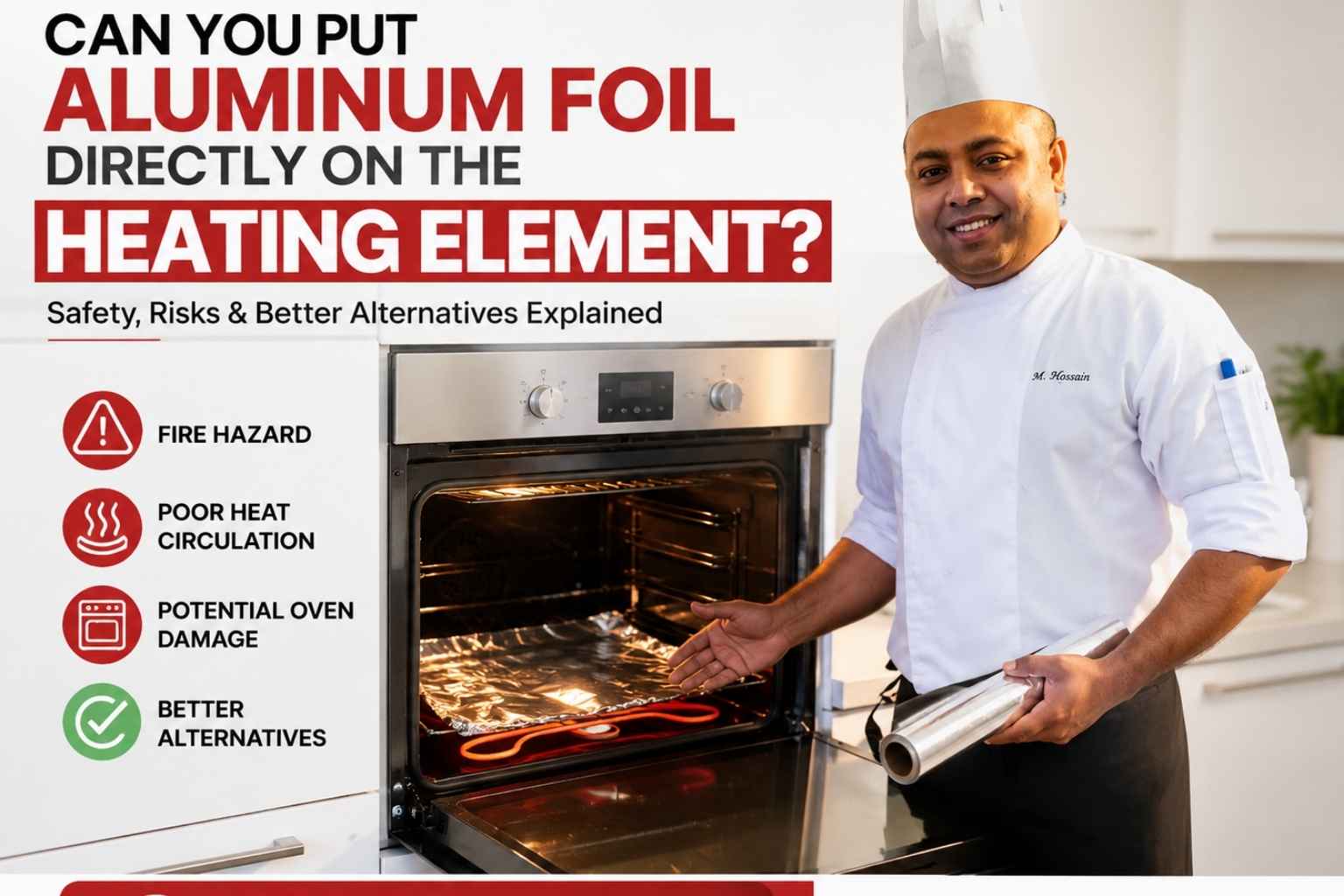
Quick Answer
- No. Never lay foil right on a heating part, in any oven.
- Foil on a bare coil can cause sparks, melted foil, and a burned-out coil (GE, 2024; Whirlpool, 2023).
- Gas ovens have a fire risk too. Foil can block air flow and heat vents.
- Foil on a rack or the oven floor, kept clear of the hot part, is fine.
- The safe fix: put foil on the rack below your dish, or grab a sheet pan.
I still remember the day I almost melted my oven’s heating element with a shiny sheet of foil. Smoke curled up, and my heart sank fast! So today, let’s answer the big question: can you put aluminum foil directly on the heating element? I’ve tested this in my own kitchen more times than I can count, and I’ll share what really works. Stick with me, and you’ll keep your oven safe and your food tasting great.
Can You Put Foil on the Heating Part? The Direct Answer
No. Foil should never touch a heating part. This holds true for gas or electric, hidden or in plain sight. It is one rule I do not bend. Not in my own kitchen, and not in any home kitchen I have walked into.
Every big oven brand says the same thing. GE tells owners not to line the oven floor or lay foil on any hot part (GE Appliances, 2024). Whirlpool’s care guide gives the same warning for its ranges (Whirlpool, 2023). Samsung and Bosch print near the same line in their guides (Samsung, 2023; Bosch, 2022).
The reason is simple. Foil sends heat right back at what it touches. Put it on a rack, and it just blocks some air. Put it right on the coil, or lay it over a hidden coil under a flat glass top, and the heat has no place to go. That heat builds up fast, right at the part meant to give it off.
What Actually Happens When Foil Touches a Hot Coil
Heat Gets Trapped, Not Let Out
A heating coil is built to give off heat in all directions. Foil breaks that. It sends heat back at the coil, not out into the air. The coil then runs far hotter than it was built for, in one small spot, not spread out.
Electric Coils Can Spark
On a bare coil, foil that touches the metal can open a short path for power to jump. This is called arcing: a small, hot spark that jumps between two spots. Arcing can melt foil, pit the coil, and in some cases start a small fire in the oven (Underwriters Laboratories, 2021).
Hidden Coils Can Fail Early
Flat-top and hidden-coil ovens tuck the coil under a metal floor or a glass top. Foil laid on the oven floor over a hidden coil traps heat right against that floor. Repair techs see early coil failures and warped floor parts tied to this exact slip-up (Repair Clinic, 2023).
Gas Ovens Bring a Different Risk
Gas ovens use a flame, not a glowing coil. Foil near a gas burner or broiler can block the flame’s air and its heat sensor. A blocked sensor can throw off oven temps. In rare cases, it can make a flame burn in an uneven way (National Fire Protection Association, 2022).
A gas flame needs a clean, steady flow of air to burn right. Foil that sits too close cuts off part of that flow. The flame then burns lopsided, or it may not reach full heat at all. Your food ends up under-cooked in spots, over-cooked in others, and you may not know why until you check the flame itself.
Foil Risk by Oven Type: Quick Reference Table
| Oven / Part Type | Risk Level | Why |
|---|---|---|
| Bare electric coil (in plain sight) | High | Direct touch can cause sparks, melted foil, and coil damage |
| Hidden coil (flat top or oven floor) | High | Trapped heat warps the floor part and cuts the coil’s life short |
| Gas bake part (flame under a panel) | Medium-High | Foil can block air flow and throw off the heat sensor |
| Gas broiler (open flame, top part) | High | Foil right on this spot near the flame is a fire risk |
| Foil on a rack, below the dish, off any hot part | Low | Normal use. Keep it clear of any heat source |
Big Brand Warnings: Why They All Say the Same Thing
GE
GE’s owner guides ask users not to line any part of the oven, floor included, with foil (GE Appliances, 2024). The stated reason: trapped heat can hurt the finish and the coil.
Whirlpool
Whirlpool’s advice is close to word for word the same. Its guides warn that foil can trap heat, hurt the oven’s inner shell, and cause lasting harm not covered by the warranty (Whirlpool, 2023).
Samsung
Samsung’s range guides list foil lining as an act that cancels the warranty. The brand points to shell damage, plus fire risk from trapped heat, as the cause (Samsung, 2023).
Bosch
Bosch’s care guide gives the same warning for its built-in ovens. It adds that foil on a hidden coil can also throw off the oven’s heat sensor, so your food may cook in an uneven way (Bosch, 2022).
Gas vs. Electric Coil vs. Hidden Coil: Not the Same Risk
It helps to think of these as three, not one.
Bare electric coil: This is the most direct risk. Foil on bare, glowing metal can spark, melt, and pit the coil in one use.
Hidden or flat-top coil: The coil sits under a floor panel here, so you will not see a spark. What you get instead is a slow build-up of heat that warps the panel and wears the coil out early.
Gas bake or broiler: There is no coil to spark, but trapped foil can choke off air to the flame, or block a sensor. That throws off your oven’s heat level and adds a fire risk near the open flame.
What Can Go Wrong: The Real Costs
- Coil burnout. A hurt coil often needs a full swap, which can run $100 to $250 in parts and work time (Repair Clinic, 2023).
- Fire risk. Melted or burnt foil near a hot part is a known cause of small kitchen fires (National Fire Protection Association, 2022).
- Lost warranty. Each brand above treats foil harm to a coil as user error, not a fault they will fix free of charge.
- Hurt inner shell. Trapped heat can crack or stain the oven’s inner coat. That is costly to fix and often can’t be fully undone.
Safer Ways to Catch Drips
You do not need to skip foil for good. You just need to keep it off the hot part.
Foil on the Rack Below
Set a piece of thick foil on the rack right under your dish, with open space on all sides. This catches drips with no touch to any hot part.
Oven Liners
A reuse-ready, oven-safe liner made just for this job sits on the rack below your food. Pick one rated for your oven’s top heat, and keep it off the floor and clear of any hot part.
A Sheet Pan
My own go-to move. A rimmed sheet pan on the rack below a roast or a bubbling dish catches every drip. It washes clean in one pass and never touches a coil or a flame.
A Drip Tray or Broiler Pan
If your oven came with a broiler pan or a drip tray, use it. These are built to sit at a safe height, off the flame or coil, and to hold hot fat and juice without warping. Skip the store box, and just wash it after each use.
Pick the Right Rack Height
Set your rack one level below where the food sits, not right at the oven floor. This keeps your catch-pan clear of the heat source below, gas or electric, and still close enough to catch every drip.
Already Done It? Here’s What to Check
- Turn the oven off and let it cool all the way before you touch a thing inside.
- Take out the foil with care. If it has melted or stuck to the coil or floor, do not pull hard. Call a repair tech first.
- Look for pits, warps, or stains on the coil or the floor panel.
- Do a smell test. A burnt-plastic or metal smell on your next use means stop, and call a tech before you run the oven again.
- Check the breaker. If the oven trips a breaker right after this, do not just reset it and run the oven. Get it checked first.
Stop using the oven if you see melted metal, a scorch mark that was not there before, or if the coil glows in an uneven way during a test run.
Common Mistakes and Fixes
- Mistake: Lining the whole oven floor with foil to “catch it all.” Fix: Use a sheet pan or a liner on the rack. Never the floor.
- Mistake: Wrapping foil right around a broiler part to “bounce back heat.” Fix: Never wrap any hot part. Use a broiler pan built for the job.
- Mistake: Thinking a flat-top oven is safer since you can’t see the coil. Fix: Hidden coils trap heat just as fast. Treat them the same as a bare coil.
- Mistake: Leaving scorched foil in place after a spill. Fix: Pull off burnt foil right away, then check the spot below it before your next bake.
A Chef’s Take: What I Use Instead
Years back, in a hotel kitchen, a new cook lined an oven floor with foil to cut down on clean-up before a busy brunch shift. In under twenty minutes, we caught a burning-metal smell and had to shut the unit down mid-shift, right as orders were stacking up.
That oven needed a new coil. It cost us the better part of a week at full output while we waited on the part. Since then, my rule in every kitchen I run stays simple: sheet pans on the rack below, never foil on the floor or the coil. It is one habit that costs you nothing and saves a repair bill down the road.
I have trained more than a few line cooks who thought foil on the floor was just good sense. It is not. It is the single most common oven mistake I have seen walk through a kitchen door.
In a busy kitchen, we run our ovens hard, day in and day out, so a bad habit shows up fast. In a home kitchen, the same slip-up just takes longer to show its face. The oven may run fine for weeks, then one day the coil gives out mid-bake, or a scorch mark shows up on the floor panel out of nowhere. By the time you see it, the harm is often done.
I also tell home cooks the same thing I tell new hires: a clean oven is not worth a burnt coil. Wipe up spills once they cool, run a self-clean cycle if your oven has one, and skip the urge to “foil-proof” the whole box. A ten-minute wipe-down beats a repair call every time.
If you roast a lot of fatty cuts, like a whole chicken or a pork shoulder, drips are part of the job. That is exactly why a rack-level pan matters more in your kitchen than in a light-use oven. Set the habit now, before a drip turns into a bigger problem.
Frequently Asked Questions
Can you put aluminum foil directly on the heating part?
No. Foil that touches a heating part, gas or electric, can trap heat, cause sparks on a bare coil, and add a fire risk in any oven type.
Is it safe to line the bottom of my oven with foil?
No, for most ovens. Guides from GE, Whirlpool, Samsung, and Bosch all warn against lining the oven floor. It traps heat against a hidden coil or blocks gas air flow.
What happens if foil touches an electric coil?
It can melt, spark, and pit the coil’s face. A spark is a small jump of power that can hurt the coil, and in rare cases, start a fire.
Does foil on the rack below my food carry the same risk?
No. Foil on a rack, kept off any hot part or flame, is a normal, safe way to catch drips.
Will foil on a heating part cancel my oven’s warranty?
Often, yes. Samsung and Whirlpool both list foil-based heat harm as user error, which most warranty plans will not cover (Samsung, 2023; Whirlpool, 2023).
How do I know if my oven’s coil is already hurt from foil?
Look for melted metal, pits, warps, or a burnt smell during use. Any one of these means stop use and call a repair tech.
Is a gas oven safer than an electric one for foil use?
Not by much. Gas ovens trade spark risk for a new one: blocked air near the flame, and a chance of fire if foil sits too close to the burner or broiler.
What should I use in place of foil to catch spills?
A sheet pan or an oven-safe liner set on the rack below your dish. Both catch drips with no touch to any hot part.
Key Takeaways
- Never lay foil right on a heating part, gas or electric, hidden or in plain sight.
- Bare coils risk sparks and burnout. Gas ovens risk blocked air and a fire hazard near the flame.
- Guides from GE, Whirlpool, Samsung, and Bosch all warn against foil on the oven floor or a hot part.
- Use a sheet pan or a rack-level liner in its place. Keep it clear of any heat source.
- If you have already lined your oven with foil, let it cool, check for harm, and call a tech if you see melted metal, pits, or a burnt smell.