At A Glance
- Yes, most Dutch ovens are oven-safe, but the maximum temperature depends entirely on the material and the lid knob — not the pot itself.
- Bare cast iron (like Lodge) handles temperatures up to 500°F and beyond. Enameled cast iron (like Le Creuset and Staub) is safe up to 500°F for the pot, but the lid knob may cap you at 375°F or 480°F depending on the model.
- Ceramic and aluminum Dutch ovens are generally not rated for high-heat oven work and should stay below 400°F in most cases.
- The lid, not the pot, is almost always the weak point — phenolic (plastic) knobs melt above 375°F-400°F; always check before you preheat.
- Never put a cold Dutch oven directly from the fridge into a screaming-hot oven — thermal shock can crack enamel, sometimes on the first offense.
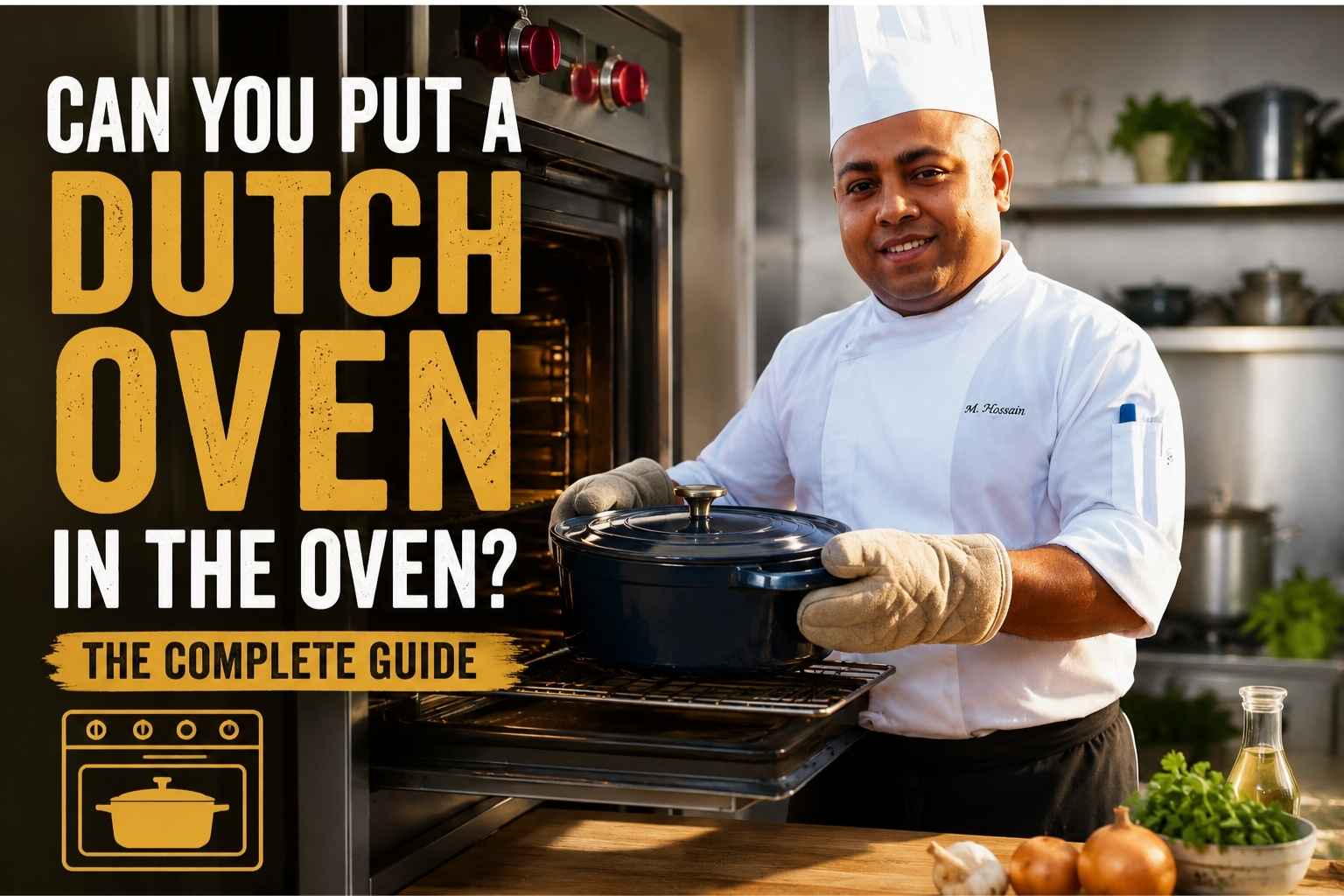
I used to stare at my heavy cast iron pot and wonder, can you put a Dutch oven in the oven? It felt like a silly thing to worry about until I tried baking my first loaf of sourdough bread in it. Honestly, that crusty, bakery-style bread changed my entire kitchen game forever. Now, I use this pot for almost every single cozy dinner I make, and you can easily do the exact same thing too. Let’s look at how this simple kitchen tool can safely transform your next home-cooked meal.
Yes, But the Material Decides Everything
Most Dutch ovens are oven-safe. That’s the short answer. But “oven-safe” covers a wide range, and the difference between 375°F and 500°F matters enormously depending on what you’re cooking.
I’ve been cooking professionally for 17 years — hotel kitchens, private dining, catering, and now recipe development for my own platform. In that time, I’ve used Dutch ovens on gas burners, induction tops, wood-fired ovens, and standard home ranges. I’ve also cracked a lid, warped a cheap knob, and scorched enamel I couldn’t undo. Every one of those mistakes taught me something the manufacturer’s manual skipped over.
The material your Dutch oven is made from dictates its ceiling temperature, how it responds to sudden heat changes, and whether it’ll last 40 years or fall apart in four. Get this part right and everything else is straightforward.
Dutch Oven Types and Oven Safety at a Glance
Use this table as your first reference before putting any Dutch oven in the oven. The temperatures listed are the manufacturer-rated maximums for the pot body. Lid knobs are addressed separately below.
| Material | Max Oven Temp (Body) | Lid Oven-Safe? | Notes |
|---|---|---|---|
| Bare cast iron | 500°F+ (no upper limit for most) | Yes — cast iron lids are safe | Safe under broiler without lid. Season regularly. |
| Enameled cast iron | 500°F (Le Creuset, Staub) | Check knob type — see below | Enamel can chip above 500°F or with thermal shock. |
| Ceramic (glazed) | Up to 400°F typically | Check glaze rating | Not rated for stovetop-to-oven transfers in most cases. |
| Stainless steel | 500°F+ for most models | Depends on handle material | Lids with plastic or silicone handles may cap at 350°F. |
| Aluminum (non-anodized) | 400°F max typically | Usually not | Warps at high heat; not built for oven braising. |
| Enameled steel (budget) | 350°F-400°F typically | Often no | Thin walls lose heat quickly; enamel chips easily. |
(Temperature ratings compiled from Lodge, Le Creuset, Staub, and Cuisinart product documentation, 2025.)
Temperature Limits by Dutch Oven Type — And What Happens When You Go Too Far
Bare Cast Iron: The High-Heat Workhorse
Bare cast iron has no meaningful upper temperature limit for home cooking. Lodge rates their cast iron ovens-safe up to 500°F on the product body, but the real ceiling is whatever your oven can produce (Lodge Manufacturing, 2025). I’ve had bare cast iron Dutch ovens at 550°F for bread baking without any damage — and they came out better seasoned than when they went in.
The one exception: bare cast iron lids with a steel loop handle are equally bombproof. But if someone has swapped in a silicone or wooden knob as an aftermarket mod, that piece is the limit.
Enameled Cast Iron: The 500°F Line
Le Creuset and Staub both rate their enameled Dutch ovens to 500°F for the pot body (Le Creuset, 2025; Staub, 2024). That covers virtually every home oven task, including bread baking at 450°F-500°F.
Where people get into trouble is the enamel itself. Enamel is a glass coating fused to cast iron. Above 500°F, that coating can start to dull, discolor, or — if there’s a sudden temperature drop — crack. I learned this when I shoved a screaming-hot Le Creuset into the sink and hit it with water to speed up cleaning. The interior enamel cracked in two places. The pot still works, but I think about that mistake every time I pull it out.
Thermal shock is the enemy of enamel, not sustained high heat alone. Let the pot cool on a trivet before washing.
Ceramic Dutch Ovens: Handle With Care
Glazed ceramic Dutch ovens like those from Emile Henry are oven-safe to around 500°F for the oven-specific models, but the standard stovetop-to-oven transfer can stress the glaze if done carelessly (Emile Henry, 2024). Many budget ceramic pots max out at 400°F and are not designed for direct flame or high broiler exposure.
If your ceramic Dutch oven doesn’t have a clear oven-safe rating on the bottom or in the manual, treat 350°F as your ceiling until you confirm otherwise.
Stainless Steel: Safe, But Watch the Handles
All-Clad and similar stainless Dutch ovens are safe to 500°F for the pot (All-Clad, 2025). The lids are usually stainless too and safe at the same temperature. The catch is handles with plastic or silicone grips — those cap out around 350°F-400°F. If your stainless Dutch oven has all-metal construction, it’s oven-safe at any home temperature without restrictions.
Lids, Knobs, and Handles – The Parts People Forget to Check
This is where most oven accidents happen. The pot is fine. The knob melts.
Phenolic knobs — the black plastic knobs that come standard on many Le Creuset lids — are rated to 375°F (Le Creuset, 2025). Go over that, and the knob warps, discolors, or melts. Le Creuset sells a stainless steel knob replacement for around $15-20 that’s safe at any oven temperature. If you bake bread regularly at 450°F+, swap the knob before you forget.
Staub lids come with a brass or nickel-plated steel knob standard on most models, rated to 500°F (Staub, 2024). This is one reason I prefer Staub for high-heat bread baking — I don’t need to think about the lid.
Generic brands are the wildcard. I’ve tested Dutch ovens from brands I’d rather not name where the lid handle was some sort of resin composite with no temperature rating in the box at all. In those cases, I remove the lid for any oven work above 375°F, or I bake without it entirely.
If you’re not sure about your lid: remove it, or use an oven-safe silicone trivet to cover the pot loosely.
What You Can Actually Cook in a Dutch Oven in the Oven
Braising: 300°F-325°F for 2-4 Hours
A Dutch oven is the best braising vessel I’ve used in 17 years. The heavy lid traps steam, the thick walls hold heat evenly, and you can go from stovetop sear to oven braise in the same pot without losing the fond.
Typical temperatures: 300°F-325°F for most braises. Tougher cuts like short ribs or lamb shanks need 3-4 hours at 300°F. Chicken thighs are done in about 45 minutes at 325°F.
No-Knead Bread: 450°F-500°F Covered, Then Uncovered
Baking bread in a Dutch oven changed how I think about home bread production. The enclosed space traps steam during the first 20-25 minutes, which is what gives the crust its snap and the crumb its open structure.
My standard method: preheat the Dutch oven (empty, with lid on) at 500°F for 45 minutes. Drop the dough in — carefully — bake covered for 20 minutes at 500°F, then remove the lid and drop to 450°F for 20-25 more minutes. The result is a bakery-quality crust that a sheet pan cannot produce (America’s Test Kitchen, 2024).
This only works with bare cast iron or a stainless-knobbed enameled pot. A phenolic knob at 500°F is a problem.
Soups and Stews: 325°F-375°F
For soups and stews that start on the stovetop and finish in the oven, 325°F-375°F gives you the gentle, even heat that keeps proteins tender without over-reducing the liquid. An hour at 350°F for most chicken soups; two or more hours for beef-based stews.
Whole Chickens and Roasts: 350°F-425°F
A 4-pound chicken fits comfortably in a 5.5-quart Dutch oven. Roast covered at 375°F for the first 45 minutes to trap steam and cook the meat through, then remove the lid for the final 20-25 minutes to crisp the skin. Internal temperature should reach 165°F at the thigh (USDA Food Safety and Inspection Service, 2024).
For beef roasts, I prefer 325°F for 3-4 hours covered, finishing at 425°F uncovered for 15 minutes to develop the crust.
Casseroles: 350°F-375°F
Any casserole that benefits from a braised texture — white beans with sausage, cassoulet, baked pasta — works well in a Dutch oven. The heavy walls prevent the scorching you get with thinner baking dishes. Cover for most of the cook time; uncover for the last 20 minutes if you want a crust on top.
Brand-by-Brand Breakdown: What I Trust and Why
Lodge (Bare Cast Iron)
Lodge is my workhorse pick for bread baking and any high-heat oven work. The 6-quart bare cast iron Dutch oven runs around $70 and is rated for any temperature your home oven produces (Lodge Manufacturing, 2025). There’s no enamel to worry about, no knob to melt, and the seasoning improves every time you use it. The downside: you can’t cook acidic foods (tomatoes, wine reductions) for long periods without stripping the seasoning.
Le Creuset (Enameled Cast Iron)
Le Creuset’s 5.5-quart Dutch oven is the most-used piece in my personal kitchen. The enamel interior makes it easier to clean, acid-safe, and better for braising than bare cast iron. The pot is rated to 500°F. The standard black phenolic knob, however, caps at 375°F, so I replaced mine with the stainless steel knob years ago (Le Creuset, 2025). Yes, the price is high — around $380-420 at retail — but mine is 11 years old and shows no wear beyond a small chip near the handle I caused myself.
Staub (Enameled Cast Iron)
Staub is my pick for bread baking among enameled pots, specifically because the standard knob is metal and rated to 500°F (Staub, 2024). The black matte interior enamel also holds up better visually over time compared to Le Creuset’s cream interior, which stains with regular use. Comparable price to Le Creuset — around $300-400 for the 5.5-quart — and equally long-lasting.
Cuisinart (Enameled Cast Iron)
Cuisinart’s enameled Dutch ovens perform well for braising and everyday oven cooking at a lower price point than Le Creuset or Staub (around $80-120). I’ve tested the 5-quart model over 18 months and found the enamel to be durable at temperatures up to 450°F. The knob is stainless on most current models, which removes the temperature-limit headache. For home cooks who don’t want to spend $400, this is the most practical option.
Amazon Basics and Generic Brands
I’ve tested several of these and my honest take: the pots are fine for slow braises at 325°F-350°F. The enamel quality is thinner, the wall mass is lower, and the lid knobs and handles are frequently unrated or rated only to 350°F. I wouldn’t use them for bread baking at 500°F or any sustained high-heat work. If you’re on a tight budget and only plan to braise, they’ll hold up. Don’t expect them to perform like a Lodge or Staub.
When NOT to Put a Dutch Oven in the Oven
- The lid has a plastic or wooden handle with no oven-safe rating. Remove the lid or don’t use the oven above 350°F.
- The pot has a “stovetop only” label or no oven-safe temperature listed in the manual.
- The enamel is cracked, chipped, or has exposed cast iron underneath. Damaged enamel can continue to chip or allow moisture into the cast iron, causing rust to form inside the pot.
- The pot is made from thin enameled steel (common in budget sets sold as Dutch ovens). These are really just stockpots with lids — not built for oven use.
- You’re using a non-stick-coated Dutch oven. Most non-stick coatings degrade at temperatures above 400°F-450°F and can off-gas if overheated (American Cancer Society, 2024). Check the manufacturer’s rated limit specifically.
Broiler Rules: What I Actually Do
A Dutch oven under the broiler is a bad idea in almost every situation. Here’s why:
The broiler produces direct radiant heat above 550°F-600°F in most home ovens. That’s above the safe limit for enameled cast iron and well above what most lid hardware is rated for. I’ve seen broiler-cracked enamel in professional kitchens, and it’s not repairable.
For bare cast iron without enamel, broiling is technically fine for the pot. But the intense, uneven top heat makes it poor for most Dutch oven tasks anyway — braising, stewing, and bread baking all benefit from even, enclosed heat, not direct overhead flame.
The one exception I make: after a braise is done, I sometimes remove the lid, pull the pot to the top rack, and hit it with 60-90 seconds of broiler heat to brown the top layer of meat or crisp the surface of a casserole. I do this only with a Lodge bare cast iron pot or a Staub with a metal knob. I stay at the oven the entire time. One minute under a broiler can go from “golden” to “burnt” faster than you’d think.
Care After Oven Use: Cooling, Cleaning, and Thermal Shock
Let It Cool First
This is the rule I broke to ruin my Le Creuset interior. After high-heat oven use, set the Dutch oven on a dry trivet or folded towel and let it cool to room temperature before washing. For a pot that’s been at 500°F, that means 30-45 minutes of rest.
Running cold water onto a hot enameled pot creates thermal shock — a sudden temperature change that the glass enamel can’t absorb evenly. The result is hairline cracks in the enamel that grow over time.
Cleaning Enameled Cast Iron After Oven Use
Once the pot is cool: warm soapy water and a nylon brush. That’s it for most oven cooking. If there are stuck bits, fill the pot with water, bring it to a simmer on the stovetop for 2-3 minutes, then wipe clean. Never use metal scourers on enamel — they scratch the surface and create nucleation points for future chips.
For stubborn staining on the enamel interior, a paste of baking soda and water left for 15 minutes before scrubbing clears most discoloration without damaging the surface (Cook’s Illustrated, 2024).
Cleaning Bare Cast Iron After Oven Use
After the pot cools, scrape out any food residue with a stiff brush or a chain mail scrubber. Rinse with hot water — dish soap in small amounts is fine, despite what you may have read; it won’t strip seasoning with normal use. Dry the pot immediately and thoroughly over low heat on the stovetop, then wipe with a thin layer of neutral oil before storing. A damp cast iron pot stored in a cabinet will rust within days.
My Personal Dutch Oven Routine
For bread baking, I use a Lodge 6-quart bare cast iron Dutch oven exclusively. I preheat it empty at 500°F for 45 minutes on the lower-middle rack, then drop in a scored no-knead loaf using a parchment sling. Covered for 20 minutes at 500°F, uncovered for 22 minutes at 450°F. The crust comes out crackling like a baguette from a deck oven. Nothing else in my home kitchen replicates that result.
For braising, I use a 6.75-quart Le Creuset round Dutch oven with a stainless knob replacement. I sear on the stovetop over high heat, build the braise liquid, then move the whole pot into the oven at 300°F-325°F. I check at 90 minutes and usually have another 1-2 hours to go for tougher cuts. The enameled interior makes cleanup faster than bare iron, and I can cook wine-based braises without worrying about the seasoning.
I own four Dutch ovens in total. The Lodge gets used weekly. The Le Creuset gets used at least twice a week. The Staub comes out for guests. The Cuisinart lives in the back of the cabinet and gets loaned to friends.
Common Mistakes and How to Fix Them
| Mistake | What Goes Wrong | Fix |
|---|---|---|
| Putting a cold pot into a hot oven | Thermal shock cracks or weakens enamel over time | Bring the pot to room temperature before putting it in the oven, especially from the fridge |
| Using a phenolic knob above 375°F | Knob warps, melts, or releases fumes | Replace with the stainless steel knob from the manufacturer before any high-heat cooking |
| Skipping the preheat for bread baking | Bread doesn’t spring properly; crust is soft | Always preheat the Dutch oven for a full 30-45 minutes before dropping in the dough |
| Running cold water on a hot pot | Enamel cracks immediately or develops micro-fractures | Always cool to room temperature on a dry trivet before washing |
| Cooking tomato-based dishes for hours in bare cast iron | Acid strips seasoning and can leave a metallic taste | Use enameled cast iron for any long-cooked acidic dish |
| Leaving bare cast iron wet after washing | Rust forms within hours | Dry immediately over heat and apply a light coat of oil before storing |
| Overfilling for oven braises | Liquid boils over and bakes onto the outside | Fill to two-thirds maximum; liquid expands in the oven |
Frequently Asked Questions About Dutch Ovens in the Oven
Can you preheat an empty Dutch oven in the oven?
Yes — and for bread baking, you should. Preheating an empty Dutch oven at 450°F-500°F for 30-45 minutes is the standard method for producing bakery-quality crust at home. The hot walls deliver immediate heat to the dough surface, and the trapped steam during the first 20 minutes creates the open crumb structure you want. This is safe for bare cast iron and for enameled cast iron from quality brands like Lodge, Le Creuset, and Staub, provided you use a stainless steel knob on enameled lids.
Can you use a Dutch oven at 500°F?
Bare cast iron: yes, without any restrictions. Enameled cast iron from Lodge, Le Creuset, and Staub: yes for the pot body, but only if your lid knob is stainless steel (not the standard phenolic knob). Ceramic, aluminum, or budget enameled steel Dutch ovens: no, stay at 400°F or below and confirm the rating on the base of the pot.
Is Le Creuset worth the price?
For most home cooks who will use it regularly, yes. I’ve had mine for 11 years and it shows almost no wear beyond one enamel chip I caused by dropping it. The pot distributes heat evenly, the interior enamel makes cleaning easier than bare cast iron, and it’s acid-safe for wine and tomato braises. If you buy it, replace the phenolic knob with the stainless one right away. At $380-420, it’s a significant purchase — but the Cuisinart at $80-120 performs at around 80% of the same quality for home cooking and may be the better value depending on how often you’ll use it.
Can you put a cold Dutch oven in a hot oven?
You can, but you should bring the pot to room temperature first if it’s been in the fridge. Moving a pot from 38°F to a 450°F oven is a 400-degree temperature swing that stresses enamel. Serious Eats tested this and found that thermal shock damage accumulates over time rather than always appearing immediately after one incident (Serious Eats, 2023). For bare cast iron, thermal shock is less of a concern — cast iron handles temperature swings better than enamel.
What if the knob melts in the oven?
Turn off the oven, let it cool completely before opening it. Once the oven is cool, remove the Dutch oven carefully. Melted plastic knobs can fuse to the lid or drip onto the oven floor. If the knob has melted, the lid is likely warped as well; the lid seal may no longer be airtight. Replace both the knob and the lid if the lid doesn’t sit flat after the incident. Going forward, swap to a stainless steel knob — Le Creuset, Staub, and Lodge all sell replacements.
Can you use a Dutch oven under the broiler?
I recommend against it for enameled cast iron. The radiant heat from a broiler can exceed the enamel’s rated limit quickly, and the damage is permanent. Bare cast iron is more forgiving, but the intense, uneven heat makes it a poor fit for most Dutch oven uses. If you do use a broiler for a brief surface browning at the end of a braise, stick to bare cast iron, keep it to 60-90 seconds maximum, and watch it the entire time.
How do you know if a Dutch oven is oven-safe?
Check the base of the pot for a temperature rating or an oven-safe symbol. If neither is present, look up the manufacturer’s product page for your specific model. As a general rule: bare cast iron is always oven-safe; enameled cast iron from major brands is safe to at least 450°F for the pot body; ceramic and aluminum models vary widely and should be confirmed before use. When in doubt, contact the manufacturer directly — they’ll give you a specific number for your model.
Does oven cooking damage Dutch oven seasoning?
For bare cast iron, no — oven cooking at 350°F+ generally maintains or builds seasoning rather than stripping it. You may need to add a light coat of oil after very high-heat sessions above 500°F if the surface looks dry. For enameled cast iron, seasoning is not a concern; the enamel is the cooking surface and doesn’t require seasoning.
Key Takeaways
- Most Dutch ovens are oven-safe, but maximum temperature varies by material — bare cast iron is the most forgiving, enameled cast iron tops out at 500°F, and budget ceramic or aluminum models should stay under 400°F.
- The lid knob is your biggest limitation for high-heat cooking — phenolic (plastic) knobs cap at 375°F; replace with stainless steel before any bread baking or high-heat oven work.
- Thermal shock is the primary enemy of enameled cast iron — let the pot cool to room temperature before washing, and don’t move it from the fridge directly to a hot oven.
- For bread baking at home, bare cast iron (Lodge) is the best tool — no temperature limits, no knob issues, and the seasoning improves with every use.
- For braising, enameled cast iron (Le Creuset or Staub) wins on cleaning convenience, acid resistance, and even heat distribution over long cooks.
- Avoid the broiler for enameled pots; use it only briefly with bare cast iron and stay at the oven the entire time.
- Clean bare cast iron while still slightly warm, dry it thoroughly over heat, and oil it before storing — skipping this step is what causes rust.

I’m Mossaraof, a trained chef and the founder of OvenInsights.com. I spent years cooking at Larrupin’ Cafe and in kitchens across Chicago and Seattle. Now I test kitchen gear for a living. I moved to North Acton, London, and I test every tool I write about. I use real meals and real heat. No brand deals. No shortcuts. I cover 12 kitchen types and hundreds of recipes. I believe this: the right tools matter as much as the recipe.