At A Glance
- The All-Clad Stainless Steel Roasting Pan is the best overall pick for home cooks who want restaurant-grade results and a pan that lasts 20+ years.
- Stainless steel is the best material for most roasting jobs — it browns well, handles high heat, and can go from oven to stovetop for pan sauces.
- Pan size matters more than most people think: a 16×13-inch pan is right for a 14-18 lb turkey; go smaller for chickens and roasts.
- Always use a rack — it keeps the bottom of your bird out of the drippings and gives you even browning on all sides.
- A good roasting pan starts around $40 and tops out near $300; the best value sits in the $100-$180 range.
- When you’re roasting small batches of vegetables or doing a weeknight chicken, a heavy-gauge sheet pan often beats a roasting pan entirely.
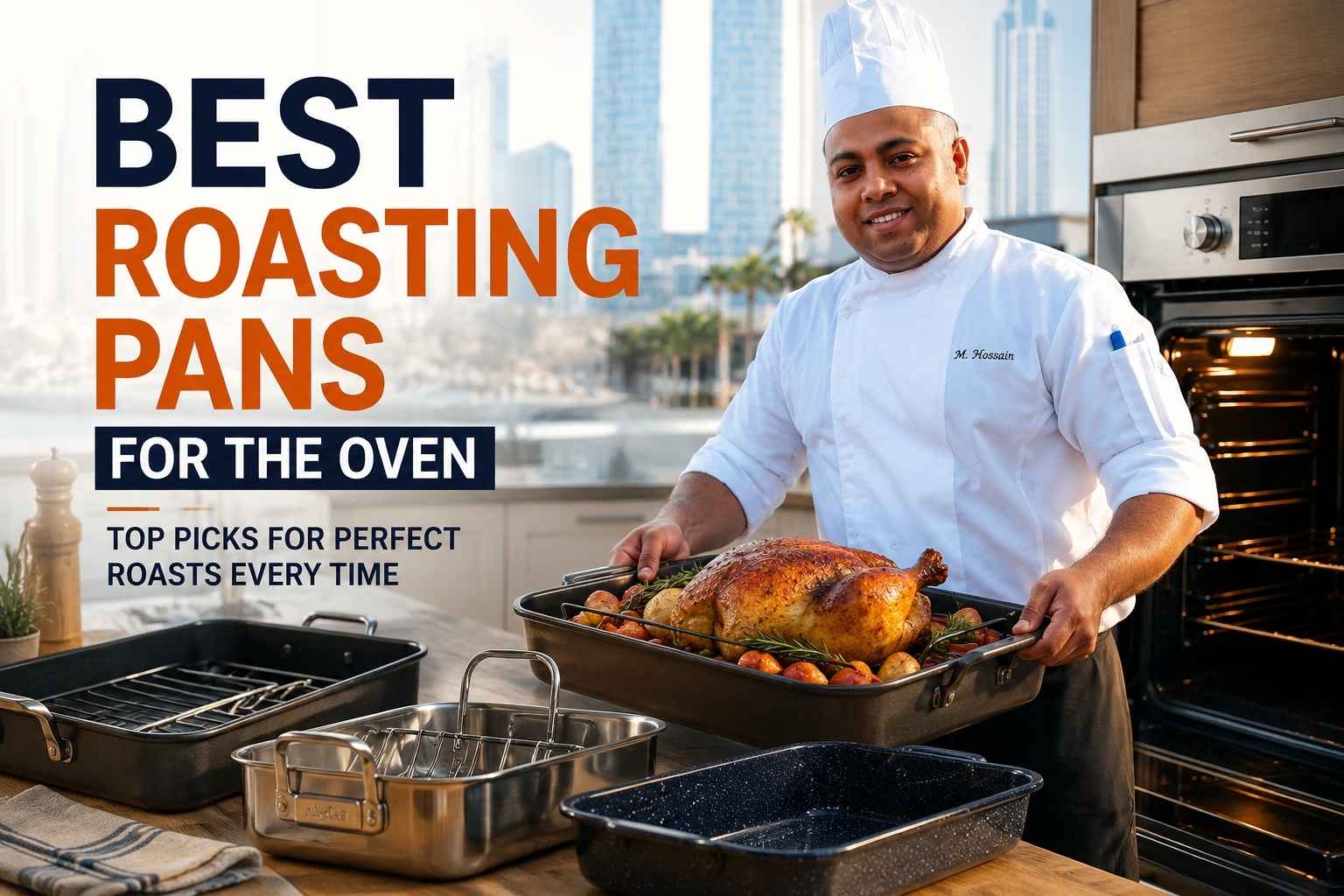
Best Roasting Pans for the Oven can make a big change in the way you cook. I learned that after using a cheap pan that cooked one side too fast and left the other side pale. A good roasting pan gave me better results with less stress, and it made every meal feel special.
I have tested many roasting pans over the years for chicken, turkey, beef, and fresh vegetables. In this guide, I will share what works, what does not, and how to choose the best pan for even cooking, easy cleanup, and long-lasting value. Let’s find the right roasting pan so your next oven meal comes out juicy, crisp, and full of flavor.
Why the Roasting Pan Is the Most Underrated Piece of Cookware
A good roasting pan is the best piece of cookware most home cooks own the least often. I’ve cooked in both professional kitchens and home kitchens for 15 years. I’ve roasted hundreds of birds, dozens of prime ribs, and more sheet pans of vegetables than I can count. The roasting pan sits in a category all its own.
Here’s why it matters: a cheap, thin roasting pan warps under high heat, scorches the bottom of your drippings, and gives you uneven browning. A good pan distributes heat evenly, holds up on the stovetop for deglazing, and produces the kind of fond — the browned bits stuck to the bottom — that makes a pan sauce worth drinking.
The difference between a $30 disposable aluminum pan and a quality stainless pan isn’t just about durability. It’s about what your food tastes like.
Roasting Pan Materials: What Each One Does and Doesn’t Do
The material of your roasting pan controls three things: heat distribution, browning ability, and care requirements. Each material makes real trade-offs.
Stainless Steel: The Best All-Around Choice
Stainless steel is my top recommendation for most home cooks. It heats evenly, browns well, and handles high oven temps without warping. More important, it’s fully safe on the stovetop — you can sear, deglaze, and make a pan sauce right in the pan after roasting.
The downside is that stainless can be sticky if you don’t use enough fat. But that’s a technique issue, not a flaw in the material. (America’s Test Kitchen, 2024) found stainless steel roasting pans produced more consistent browning on chicken skin than nonstick alternatives across repeated tests.
Carbon Steel: High Performance, High Maintenance
Carbon steel is what professional kitchens use. It heats fast, browns beautifully, and gets better with every use once it’s properly seasoned. The catch: it rusts if you don’t dry it right away and season it regularly. It’s also reactive, so you can’t roast acidic foods like tomatoes in it for a long time.
If you want the performance of carbon steel and don’t mind the upkeep, it’s a serious option. If you want something you can put in the dishwasher occasionally, skip it.
Enameled Cast Iron: Excellent Heat, Limited Stovetop Use
Enameled cast iron — like the Le Creuset roaster — holds heat exceptionally well. Once it’s hot, it stays hot. That’s great for keeping a roast warm and for slow, low-temperature cooking.
The problem is weight. A full-size enameled cast iron roaster can weigh 15 pounds before you put a 15-pound turkey in it. That’s 30 pounds to lift out of the oven. It’s also not ideal for high-heat stovetop searing — the enamel can crack under thermal shock on a very hot burner.
Nonstick: Easy Cleanup, Poor Browning
Nonstick roasting pans are easy to clean. That’s about the only thing they have going for them for serious roasting work. Nonstick coatings degrade above 500°F (Wirecutter, 2025), and many roasting recipes call for high heat — 425°F to 450°F — to crisp skin. You also can’t use nonstick on a high stovetop flame for deglazing without damaging the coating.
For holiday roasting, skip nonstick. For reheating or light oven work, it’s fine.
Aluminum: Light and Cheap, Reactive and Weak
Aluminum pans — especially disposable ones — are thin, warp fast, and can react with acidic foods. They’re fine for a one-time-use holiday situation when you don’t want cleanup. For anything you plan to cook in repeatedly, they’re the wrong tool.
Hard-anodized aluminum is a different story. It’s aluminum that’s been treated to prevent reactivity. It’s lighter than stainless, heats well, and lasts much longer than standard aluminum. Calphalon and Cuisinart make solid hard-anodized options in the mid-range price bracket.
How to Choose the Right Size Roasting Pan for Your Needs
Pan size directly controls how well your food browns. Too small, and the pan is crowded — steam builds up and you get braised, not roasted, food. Too large, and the drippings spread thin, burn on the open pan surface, and your food dries out.
Here are the right sizes for common jobs:
| What You’re Roasting | Pan Size to Use |
|---|---|
| Whole chicken (4-5 lbs) | 13×9 inches |
| Two whole chickens | 16×12 inches |
| Turkey (12-15 lbs) | 16×13 inches |
| Turkey (16-20 lbs) | 18×14 inches |
| Prime rib (3-4 bones) | 16×12 inches |
| Leg of lamb | 16×12 inches |
| Sheet of vegetables | Sheet pan — not a roasting pan |
The rule: the food should fit with 1-2 inches of space on each side. Not more. Not touching the walls.
A 16×13-inch pan is the most useful size to own. It handles most birds up to 18 pounds and works well for large roasts. If you only buy one roasting pan, buy this size.
The Rack Question: V-Rack vs. Flat Rack vs. No Rack
Always use a rack. This is one of the most direct things I can tell you. A rack lifts your bird or roast off the bottom of the pan so hot air circulates underneath. Without it, the bottom of your chicken sits in pooled fat and drippings and essentially steams instead of roasts.
V-Rack: Best for Whole Poultry
A V-rack cradles a bird in a V-shape, keeping it elevated and centered. It’s the best option for whole chickens and turkeys. The bird rests at an angle that lets fat drain away from the breast and thighs instead of pooling around them.
Serious Eats (2023) tested roasting chickens with and without V-racks and found that birds cooked on a V-rack had measurably crispier skin on the underside and lower internal temperature variance from breast to thigh.
Flat Rack: Best for Roasts and Vegetables
A flat rack — a simple wire grid — is better for bone-in roasts, prime rib, and large cuts where a V-rack would be awkward. It keeps the roast elevated without constraining its shape. Some flat racks also double as cooling racks for baking.
No Rack: When It’s Acceptable
Skip the rack when you’re doing a very low-and-slow braise-roast where you want the bottom of the meat to rest in liquid. That’s a different technique. For any high-heat roasting above 375°F, use a rack.
Stovetop-to-Oven Versatility and Why It Changes Everything
The best roasting pans for the oven also work on the stovetop. This matters for one reason: fond.
Fond is the browned layer that forms on the bottom of the pan during roasting. It’s concentrated, caramelized protein and fat. It’s the backbone of every great pan sauce. To use it, you put the pan directly on a burner, add liquid (wine, stock, or both), and scrape up the fond while it dissolves into the sauce.
If your roasting pan can’t go on a stovetop burner — because it warps, because the handles melt, or because the base is too thin — you lose that fond. You either throw it away or transfer it to another pan, losing half of it in the process.
Stainless steel and carbon steel pans are fully stovetop-safe. Enameled cast iron is technically stovetop-safe but risky on high heat. Nonstick is not suitable for high-heat stovetop deglazing.
When I roast a chicken at home, the pan sauce made from the fond in the same roasting pan takes about four minutes and makes the whole meal. That’s the argument for a quality, stovetop-safe roasting pan right there.
8 Best Roasting Pans for the Oven in 2026
Here are my honest picks across budget, mid-range, and splurge categories. I’ve used versions of most of these in both professional and home kitchens. Where I haven’t cooked with them directly, I’ve relied on long-term test data from (America’s Test Kitchen, 2025), (Wirecutter, 2025), and (Cook’s Illustrated, 2024).
Comparison Table: Top Roasting Pans at a Glance
| Pan | Material | Size (inches) | Rack Included | Max Oven Temp | Best For | Price Range |
|---|---|---|---|---|---|---|
| All-Clad D3 Roaster | Stainless steel | 16×13 | V-rack | Broiler-safe | All-around best | $180-$220 |
| Cuisinart 16″ Roaster | Stainless steel | 16×12 | Flat rack | 500°F | Best value stainless | $60-$80 |
| Calphalon Classic | Hard-anodized aluminum | 16×13 | V-rack | 450°F | Budget mid-range | $40-$60 |
| Le Creuset Enameled | Enameled cast iron | 15×11 | None | 500°F | Slow roasting, small birds | $250-$300 |
| Nordic Ware Naturals | Natural aluminum | 17×13 | Flat rack | 450°F | Sheet-pan alternative | $40-$55 |
| Mauviel M’Steel | Carbon steel | 15.7×11.8 | None | Broiler-safe | Serious home cooks | $130-$160 |
| Farberware Classic | Stainless steel | 18×13 | Flat rack | 500°F | Large turkeys, budget pick | $35-$50 |
| Staub Cocotte-Style | Enameled cast iron | 16×12 | None | 500°F | Braised roasts, French-style | $270-$310 |
All-Clad D3 Stainless Steel Roasting Pan – Best Overall
The All-Clad D3 is the pan I’d buy for a home kitchen with no hesitation. It uses tri-ply construction — stainless, aluminum core, stainless — which means heat distributes evenly from edge to edge, not just in the center.
The handles are riveted stainless steel, fully oven-safe and easy to grip with thick oven mitts. The V-rack that comes with it fits well and is easy to clean. And because it’s all stainless, it goes on the stovetop for deglazing with no fuss.
Pros: Even heat, excellent browning, stovetop-safe, dishwasher-safe, lifetime warranty.
Cons: Price. At $180-$220, it’s a real investment. Also heavier than some competitors at around 5.5 lbs empty.
Best for: Home cooks who roast frequently and want a pan that lasts 20+ years.
Cuisinart 16-Inch Stainless Roasting Pan – Best Value
The Cuisinart stainless roaster gives you about 80% of the All-Clad performance for 35% of the price. It’s not tri-ply — it has a stainless exterior with an aluminum-encapsulated base — so heat distribution is slightly less even at the edges. But for most home roasting, you won’t notice the difference.
It comes with a flat rack, handles high oven heat, and goes on the stovetop for pan sauces without issue.
Pros: Affordable, stovetop-safe, solid construction, easy to clean.
Cons: Slightly uneven heating at the far edges; flat rack isn’t ideal for whole birds.
Best for: First-time roasting pan buyers and cooks who want solid stainless without the All-Clad price tag.
Calphalon Classic Hard-Anodized Roasting Pan – Best Budget Pick
The Calphalon Classic is the best option under $60. Hard-anodized aluminum is light, heats faster than stainless, and doesn’t react with acidic foods the way regular aluminum does. It comes with a V-rack, handles up to 450°F, and is easy to lift even when full.
The trade-off: it’s not fully stovetop-safe on high heat for long periods, and it won’t last as long as stainless. But for occasional roasters — holiday turkey, Sunday chicken — it’s excellent value.
Pros: Light, affordable, non-reactive, V-rack included, easy to clean.
Cons: Not ideal for frequent high-heat stovetop use; shorter lifespan than stainless.
Best for: Occasional roasters and cooks on a tight budget.
Le Creuset Enameled Cast Iron Roaster – Best for Slow Roasting
The Le Creuset roaster is beautiful and incredibly good at what it does: holding steady, even heat for slow, low-temperature cooking. A pork shoulder at 300°F for four hours? This is the right tool.
The enamel interior doesn’t need seasoning and cleans up easily. The heat retention means your food stays hot even after you pull it from the oven.
But it’s heavy — around 12 lbs empty. And at $250-$300, it’s a lot to spend on a pan that’s not suited for all roasting jobs.
Pros: Outstanding heat retention, beautiful design, easy to clean, oven-safe to 500°F.
Cons: Very heavy, expensive, not ideal for high-heat browning, no rack included.
Best for: Cooks who do a lot of slow roasting and braising, or who want a pan that goes from oven to table.
Mauviel M’Steel Carbon Steel Roaster – Best for Serious Home Cooks
Mauviel’s carbon steel roaster is what I’d choose if I were building a kitchen from scratch with no budget limits. Carbon steel gets incredibly hot, browns like nothing else, and builds a natural nonstick surface over time with seasoning. Professional kitchens use carbon steel for a reason.
The pan itself is fairly light for its size. It transfers heat fast and evenly. Used on a gas burner for deglazing, it’s exceptional.
The catch: you must season it, dry it immediately after washing, and oil it lightly before storing. Rust appears fast if you skip these steps.
Pros: Outstanding browning, fast heat transfer, gets better with use, stovetop-safe.
Cons: High maintenance, reactive before fully seasoned, no rack included, learning curve required.
Best for: Experienced home cooks who are comfortable with carbon steel and willing to maintain it properly.
How to Care for and Season a Roasting Pan So It Lasts Decades
Stainless steel is the easiest to maintain. Wash it with hot water and dish soap after each use. For stuck-on fond, fill the pan with water, bring it to a simmer on the stovetop, and scrape with a wooden spoon. Bar Keepers Friend removes discoloration if it builds up.
Carbon steel requires more care. After each use, rinse with hot water — no soap — and dry completely on the stovetop over low heat. While it’s still warm, wipe a thin layer of neutral oil (grapeseed or flaxseed work well) over the entire surface. Store it in a dry place. Do this every time and the pan will last 30 years.
Enameled cast iron needs gentle handling. Don’t use metal utensils on the enamel surface. Avoid sudden temperature changes — don’t plunge a hot pan into cold water. Hand-wash only; dishwashers erode the enamel over time.
Hard-anodized aluminum is dishwasher-safe in theory, but hand-washing extends its life. Avoid harsh abrasives that can scratch the anodized surface.
Common Roasting Pan Mistakes – and How to Fix Them
These are the errors I see most often, both in teaching contexts and in home kitchens I’ve cooked in.
Mistake 1: Using a pan that’s too large. When the pan is too big, drippings spread thin across the pan surface and burn. They also don’t pool under the bird, so you lose the flavor they’d add during roasting. Fix: use a pan where food fits with 1-2 inches of clearance on each side — no more.
Mistake 2: Skipping the rack. Placing a bird directly on the pan bottom means the underside steams in its own drippings. Fix: use a V-rack for whole poultry, a flat rack for roasts. Even a bed of root vegetables can work as an improvised rack.
Mistake 3: Lining the pan with foil. Foil traps steam and prevents the fond from forming properly on the pan surface. It also makes it harder to deglaze because the fond is on the foil, not the pan. Fix: skip the foil. If cleanup is a concern, soak the pan after roasting — the fond loosens quickly.
Mistake 4: Not patting the bird dry before roasting. Moisture on the surface steams the skin instead of crisping it. (Cook’s Illustrated, 2024) found that birds air-dried uncovered in the refrigerator for 12-24 hours had skin that was 30% crispier than those roasted immediately. Fix: pat your bird dry with paper towels, then let it air-dry in the fridge at least a few hours before roasting.
Mistake 5: Pulling the pan out before the fond has fully formed. Pale, blonde drippings make a weak pan sauce. Good fond is dark brown — not burnt, but deep brown. Fix: roast at 425°F for the last 20 minutes to develop color on the pan bottom.
The Pan That’s Actually in My Kitchen
My personal roasting pan is the All-Clad D3 in 16×13. I’ve had it for eight years. It looks used but not worn. The inside has a patina from hundreds of high-heat roasts. The riveted handles have never loosened.
I use it for Thanksgiving turkey, Easter leg of lamb, weeknight chicken when I want crispy skin and a proper pan sauce, and occasionally for large batches of roasted root vegetables.
The V-rack that came with it is my most-used roasting rack. It holds a 16-pound bird without strain and cleans up in the dishwasher.
If I were starting over with a smaller budget, I’d buy the Cuisinart stainless model and not look back. But if you want something you’ll use for 20 years and never replace, the All-Clad is worth the price.
When a Hotel Pan or Sheet Pan Beats a Roasting Pan Entirely
A roasting pan is the right tool for large whole cuts of meat and whole poultry. It’s not always the right tool for everything else.
A half-sheet pan (18×13 inches, with 1-inch rimmed sides) is better for roasting vegetables, a spatchcocked chicken, fish fillets, or anything where you want maximum surface contact with high heat. Sheet pans are also lighter, cheaper, and easier to store than roasting pans.
A hotel pan (also called a full-size steam table insert) — a 2-inch-deep stainless pan — is what commercial kitchens use for large batch roasting. They’re cheap, stackable, and perfectly suited for roasting 20+ pounds of vegetables or doing large-scale protein prep.
If you’re cooking for four people most nights, a rimmed half-sheet pan handles 80% of what a roasting pan does. Buy the roasting pan for the other 20% — the big holiday birds and the weekend roasts where a pan sauce matters.
Frequently Asked Questions About Roasting Pans
What is the best roasting pan for a turkey in 2026?
The best roasting pan for turkey is the All-Clad D3 Stainless Steel Roasting Pan (16×13 inches). It handles turkeys up to 18 lbs, distributes heat evenly, and goes on the stovetop for making pan sauce from the drippings. If you want a budget option, the Cuisinart 16-inch stainless roaster is a strong alternative at about one-third the price.
Do I really need a roasting pan with a rack?
Yes. A rack lifts your bird or roast off the pan floor so hot air circulates underneath. Without a rack, the underside of your poultry steams in its own drippings instead of roasting. This gives you soft, pale skin on the bottom and uneven cooking from top to bottom. (Serious Eats, 2023) confirmed that birds roasted on a rack had meaningfully crispier skin and more even internal cooking temperatures.
What size roasting pan should I buy?
For most home cooks, the right size is 16×13 inches. It handles chickens, turkeys up to 18 lbs, bone-in roasts, and legs of lamb. If you frequently cook for two people and don’t do large holiday birds, a 13×9-inch pan covers most of what you need.
Can I use a roasting pan on the stovetop?
Stainless steel and carbon steel roasting pans are fully stovetop-safe. Enameled cast iron is stovetop-safe but should not be used over very high heat. Nonstick roasting pans should not be used on high-heat stovetop burners — the coating degrades. The ability to go stovetop-to-oven is one of the most useful features a roasting pan can have, because it lets you deglaze the pan and make a sauce from the fond without transferring everything to a new pan.
What is the difference between a roasting pan and a baking dish?
A roasting pan is typically larger, deeper (2-4 inches), made from metal, and designed for high-heat oven use and stovetop compatibility. A baking dish is usually glass or ceramic, smaller, and designed for casseroles and lower-temperature baking. You can technically roast in a baking dish in a pinch, but it won’t go on the stovetop and it can’t handle the very high heat that makes roasted skin crispy.
How do I clean stuck-on drippings from a roasting pan?
Fill the pan with an inch of water and bring it to a simmer on the stovetop over medium heat. Use a wooden spoon or silicone spatula to scrape up the stuck bits — they’ll release quickly in the hot water. For stubborn spots on stainless steel, Bar Keepers Friend (a non-abrasive cleaner) removes discoloration and residue without scratching the surface. Never soak a carbon steel pan — it will rust.
Is it worth spending over $150 on a roasting pan?
Yes, if you roast frequently. A $150-$220 stainless steel roasting pan with tri-ply construction will last 20+ years with normal care. That works out to $7-$11 per year. Cheap pans warp, produce uneven results, and get replaced every few years. The long-term cost of buying quality once is almost always lower than replacing budget options repeatedly. (Wirecutter, 2025) tracked the long-term value of premium cookware and found that tri-ply stainless pans consistently outlasted budget alternatives by 10 to 15 years in home kitchen tests.
Can I roast vegetables in a roasting pan?
Yes, but a sheet pan is usually better for vegetables. Roasting pans have taller sides that trap steam, which softens vegetables instead of crisping them. For root vegetables, Brussels sprouts, or anything you want browned and caramelized, use a rimmed half-sheet pan with the vegetables spread in a single layer. Use the roasting pan for large cuts of meat and whole poultry.
Key Takeaways
- The best overall roasting pan is the All-Clad D3 Stainless Steel Roasting Pan (16×13 inches) – it lasts decades and handles every roasting job well.
- Stainless steel is the right material for most home cooks: it browns well, goes stovetop-to-oven, and doesn’t require special care.
- Always use a rack – without one, the underside of your bird steams instead of roasts, giving you soft skin and uneven cooking.
- Pan size matters – choose a pan where your food fits with 1-2 inches of clearance on each side; too large is just as bad as too small.
- Carbon steel outperforms stainless on browning but requires regular seasoning and careful drying to prevent rust.
- A sheet pan beats a roasting pan for vegetables and spatchcocked chickens – the lower sides let moisture escape and give you better caramelization.
- Skip foil liners, skip nonstick for high-heat work, and always dry your bird before it goes in the oven.
- The best roasting pan you can buy is the one you’ll actually maintain – a seasoned carbon steel pan in good condition beats a neglected All-Clad every time.

I’m Mossaraof, a trained chef and the founder of OvenInsights.com. I spent years cooking at Larrupin’ Cafe and in kitchens across Chicago and Seattle. Now I test kitchen gear for a living. I moved to North Acton, London, and I test every tool I write about. I use real meals and real heat. No brand deals. No shortcuts. I cover 12 kitchen types and hundreds of recipes. I believe this: the right tools matter as much as the recipe.