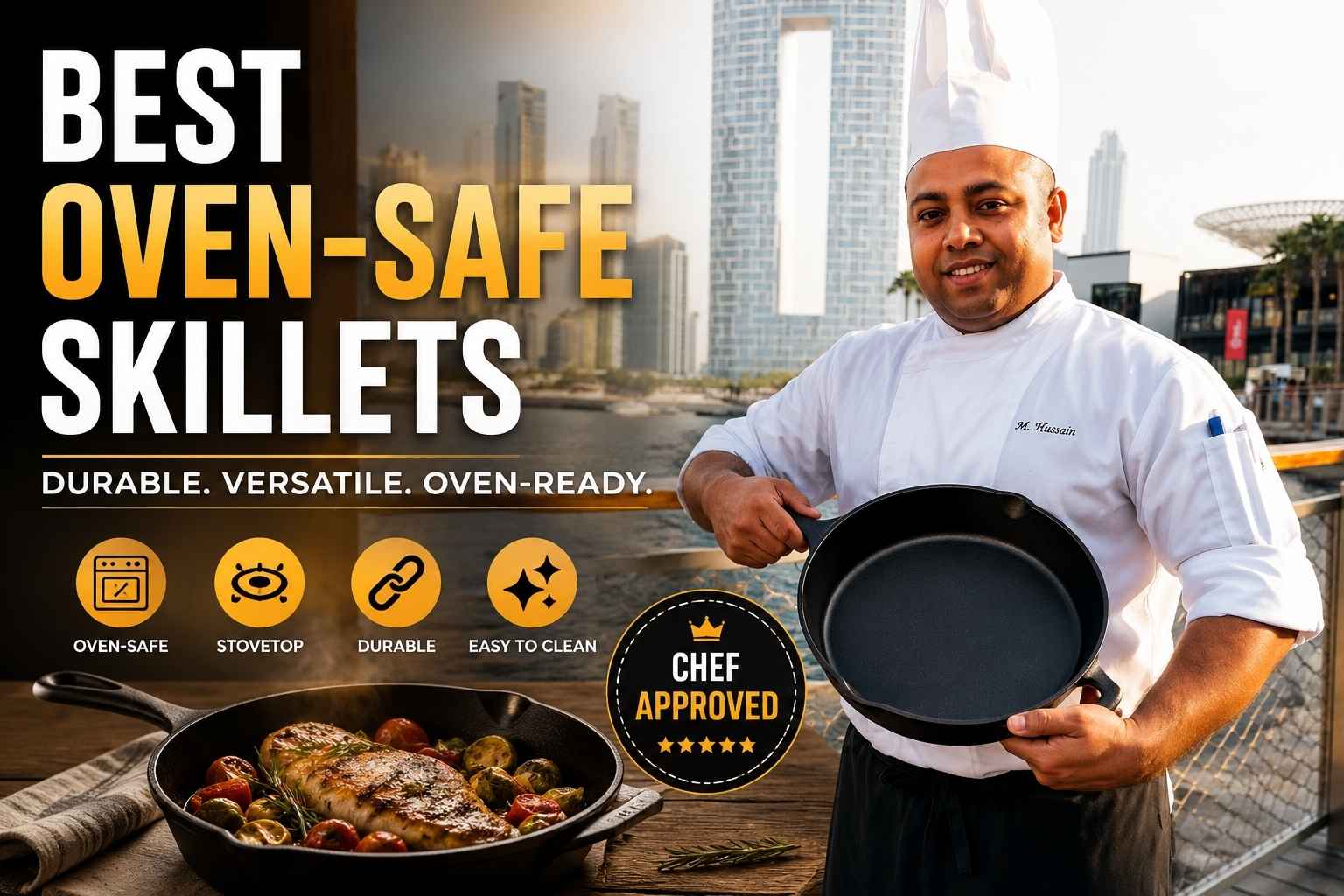
At A Glance
- The best oven-safe skillet overall is the Lodge 12-inch cast iron – it handles temperatures up to 1,500°F and costs under $40.
- Stainless steel tri-ply pans like the All-Clad D3 are safe to 600°F and work for everything from stovetop searing to oven finishing.
- Carbon steel is the professional kitchen’s best-kept secret – lighter than cast iron, just as heat-tolerant, and faster to season.
- Hard-anodized aluminum tops out at 400-450°F; most nonstick coatings should not go above 450°F due to fume risk.
- The handle is the most overlooked failure point – plastic and silicone grips disqualify most “ovenproof” skillets above 400°F.
I love cooking with Best Oven-Safe Skillets because one pan can do almost every job. It feels like having a trusted friend in the kitchen. From quick stovetop meals to oven dinners, the right skillet makes cooking easy and fun.
Over the years, I have tested many skillets in my own kitchen. I have learned what works well for baking, searing, roasting, and everyday meals. In this guide, I will share the best picks, what to look for, and simple tips to help you choose the perfect oven-safe skillet for your home. Let’s find the one that fits your cooking style.
What Makes a Skillet Truly Oven-Safe
A skillet is oven-safe when every single component – pan body, handle, rivets, and any coating – can withstand prolonged dry heat without warping, off-gassing, or becoming structurally unsafe.
That last part trips up a lot of home cooks. The pan body itself is almost never the problem. The handle is.
I’ve worked in professional kitchens for 15 years, and I’ve watched enough home cooks ruin a good pan – or a meal – by sliding a skillet into a 450°F oven without checking what the handle is made of. Silicone grips melt or fuse. Phenolic (plastic) handles crack and smoke. Even oven-safe silicone sleeve handles, the kind that slide on and off, are usually only rated to 400°F.
The four things to check before putting any skillet in the oven:
- Handle material: All-metal handles (stainless, cast iron, carbon steel) are the only truly unlimited option. Silicone and plastic both have hard ceilings.
- Rivet type: Stainless and aluminum rivets handle oven heat fine. Plastic rivets – rare but they exist – do not.
- Surface coating: PTFE nonstick coatings should not exceed 450°F (America’s Test Kitchen, 2024). Ceramic coatings vary by brand, typically 450-500°F.
- Manufacturer’s stated max temp: Always check. A pan rated “oven-safe” without a temperature listed is not telling you enough.
Material Breakdown: Which Skillets Can Take the Heat
Cast Iron – The Indestructible Standard
Cast iron is fully oven-safe at any temperature a home oven can produce. Lodge rates their skillets to 1,500°F (Lodge Manufacturing, 2025). Your oven maxes out at 550°F. You will never hit the limit.
The downsides are real: cast iron is heavy (a 12-inch pan runs 8-10 lbs), slow to heat evenly on gas burners, and requires dry storage to prevent rust. But for high-heat oven work – finishing a sear, baking cornbread, making a Dutch baby – nothing beats it.
Cast iron also holds heat longer than any other material. That matters when you’re moving a pan from a 500°F oven to the table for service and need the food to stay hot.
Best for: High-heat roasting, pan sauces, cornbread, anything requiring a long oven stay.
Carbon Steel – The Professional Chef’s Choice
Carbon steel is what most professional kitchens actually use. It seasons like cast iron, handles the same temperatures, but weighs roughly half as much. A 12-inch carbon steel skillet from Matfer Bourgeat or de Buyer runs 4.5-5.5 lbs versus 8-10 lbs for cast iron.
The trade-off: carbon steel has a thinner gauge, so it responds faster to heat changes. That’s an advantage on the stovetop and a minor disadvantage in the oven, where even heat retention matters more. You also need to season it yourself – it doesn’t come pre-seasoned like most cast iron does today.
I keep two carbon steel pans in my personal rotation. They are the first thing I reach for when I need stovetop-to-oven transitions – searing chicken thighs hard on the burner, then finishing in a 425°F oven for 20 minutes.
Oven limit: Unlimited (metal handles only). Typically rated 1,200°F+ (de Buyer, 2025).
Best for: Stovetop-to-oven transitions, eggs, crepes, searing proteins.
Stainless Steel Tri-Ply – The Versatile Everyday Pan
A good stainless tri-ply skillet – stainless outer layers bonded to an aluminum core – is oven-safe to 500-600°F depending on the brand. All-Clad’s D3 line is rated to 600°F (All-Clad, 2025). The aluminum core distributes heat more evenly than bare stainless, which is notoriously bad at even heating.
Stainless doesn’t season and won’t react with acidic foods, making it the right tool for pan sauces with wine or tomato. It’s also dishwasher-safe, which cast iron and carbon steel are not.
The one limitation: stainless has no natural nonstick properties. Proteins stick badly if you don’t preheat properly and use enough fat.
Oven limit: 500-600°F (varies by brand; check the handle material – some lower-end stainless pans have phenolic handles).
Best for: Pan sauces, braises, anything acidic, all-purpose cooking.
Hard-Anodized Aluminum – Good to 400-450°F
Hard-anodized aluminum is electrochemically treated to create a harder, non-reactive surface. It heats faster and more evenly than cast iron and costs less than stainless tri-ply. Brands like Calphalon rate their hard-anodized pans to 400-450°F (Calphalon, 2025).
The ceiling is real. At 475°F and above, the anodized layer can degrade over time. It won’t fail catastrophically on one use, but repeated high-heat oven sessions shorten the pan’s life.
Best for: Everyday cooking, moderate oven use (up to 400°F), baking.
Nonstick – Use with Caution Above 400°F
PTFE-coated nonstick pans (Teflon is the most recognized brand name) are convenient and genuinely useful for eggs, fish, and delicate foods. But PTFE begins to break down above 450°F (Environmental Working Group, 2023), releasing fumes that are harmless to most humans in small amounts but toxic to pet birds. Above 500°F, the risks increase for humans too.
Ceramic nonstick coatings are marketed as safer at higher temperatures, and most are rated to 450-500°F. But ceramic coatings lose their nonstick properties faster than PTFE – most perform well for 1-2 years of regular use before food starts sticking (Cook’s Illustrated, 2024).
My honest take: nonstick pans have a place in any kitchen for low-heat work. They are not oven workhorses. Buy them knowing you’ll replace them every 2-3 years.
Oven limit: 350-450°F for PTFE. 450-500°F for most ceramic. Never under the broiler.
Top Picks by Category
| Skillet | Material | Max Oven Temp | Weight (12″) | Best Use Case |
|---|---|---|---|---|
| Lodge Cast Iron Skillet | Cast iron | 1,500°F | 8.4 lbs | High-heat roasting, cornbread |
| All-Clad D3 Stainless | Stainless tri-ply | 600°F | 3.6 lbs | Everyday cooking, pan sauces |
| Matfer Bourgeat Carbon Steel | Carbon steel | 1,200°F | 5.4 lbs | Stovetop-to-oven, searing |
| Made In Blue Carbon Steel | Carbon steel | 1,200°F | 4.8 lbs | Budget professional option |
| Calphalon Premier Hard-Anodized | Hard-anodized aluminum | 450°F | 4.2 lbs | Moderate oven use |
| GreenPan Valencia Pro Ceramic | Ceramic nonstick | 600°F (mfr. claim) | 3.8 lbs | Low-to-medium heat cooking |
Best Overall: Lodge 12-Inch Cast Iron Skillet
The Lodge 12-inch cast iron skillet costs around $35-40 and will outlive you. It’s pre-seasoned, fully oven-safe without any temperature ceiling, and handles everything from a Sunday roast to a stovetop frittata.
The weight is the main objection – 8.4 lbs for the pan alone. But in an oven context, you’re not tossing it around. You set it in, you pull it out. The weight becomes irrelevant.
I have used Lodge cast iron in every professional kitchen I’ve worked in. It is not glamorous. It is not expensive. It works.
Best Budget Pick: Made In Blue Carbon Steel
Made In’s 12-inch blue carbon steel skillet runs about $109 – cheaper than most All-Clad stainless and significantly lighter than cast iron. It comes unseasoned, which is either a drawback or a feature depending on how much you care about controlling the initial seasoning process.
For home cooks who want a professional-grade oven skillet without the weight of cast iron, this is the one I recommend first.
Best for Searing: Matfer Bourgeat Black Steel
Matfer Bourgeat is what French professional kitchens use. The 11 7/8-inch black steel pan has a sloped, riveted handle that stays cooler longer than cast iron’s thick handle, and the thinner gauge means it gets screaming hot fast.
For a hard stovetop sear followed by an oven finish – steak, duck breast, pork chop – this is the best tool available at any price point.
Best Stainless: All-Clad D3 12-Inch
All-Clad’s D3 tri-ply is the standard by which most stainless skillets are measured (Good Housekeeping Institute, 2025). The bonded aluminum core gives even heat. The all-metal construction is safe to 600°F. The flared rim makes deglazing and pouring clean.
It’s expensive – around $150-180 – but it’s a 30-year pan if you treat it right.
Best Lightweight Option: Cuisinart Multiclad Pro
If you want stainless performance without the All-Clad price, the Cuisinart Multiclad Pro gives you tri-ply construction at around $60-70. Oven-safe to 550°F. Heavier than All-Clad claims for “lightweight,” but still significantly lighter than cast iron.
How Oven Temperature Affects Which Skillet You Should Use
At 350°F, almost any skillet works – including hard-anodized aluminum and quality nonstick. This is the range for finishing chicken breasts, baking frittatas, and warming leftovers.
At 400-425°F, eliminate nonstick from consideration unless you’re certain of the coating’s rating. Cast iron, carbon steel, stainless, and hard-anodized aluminum are all fine here. This is the standard range for roasting vegetables, finishing pork, and baking in a skillet.
At 450-500°F, you’re in high-heat territory. Use cast iron, carbon steel, or all-metal stainless. Hard-anodized aluminum works for occasional use but shouldn’t be a regular thing at this temperature. Nonstick should not be in this oven.
At 500°F+ (including the broiler), cast iron and carbon steel only. Stainless tri-ply from reputable brands like All-Clad is technically rated for this range, but the pan will discolor permanently if exposed to broiler heat regularly.
The Handle Problem – Why Most Home Cooks Ruin Their Skillets
I want to spend a minute on handles because this is where most mistakes happen.
Phenolic (plastic) handles: Common on mid-range pans from brands like T-fal and older Calphalon lines. Usually rated to 350°F. Above that, they crack, smoke, and in some cases melt onto oven racks. Do not put these in the oven above 350°F.
Silicone-wrapped handles: Feel comfortable and stay cool on the stovetop. Most are rated to 400-450°F. The wrapping can degrade with repeated high-heat exposure. Check the rating – don’t assume.
Removable silicone sleeve handles: The absolute worst option for oven cooking. They’re designed for stovetop use. They slip off when the pan is hot. I have seen burns happen this way.
All-metal handles (stainless, cast iron, carbon steel): The right answer for oven use. They get very hot – always use a dry kitchen towel or oven mitt to pull them out. But they will not fail, melt, or crack.
A word on helper handles: Many cast iron and carbon steel pans have a small secondary handle opposite the main one. Check that it’s the same material as the main handle. It almost always is. Just verify before assuming.
Broiler Safety – Which Skillets Can Handle It
The broiler is the most aggressive heat source in a home kitchen – a gas broiler can hit 550°F, and the infrared element in an electric broiler can run hotter.
Safe under the broiler: Cast iron, carbon steel, all-metal stainless skillets (bare or with a stainless handle rated 500°F+).
Not safe under the broiler: Any nonstick coating (PTFE or ceramic). Hard-anodized aluminum – technically it won’t catastrophically fail once, but repeated broiler use degrades the anodized layer. Any pan with a non-metal handle or handle wrap.
One common mistake I see: Home cooks use a nonstick pan for eggs, then slide it under the broiler to finish an omelette or frittata. I’ve watched PTFE-coated pans emit visible fumes at broiler distance. Don’t do this. Use a stainless or carbon steel pan for anything that goes under the broiler.
How to Care for Oven-Safe Skillets After Repeated High-Heat Use
Cast Iron
Wipe clean while warm. Never soak in water. Dry thoroughly – either on the stovetop over low heat for 60 seconds or in a 200°F oven for 10 minutes. Apply a thin coat of flaxseed or vegetable oil after drying, then heat again until the oil polymerizes (about 10 minutes at 350°F). This rebuilds the seasoning layer.
Carbon Steel
Same protocol as cast iron. Carbon steel seasons and maintains exactly the same way. The thinner gauge means it dries faster, but the principle is identical.
Stainless Steel
Stainless can handle water and even the dishwasher, but high-heat oven use causes discoloration (blue/yellow tinting on the pan body and handle). This is cosmetic and doesn’t affect performance. To remove it, Bar Keepers Friend and a non-scratch scrub pad work well. Avoid steel wool – it scratches the surface permanently.
Hard-Anodized Aluminum
Handwash only. The anodized layer is harder than bare aluminum but not dishwasher-safe – detergent degrades it over time. Dry immediately. Do not use abrasive scrubbers.
When to Upgrade – Signs Your Skillet Is No Longer Safe or Effective
For Nonstick Pans
Replace when you see scratches through the coating, peeling, bubbling, or flaking. A scratched nonstick pan doesn’t automatically mean the coating is entering your food at dangerous levels, but it does mean the nonstick properties are gone and continuing to use it is pointless. Most quality nonstick pans last 2-5 years with regular home use (America’s Test Kitchen, 2024).
For Cast Iron and Carbon Steel
These pans essentially last forever with proper care. The only reason to retire a cast iron or carbon steel pan is if it cracks (extremely rare) or if the seasoning has become irreversibly contaminated – which can happen if acidic food is cooked in an unseasoned pan repeatedly. Rust is not a death sentence; it can be removed and the pan re-seasoned.
For Stainless Steel
Stainless is nearly indestructible. The only failure mode is if the bonded layers in tri-ply construction begin to delaminate – visible as bubbling or separation near the rim. This typically only happens from thermal shock (plunging a very hot pan into cold water) or extreme misuse.
A warped pan – one that rocks on a flat burner – should be replaced regardless of material. Warping causes uneven cooking and, in the oven, can cause the pan to shift on the rack.
Common Mistakes When Buying or Using Oven-Safe Skillets
Buying based on handle temperature alone: A pan being “oven-safe” to 500°F means nothing if the handle is phenolic and rated to 350°F. Always check handle material separately from pan body rating.
Putting a cold cast iron skillet in a hot oven: Thermal shock can crack cast iron, especially older or thinner pans. Preheat cast iron gradually – start it in a cold oven and let it come up to temperature with the oven, or warm it on the stovetop first.
Using nonstick above its rated temperature: The fumes from PTFE degradation are not going to hospitalize you from one exposure. But it’s a sign the coating is breaking down. You’ll be replacing the pan soon anyway.
Ignoring warping signs: A warped pan that wobbles on the burner will also sit unevenly on the oven rack, causing hot spots and uneven cooking. Replace it.
Assuming “oven-safe” means “broiler-safe”: It does not. These are different environments. Check specifically for broiler safety – most manufacturers list this separately from general oven ratings.
My Personal Skillet Lineup
I keep six pans in active rotation at home, and they cover everything I cook:
Lodge 10-inch cast iron: Cornbread, frittatas, skillet cookies, and anything that needs to go from a 500°F oven to the table for service. I’ve had this pan for 11 years.
Matfer Bourgeat 11 7/8-inch carbon steel: My primary stovetop-to-oven searing pan. Steak, pork chops, duck breast. The handle stays manageable longer than cast iron on the stovetop.
All-Clad D3 12-inch stainless: Pan sauces, braised greens, anything with acid. This is my “thinking” pan – the one I use when I need to see what’s happening in the fond.
Made In 12-inch carbon steel: My backup large pan and the one I lend to my partner when she doesn’t want to deal with the weight of the Lodge.
Calphalon Premier hard-anodized 10-inch: For eggs in the morning. This lives on the stovetop and rarely sees the oven. I use it at medium heat and it’s been reliable for four years.
GreenPan Valencia Pro 8-inch ceramic: My egg pan for when I’m cooking for one and want the fastest, easiest cleanup. This does not go in the oven. It doesn’t need to.
Frequently Asked Questions About Oven-Safe Skillets
Can I put a nonstick skillet in the oven?
Yes, but only up to the manufacturer’s stated limit – usually 350-450°F for PTFE coatings and 450-500°F for ceramic. Never put a nonstick pan under the broiler. PTFE coatings begin to break down above 450°F, releasing fumes that are harmful to birds and potentially irritating to humans at higher temperatures (Environmental Working Group, 2023).
What temperature is safe for stainless steel skillets?
Most quality stainless tri-ply skillets from brands like All-Clad, Made In, and Cuisinart are rated to 500-600°F. The limiting factor is usually the handle, not the pan body. All-metal stainless handles are safe to the pan’s full rated temperature. Pans with silicone or plastic handle wraps have lower ceilings – check the label.
Is cast iron always oven-safe?
Yes – bare cast iron (Lodge, Le Creuset bare iron, Field Company, Stargazer) is safe at any oven temperature, including the broiler. The exception is enameled cast iron: Le Creuset and Staub enamel Dutch ovens and skillets are oven-safe to 500°F, but the enamel coating can crack or discolor under the broiler. For bare cast iron, there is no practical temperature ceiling for home oven use.
Can I use a skillet under the broiler?
Cast iron and carbon steel: yes. All-metal stainless (with an all-metal handle): yes, though the pan will discolor. Hard-anodized aluminum: avoid repeated broiler use. Nonstick of any kind: no. The broiler runs hotter than most people expect and exceeds the safe limit for coatings and non-metal handles quickly.
What’s the difference between cast iron and carbon steel for oven use?
Both handle unlimited oven temperatures with all-metal construction. Carbon steel is lighter (roughly half the weight), heats and cools faster, and is what professional kitchens use. Cast iron is heavier, retains heat longer, and comes pre-seasoned from most brands today. For oven-only tasks, cast iron’s superior heat retention is an advantage. For stovetop-to-oven transitions, carbon steel’s lighter weight and faster response make it easier to handle.
Why does my oven-safe pan say “oven-safe” but not give a temperature?
This is a marketing shortcut that benefits the manufacturer, not you. “Oven-safe” without a temperature limit usually means the pan body is oven-safe but the handle material is untested or has a low ceiling. Contact the manufacturer directly or check the full product documentation. If you can’t find a specific temperature rating, don’t assume it’s high.
How do I know if my skillet’s handle will hold up in the oven?
Look up the material. An all-metal handle (stainless steel, cast iron, carbon steel) will hold up at any temperature a home oven can produce. A handle described as “heat-resistant” or “stay-cool” is likely silicone or phenolic – useful on the stovetop, limited in the oven. Always check the manufacturer’s maximum oven temperature, listed on the pan or in the product documentation.
Can I use an oven-safe skillet on the grill?
Cast iron and carbon steel: yes. Both handle open-flame grill heat without any issues – in fact, grill cooking is a good way to season carbon steel. Stainless steel: generally yes, but check the handle material if the grill runs above 500°F. Nonstick and hard-anodized aluminum: avoid grill use. The heat is uncontrolled and easily exceeds safe limits for coatings.
Key Takeaways
- Cast iron and carbon steel are the only unlimited-temperature oven skillets. If you want to cook at 500°F or under the broiler without worrying about limits, these are the materials.
- The handle is the most important thing to check – not the pan body. An all-metal handle means no ceiling. Anything else has a limit.
- Nonstick is useful and has a place in your kitchen. It is not an oven workhorse. Buy it knowing what it is.
- Stainless tri-ply (500-600°F rating) is the best all-around choice for home cooks who want one pan that works on the stovetop and in the oven for most tasks.
- Carbon steel is the professional chef’s choice – lighter than cast iron, equally heat-tolerant, faster to season and maintain.
- Replace nonstick pans when the coating is scratched or peeling. Cast iron and carbon steel last indefinitely with basic maintenance.
- Never assume “oven-safe” means “broiler-safe.” Check specifically.

I’m Mossaraof, a trained chef and the founder of OvenInsights.com. I spent years cooking at Larrupin’ Cafe and in kitchens across Chicago and Seattle. Now I test kitchen gear for a living. I moved to North Acton, London, and I test every tool I write about. I use real meals and real heat. No brand deals. No shortcuts. I cover 12 kitchen types and hundreds of recipes. I believe this: the right tools matter as much as the recipe.