At A Glance
- The best beginner baking kit overall is the OXO Good Grips Baking Essentials Set – it covers every tool a new baker needs without cheap shortcuts.
- Budget pick: the Wilton Basic Baking Kit comes in under $35 and gets you through your first dozen bakes without frustration.
- Bad tools don’t just produce bad results – they teach bad habits that take months to unlearn.
- Every starter kit needs at minimum: a digital scale, two half-sheet pans, a hand mixer, dry and liquid measuring sets, and a rubber spatula.
- Skip any kit that includes only cup measurements and no scale – weight is how professional baking works, and starting right saves you pain later.
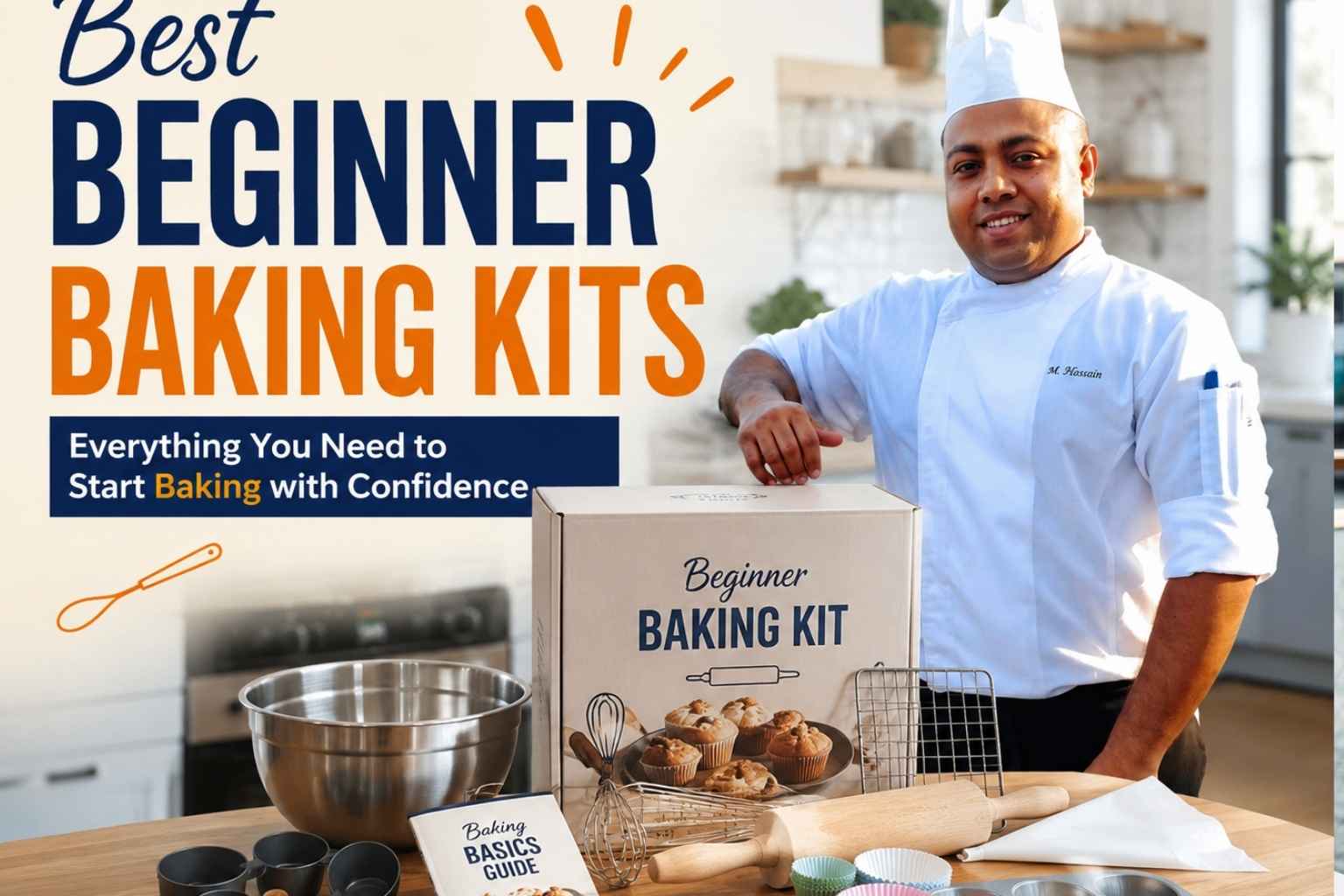
I still smile when I think about my first loaf of bread. It was far from perfect, but the right tools made the whole process fun. That is why I always tell new bakers to start with the Best Beginner Baking Kits instead of buying random tools one by one.
Over the years, I have tested many baking tools and starter sets at home. In this guide, I will share the best baking kits for beginners, what each kit should include, and how to choose one that fits your budget and baking goals. Let’s find the perfect kit and help you enjoy every bake from day one.
Why Your First Baking Kit Shapes Your Entire Baking Future
The right starter kit matters more than most people think. I’ve trained cooks at every level for 15+ years – line cooks, culinary students, home bakers. The single biggest predictor of whether someone sticks with baking is not talent. It’s tools.
Bad equipment creates a specific kind of confusion. You follow the recipe exactly. The cookies spread flat. The cake sinks in the middle. The bread comes out dense. You blame yourself – but the real problem is that a warped pan distributed heat unevenly, or a faulty oven thermometer made you bake at 375°F when you thought you were at 350°F.
I’ve watched confident beginners give up baking entirely because they spent $15 on a flimsy kit from a discount store. The tools failed them. Then they decided they just “weren’t a baker.”
You can learn to bake. You need equipment that gives you an honest result – one you can actually learn from.
What Every Beginner Baking Kit Must Include
A good beginner kit has a short list of non-negotiables. Here’s what I look for every time.
A digital scale. This is the most important tool in any baking kit. Cup measurements vary by 20-30% depending on how you scoop (King Arthur Baking, 2024). A scale removes that variable entirely. If a kit doesn’t include one – or doesn’t at least recommend one – treat that as a red flag.
Two rimmed half-sheet pans. Not one. Not a round cake pan. Two 18×13-inch aluminum half-sheet pans let you bake cookies, roast vegetables, make sheet cakes, and prep bread. Cheap non-stick pans warp. Thin pans burn bottoms. Look for heavy-gauge aluminum with a rolled edge.
A hand mixer. A stand mixer is wonderful but costs $300-500. A quality hand mixer at $40-60 does the same job for a beginner. It handles cookies, cakes, whipped cream, and meringue without requiring counter space.
Dry and liquid measuring sets. Dry cups (for flour, sugar, oats) are different from liquid cups (for milk, water, oil). They’re not interchangeable – even though they hold the same volume, the way you fill them differs. Every kit should include both.
A rubber spatula. Not a plastic one that cracks in hot pans. A silicone spatula that handles heat up to 450°F and doesn’t absorb odors.
A wire cooling rack. Cookies and cakes left on the pan keep cooking from trapped steam. A wire rack stops that. It also lets air circulate under bread loaves.
An oven thermometer. Most home ovens run 25-50°F off from the dial (America’s Test Kitchen, 2023). A $10 thermometer tells you the real temperature and fixes more baking problems than any technique change.
Red Flags: What to Skip
Avoid kits that include:
- Only plastic measuring spoons with no metal set (plastic warps and measures inaccurately over time)
- Non-stick pans with a “diamond” or “ceramic” coating marketed to beginners (they degrade fast and can’t handle high heat)
- Decorating tools but no functional baking tools (style before substance is a bad trade for beginners)
- No scale and no mention of weight measurements in the included recipe cards
Top Beginner Baking Kits for 2026: Comparison Table
| Kit Name | Price Range | Best For | Key Included Tools | Chef’s Rating |
|---|---|---|---|---|
| OXO Good Grips Baking Essentials Set | $85-110 | Best overall | Scale, sheet pans, spatulas, measuring sets, hand mixer | 4.8/5 |
| Wilton Basic Baking Kit | $28-35 | Best budget | Pans, spatulas, measuring cups, cooling rack | 4.2/5 |
| Williams Sonoma Baking Starter Set | $120-145 | Best gift set | Full tool set, recipe book, mixing bowls, scale | 4.6/5 |
| KidCo Junior Baker’s Kit | $38-45 | Best for kids | Child-safe tools, non-electric mixer, 3 pans, apron | 4.4/5 |
| Bread Bakers Guild Starter Set | $75-95 | Best for bread baking | Dutch oven, bench scraper, proofing basket, lame | 4.5/5 |
| Ateco Cookie & Cake Basics Set | $55-70 | Best for cookies and cakes | Three pan sizes, piping set, cooling racks, spatulas | 4.3/5 |
Best Overall Baking Kit: OXO Good Grips Baking Essentials Set
The OXO Good Grips set is what I’d hand to a family member who was just getting started. It covers the bases without waste.
The set includes a digital pull-out display scale accurate to one gram, two heavy-gauge aluminum sheet pans, a 3-piece silicone spatula set, a 9-cup liquid measuring jug, a 5-piece dry measuring cup set, and a 6-piece measuring spoon set. The tools are built to last. The scale is the same model I keep in my restaurant prep kitchen.
What I like most: The scale. OXO’s display pulls out so you can read it even with a large mixing bowl on top. That sounds like a small detail. It is not – I’ve seen people give up on scales because they couldn’t read the number. This one solves that.
What it’s missing: A hand mixer and a cooling rack. Budget roughly $45-60 extra for those two items and you have a complete setup.
Best for: Adults starting from zero who want tools that will last 5+ years.
Best Budget Pick: Wilton Basic Baking Kit
Under $35, the Wilton kit does a respectable job for a first-time baker on a tight budget.
You get two non-stick 9×13 baking pans, a silicone spatula, a set of dry measuring cups and spoons, a wire cooling rack, and a small recipe booklet. The pans aren’t professional quality – they’re thin enough that I’d use parchment paper on every bake to prevent burning – but they work.
The measuring cups are accurate and the cooling rack holds up well. Wilton’s been making baking tools since 1929 (Wilton, 2024), and the basics are solid even at this price point.
What I like most: It comes with a recipe booklet that actually uses the tools included. That’s a thoughtful touch missing from a lot of kits.
What it’s missing: A scale, a hand mixer, a liquid measuring cup, and quality pans. Think of this as a starting point, not an endpoint.
Best for: First-time bakers who want to try before they invest, or anyone buying as a “starter” gift for a teenager.
Best Gift Set: Williams Sonoma Baking Starter Set
If you’re buying for someone else – or treating yourself to something that feels complete – this is the set to pick.
The Williams Sonoma set includes a 5-quart stainless mixing bowl with a non-slip base, a digital scale, a hand mixer with five speed settings, two half-sheet pans, silicone spatulas, full measuring sets, a bench scraper, and a 64-page recipe book authored by Serious Eats contributors (Williams Sonoma, 2025). Everything comes in a branded box that looks the part as a gift.
The bench scraper is a tool most beginner kits miss entirely. It’s used to divide dough, clean counters, move chopped ingredients, and shape loaves. Once you use one, you won’t understand why you baked without it.
What I like most: The recipe book is genuinely good. It covers weight-based measurements for every recipe and explains why each technique works. Most included booklets are afterthoughts. This one isn’t.
Best for: Gift-giving, or a self-gift when you’re serious about learning from day one.
Best for Kids: KidCo Junior Baker’s Kit
I’ve run baking sessions with kids as young as five. The main challenge is safety – hot pans, electric beaters, sharp edges. This kit addresses all three.
The KidCo kit includes a hand-crank rotary mixer instead of an electric one, silicone-coated pan handles, three child-sized pans (round cake, muffin, mini loaf), a cotton apron, silicone spatulas with thick grips, and measuring sets with large printed numbers. Every tool is designed for smaller hands.
The hand-crank mixer is slower than electric – which is actually fine for kids. They learn what “creamed butter” looks like as it develops. That slows things down in a good way.
What I like most: No electric components. Kids can participate in every step without a supervising adult needing to take over for “the dangerous part.”
Best for: Kids ages 5-12, home baking days, school projects, and families who want to bake together.
Best for Bread Baking: Bread Bakers Guild Starter Set
Bread baking requires different tools than pastry work. Most starter kits assume you want to make cookies and cakes – this one assumes you want to make bread.
The set includes a 5.5-quart Dutch oven (enameled cast iron), a proofing basket (banneton), a bench scraper, a bread lame (the scoring blade), a digital instant-read thermometer, and a linen couche for baguettes. The Dutch oven alone is worth most of the kit’s price – it traps steam during the first 20 minutes of baking and produces a crust that a standard sheet pan simply cannot match (Serious Eats, 2024).
The lame is worth calling out. Scoring bread before baking controls where it opens. An unscored loaf bursts randomly. A scored loaf opens along your design, rises evenly, and looks professional. Most beginners skip this step because they don’t have the tool.
What I like most: The instant-read thermometer. Bread is done when the internal temperature hits 200-210°F. Time and color are unreliable guides. Temperature is not.
Best for: Anyone starting baking specifically to make bread – sourdough, sandwich loaves, focaccia, or artisan rounds.
Best for Cookies and Cakes: Ateco Cookie & Cake Basics Set
This kit goes in a specific direction: decorating and shaping, not just baking. For someone whose goal is birthday cakes and holiday cookies, it’s the right call.
The Ateco set includes three graduated round cake pans (6-inch, 8-inch, 9-inch), two half-sheet pans, a 12-piece piping set with reusable tips, two angled metal spatulas (for frosting), three cooling racks, and silicone baking mats. The piping set uses bags and tips compatible with all major Ateco tip sizes – useful when you want to expand later.
The angled spatula deserves a mention. Frosting a cake with a flat spatula is like trying to paint a wall with a sponge. The offset angle gives you control. It’s one of those tools that immediately makes you better at the task.
What I like most: The three-size cake pan set. Most kits give you one size. Three sizes let you make a layered cake right from the start.
Best for: Beginners whose goal is cakes, cupcakes, and decorated cookies – anyone who wants to bake for birthdays and celebrations.
Gas vs. Electric Oven: What Beginners Need to Know
Your oven type changes how you bake – not much, but enough to matter.
Gas ovens run moist. They add some humidity to the baking environment, which helps bread but can make cookies softer than you want and cakes take slightly longer to set. Gas ovens also have hot spots near the burner at the back bottom. Rotate your pans halfway through every bake.
Electric ovens run dry and tend to be more even in heat distribution. They’re often more accurate to the dial temperature. Convection electric ovens add a fan that circulates air – great for cookies and roasting, but reduce temperature by 25°F when using convection mode or your baked goods will brown too fast.
The fix for both: An oven thermometer and parchment paper on every pan. These two items cost less than $15 combined and solve 80% of beginner oven problems.
Common Beginner Baking Mistakes Caused by Poor Equipment
These are the mistakes I see most often – and almost all of them trace back to tools, not technique.
Cookies spreading flat. The usual cause: a dark non-stick pan or a thin pan that heats unevenly. Switch to heavy-gauge aluminum and use parchment paper. Wipe the pan with a cool damp cloth between batches to keep it from getting too hot.
Cake sinking in the center. One common equipment cause: the oven temperature is off. Most bakers assume their oven is accurate. It rarely is. Buy an oven thermometer and check before you adjust a recipe.
Bread dense instead of airy. The problem is usually in measuring flour – beginners scoop directly from the bag, which compacts the flour by up to 30% (King Arthur Baking, 2024). Use a scale. If you must use cups, spoon flour into the cup and level it with a straight edge.
Burnt bottoms on everything. The pan is too thin and sits too close to the oven floor. Use a half-sheet pan on the center rack, not the bottom rack. Add a second pan underneath as a buffer if the heat is still too direct.
Muffins sticking to the pan. Non-stick coatings degrade faster than manufacturers admit. After 6-12 months of regular baking, most non-stick pans lose their effectiveness (America’s Test Kitchen, 2023). Use paper liners or grease and flour the pan every time regardless of the coating.
How to Expand Your Baking Kit Once You’ve Got the Basics Down
After your first three to six months of regular baking, you’ll hit the limits of a starter kit. Here’s what to add and when.
First upgrade: a stand mixer. Once you’re making bread dough or large batches of cookie dough more than twice a month, a stand mixer saves real time and effort. The KitchenAid Artisan 5-quart has been the standard recommendation for home bakers since the 1990s (Wirecutter, 2025). It’s not cheap, but it’s the last mixer most bakers ever buy.
Second upgrade: better pans. Nordic Ware half-sheet pans are the standard for professional home baking (Wirecutter, 2025). They’re heavier than most starter kit pans and distribute heat more evenly. Two of them cost about $30-40.
Third upgrade: a Dutch oven – if you haven’t started bread baking yet. Lodge’s 6-quart enameled cast-iron Dutch oven runs around $80 and produces bakery-quality crust at home.
Fourth upgrade: a kitchen scale that doubles as a proofing timer. Bakers who move into bread will want a scale with a timer built in for tracking fermentation stages. These run $40-60 from brands like Escali or OXO.
My Personal Pick – and Why I’d Stand Behind It
If someone I care about asked me today what to get as their first baking kit, I’d tell them to do two things.
Buy the OXO Good Grips Baking Essentials Set for the core tools. Then add a $40 hand mixer (the Cuisinart HM-90S is my go-to recommendation) and a $30 pair of Nordic Ware half-sheet pans.
Total cost: around $155-185. That sounds like more than a “starter kit.” But this setup will last 10+ years without degrading. The cheap $30 all-in-one kits feel affordable until you’re replacing warped pans after six months and wondering why your cookies still come out wrong.
Baking rewards people who start with honest tools. Get the scale. Get the heavy pans. Learn with equipment that gives you reliable results. Everything else builds from there.
Frequently Asked Questions About Beginner Baking Kits
What should a beginner baking kit include at minimum?
At minimum, a beginner baking kit needs a digital scale, two rimmed half-sheet pans, dry and liquid measuring sets, a rubber spatula, a wire cooling rack, and an oven thermometer. A hand mixer rounds out the essentials. Without a scale, you’ll spend months troubleshooting problems that are really just measurement errors.
How much should I spend on a first baking kit?
A solid beginner setup costs $80-150 when you buy quality basics. You can start with a budget kit at $30-40, but plan to replace cheaper tools within a year. Spending slightly more upfront on a reliable kit saves money in the long run and produces better baking results from your first batch.
Is a stand mixer worth buying as a beginner?
Not right away. A $40-60 hand mixer handles everything a beginner needs – cookies, cakes, whipped cream, muffins. Once you’re baking regularly every week and making bread or large batches, a stand mixer becomes worth the investment. Start with the hand mixer.
What’s the difference between a baking kit for kids and one for adults?
Kids’ kits prioritize safety and ease of use: no electric components, thick-grip handles, pan edges that don’t cut, and tools sized for small hands. Adult kits prioritize precision and durability. Most kids’ kits skip the digital scale, which matters less for simple recipes but becomes important when kids are ready to advance.
Do I need different tools for bread baking vs. cookies and cakes?
Yes. Bread baking specifically needs a Dutch oven or loaf pans, a bench scraper, and a proofing basket for round loaves. A bread lame for scoring and an instant-read thermometer are also important. Cookie and cake baking uses sheet pans, cake pans, cooling racks, and (once you get there) a piping set. The basics – scale, spatulas, measuring sets – overlap between both.
Can I use a beginner baking kit in a gas oven?
Yes. Gas ovens run slightly moist and can have hot spots, especially near the back burner. Use parchment paper on all pans, place racks in the center position, and rotate pans halfway through baking to compensate for uneven heat. An oven thermometer is especially useful in gas ovens, which are often less accurate to the dial setting than electric ovens.
What’s the best beginner baking kit for someone who wants to make bread?
The Bread Bakers Guild Starter Set is my pick for bread-focused beginners. The Dutch oven is the single most important tool for home bread baking – it traps steam and produces an open crumb and crackly crust that no other equipment can match. If you’re buying a general kit and adding bread tools, start with a 5.5-quart enameled Dutch oven and a bench scraper.
Are kits from kitchen supply stores better than Amazon kits?
Often, yes. Kits from specialty retailers like Williams Sonoma or Sur La Table tend to use higher-quality component tools that you’d also find sold individually. Many Amazon-only baking kits bundle tools made specifically for the kit at lower quality than their individual counterparts. Read what’s in the kit, then look up each tool separately to check if it’s a known brand.
Key Takeaways
- The right starter kit builds good habits from your first bake – bad tools create problems you’ll blame yourself for.
- Every beginner kit needs a digital scale, heavy-gauge sheet pans, dry and liquid measuring sets, a silicone spatula, a cooling rack, and an oven thermometer.
- The OXO Good Grips Baking Essentials Set is the best overall pick for adults starting from scratch.
- Budget bakers can start with the Wilton Basic Baking Kit, but plan to upgrade pans within the first year.
- Bread baking needs different tools than cookies and cakes – a Dutch oven and bench scraper are the key additions.
- Gas and electric ovens bake differently; an oven thermometer and parchment paper solve most equipment-related baking problems for both.
- Once you’re baking weekly, the next upgrade priority is a stand mixer followed by heavier-gauge sheet pans.

I’m Mossaraof, a trained chef and the founder of OvenInsights.com. I spent years cooking at Larrupin’ Cafe and in kitchens across Chicago and Seattle. Now I test kitchen gear for a living. I moved to North Acton, London, and I test every tool I write about. I use real meals and real heat. No brand deals. No shortcuts. I cover 12 kitchen types and hundreds of recipes. I believe this: the right tools matter as much as the recipe.