At A Glance
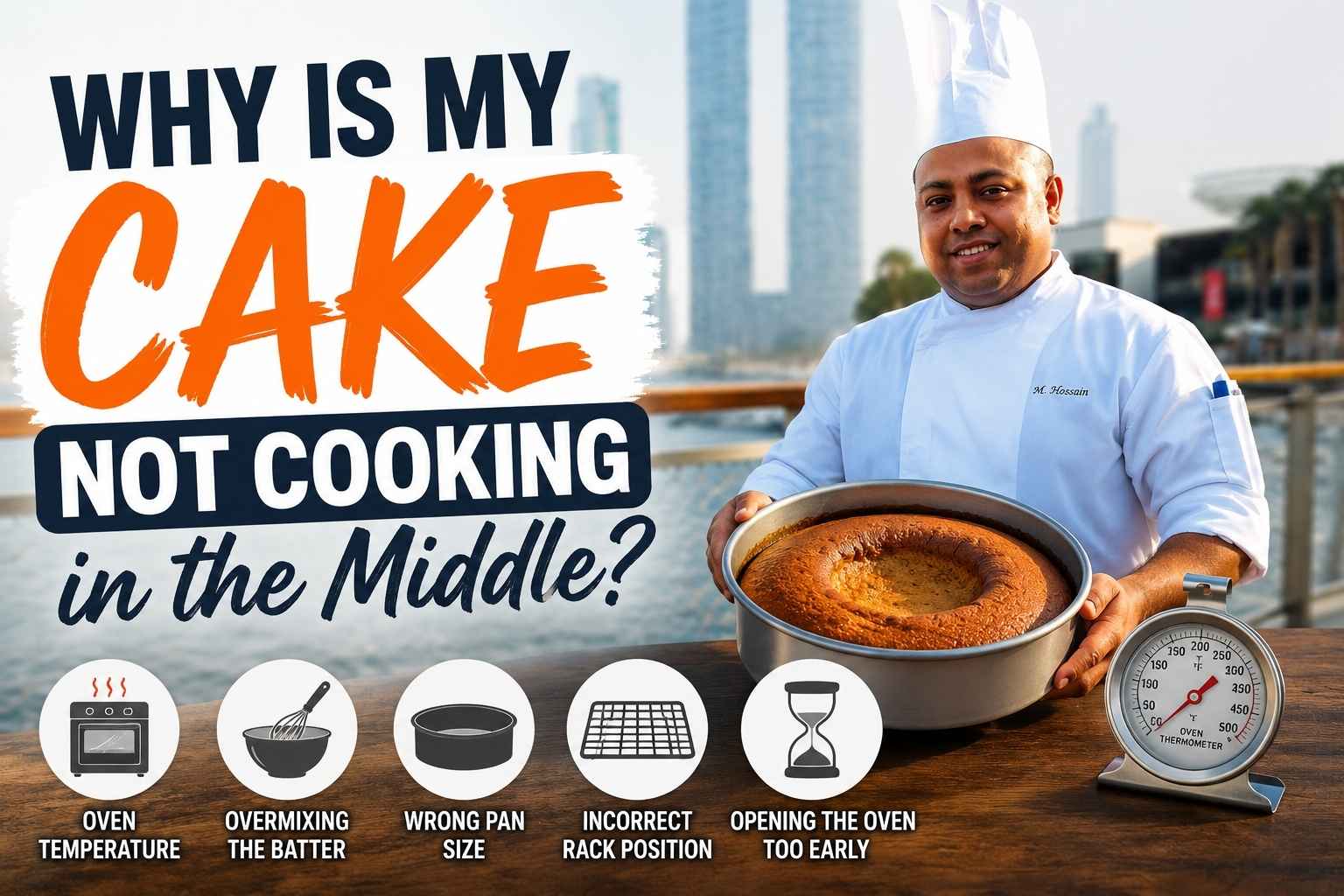
- The single most common cause of a raw cake center is an oven running hotter than its display shows, which burns the outside before the inside sets — fix it with a standalone oven thermometer.
- Using the wrong pan size redistributes batter depth and throws off every timing cue in the recipe.
- Too much baking powder or baking soda causes rapid rise and collapse, leaving a dense, wet core.
- The toothpick test alone is unreliable for dense cakes — use an instant-read thermometer and aim for 200-210°F (93-99°C) at the center.
- If your cake top is browning too fast before the center sets, tent with foil and drop the oven temperature by 25°F — don’t just pull it out.
You pull the cake out. It looks perfect on top. Then you cut in, and the middle is wet, gooey, and just… raw.
I get this question all the time: why is my cake not cooking in the middle? It happens to bakers at every skill level, not just beginners. I’m Mossaraof, and I’ve spent years testing ovens, batters, and pan sizes to solve this exact problem. Most of the time, the fix is simple once you know what to look for. Stick with me, and I’ll walk you through the real reasons your cake sinks in the center and how to bake it right every time.
Quick-Reference Diagnostic Table
| Symptom | Most Likely Cause | Fix |
|---|---|---|
| Wet, gummy center — edges fully baked | Oven temp too high (outside cooked, inside didn’t) | Test oven with thermometer; reduce temp by 25°F |
| Sunken middle, raw underneath the crater | Too much leavening agent | Reduce baking powder/soda by 25% |
| Pale, undercooked throughout | Oven not preheated; temp too low | Preheat minimum 20 min; verify with thermometer |
| Cooked sides, wet strip across the center | Wrong pan size — batter too deep | Match pan to recipe exactly; recalculate bake time |
| Top burns, center still raw | Hot spots + high temp | Rotate at halfway point; lower temp 25°F; tent with foil |
| Dense, pasty center even when “done” | Overmixed batter or too much liquid | Mix only until combined; measure wet ingredients by weight |
| Bakes fine on edges, flat and raw in middle | Oven door opened early | Don’t open door before 75% of bake time |
What Actually Happens Inside a Cake While It Bakes
A baking cake goes through several overlapping stages, and the center is always the last to finish. Understanding those stages tells you exactly why things go wrong.
Heat transfer starts from the outside in. The pan walls and bottom absorb oven heat first and transfer it into the batter. The center of the cake is the farthest point from any heat source, so it takes the longest to reach the temperatures needed for the structure to set.
Here’s the sequence:
1. Steam generation (100°F-160°F / 38-71°C). Water in the batter turns to steam. This steam expands the batter and begins the rise. If the oven is too hot, the crust sets before steam can escape — trapping moisture in the center.
2. Leavening activation (80-115°F / 27-46°C for baking powder). Carbon dioxide gas is released, expanding air cells throughout the batter. Too much leavening creates oversized bubbles that collapse under their own weight — leaving a sunken, wet core (King Arthur Baking, 2024).
3. Egg coagulation and starch gelatinization (140-180°F / 60-82°C). This is the structural “set.” Egg proteins coagulate and starches absorb liquid and firm up. If the center never reaches these temperatures, it stays wet and gummy — no matter how done the outside looks.
4. The Maillard reaction (280°F+ / 138°C+). This is surface browning. It happens only on the crust. A golden-brown top tells you nothing about whether the center has gone through stages 2 and 3. That’s the whole reason a toothpick — or better, a thermometer — matters.
The center of a standard 9-inch round layer cake reaches target temperature roughly 8-12 minutes later than the edges (America’s Test Kitchen, 2023). That window is where most cake failures happen.
7 Most Common Reasons Your Cake Is Raw in the Middle
1. Your Oven Temperature Is Wrong — and Your Oven Is Lying to You
This is the cause behind the majority of raw-center failures, and most home bakers never suspect it.
Oven thermostats drift over time. A study by Cook’s Illustrated found that home ovens can run anywhere from 25°F to 75°F off their dial setting (Cook’s Illustrated, 2022). An oven that reads 350°F but actually runs at 400°F will brown your cake’s exterior in 20 minutes while the center sits at 220°F — nowhere near the 200-210°F internal set point it needs.
Fix: Buy a standalone oven thermometer. They cost $8-12 and change everything. Place it on the center rack, preheat for 20 minutes, and read the actual temperature before placing your cake. If your oven runs hot, dial down accordingly.
I had this problem for two years in my first restaurant kitchen. We blamed the recipes. The oven was running 40°F hot. The day we confirmed it with a thermometer was the day our sponge cakes stopped collapsing.
2. You Didn’t Preheat Long Enough
Most ovens signal “ready” with a beep or light within 8-10 minutes — but the oven walls, floor, and rack haven’t absorbed enough heat to bake evenly. Only the air temperature has reached the target. Baking into an under-heated oven means slow, uneven heat transfer and a center that lags even further behind.
Fix: Preheat for a minimum of 20 minutes. For thick cakes like bundt cakes or pound cakes, preheat 25-30 minutes. If you have a baking stone, put it on the bottom rack — it acts as a heat buffer and stabilizes oven temperature swings.
3. You Used the Wrong Pan Size
This one is badly underrated. The recipe is calibrated to a specific batter depth. Change the pan and you change the physics.
Put a recipe designed for two 9-inch round pans into one 9-inch pan and you’ve doubled the batter depth. The edges will cook correctly while the center has twice as far to go — and the recipe timing is now wrong by 20-30 minutes (Joy of Baking, 2024).
The math: Batter depth drives bake time more than surface area does. A 2-inch deep cake takes roughly 50-80% longer to bake than a 1-inch deep cake at the same temperature. There’s no rule of thumb precise enough to substitute for matching the pan to the recipe.
Fix: Match your pan to the recipe exactly. If you must substitute, use a pan with equal total volume — and start checking for doneness 15 minutes earlier than the recipe states, then continue checking every 5 minutes.
4. You Opened the Oven Door Too Early
Opening the door during baking drops oven temperature by 25-50°F in seconds (Serious Eats, 2023). That sudden drop interrupts heat transfer mid-bake. For leavened cakes, it’s especially damaging — the rapid pressure change collapses partially-set air structure, and the gooey center that results won’t re-set cleanly even if you close the door immediately.
Fix: Don’t open the oven door before 75% of the stated bake time. For a 35-minute cake, that means waiting until at least the 26-minute mark. Use the oven light to check visually before that point.
5. Too Much Baking Powder or Baking Soda
Leavening agents don’t follow a “more is better” rule. Excess baking powder or soda creates a rapid, aggressive rise — the cake puffs up fast, then collapses back on itself before the structure sets. The result is a sunken center that’s raw and dense, often with a slightly bitter, chemical taste.
The correct ratio for most butter cakes is 1 teaspoon of baking powder per 1 cup of flour. More than that and you’re working against yourself (King Arthur Baking, 2025).
Fix: Measure leavening agents with the spoon-and-level method, not by scooping directly with the measuring spoon — direct scooping compresses the powder and can result in 20-30% more than intended. If your cake consistently sinks in the middle, try reducing baking powder by 1/4 teaspoon and see if the center holds.
6. Your Batter Has Too Much Liquid
Excess liquid extends the time it takes for egg proteins to coagulate and starches to gelatinize. The outside bakes at a normal rate, but the wet center is essentially fighting the heat — delaying the structural set that makes the interior firm.
This often comes from measuring liquid ingredients by volume instead of weight. A cup of sour cream packed loosely versus pressed down can vary by 15-20% (America’s Test Kitchen, 2024).
Fix: Measure wet ingredients — especially sour cream, yogurt, buttermilk, and mashed fruit — by weight whenever the recipe gives grams or ounces. If the recipe doesn’t, use weight-based ratios from a reliable source.
7. Hot Spots and Uneven Oven Heat Distribution
Every oven has hotter zones — typically near the back, near the heating element, or in one corner. If your cake bakes faster on one side, hot spots are why. But hot spots can also cause the center to lag if the outer edges absorb too much heat relative to the middle of the batter.
Fix: Rotate your cake pan 180 degrees at the halfway mark of bake time. Do it quickly and gently. This distributes uneven heat across the pan more evenly. For ovens with a known hot back wall, consider moving the rack one position higher to add distance from the lower element.
Gas vs. Electric vs. Convection: How Oven Type Affects Your Cake’s Center
Gas ovens heat primarily from the bottom and tend to run moister because gas combustion releases water vapor. The bottom of your cake may cook faster than the top. This can push raw batter upward into the center. Gas ovens also cycle heat more dramatically — temperature swings of 30-50°F between cycles are normal (Serious Eats, 2022). Use an insulated baking sheet under your cake pan to buffer bottom heat.
Electric ovens heat more evenly from both top and bottom elements, making them generally better for cakes. Temperature swings are smaller — around 10-15°F. The main problem with electric ovens is inaccurate thermostats. Verify temperature with a standalone thermometer.
Convection ovens use a fan to circulate air, which speeds heat transfer by 20-25% and reduces surface moisture. The result: faster browning and faster edge baking — but the center can still lag if you don’t adjust. Standard rule: reduce the recipe temperature by 25°F when using convection, or reduce bake time by 20%. Never do both at the same time without testing first.
Pan Size Math: The #1 Underrated Mistake
Most recipes specify pan size for a reason — batter depth controls heat penetration time, and batter volume controls how much the cake rises before the structure sets.
Here’s a practical reference:
| Pan Type | Approximate Volume | Common Swap |
|---|---|---|
| 9-inch round (2 pans) | 16 cups | Standard layer cake |
| 9×13-inch rectangular | 14-15 cups | Sheet cake |
| 10-inch bundt | 12 cups | — |
| 8-inch round (2 pans) | 12 cups | Slightly taller layers |
| 9×5-inch loaf | 8 cups | — |
Swapping a 9-inch round for an 8-inch round increases batter depth by roughly 25% per pan. That extra depth requires 10-15 more minutes of bake time at minimum (Joy of Baking, 2024).
My standing rule: If a pan swap changes batter depth by more than 1/2 inch, start checking with a thermometer 15 minutes before the recipe says to, and check every 5 minutes after that.
The Toothpick Test vs. the Internal Temperature Method
The toothpick test is useful but imprecise, especially for dense cakes. A toothpick inserted into the center can come out clean while the surrounding batter is still 15-20°F below the set point — because the toothpick passed through a set pocket of crumb without hitting underbaked areas nearby.
Use an instant-read thermometer for accuracy. Insert it into the geometric center of the cake — not near the edge.
| Cake Type | Target Internal Temperature |
|---|---|
| Standard butter cake / layer cake | 200-205°F (93-96°C) |
| Dense pound cake or loaf cake | 205-210°F (96-99°C) |
| Cheesecake | 150-155°F (66-68°C) |
| Flourless chocolate cake | 140-145°F (60-63°C) |
| Carrot cake | 200-205°F (93-96°C) |
Sources: America’s Test Kitchen (2024), King Arthur Baking (2025).
For cakes where the toothpick is your only option: the toothpick should come out with a few moist crumbs attached — not batter, but not bone-dry either. A completely clean toothpick often means the cake is already overbaked.
When to Cover with Foil vs. When to Lower the Temperature
These are two different problems with two different fixes. Using the wrong one makes things worse.
Cover with foil when: The cake top is browning faster than the center is baking. This is common with dark cake pans, convection ovens, and high-sugar batters. Tent the cake loosely with foil — don’t press it down onto the top — and continue baking at the same temperature. The foil reflects surface heat while allowing oven heat to keep working on the interior.
Lower the temperature when: The whole cake is baking too fast, or when you’ve already extended the bake time significantly and the center still isn’t setting. Drop by 25°F, not more. Extending bake time at high heat doesn’t fix the center — it just keeps burning the outside.
Use both together for: Large, deep cakes like bundt cakes or dense loaf cakes. At the halfway point, tent with foil and reduce temperature by 25°F. This is the approach I use for any cake over 2.5 inches of batter depth.
Altitude Baking Adjustments and What They Do to Your Cake’s Center
Above 3,500 feet, air pressure is lower. That lower pressure means leavening gases expand faster and more aggressively — and liquid evaporates more quickly. The result for cake centers: rapid over-expansion that collapses before the structure sets, leaving a wet, sunken core.
Standard high-altitude adjustments for 3,500-6,500 feet (King Arthur Baking, 2024):
- Reduce baking powder by 1/8 to 1/4 teaspoon per teaspoon
- Reduce sugar by 1-3 tablespoons per cup
- Increase liquid by 2-4 tablespoons per cup
- Increase flour by 1-2 tablespoons per cup
- Raise oven temperature by 15-25°F
Above 6,500 feet, double those adjustments. The higher you go, the harder your eggs have to work to set the structure before the gas expansion runs away from you.
When to Trust the Recipe vs. When to Override It
Trust the recipe for: ratios (flour to fat to liquid to leavening), mixing method (creaming vs. folding vs. one-bowl), and pan preparation (greased only vs. lined vs. floated with flour).
Override the recipe based on your oven for: temperature, bake time, and done-ness tests. Recipes are written and tested in specific ovens. Yours is different. Bake time in a recipe is always a starting point — your thermometer and your doneness test give you the finish line.
My personal routine: I set a timer for 10 minutes before the recipe’s minimum bake time. I check visually through the oven window. At the recipe’s minimum, I take an internal temperature reading. I pull the cake when it hits the target temp — not when the timer says so.
My Personal Cake-Baking Routine (After 15 Years of Getting This Wrong)
I’ve turned out more broken, sunken, raw-centered cakes than I care to admit — mostly in the first five years of my career, and mostly because I trusted recipe timings without verifying my oven.
Here’s what I actually do now, every time:
30 minutes before baking: I turn on the oven and place the oven thermometer on the center rack. I do not trust the preheat beep.
At the 20-minute mark: I check the thermometer. If the oven needs adjustment, I dial it in now, not after the cake goes in.
Pan prep: I use the exact pan the recipe specifies. If I don’t have it, I calculate batter depth in the substitute pan before committing.
Batter: I mix only until the flour disappears — 3 to 5 strokes past that, maximum. Overmixing develops gluten and makes the center dense and chewy, not airy.
Placing the cake: Center rack, middle of the oven — not pushed against the back wall.
During baking: I don’t touch the oven door until 75% of the stated time has passed. I rotate once at the halfway mark.
Checking doneness: Instant-read thermometer, inserted horizontally from the side into the absolute center. I don’t rely on the toothpick for any cake over 2 inches deep.
After pulling the oven: I leave the cake in the pan on a wire rack for 10-15 minutes before unmolding. The residual heat from the pan continues to set the center slightly — don’t short-cut this step.
Frequently Asked Questions About Cake Not Cooking in the Middle
Why is my cake raw in the middle but cooked on the outside?
Your oven temperature is almost certainly too high. When the oven runs hotter than the recipe intends, the outside of the cake bakes and sets quickly while the center hasn’t had time to reach the structural set point. The exterior looks done, but the interior is still liquid or underbaked. Verify your actual oven temperature with a standalone thermometer and reduce by 25°F if it’s running hot.
How do I fix a cake that’s already baked but raw in the middle?
Put it back in the oven immediately — don’t let it cool first. Lower the temperature to 300°F (150°C), tent loosely with foil to prevent further surface browning, and bake in 10-minute increments, checking internal temperature each time. This works within the first 20 minutes after pulling it. Once the cake has cooled, the structure has locked into place and re-baking will dry the edges without fixing the center.
Can I cover my cake with foil if it’s getting too brown too fast?
Yes. Tent the foil loosely over the top without touching the surface of the cake. This reflects heat away from the top while the oven continues working on the interior. Don’t seal the foil around the pan edges — you want some air circulation.
Does the type of pan material affect whether a cake bakes evenly in the middle?
Yes. Dark metal pans absorb more heat and bake faster on the bottom and sides — which can cause the edges to overbake before the center sets. Light aluminum pans reflect heat and bake more evenly. Glass pans heat slowly but retain heat longer, which helps the center finish but can cause over-browning on the bottom. For most layer cakes, light aluminum is the most reliable choice.
How do I know when a dense cake like pound cake or carrot cake is actually done?
Use an instant-read thermometer. Dense cakes need to reach 205-210°F (96-99°C) at the center to fully set. The toothpick test is unreliable for these because the crumb can appear set near the toothpick’s path while the surrounding batter is still underbaked. Insert the thermometer horizontally through the side of the cake, targeting the geometric center.
Why does my bundt cake always have a raw center even when I follow the recipe?
Bundt pans are deep with thick batter on all sides and a tube center — that tube is supposed to conduct heat into the middle of the cake. If your bundt center is consistently raw, either your oven runs too hot (browning the outside too fast) or the tube isn’t doing its job because of insufficient preheat. Preheat for 30 minutes, verify temperature with a thermometer, and bake at 325°F rather than 350°F. Expect a 55-70 minute bake time for most bundt recipes.
Does opening the oven door really ruin a cake in the middle?
Opening the door before 75% of the bake time is done causes a 25-50°F temperature drop inside the oven and a sudden pressure change (Serious Eats, 2023). For leavened cakes, this can collapse partially-set structure in the center — and once that structure collapses wet, it won’t re-set cleanly. After 75% of bake time, the structure is firm enough that a brief door opening won’t hurt. Before that point, check through the oven window and trust the timer.
Key Takeaways
- Verify your oven’s actual temperature with a standalone thermometer before every bake — oven displays are routinely 25-75°F off.
- Match your pan to the recipe exactly. Batter depth drives bake time more than any other single variable.
- Measure leavening agents by the spoon-and-level method — not by scooping. Excess baking powder or soda collapses the center.
- Use an instant-read thermometer to confirm doneness. Target 200-210°F at the center for most butter cakes and layer cakes.
- If the top is browning too fast, tent with foil and drop the oven temperature by 25°F — don’t just pull the cake early.
- Don’t open the oven door before 75% of the stated bake time has elapsed.
- After pulling the cake, let it rest in the pan for 10-15 minutes on a wire rack before unmolding — residual pan heat continues setting the center.

I’m Mossaraof, a trained chef and the founder of OvenInsights.com. I spent years cooking at Larrupin’ Cafe and in kitchens across Chicago and Seattle. Now I test kitchen gear for a living. I moved to North Acton, London, and I test every tool I write about. I use real meals and real heat. No brand deals. No shortcuts. I cover 12 kitchen types and hundreds of recipes. I believe this: the right tools matter as much as the recipe.