
At A Glance
- Convection ovens cook 20-30% faster than conventional ovens because a fan strips away the insulating layer of cool air surrounding your food, forcing direct contact between hot air and the food’s surface.
- The standard conversion rule is to drop temperature by 25°F (about 14°C) or cut cook time by 25% – but not both at once.
- Moving air accelerates moisture evaporation, which is great for roasted vegetables and crusty bread, but damaging for custards, souffles, and delicate layer cakes.
- True convection (also called European convection or third-element convection) includes a dedicated heating element around the fan; fan-only convection simply circulates air from existing elements – and the difference matters for browning.
- Foods that benefit most from convection: roasted meats, vegetables, cookies, pies, and anything you want browned evenly. Foods to keep in conventional mode: custards, cheesecakes, quick breads, and souffles.
Have you ever wondered Why Convection Cooks Faster than a regular oven? I asked the same thing after one batch of cookies came out crisp and golden in less time than I expected. Once I learned how hot air moves around the food, everything made sense, and my baking became much more consistent. In this guide, I will explain why convection ovens cook faster, when to use them, and how to get the best results every time, so let’s get started.
What Actually Makes Convection Cooks Faster: The Physics, Not the Marketing
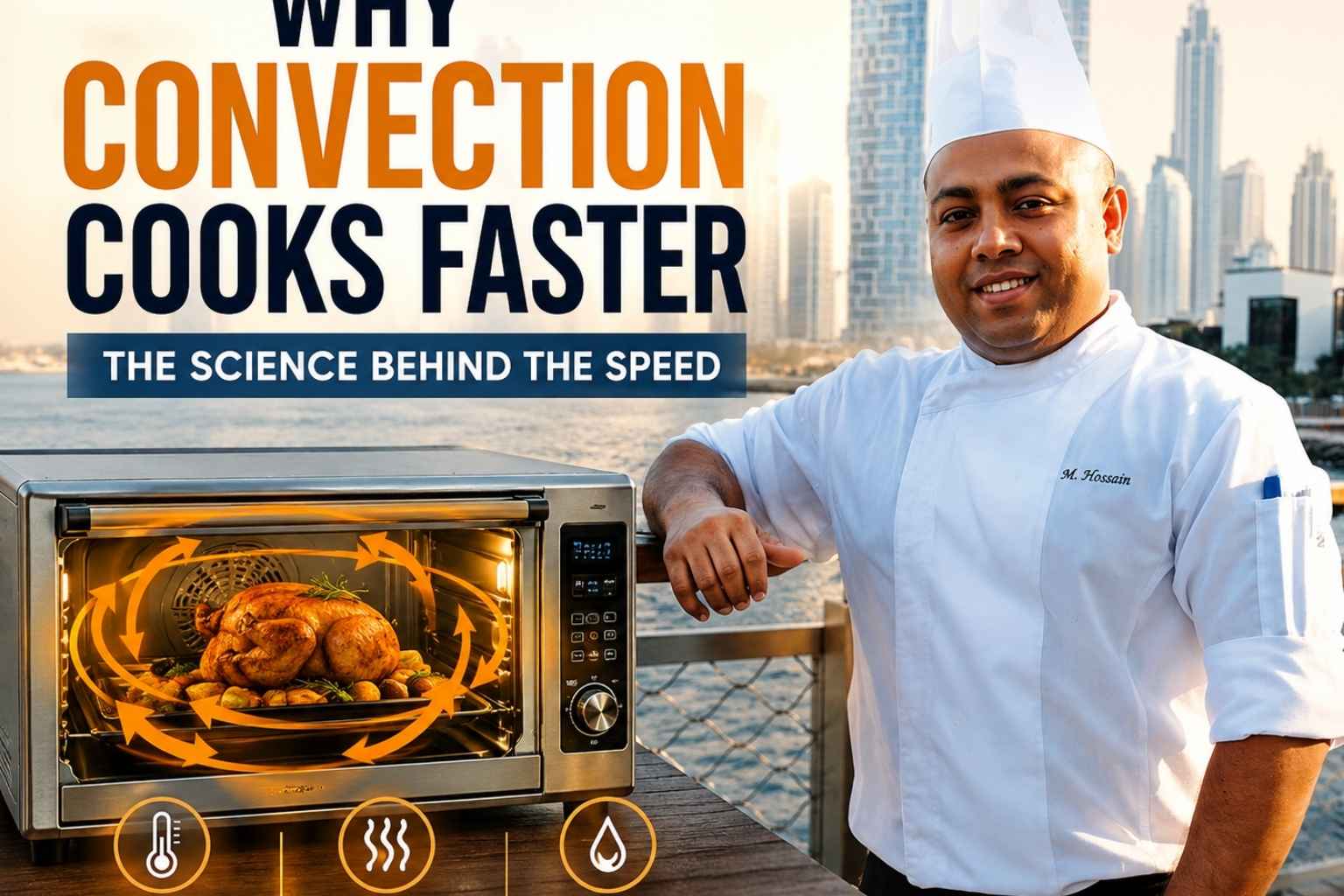
Convection cooks faster because of forced convection heat transfer – a fan continuously moves hot air across every surface of your food, eliminating the stagnant cool-air layer that forms around food in a still oven.
In a conventional oven, heat moves from the oven walls through the air to your food. That process is slow because air is a poor conductor. A thin layer of cooler air builds up right next to the food’s surface – physicists call this the boundary layer – and it acts like a blanket, slowing heat penetration.
Turn on the fan, and that boundary layer collapses. Hot air keeps hitting fresh food surface. Heat transfer rates go up by roughly 20-30% depending on fan speed and oven design (America’s Test Kitchen, 2022). That’s not a small difference – it’s the gap between a properly roasted chicken and one that takes 90 minutes when you expected 70.
The fan also drives moisture off the food’s surface faster through evaporative cooling – which sounds counterproductive but is actually what gives roasted vegetables their caramelized exterior and bread its crackly crust. The surface dries quickly, the Maillard reaction (the chemical browning process triggered above 280°F / 138°C) accelerates, and you get color and flavor that a conventional oven takes much longer to produce.
The 25°F / 25% Time Rule – And Where It Breaks Down
The standard convection conversion is this: reduce the recipe temperature by 25°F (14°C) OR reduce the cook time by 25% – not both simultaneously unless you know your oven well.
Most recipe developers write for conventional ovens, so convection adjustments are almost always necessary. If a recipe says 375°F for 45 minutes in a conventional oven, your convection options are:
- Run it at 350°F for 45 minutes, or
- Run it at 375°F for roughly 34 minutes
I prefer the temperature-reduction method for most things. Keeping the time close to the original gives you more reliable cues – you can still trust the “toothpick comes out clean” or “juices run clear” checks without recalibrating your instincts.
When the Rule Breaks Down
The 25% rule assumes an average-sized item in a well-calibrated oven. It falls apart in three situations:
- Very large roasts (over 5 lbs / 2.3 kg): The interior takes time to come up to temperature regardless of surface conditions. Reduce time by 15% instead of 25%, and use a probe thermometer.
- Very thin items (cookies under 1/4 inch thick, flatbreads): They brown so fast in convection that a 25% reduction may not be enough. Check at 30% reduced time.
- Ovens with poor fan placement: Some budget convection ovens have fans that create hot spots rather than even airflow. In those cases, you may need to rotate pans and stick closer to conventional temperatures.
Always calibrate with a separate oven thermometer (Taylor Precision Products, 2023, recommends checking at least quarterly). Built-in oven displays are often off by 15-25°F.
Moisture Loss in Convection: When It Helps and When It Ruins Your Dish
Moving air pulls moisture off food’s surface faster than still air. Whether that’s a feature or a flaw depends entirely on what you’re cooking.
Where Faster Evaporation Helps
- Roasted vegetables: The surface dries quickly, concentrating sugars and driving browning. Brussels sprouts, potatoes, and root vegetables come out genuinely caramelized rather than steamed.
- Roasted meats with skin: Chicken skin, duck skin, and pork crackling all need surface moisture to evacuate before browning can begin. Convection accelerates this dramatically.
- Pies and tarts: The bottom crust of a pie benefits from faster moisture removal – it’s the difference between a soggy bottom and a properly baked base.
- Cookies: Convection gives cookies crisper edges and more even browning across the entire sheet, especially useful when you’re baking two trays at once.
- Bread with a firm crust: Convection in the first half of the bake helps set the crust. Many artisan bakers use convection after the initial steam phase.
Where Faster Evaporation Destroys the Result
- Custards and puddings: The slow, gentle heat of a conventional oven (often assisted by a water bath) gives proteins time to set without curdling. Convection moves too fast and too dry.
- Cheesecakes: Same problem – surface dries out and cracks before the center sets.
- Souffles: Moving air disrupts the delicate structure as it rises. Leave convection off.
- Delicate layer cakes: The dry moving air forms a skin on the batter before it fully rises, which throws off the dome and texture.
- Quick breads and muffins: These rely on steam trapped inside the batter for their rise. Convection vents that steam too early.
My rule: if water is a structural ingredient in the final texture (custards, cheesecakes, anything with a creamy interior), stay in conventional mode.
Convection vs. Conventional: A Direct Comparison
| Factor | Convection | Conventional |
|---|---|---|
| Cook time | 20-30% faster (America’s Test Kitchen, 2022) | Baseline |
| Temperature needed | 25°F / 14°C lower for same result | Baseline |
| Browning evenness | High – air circulates to all surfaces | Low to medium – dependent on element position |
| Moisture retention | Lower – fan drives evaporation | Higher – still air holds surface moisture |
| Best uses | Roasting, baking cookies/pies, dehydrating | Custards, cheesecakes, souffles, delicate cakes |
| Multi-rack baking | Works well – fan equalizes heat | Problematic – top rack always hotter |
| Hot spots | Possible near fan, less overall variation | Yes – usually near top heating element |
| Energy use | 20% more efficient (U.S. Department of Energy, 2021) | Baseline |
Gas Convection vs. Electric Convection: Real Differences a Chef Notices
Gas and electric convection ovens both use fans, but they behave differently – and after cooking on both for 15 years, the differences are real enough to change how I work.
Gas convection has more moisture in the combustion air. Gas burners produce water vapor as a byproduct of burning, which means the oven environment is slightly more humid than electric. This is subtle but noticeable: gas convection browns a little less aggressively on the surface, and the interior of roasted meats stays slightly more moist. In a commercial kitchen running 20 chickens at a time, that difference matters.
Electric convection creates a drier heat environment. The browning is more aggressive, crisping happens faster, and the results are more consistent because electric elements maintain temperature with less fluctuation than gas flames. For cookies, pastries, and anything where crisp texture is the goal, electric convection outperforms gas.
Recovery time after you open the door also differs. Electric ovens with fan-forced air recover faster because the element response is immediate. Gas ovens take a few extra seconds for the flame to rebuild temperature. In a busy kitchen where you’re opening and closing doors constantly, electric convection is the better tool.
For home cooks: if you have electric convection, lean into the browning capability. If you have gas convection, use it for roasts and braises where a slightly more humid environment works in your favor.
True Convection vs. Fan-Only Convection: Why the Third Element Changes Everything
True convection (also called European convection or third-element convection) includes a dedicated heating element wrapped around the fan, not just the standard top and bottom elements. Fan-only convection simply circulates air heated by those standard elements.
The difference is significant. In fan-only convection, the fan moves air but that air still has to travel from the top or bottom element across the oven cavity. By the time it reaches certain spots, it’s cooled slightly. The airflow also creates uneven patterns depending on the distance from the element.
In true convection, the fan draws air through a heating ring and distributes freshly heated air from the back wall in a circular pattern. Every part of the oven gets air at the same temperature at the same time (Serious Eats, 2023). This is why true convection genuinely equalizes heat across multiple racks – it’s not moving the same air around, it’s continuously reheating it.
If your oven has a “convection bake” and a “convection roast” setting, check the manual. Many manufacturers use “convection bake” for fan-only and “convection roast” for the true convection mode with the third element. Use true convection for anything where browning and evenness both matter.
Hot Spots in Convection Ovens and How to Manage Rack Position
Convection ovens have hot spots too – they’re just different from the hot spots in conventional ovens.
In a conventional oven, the hottest zone is near the top broil element. In a convection oven, the hot zone is typically near the fan itself, which is usually at the back wall. Food placed directly in front of the fan browns faster on the side facing the fan.
Rack Positions That Work
- Middle rack: Best for single-tray baking. The airflow reaches the item from all sides equally.
- Upper-middle and lower-middle simultaneously: True convection handles two racks well. Rotate front-to-back at the halfway mark, not top-to-bottom.
- Avoid the very top rack: Even in convection, the top heating element can create uneven radiant heat on the top surface of your food.
For sheet pan dinners and roasted vegetables, I put the pan on the lower-middle rack, set the oven to true convection at 400°F (205°C), and don’t touch it for the first 20 minutes. The underside of the vegetables picks up heat from the pan, the top surface picks up convection airflow, and the result is caramelized on both sides.
Foods That Love Convection vs. Foods That Need Conventional Heat
Cook in Convection Mode
- Roasted chicken and turkey: Skin crisps faster, the bird cooks more evenly, and you recover 15-20 minutes on cook time for a standard roast chicken (Cook’s Illustrated, 2024).
- Sheet pan vegetables: Broccoli, Brussels sprouts, cauliflower, sweet potatoes, and root vegetables all benefit from the fast surface drying that convection provides.
- Cookies: Two racks of cookies come out evenly browned at the same time – something a conventional oven can rarely manage.
- Pies and tarts: Especially beneficial for blind-baked crusts and fruit pies where a soggy bottom is the enemy.
- Bacon and pork belly: The fan accelerates fat rendering and gives you crisper results without constant attention.
- Dehydrating: Low-temperature convection (150-175°F / 65-80°C) is a solid substitute for a dedicated dehydrator.
Keep in Conventional Mode
- Custards, creme brulee, pots de creme: The gentle still heat is part of the technique.
- Cheesecakes: Use conventional with a water bath.
- Souffles: Never use convection.
- Angel food and chiffon cakes: Delicate foam structures need still air.
- Quick breads (banana bread, zucchini bread): Steam retention is essential.
- Delicate layer cakes with thin batter: Surface sets too fast in convection.
When to Convert a Recipe and When to Leave It Alone
Convert a recipe to convection when the dish benefits from browning, crispness, or faster cooking and the original recipe was written for a conventional oven.
Leave a recipe in conventional mode when it involves any of the following: a water bath, a covered pan, a steam-dependent rise, or a very wet batter.
My Conversion Decision System
Ask yourself three questions:
- Do I want the surface to brown and crisp? If yes, convert to convection.
- Does the recipe rely on trapped moisture or steam for its texture? If yes, stay conventional.
- Is the dish more than 3 inches / 7.5 cm deep? If yes, use the temperature-reduction method (not time reduction) to avoid over-browning the outside before the inside is done.
For any new recipe I’m trying in convection for the first time, I reduce the temperature by 25°F and keep the original time as my starting point. I check 10 minutes before the original time is up and go from there.
Common Convection Mistakes and How to Fix Them
Using convection for a recipe that calls for it but not checking your oven type: Not all convection ovens are equal. Fan-only convection and true convection require different adjustments. Check your oven manual before applying any standard conversion.
Reducing both temperature AND time simultaneously: This is the most common mistake I see in home kitchens. Reducing both leads to undercooked interiors, especially in large items. Pick one adjustment method and commit.
Not rotating pans: Even true convection has slight airflow variation. For cookies and pastries, rotate front-to-back halfway through the bake.
Covering food that should stay uncovered: A covered pan defeats the purpose of convection – you’re trapping the moisture the fan is trying to remove. Only cover food in convection if you want to mimic conventional cooking behavior (for braises and stews, this is actually useful in the first phase).
Ignoring pan material: Dark metal pans absorb more radiant heat. In convection, the combination of moving hot air and dark pan can over-brown the bottom before the top is done. Use light-colored aluminum sheet pans for cookies and pastries.
My Personal Convection Routine After 15 Years in Professional Kitchens
My default setting for most savory cooking is true convection at 400°F (205°C). Roasted vegetables, whole chickens, pork tenderloin, sheet pan meals – it all goes in at 400 with the fan on.
For baked goods, I split it: convection for pies, tarts, shortbread, and cookies. Conventional for anything with eggs and cream as the main structural ingredient.
I always keep a Taylor Precision oven thermometer in the oven. My current home oven reads 375°F when it’s actually 355°F – a common calibration issue. Without that thermometer, every convection conversion would be off.
One piece of advice I give every cooking student: spend one month cooking the same five dishes in both modes and compare the results yourself. A roast chicken. A batch of chocolate chip cookies. A cheesecake. Roasted broccoli. A loaf of banana bread. After that experiment, you’ll have an intuitive sense of when to flip the switch that no written rule can fully replace.
Convection is not always better. It’s a specific tool for specific results. Know what it does, and you’ll stop guessing.
Frequently Asked Questions About Convection Cooking
Why does convection cook faster than a regular oven?
Convection cooks faster because a fan continuously moves hot air across food’s surface, eliminating the boundary layer – a thin zone of cooler air that naturally forms around food in a still oven and slows heat transfer. Without that insulating layer, heat reaches the food surface directly and continuously, reducing cook times by 20-30% (America’s Test Kitchen, 2022).
What is the convection temperature conversion rule?
The standard rule is to reduce your recipe’s oven temperature by 25°F (14°C) when switching from conventional to convection, keeping the cook time the same. Alternatively, keep the temperature the same and reduce cook time by 25%. Do not apply both adjustments simultaneously unless you are highly familiar with your specific oven’s output.
What is the difference between true convection and fan-only convection?
True convection (also called European convection or third-element convection) uses a dedicated heating element wrapped around the oven’s rear fan. This element reheats air as the fan circulates it, producing consistently hot air across all rack levels. Fan-only convection simply moves air from the standard top and bottom heating elements, which creates more temperature variation across the oven cavity (Serious Eats, 2023).
What foods should you never cook in a convection oven?
Avoid convection for custards, cheesecakes, souffles, chiffon cakes, quick breads (like banana bread), and delicate foam-based cakes. These dishes either rely on trapped moisture for their texture, require still heat for proper protein setting, or have foam structures that moving air disrupts before they can stabilize.
Does convection dry out meat?
Convection can dry out the surface of meat faster than conventional heat – which is actually desirable for skin-on poultry and pork, where a dry, crispy exterior is the goal. For larger roasts (over 5 lbs / 2.3 kg), reduce the temperature rather than the time to avoid excessive moisture loss from the exterior while the center comes up to temperature. Using a probe thermometer is the most reliable way to avoid overcooking.
Is gas convection or electric convection better?
Electric convection produces drier heat and more consistent browning, making it better for cookies, pastries, and anything where crisp texture matters. Gas convection introduces slight moisture from combustion and has slightly more temperature fluctuation, making it more forgiving for roasted meats. Neither is universally better – the right choice depends on what you’re cooking most often.
How do I know if my oven has true convection or fan-only convection?
Check your oven manual. Many manufacturers label their settings as “convection bake” (fan-only) and “convection roast” (true convection with the third element). You can also look at the back wall of the oven cavity – true convection ovens have a circular or rectangular heating element surrounding the fan. If there is no element around the fan, your oven has fan-only convection.
Can I use convection for multi-rack baking?
Yes, and this is one of convection’s biggest practical advantages. True convection distributes heat evenly across multiple racks, allowing you to bake two sheets of cookies or two pies simultaneously with consistent results. Rotate pans front-to-back halfway through the bake time – but in true convection, rack-swapping is usually unnecessary.
Key Takeaways
- Convection cooks faster because a fan removes the cool-air boundary layer that insulates food in a still oven – heat hits the surface directly, cutting cook times by 20-30%.
- Use the 25°F temperature reduction OR the 25% time reduction – not both at once – when converting conventional recipes.
- True convection (with a dedicated heating element around the fan) produces more even heat than fan-only convection, especially across multiple racks.
- Fast moisture evaporation in convection is a feature for roasted meats, vegetables, pies, and cookies – and a problem for custards, cheesecakes, souffles, and quick breads.
- Electric convection browning is more aggressive and consistent; gas convection runs slightly more humid and is more forgiving for large roasts.
- Always use a separate oven thermometer – built-in displays are frequently off by 15-25°F, and convection conversions fail when your starting temperature is wrong.
- Rotate pans front-to-back (not top-to-bottom) halfway through the bake, even in convection mode, to compensate for fan-side hot spots.

I’m Mossaraof, a trained chef and the founder of OvenInsights.com. I spent years cooking at Larrupin’ Cafe and in kitchens across Chicago and Seattle. Now I test kitchen gear for a living. I moved to North Acton, London, and I test every tool I write about. I use real meals and real heat. No brand deals. No shortcuts. I cover 12 kitchen types and hundreds of recipes. I believe this: the right tools matter as much as the recipe.