
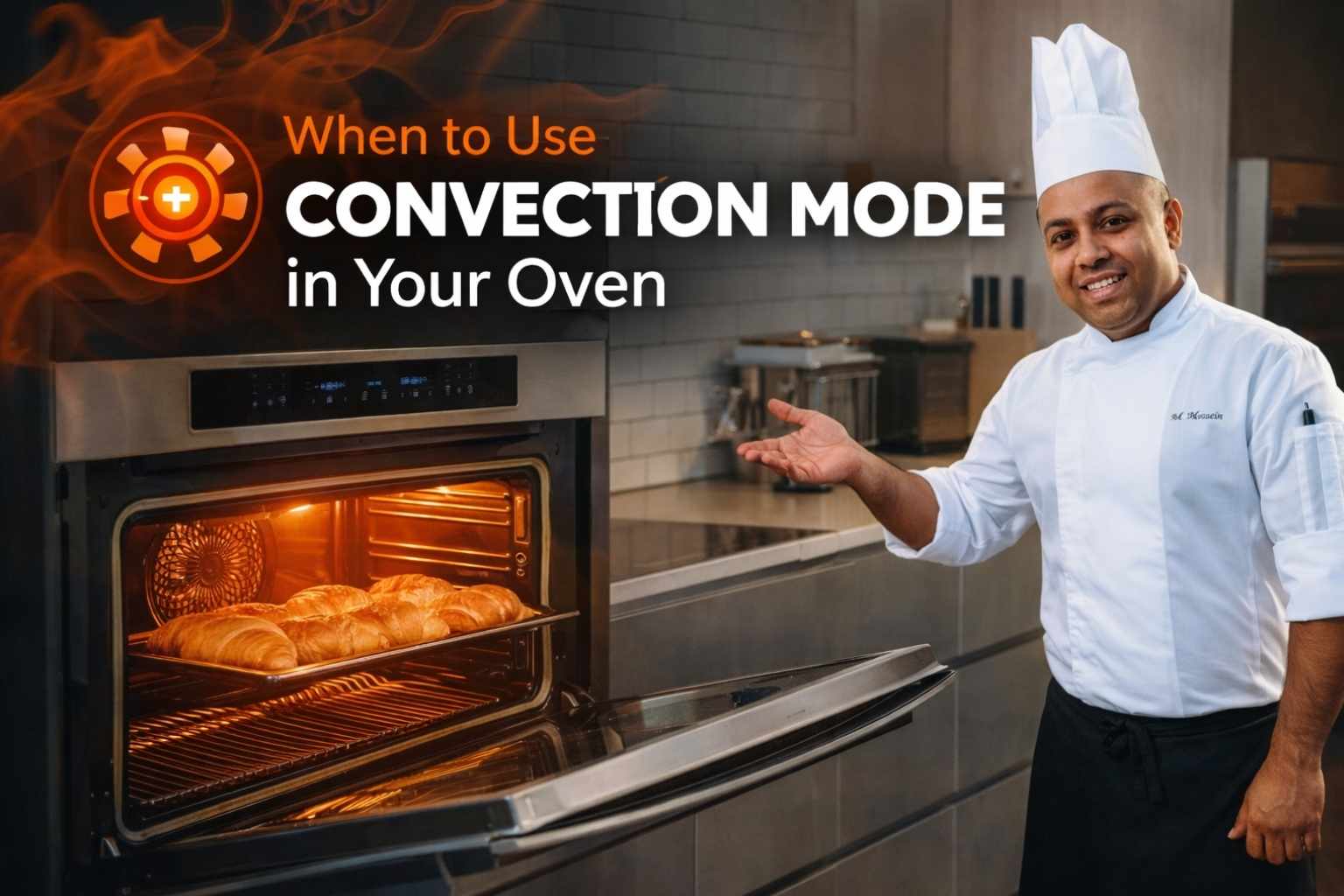
Hey, I’m Mossaraof — a professional cook and food blogger.
We all want that perfectly even, golden-brown tan and a shattered-glass crunch that only a high-speed fan can deliver. I will show you when to use convection mode in your oven so you can get restaurant-quality results, from roasted meats that stay dripping with juice to pastries that rise with beautiful, flaky layers.
My years in a busy Chicago kitchen taught me that the moving air of a convection fan is the true secret to eliminating hot spots and speeding up your cook time by about 25%. Use my Ultimate Guide to Master Your Oven to learn how to adjust your temperatures and rack positions for this powerful setting. Let’s grab your roasting pan and start mastering this professional heat technique together right now!
What Is Convection Mode (And Why Does It Matter So Much?)
Let’s get this out of the way before we jump into chicken skin and pie crusts.
Convection mode isn’t some mysterious setting. It just means your oven has a fan inside. That fan moves hot air around so heat hits your food more evenly.
The Fan and Heating Combo — What Really Happens Inside
Regular ovens heat from the bottom (and sometimes the top). But that heat just sits there—hot in some spots, cooler in others.
With convection, the fan pushes hot air around:
- Food cooks more evenly.
- Surfaces brown better.
- Roasting happens faster.
In my Arizona kitchen, I roast chicken in convection mode year-round. It crisps better—even in dry air that normally dries meat out.
How It Differs From Standard Bake
I used to think 375°F was 375°F. It’s not.
Standard bake = radiant heat from the bottom. You get hot spots, especially on lower racks. That’s how I burned a lasagna in Chicago—bottom crisped to charcoal while the top was barely bubbling.
Convection changes that. Air circulates. Temps stay consistent. And the heat wraps around the food instead of just blasting one side.
U.S. Kitchen Brands I’ve Used with Convection
If you’re in the U.S., here are a few convection ovens I’ve cooked with:
- GE Profile Wall Oven – Reliable, even heat. Used in a New York test kitchen.
- Whirlpool True Convection Oven – My current workhorse in Florida. Solid all-around.
- KitchenAid Convection – Great for baking. Slightly noisy fan, but worth it.
If your oven has a fan icon, or says “convection bake,” you probably have this setting already.
When You Should Definitely Use Convection Mode
This is where convection shines. Over the years, I’ve figured out what dishes thrive under that circulating heat.
Roasting Meats: That Crispy Skin, Even in Winter
The first time I roasted a turkey in convection mode, I panicked. It cooked fast. Like—too fast.
But when I took it out, the skin was shatteringly crisp, and the meat inside stayed juicy. It was December in Chicago. Snow outside. But inside? Perfect roast.
Chicken, Turkey, and Game
- Even browning, top and bottom
- No soggy bottom skin
- Skin crisps without drying the inside
Now, when I roast bone-in chicken thighs, I always use convection at 400°F. I place them skin-side up, no foil. The results? Golden brown in under 35 minutes.
Pork Loins and Beef Roasts
Pork loin used to dry out on me. Then I started using convection:
- Start high (425°F) for sear
- Drop to 375°F halfway through
- Juices stay inside, crust outside
Beef roast gets that dark bark I love—without needing a broiler finish.
Baking Cookies, Pies, and Pastries
I run a weekly baking session on Sundays. Three trays of cookies. One oven. Convection mode makes it possible.
Batch Cookies (With Rotation Hacks)
- Even browning across trays
- No flipping or pan swapping
- Bake time: 9–11 minutes at 350°F
The only trick? Rotate the pans once halfway through. Front to back. That’s it.
Fruit Pies and Puff Pastry
- Crust sets faster
- No soggy bottoms (yes, really)
One time in Minnesota, I made apple pie without convection. The middle was a mess—watery and undercooked. Now I go convection every time.
Sheet Pan Meals and Veggies
This is my go-to for fast weeknight dinners. One pan. One oven. Done.
Some of my favorites:
- Salmon + green beans (convection at 400°F = 16 minutes)
- Chicken sausage + Brussels sprouts
- Cauliflower + sweet potato cubes
Just remember: Don’t crowd the pan. Give everything room.
When You Should NOT Use Convection Mode
Convection is powerful. Sometimes too powerful. Here’s where I learned the hard way.
Delicate Cakes and Quickbreads
My first banana bread in convection mode was tragic. It looked beautiful—on the outside. But inside? Gummy and sunken.
What Happened to My Banana Bread
- Edges cooked too fast
- Center collapsed
- Crust too thick
Now I stick to regular bake at 325°F. No fan. Longer time. Better result.
Soufflés and Sponge Cakes
Air movement = collapse. I once made a lemon chiffon cake with convection. It puffed up, then fell like a deflated balloon.
If it needs gentle heat and slow rise, convection is not your friend.
Custards and Flans
Still heat = smooth texture. Convection = ruined top layer.
I made flan for a dinner party in Florida. It had bubbles all over the top and dry patches around the edge. I had to remake it. Standard bake saved the day.
Bread Proofing and Low-Temp Drying
Dough likes a quiet, steady warmth. That fan? It ruins the vibe.
Also, I tried drying apple slices with convection. They curled up weird and never crisped.
Lesson: Convection isn’t for everything.
How to Use Convection Mode the Right Way
It’s not just about turning the fan on. There’s a method to this madness.
Adjusting Temperature and Time
Every oven manual says it: drop your temp by 25°F in convection.
But honestly? That’s just a starting point. You have to test your own oven.
For my baked ziti:
- Standard: 375°F for 50 minutes
- Convection: 350°F for 40 minutes
Always check 5–10 minutes early. Convection moves fast.
Pan Types Matter More Than You Think
This was a surprise. But it matters.
- Dark pans = faster browning (sometimes too fast)
- Shiny pans = slower, more even
I tested three brands:
- Nordic Ware – Balanced result
- USA Pan – Quick crust, good lift
- Wilton – Lighter browning, good for cookies
Rack Positioning for Airflow
Hot air needs space. So does your food.
- Use the middle rack for most dishes
- Don’t block the fan
- I leave my baking steel on the bottom rack—it helps stabilize heat
Don’t Crowd the Oven
This one bites me during meal prep. Too many trays, and convection stops working right.
Leave a finger’s width between pans. At least.
Convection Settings Across U.S. Ovens: What to Look For
Not all convection ovens are equal. Some are sneaky about it.
True Convection vs Fan Bake
- True convection: Heating element + fan
- Fan bake: Fan only, no extra heat
My Chicago oven had fan bake. It helped, but it wasn’t great. My Florida Whirlpool has true convection—total game changer.
Dual-Fuel Ovens (Gas + Electric)
In 2025, I switched to a dual-fuel range. Gas stove, electric oven.
Best decision ever. Gas gives me flame control. Electric gives me baking accuracy.
Perfect combo for convection.
Common Symbols (And Why They’re Confusing)
- Fan icon = convection
- Fan with lines = convection bake
- Wavy lines = regular top or bottom heat
U.S. brands don’t always explain these clearly. I had to look them up the first time.
Real-Life Kitchen Scenarios (When I Flip the Convection Switch)
Let’s talk about real dinners—not just test recipes.
Weeknight Dinners
- Sheet pan chicken thighs with broccoli
- Salmon with asparagus
- Turkey meatballs and squash
Convection cuts the time by 8–10 minutes. I’m done cooking before my kids finish their homework.
Holiday Cooking
I go half-and-half on holidays:
- Turkey = convection
- Stuffing = regular bake
- Mac and cheese? Bake first, convection finish for the crust
My Christmas roast in Arizona needed convection. The outside browned beautifully, even with dry air.
Baking Marathons
Sundays are cookie days. I bake:
- Chocolate chip
- Oatmeal raisin
- Snickerdoodles
All in one oven, three trays at once. I rotate the racks halfway. Convection does the rest.
Troubleshooting: When Convection Misbehaves
Yes, it messes up sometimes. Here’s how I fix it.
Uneven Browning
- Rotate pans front to back
- Check rack level with a bubble tool
- Try a baking stone to balance temps
Overcooking or Dry Texture
- Lower temp further
- Use a digital thermometer (I trust ThermoWorks)
- Tent with foil if tops brown too fast
Fan Noise or Failure
- Check for grease buildup
- Listen for buzzing
- My fan once stopped mid-roast—had to call a repair tech
Should You Always Use Convection If Your Oven Has It?
Short answer? Nope. But when it works, it really works.
Learning Your Oven’s Personality
Each oven acts different:
- My GE in Chicago ran hot
- Whirlpool in Florida is steady
- Samsung rental oven in Texas was all over the place
Keep notes. Seriously. Write down what works.
Split Settings: Start Convection, End Regular
One trick I love:
- Roast with convection until browning happens
- Switch to regular bake to finish
Great for:
- Casseroles
- Meatloaf
- Baked ziti
Final Tips from My Own Convection Journey
Here’s what’s taped inside my kitchen cabinet:
- Always lower temp 25°F—but test your own oven
- Rotate pans no matter what
- Clean your fan monthly
- Use a thermometer, not guesswork
- Don’t crowd the oven
And never forget: Just because the oven can do convection doesn’t mean you should every time.
Now I trust my convection mode—but only because I learned when to use it.
Even if it took a few ruined banana breads to figure it out.
FAQs
When to Use Convection Mode in Your Oven for Roasting?
Use convection mode when roasting chicken, turkey, or veggies. The fan moves hot air, so food browns faster and cooks more even, with crisp edges and juicy centers.
Is Convection Mode Good for Baking Cookies and Pastries?
Yes, convection mode works great for cookies and puff pastry. It helps trays bake evenly, so you can use more racks and still get golden, not burnt, bottoms.
When Should You Avoid Convection Mode in Your Oven?
Skip convection for cakes, custards, and soft breads. The fan can dry the top and make centers sink, which ruins light and fluffy textures.
Do I Need to Change Temperature When Using Convection Mode?
Yes. Lower the temp by about 25°F when you use convection mode in your oven. Food cooks faster, so always check a few minutes early to avoid overbaking.
Is Convection Mode Better Than Regular Bake for Weeknight Meals?
For sheet‑pan dinners and fast meals, convection mode is better. It cooks food quicker and helps everything brown at the same time, with less tray swapping.

I’m Mossaraof, a trained chef and the founder of OvenInsights.com. I spent years cooking at Larrupin’ Cafe and in kitchens across Chicago and Seattle. Now I test kitchen gear for a living. I moved to North Acton, London, and I test every tool I write about. I use real meals and real heat. No brand deals. No shortcuts. I cover 12 kitchen types and hundreds of recipes. I believe this: the right tools matter as much as the recipe.