At A Glance
- Bake most fish at 400°F (204°C) – it works for the widest range of fillets and cuts without drying them out.
- The FDA says fish is safe at an internal temp of 145°F (63°C), but most chefs pull fish at 130–135°F and let carryover cooking do the rest (FDA FoodSafety.gov, 2024).
- Delicate fish like sole and flounder do best at 275–300°F. Thicker cuts like cod and halibut handle 400–425°F well. Whole fish go into a 450°F oven for crispy skin.
- Frozen fish should never go into the oven at the same temp as thawed fish – always thaw first or extend cook time by 50% at lower heat.
- A $15 instant-read thermometer is the single best tool you can buy for fish. Nothing replaces it.
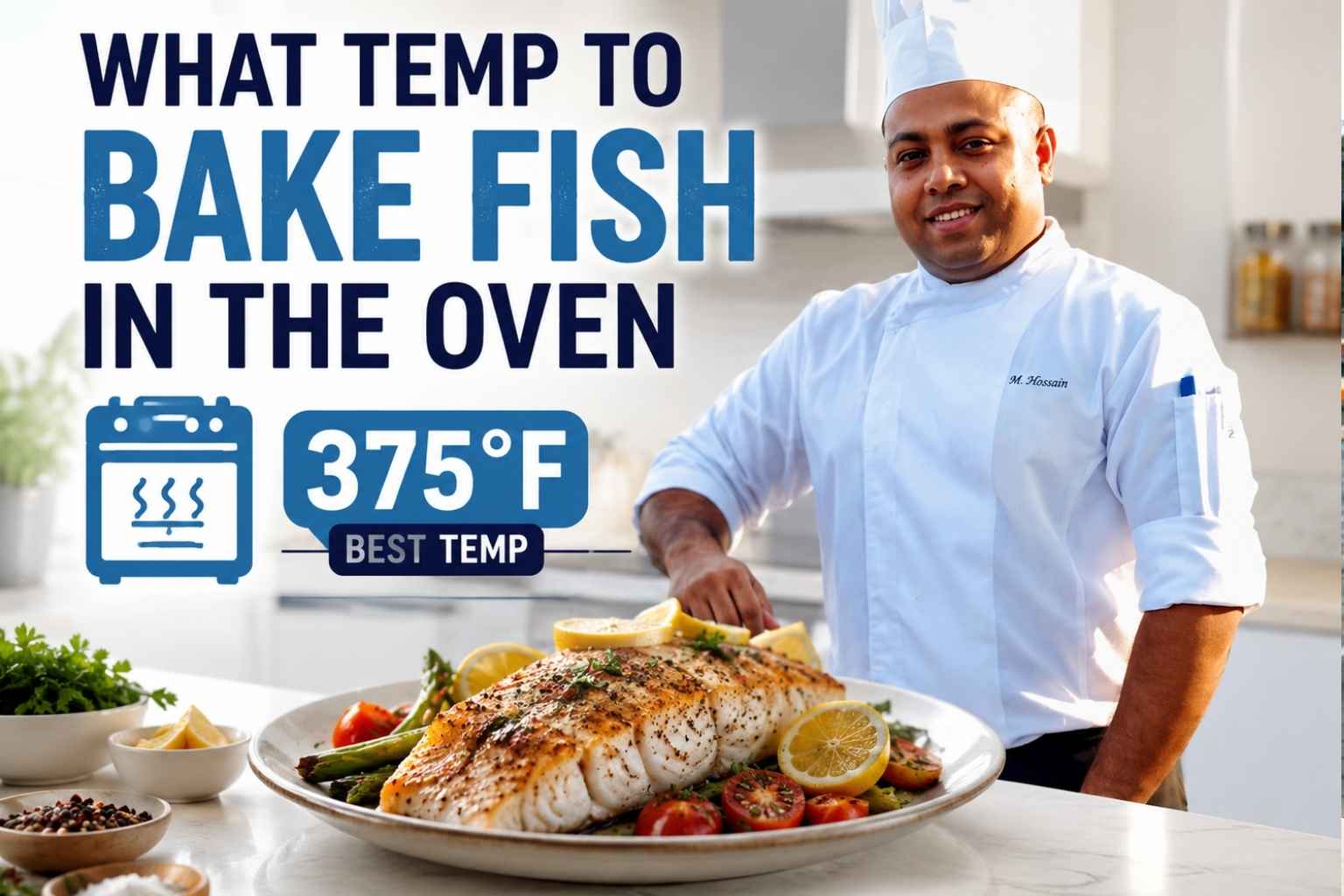
I used to guess the oven setting every time I cooked fish. It worked some days, but other days the fish came out dry. If you have ever asked What Temp to Bake Fish in the Oven, you are in the right place. I have tested different fish, baking times, and oven temperatures, and I will share what really works. By the end, you will know the best temperature, helpful baking tips, and simple steps to make juicy, flaky fish every time. Let’s get started.
Why Oven Temperature Is the Most Important Fish Decision You’ll Make
The temp you set on your oven dial decides everything – texture, moisture, and whether your fish tastes like dinner or a dry hockey puck.
Fish is about 70–80% water by weight (Harold McGee, On Food and Cooking, 2004). When you apply too much heat too fast, that water turns to steam and shoots out of the flesh. What’s left is dry, rubbery, and sad. Apply the right heat at the right rate, and the proteins set gently, the fats render slowly, and you get fish that flakes with a fork and stays moist all the way through.
Here’s the simple science. Fish proteins – mainly myosin and actin – start to set at around 104°F (40°C). By 130°F (54°C), myosin is fully coagulated and the fish is technically done in terms of texture. By 145°F (63°C), actin starts to contract hard. That’s when fish gets tough and dry. So the gap between “perfect” and “overcooked” is roughly 15 degrees. That’s a narrow window. And your oven temp is the main lever that controls how fast you move through it.
I’ve been cooking fish in professional kitchens for 15 years. The most common mistake I see home cooks make – every single time – is cranking the oven to 375°F and leaving the fish in “until it looks done.” By the time it looks done, it’s 10 degrees past done.
Fish Baking Temperature Reference Table
Use this as your go-to guide. Times assume fillets are 1 inch thick unless noted.
| Oven Temp | Best Fish Types | Est. Time (1″ fillet) | Notes |
|---|---|---|---|
| 275°F (135°C) | Sole, flounder, thin tilapia | 25–35 min | Slow and gentle; great for very thin or delicate fillets |
| 300°F (149°C) | Trout, thin salmon portions | 20–28 min | Keeps fat from rendering too fast |
| 325°F (163°C) | Halibut, mahi-mahi | 18–25 min | Good middle-ground for medium-density fish |
| 350°F (177°C) | Salmon fillets, arctic char | 15–20 min | Classic temp; works well but watch closely |
| 375°F (191°C) | Cod, tilapia (thicker cuts) | 12–18 min | Fast enough for texture, gentle enough for moisture |
| 400°F (204°C) | Cod, halibut, striped bass | 10–14 min | Best all-around temp for most home cooking |
| 425°F (218°C) | Swordfish, tuna steaks | 8–12 min | Sears exterior well; needs close watching |
| 450°F (232°C)+ | Whole fish, skin-on fillets | 15–25 min (whole) | High heat crisps skin; rest fish for 3 min after |
Note: All times are estimates. Always verify with an instant-read thermometer (Taylor Precision Products, 2025).
The Internal Temperature Debate: FDA Says 145°F, Chefs Say Pull Earlier
The FDA recommends cooking fish to an internal temp of 145°F (63°C) to kill pathogens (FDA FoodSafety.gov, 2024). That number is correct from a food safety standpoint. I follow it in professional kitchens when serving large groups or anyone immunocompromised.
But here’s the honest truth: most experienced chefs pull fish from the oven at 130–135°F (54–57°C) for best texture.
Why? Carryover cooking. After you take fish out of the oven, the internal temp keeps rising for 3–5 minutes. Fish is thin. It carries over fast – typically 5–10 degrees (America’s Test Kitchen, 2023). So if you pull at 135°F, it often lands at 140–145°F by the time it hits the plate.
If you wait until the thermometer reads 145°F inside the oven, the fish lands at 150–155°F on the plate. At that point, the actin proteins have tightened. The texture is noticeably worse.
My personal rule: pull salmon and delicate white fish at 130°F. Pull tuna and swordfish at 125°F if you want a medium-rare center (similar to a steak). Pull anything going to a vulnerable person – the elderly, pregnant women, kids – at 145°F, no exceptions.
Temperature Breakdown by Fish Type and Cut
Low-and-Slow (275–300°F): Delicate Fillets Like Flounder and Sole
Flounder, sole, and other thin, flaky white fish need low heat. They’re thin – often half an inch or less. At 400°F, they go from raw to overcooked in about 4 minutes. You’ll miss the window.
At 275–300°F, you get a gentler rise in internal temp. The fish has time to cook through evenly from the center out. The result is silky, tender flesh – the kind that barely holds together on the fork.
I bake sole at 275°F on a buttered sheet pan, lemon slices underneath, for about 20–25 minutes. It’s gentle and forgiving.
Moderate Heat (350°F): Salmon and Trout
Salmon is fatty enough to handle moderate heat well. The fat insulates the flesh and slows moisture loss. At 350°F, a 1-inch salmon fillet takes about 15–18 minutes to hit 130°F internally.
Trout is similar in density but leaner than salmon. Keep it at 300–325°F to avoid drying out the flesh near the tail, which is always thinner than the center.
One thing I’ve noticed: salmon at 350°F gives you a more uniform interior than salmon at 425°F. At high heat, the outside overcooks before the center finishes. At moderate heat, everything comes up together.
High Heat (400–425°F): Cod, Halibut, and Thicker Cuts
Thick, dense fish like cod and halibut do well at 400–425°F. The high heat sets the exterior fast, which helps develop some color and texture. These fish are firm enough to handle the heat without falling apart.
A 1.5-inch cod fillet at 400°F takes about 12–15 minutes. I check it at 10 minutes. Every oven runs a little differently (America’s Test Kitchen, 2023).
Halibut is my favorite fish to bake at 425°F. It has a slightly sturdier texture than cod. I season it hard with salt, brush it with olive oil, and let the high heat do the work. Pull it at 130°F and rest for 3 minutes.
High-Heat Roasting (450°F+): Whole Fish and Crispy-Skin Results
If you want crispy skin – and you should want crispy skin – you need 450°F or higher. Lower temps steam the skin. They don’t crisp it.
For a whole branzino or snapper, score the skin with a knife, rub with oil, stuff the cavity with herbs and lemon, and roast at 450°F for 18–22 minutes depending on size. A 1.5-pound fish takes about 20 minutes. Check the thickest part – right behind the head – for doneness.
For skin-on fillets like salmon or striped bass, start them skin-side down on a preheated oven-safe pan at 450°F. The direct contact with the hot pan crisps the skin fast, and the oven finishes the top.
The Foil Debate: When to Wrap Fish and When to Skip It
Wrapping fish in foil traps steam. That steam keeps the fish moist – but it also prevents any browning, and it softens any texture you’d get from direct heat.
Use foil when:
- You’re baking lean, thin fish like tilapia or flounder that dry out fast.
- You’re adding aromatics – butter, garlic, herbs, wine – and want them to infuse into the fish (this is the “en papillote” method, just done in foil).
- You’re baking fish for someone who prefers very moist, soft texture with no color.
Skip the foil when:
- You want the exterior to develop any kind of crust or color.
- You’re baking skin-on fish and want crispy skin.
- You’re cooking at high heat (400°F+) and the fish is thick enough to hold its moisture on its own.
I skip foil for most high-heat baking. The steam makes the outside mushy. If I’m worried about dryness, I add a pat of butter on top and pull the fish 5 degrees early.
Fresh vs. Frozen Fish: You Need to Adjust Your Approach
Never bake frozen fish at the same temp and time as thawed fish. The ice inside the flesh insulates it. The outside will be overcooked before the center thaws and cooks through.
The best option: thaw fish in the refrigerator overnight before baking. That’s the approach Serious Eats recommends for even cooking and better texture (Serious Eats, 2024).
If you’re baking frozen fish because you forgot to thaw it, here’s what actually works:
- Start it in a 275°F oven for 20 minutes to thaw it gently.
- Pull it out, pat it dry with paper towels.
- Season it properly.
- Return it to a 400°F oven for the normal cook time.
Skipping step 1 and going straight to high heat with frozen fish is how you end up with grey, rubbery fish that weeps water across your sheet pan.
How to Test Fish for Doneness Without a Thermometer
A thermometer is still the best tool. But if you don’t have one, here are three reliable methods.
The Flake Test: Press the thickest part of the fish with a fork. If it resists, it’s not done. If it flakes apart along the natural grain of the muscle, it’s done. If it falls apart too easily and looks very white all the way through, it may be slightly overdone.
The Opacity Test: Raw fish is translucent – you can almost see through it. Cooked fish is opaque and solid white (or pink in the case of salmon). Look at the side of the fillet. If the opacity line has traveled all the way to the center, it’s done.
The Fork-Twist Method: Insert a fork at a 45-degree angle into the thickest part and twist gently. If the flesh resists and feels smooth, it’s underdone. If it separates easily with a slight twist, it’s done.
All three methods are good. But they’re all trailing indicators – you only find out the fish is done after it’s already there. A thermometer tells you in real time, before you overshoot. A basic instant-read thermometer like the ThermoWorks ThermoPop costs about $29 (ThermoWorks, 2025). It’s worth it.
Oven Rack Position: It Matters More Than Most Recipes Say
Where you put the fish in the oven changes how it cooks.
Middle rack is the default and it works well for most fish. Heat circulates evenly from top and bottom.
Top rack gives you more top-down radiant heat. This is great when you want the surface to brown – like a breadcrumb topping or a glazed salmon. But it dries out the flesh faster if you’re not watching closely.
Bottom rack gives you more direct bottom heat. It’s useful when you’re using a heavy cast iron pan and want the bottom of the fish to get color. I use this for thick halibut steaks when I want a seared-looking bottom.
For most home baking situations, stick to the middle rack at 400°F and move up to the top rack for the last 3 minutes if you want a browned top.
Convection vs. Conventional Ovens for Baking Fish
Convection ovens use a fan to circulate hot air. This makes them hotter and faster than conventional ovens at the same dial setting. It’s great for roasting vegetables. For fish, it can be a problem.
The moving air accelerates moisture loss from the surface of the fish. At 400°F convection, a salmon fillet can dry out faster than you’d expect. Serious Eats found that convection cooking reduces moisture in lean proteins more noticeably than in fattier ones (Serious Eats, 2024).
If you’re using a convection oven for fish:
- Lower the temp by 25°F compared to what the recipe says.
- Reduce cook time by about 15–20%.
- Check internal temp earlier than you think.
So a recipe that says 400°F conventional = 375°F convection. A recipe that says 20 minutes = check at 16 minutes in convection mode.
For crispy-skin fish and whole fish, convection is actually a benefit. The moving air helps skin crisp faster. Just reduce the temp slightly to avoid overcooking the flesh.
Common Mistakes When Baking Fish (And How to Fix Each One)
Overcrowding the Pan
This is the top mistake. When you crowd fillets together, they steam each other instead of roasting. Steam = soft, wet exterior, no color, uneven cooking. Fix it by using a large enough sheet pan that every piece has at least half an inch of space around it. If you have a lot of fish, use two pans.
Not Drying the Fish Before It Goes in the Oven
Wet fish steams. Dry fish roasts. Pat every piece dry with paper towels before seasoning. This single step changes the texture of the exterior dramatically.
Skipping the Preheat
Putting fish in a cold oven means the fish starts cooking slowly, then gets hit with increasing heat. This leads to uneven texture. Always preheat the oven fully before the fish goes in – and if you’re using a cast iron pan, preheat that too.
Pulling It at the Wrong Time
Most home cooks leave fish in the oven until they’re “sure” it’s done. That usually means it’s overdone. Set a timer for 2 minutes before the minimum cook time, check the temp, and pull at 130–135°F.
Over-Seasoning with Acid Before Baking
Lemon juice on raw fish is great – but if you marinate fish in acid for more than 15 minutes before baking, the acid starts to denature the proteins. That changes the texture before heat even touches it. Add lemon juice after baking, not before, unless it’s a very brief marinade.
My Go-To Method for Baking Fish at Home
I’ve tested a lot of approaches over 15 years. Here’s what I actually do at home when I want great baked fish without fuss.
The setup: I use a heavy sheet pan lined with parchment. I set the oven to 400°F and let it preheat for at least 15 minutes. Not 5 minutes – 15.
The fish: I pat it bone dry. I salt it about 10 minutes before cooking so the salt has time to draw a tiny bit of moisture and then reabsorb back into the flesh (a trick I picked up from reading Samin Nosrat’s Salt, Fat, Acid, Heat, 2017). Then I brush it with olive oil and add whatever I want on top – herbs, capers, a thin layer of Dijon, whatever.
The cook: Skin-side down, middle rack, 400°F. I set a timer for 8 minutes for a 1-inch fillet. Then I check the temp. I pull it at 130–135°F.
The rest: I let it sit on the pan for 3 minutes before serving. That carryover carries it to 140–145°F. It goes to the table at peak texture.
This works for salmon, cod, halibut, and striped bass. For thinner fish like sole, I drop to 300°F and extend the time to 20 minutes. For a whole fish, I go to 450°F.
Simple. Reliable. No drama.
Frequently Asked Questions About Baking Fish in the Oven
What temp to bake fish in the oven for the best results?
400°F (204°C) is the best all-around temperature for baking fish in the oven. It works well for most medium to thick fillets – cod, halibut, salmon, striped bass – and gives you a good balance of speed, moisture retention, and some exterior texture. For very thin or delicate fish like sole, drop to 275–300°F.
How long does fish take to bake at 400°F?
A 1-inch fillet takes 10–14 minutes at 400°F. Check it at 10 minutes with an instant-read thermometer. You’re looking for 130–135°F internal temp. Thinner fillets (half an inch) may be done in 7–8 minutes. Thicker cuts (1.5 inches) may take 16–18 minutes.
What internal temperature is fish done at?
The FDA sets the safe internal temp for fish at 145°F (63°C) (FDA FoodSafety.gov, 2024). Most professional chefs pull fish at 130–135°F to account for carryover cooking, which typically adds 5–10 degrees after the fish leaves the oven. If you’re cooking for vulnerable individuals, always reach 145°F.
Can I bake frozen fish without thawing it first?
You can, but you need to adjust your method. Start frozen fish in a 275°F oven for 20 minutes to gently thaw it, then pat dry, season, and finish at your target high temp. Going directly into a 400°F oven from frozen leads to overcooked exterior and undercooked interior.
Should I cover fish with foil when baking?
Cover fish with foil when you want to trap moisture and steam the fish gently – good for lean, thin fillets or when cooking with butter and aromatics. Skip the foil when you want any browning, crust, or crispy skin. Foil prevents all exterior texture development.
Does rack position matter when baking fish?
Yes. The middle rack gives the most even heat for most fish. The top rack adds more radiant heat from above, which is good for browning a topping or glaze. The bottom rack puts more direct heat below, useful for heavy pans where you want heat on the underside of the fish.
Why does my baked fish always come out dry?
Three things cause dry baked fish most often: cooking it to 145°F+ inside the oven (without accounting for carryover), using too high a temp for too long with no fat on top, or baking it uncovered in a convection oven that strips surface moisture fast. Pull it earlier (130–135°F), brush it with oil or butter before it goes in, and rest it for 3 minutes before serving.
Is convection or conventional better for baking fish?
Conventional ovens are gentler on fish. Convection moves hot air around, which is great for crisping but can dry out lean fillets faster. If you only have convection, reduce the temp by 25°F and check doneness 15–20% earlier than the recipe says. Convection is actually a plus for crispy-skin fish and whole fish.
Key Takeaways
- 400°F is your default for most baked fish at home. Adjust up for crispy skin and whole fish, adjust down for thin and delicate fillets.
- Pull fish at 130–135°F internal temp, not 145°F – carryover cooking finishes the job after it leaves the oven.
- Pat fish dry before baking – wet fish steams, dry fish roasts.
- Never crowd the pan – each piece needs space or you lose all texture.
- Foil = moist and soft. No foil = texture and color. Choose based on the fish and the result you want.
- Thaw fish before baking – frozen fish needs a two-step method or the exterior overcooks before the center is done.
- A thermometer beats all visual tests. Buy one. Use it every time.

I’m Mossaraof, a trained chef and the founder of OvenInsights.com. I spent years cooking at Larrupin’ Cafe and in kitchens across Chicago and Seattle. Now I test kitchen gear for a living. I moved to North Acton, London, and I test every tool I write about. I use real meals and real heat. No brand deals. No shortcuts. I cover 12 kitchen types and hundreds of recipes. I believe this: the right tools matter as much as the recipe.