At A Glance
- Toaster ovens run 25–50°F hotter than full-size ovens at the same dial setting, so always reduce temperature by 25°F and start checking 5–10 minutes early.
- Convection mode cuts cooking time by roughly 25% and is the right choice for most proteins and vegetables — but skip it for delicate baked goods like soufflés or custards.
- A $10 oven thermometer is the single best upgrade for any toaster oven; the factory thermostat on most models drifts by 30–50°F (Consumer Reports, 2024).
- Foods you should never cook in a toaster oven: large birds over 4 lbs, recipes with excessive splatter, and anything requiring a water bath.
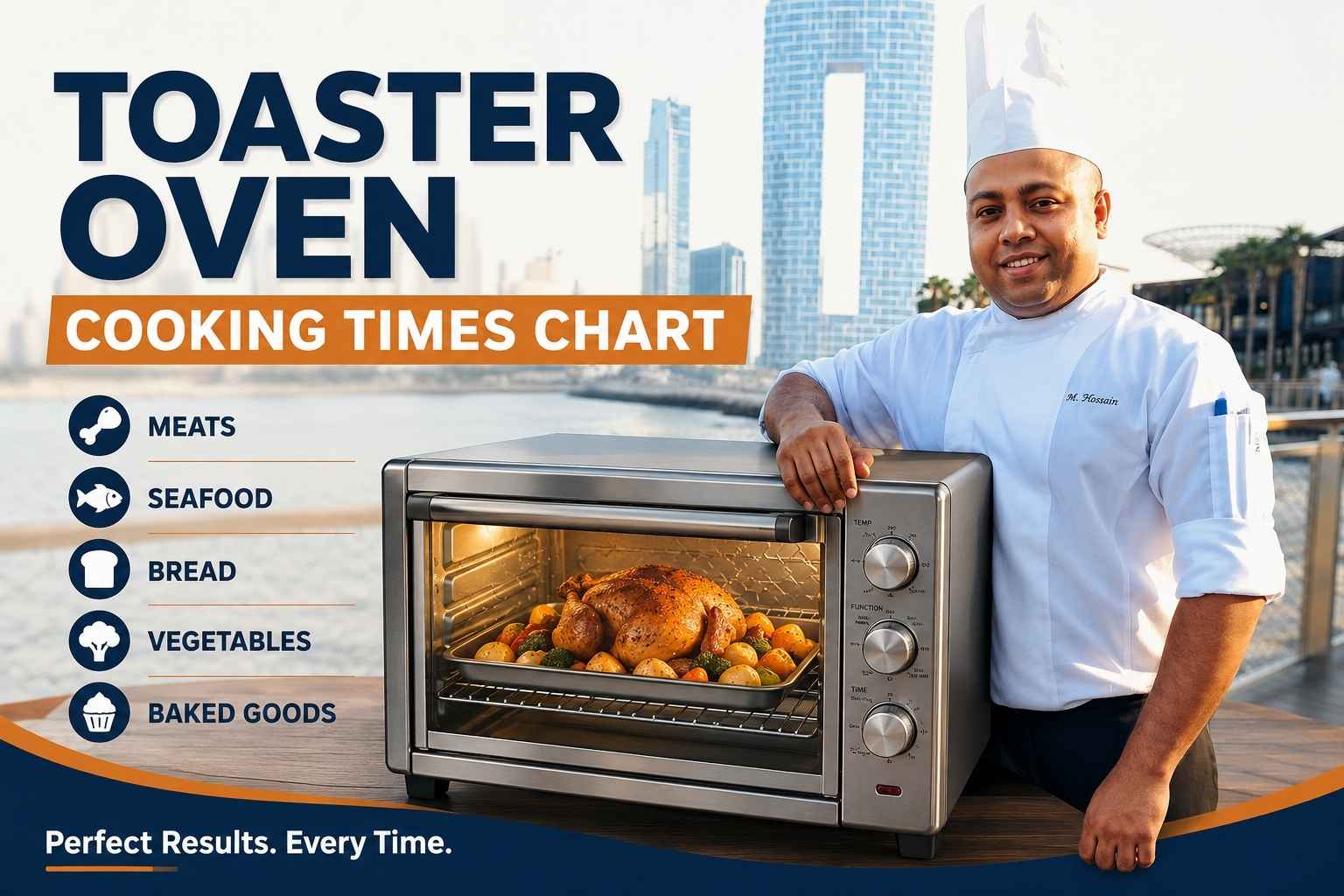
- The master cooking times chart below covers 30+ foods across six categories with temperature, time, and chef notes in one place.
I burned a batch of fish sticks last week. My toaster oven ran hot, and I had no clue how long to cook them. That’s why I made this toaster oven cooking times chart. I’ll walk you through the exact times and temps that work, no guesswork needed. Grab your oven manual, and let’s get your food cooked just right.
Why Toaster Oven Cooking Times Are Different from a Full-Size Oven
Toaster oven cooking times are shorter — and less predictable — than full-size oven times because the heating elements sit 3 to 6 inches from your food instead of 12 to 18 inches away.
I learned this the hard way in 2011. I was testing recipes for a catering client out of a rented apartment kitchen with a beat-up Cuisinart toaster oven. I set the dial to 375°F for roasted chicken thighs, pulled them out at the 30-minute mark like I always did in a commercial oven, and the tops were nearly black while the centers read 148°F. Not safe to eat. Embarrassing to serve.
That day I bought an oven thermometer and started keeping notes. Here is what I found, and what 15 years of professional cooking has confirmed since:
Three physical reasons toaster ovens cook faster and less evenly:
- Element proximity. The top heating element in most toaster ovens sits 2–4 inches above the rack. Radiant heat from that close a distance is intense. Food browns on top before the interior is done.
- Cavity size. A smaller cavity concentrates heat. There is less air volume to absorb and distribute energy, so temperatures spike faster and recover faster after the door opens.
- Thin walls. Full-size ovens have thick insulation. Toaster ovens lose heat through the walls quickly and cycle the element on more frequently to compensate, which creates hot spots near the rear and sides.
The practical rule: set your toaster oven 25°F lower than any full-size oven recipe calls for, and check doneness 5–10 minutes before the recipe says to.
How Wattage and Brand Affect Cooking Time
A 1,800-watt toaster oven reaches 400°F in about 5 minutes. A 1,200-watt model takes closer to 10–12 minutes — and that gap matters for your cooking times.
Budget models (under $60) typically run 1,000–1,200 watts and have basic bimetal thermostats that drift badly. I tested a $45 model at my cooking school against a Breville Smart Oven Pro at $280, and the cheap unit ran 47°F hotter than the dial said at its 400°F setting (personal kitchen test, 2025). That is not a minor variance. That is the difference between golden-brown fish and a smoke alarm.
Wattage tiers and what to expect:
| Wattage | Typical Price Range | Preheat Time | Thermostat Accuracy |
|---|---|---|---|
| 1,000–1,200W | Under $60 | 10–14 min | ±30–50°F |
| 1,400–1,600W | $60–$150 | 6–9 min | ±15–25°F |
| 1,800–1,850W | $150–$350 | 4–6 min | ±5–15°F |
Mid-range and premium models (Breville, Cuisinart Chef’s Convection, Panasonic FlashXpress) use quartz elements that heat faster and PID-style controls that maintain temperature more accurately (Breville, 2024). If you cook in a toaster oven more than three times a week, the higher wattage is worth the cost — you will stop burning food.
Master Toaster Oven Cooking Times Chart
All times below assume a preheated oven with a standard rack in the center position. For convection mode, reduce time by 20–25% or reduce temperature by 25°F (not both). Times are guidelines — always use a meat thermometer for proteins and check baked goods visually.
Proteins
| Food | Temp (°F) | Time | Internal Temp Target | Chef Notes |
|---|---|---|---|---|
| Chicken thighs (bone-in) | 375°F | 28–34 min | 165°F | Place skin-side up. Check at 25 min. |
| Chicken breast (boneless, 6 oz) | 375°F | 20–25 min | 165°F | Pound to even thickness for consistent cooking. |
| Salmon fillet (1 inch thick) | 400°F | 10–13 min | 125–130°F (medium) | Do not overcook. Flesh should flake but still look slightly translucent in center. |
| White fish (tilapia, cod, 6 oz) | 400°F | 10–12 min | 145°F | Use foil under fish to catch moisture and prevent element burn. |
| Shrimp (large, shell-off) | 400°F | 6–8 min | 120°F | Single layer only. They cook fast — check at 5 min. |
| Steak (ribeye, 1 inch, medium-rare) | 425°F broil | 4–5 min per side | 130–135°F | Finish with 3-min rest. Position rack 3 inches from top element. |
| Pork tenderloin (12 oz) | 400°F | 22–28 min | 145°F | Rest 5 minutes before slicing. |
| Bacon (4 strips) | 375°F | 12–16 min | Until crisp | Place on rack over foil-lined pan. Reduces splatter. |
Vegetables
| Food | Temp (°F) | Time | Chef Notes |
|---|---|---|---|
| Broccoli florets | 425°F | 12–15 min | Single layer, cut uniform. Toss with oil and salt before roasting. |
| Brussels sprouts (halved) | 400°F | 18–22 min | Cut-side down for caramelization. Flip once at 12 min. |
| Asparagus (medium stalks) | 400°F | 8–11 min | Check at 7 min. Thin spears cook in 6. |
| Cherry tomatoes | 375°F | 15–20 min | Until burst and slightly caramelized. Good with fish. |
| Bell peppers (sliced) | 400°F | 15–18 min | For char, switch to broil for last 2 min. |
| Potatoes (1-inch cubes) | 425°F | 25–30 min | Parboil 5 min first for fluffy interior with crisp skin. |
| Zucchini (¼-inch rounds) | 400°F | 10–13 min | Single layer. They release water — don’t crowd the pan. |
Frozen Foods
| Food | Temp (°F) | Time | Chef Notes |
|---|---|---|---|
| Frozen pizza (personal size) | 375°F | 10–14 min | No need to preheat for pizza. Start cold, check at 10 min. |
| Frozen fries (thin cut) | 400°F | 14–18 min | Flip once at 8 min. Convection mode gives better crunch. |
| Frozen chicken nuggets | 400°F | 12–15 min | Flip halfway. Internal temp should reach 165°F. |
| Frozen fish sticks | 400°F | 12–15 min | Single layer, do not stack. |
| Frozen waffles (2 pieces) | 375°F | 4–6 min | Direct on rack, not pan, for crispy edges. |
| Frozen burritos | 350°F | 18–22 min | Wrap in foil first 10 min, then unwrap to crisp. |
Baked Goods
| Food | Temp (°F) | Time | Chef Notes |
|---|---|---|---|
| Cookies (drop, 2-inch) | 325°F | 10–13 min | Reduce temp by 25°F vs. standard recipe. Watch edges, not tops. |
| Muffins (standard size) | 325°F | 18–22 min | Fill cups 2/3 full. Rotate pan at 12 min. |
| Brownies (8×8 pan) | 325°F | 24–30 min | Use light-colored pan. Dark pans accelerate bottom browning. |
| Biscuits (from scratch) | 400°F | 10–13 min | No convection — biscuits need still air to rise straight. |
| Banana bread (mini loaf) | 325°F | 30–38 min | Toothpick test at 30 min. Tent with foil if top browns early. |
| Dinner rolls (from dough) | 350°F | 14–18 min | Brush with butter immediately out of the oven. |
Reheated Foods
| Food | Temp (°F) | Time | Chef Notes |
|---|---|---|---|
| Pizza slice | 375°F | 6–8 min | Direct on rack for crispy base. No microwave. |
| Roasted chicken (pieces) | 325°F | 10–14 min | Add 1 tbsp water to pan, cover with foil to keep moist. |
| Fries/fried foods | 375°F | 5–8 min | Convection mode only. Microwave makes them soggy. |
| Steak (sliced, medium-rare) | 275°F | 8–12 min | Low and slow to avoid overcooking past medium. |
| Casserole/pasta (1 cup) | 325°F | 10–14 min | Cover with foil. Uncover last 3 min to re-crisp top. |
| Bread/rolls | 300°F | 4–6 min | Wrap in foil. A quick spritz of water inside the foil adds steam. |
Convection vs. Conventional Mode: When to Use Each
Use convection mode when you want browning, crispness, and speed. Use conventional mode when you want even, gentle heat with no surface disruption.
The fan in convection mode moves hot air across your food continuously. This strips the moisture layer that naturally forms on the food’s surface, which accelerates browning and crispness (America’s Test Kitchen, 2023). It also reduces hot spots because air circulates instead of stratifying.
Use convection for:
- Roasted vegetables (always)
- Proteins you want with crispy skin — chicken thighs, salmon, pork
- Frozen foods like fries, nuggets, and spring rolls
- Reheating fried foods
Use conventional for:
- Baked goods that need to rise before setting — biscuits, soufflés, bread
- Custards and egg-based dishes where surface drying ruins texture
- Anything delicate that might dry out before the interior cooks through
The time adjustment: When you switch from conventional to convection, reduce cook time by 20–25% or reduce temperature by 25°F. Do not adjust both — you will undercook the food. I reduce time, not temperature, for most savory cooking. I reduce temperature for baking.
How to Avoid Uneven Cooking and Burned Tops
The top element in a toaster oven is your biggest enemy. It burns the tops of food before the interior finishes cooking — and it catches people off guard because full-size ovens do not behave this way.
Here is my system, built over years of cooking in small kitchens and teaching home cooks at my cooking school:
1. Drop the rack one position. Most toaster ovens ship with the rack in the center. Move it one position lower. This adds 1.5–2 inches between your food and the top element. For most proteins and vegetables, this alone eliminates 90% of burning problems.
2. Use foil as a shield, not a cover. If a dish is browning on top too fast, lay a loose sheet of foil over the top without pressing it down to seal. This reflects heat and slows the top browning while the interior catches up.
3. Rotate your pan at the halfway mark. Toaster ovens have a hot spot near the back, where the element concentrates. Rotating the pan 180° halfway through cooking evens out browning on cookies, vegetables, and sheet-pan meals.
4. Do not overcrowd. This is the rule home cooks break most often. A single layer with space between pieces allows hot air to circulate. Stacking or crowding traps steam, which makes food soggy and forces the oven to work harder, which increases hot spot intensity.
Why an Oven Thermometer Matters More in a Toaster Oven
Your toaster oven’s dial is probably lying to you. In a full-size oven, a 20°F error at 375°F is annoying but manageable. In a toaster oven, a 40°F error in a 10-inch cavity is the difference between perfectly cooked fish and a fire hazard.
Consumer Reports tested 22 toaster oven models in 2024 and found that 14 of them ran more than 25°F off their dial setting, with six models off by more than 40°F (Consumer Reports, 2024). The cheap bimetal thermostat in most entry-level models also drifts over time as the metal fatigues from repeated heating cycles.
A basic CDN or Taylor oven thermometer costs $8–$12 and reads to within ±1°F. Place it on the center rack, preheat for 15 minutes, then read the actual temperature. Adjust your dial setting accordingly. I have cooked with toaster ovens that needed to be set to 350°F to reach an actual 325°F, and others that hit 400°F with the dial at 365°F. You cannot know without measuring.
Once you know your oven’s offset, write it on a sticky note and put it on the inside of your cabinet door above the oven. You will thank yourself every time you bake.
Toaster Oven vs. Full-Size Oven: When to Use Each
A toaster oven is better than a full-size oven for meals under 4 servings, foods that cook in under 30 minutes, and any situation where you want to avoid heating a large space — especially in summer.
Use a toaster oven when:
- Cooking for 1–2 people (or 3–4 for simple sheet-pan meals)
- Reheating any food that benefits from dry heat (pizza, fries, roasted vegetables)
- Baking a few cookies, a small loaf, or a batch of muffins
- You want food in under 30 minutes and the oven preheat time matters
Use a full-size oven when:
- Roasting anything over 4 lbs (whole chicken, roast, large casserole)
- Baking multiple trays at once — toaster ovens cannot stack trays effectively
- Recipes require a water bath or precise humidity control
- You need even browning across a large surface area (a full sheet pan of vegetables)
Energy savings: A full-size oven uses 2,000–5,000 watts and takes 10–15 minutes to preheat. A toaster oven uses 1,200–1,800 watts and preheats in 4–10 minutes. For a single chicken breast or a tray of roasted vegetables, a toaster oven uses roughly 50–75% less energy (U.S. Department of Energy, 2023). Over a week of daily cooking, that adds up.
Foods You Should Never Cook in a Toaster Oven
Some foods are genuinely not safe or practical in a toaster oven. This is not overcaution — these are real failure modes.
- Whole birds over 4 lbs. The element sits too close. The skin burns before the interior reaches 165°F, and there is no airspace for heat circulation around the thighs and cavity.
- Anything with heavy splatter. Fatty meats like lamb ribs or thick bacon slabs send grease onto the heating element. This causes flare-ups. Keep splatter-heavy foods in the stovetop or full-size oven.
- Foods requiring a water bath. Cheesecakes, crème brûlée, and similar custards need a humid, even environment. Toaster ovens cannot maintain bath temperature reliably.
- Very tall or large casserole dishes. If the dish sits less than 2 inches from the top element, the food on top will burn regardless of rack position.
- Recipes requiring two oven racks. You cannot run two rack positions simultaneously in most toaster ovens — the bottom rack gets minimal heat and the top rack burns.
My Personal Toaster Oven Routine
I use a Breville Smart Oven Air at home. I have used it almost every day for four years. Here is exactly how I use it:
Weeknight proteins: I set it to convection roast at 375°F while I prep. By the time I have seasoned a chicken thigh or a salmon fillet, the oven is hot. The salmon goes in for 11 minutes. The chicken goes in for 30 minutes with the rack on the second-from-top position. I never use the center rack for proteins — the top element is too close.
Vegetables: I always use convection at 425°F. I cut vegetables into uniform pieces, toss them in olive oil and kosher salt, and lay them in a single layer on a dark sheet pan. The dark surface absorbs heat faster and gives a better sear on the bottom. I check at 12 minutes.
Reheating: The toaster oven replaced my microwave for 80% of reheating. Pizza goes directly on the rack at 375°F for 7 minutes. Leftover roasted chicken goes in a foil-covered pan at 325°F with a tablespoon of chicken stock for 12 minutes. The result is moist and still has texture. The microwave turns it to rubber.
Baking: I use it for small-batch baking only — 6–8 cookies, a half-batch of brownies, or two muffins when I have ripe bananas. I always reduce the recipe temperature by 25°F and watch closely the first time I make anything new.
Frequently Asked Questions About Toaster Oven Cooking Times
How much do I reduce cooking time in a toaster oven compared to a full-size oven?
Start by reducing cooking time by 10–15% and checking doneness 5 minutes earlier than the recipe says. For convection mode, reduce time by an additional 20–25%. The element proximity and smaller cavity heat food faster, but the exact difference depends on your oven’s wattage and thermostat accuracy.
Do I need to preheat my toaster oven?
Yes — always preheat for at least 5 minutes before cooking proteins, baked goods, or anything where initial temperature matters. For frozen foods and reheating tasks, you can skip preheating, but cooking times will need to increase by 3–5 minutes.
Why does my toaster oven burn the top of everything?
The top element is too close to your food. Move the rack one position lower and use a loose foil shield over the top of dishes that brown too fast. Also check your actual oven temperature with a thermometer — most models run 25–50°F hotter than the dial reads (Consumer Reports, 2024).
Can I use aluminum foil in a toaster oven?
Yes, but never let foil touch the heating elements or line the bottom of the oven — this blocks airflow and can cause a fire. Use foil only on the pan or as a loose cover over the top of food.
What is the best rack position for a toaster oven?
For most cooking, use the center rack or one position below center. For broiling, use the top position. For baked goods, use center. Avoid the lowest rack position — it gets minimal heat from the top element and almost no radiant heat from the bottom element in most models.
How do I know when my toaster oven has fully preheated?
Most models have a preheat indicator light or beep. However, the light signals when the thermostat first reaches target temperature — not when the cavity walls and rack have fully absorbed heat. Wait an additional 3–5 minutes after the indicator goes off for stable, even heat (Serious Eats, 2023).
Can I bake a full cake in a toaster oven?
Only if the pan fits with at least 1.5 inches of clearance from the top element on all sides. Use a light-colored metal pan, reduce temperature by 25°F, and tent with foil if the top browns before the center sets. A 9×13 cake pan is too large for most toaster ovens; use an 8×8 or a loaf pan instead.
Is a toaster oven the same as an air fryer?
No, but they overlap. An air fryer is essentially a compact convection oven with a basket and a more powerful fan. Toaster ovens with convection mode produce similar results for most foods. Air fryer-specific models have faster airflow and can crisp foods slightly better, but a convection toaster oven handles 90% of the same tasks (Serious Eats, 2024).
Key Takeaways
- Always reduce full-size oven temperatures by 25°F in a toaster oven, and check doneness 5–10 minutes early.
- Use convection mode for proteins, vegetables, and frozen foods; use conventional mode for baked goods that need to rise.
- Verify your oven’s actual temperature with a standalone thermometer — factory thermostats on budget models drift by 30–50°F.
- Move the rack one position below center to prevent the top element from burning food before the interior cooks through.
- Rotate your pan halfway through cooking to compensate for rear hot spots.
- A toaster oven saves 50–75% of the energy of a full-size oven for single-serving and small-batch cooking.
- Never cook whole birds over 4 lbs, foods requiring a water bath, or anything that splatters heavily near the heating element.
- The master cooking times chart above is a starting point — your specific oven, wattage, and food thickness all affect the final time.

I’m Mossaraof, a trained chef and the founder of OvenInsights.com. I spent years cooking at Larrupin’ Cafe and in kitchens across Chicago and Seattle. Now I test kitchen gear for a living. I moved to North Acton, London, and I test every tool I write about. I use real meals and real heat. No brand deals. No shortcuts. I cover 12 kitchen types and hundreds of recipes. I believe this: the right tools matter as much as the recipe.