
At A Glance
- A home oven running at full power for one hour costs roughly $0.20-$0.60 depending on your utility rate and whether it’s gas or electric (U.S. Energy Information Administration, 2025).
- Frequent peeking drops oven temperature by 25°F or more each time you open the door (America’s Test Kitchen, 2023).
- Convection mode cuts cooking time by 25% on average and can lower your set temperature by 25°F (ENERGY STAR, 2024).
- You can turn your oven off 5-10 minutes before the timer ends for most roasts, casseroles, and baked goods – carryover heat finishes the job.
- Batch cooking 2-3 dishes in one oven session is the single biggest habit change that lowers your monthly energy bill.
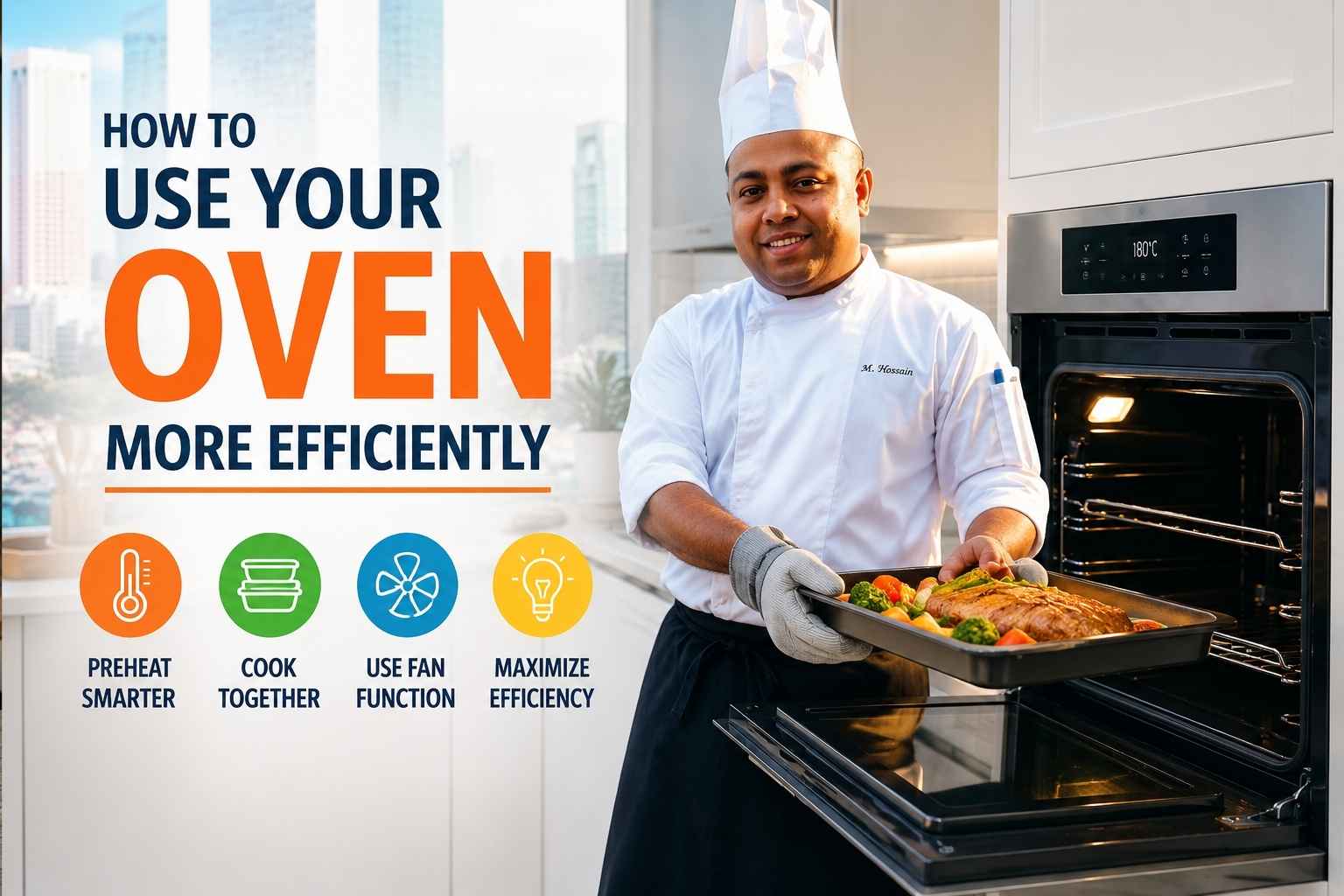
My oven used to run all day while I stood there guessing. Big waste of time and money, right? Once I learned how to use your oven more efficiently, everything changed. Small tweaks cut my energy bill and my stress. Ready to bake smarter, not harder? Let’s dive in.
Why Oven Efficiency Actually Matters
Your oven is the second-largest energy user in your kitchen, right behind the refrigerator. A standard electric oven draws between 2,000 and 5,000 watts per hour (U.S. Department of Energy, 2024). Run it carelessly every night and you’re looking at a real line item on your utility bill.
I’ve cooked in professional kitchens for 15 years. In that world, wasted energy is wasted money, and chefs get fired for wasting money. I carried those habits home. My electric bill dropped about 18% in the first month after I started applying them to my home kitchen. That’s not a guess – I tracked it.
But the efficiency payoff is about more than cost. An oven used correctly also cooks better. Stable heat means even browning. A well-sealed oven holds moisture in proteins. A preheated stone or cast iron surface gives you better crust development on bread than any other method I’ve tried. Efficiency and quality are the same goal.
Efficient vs. Inefficient Oven Habits: A Quick Reference
| Habit | Energy Impact | Chef’s Fix |
|---|---|---|
| Peeking at food every 5 minutes | Drops temp 25°F per open (America’s Test Kitchen, 2023) | Use the oven light and window |
| Preheating 30+ minutes for a sheet pan dinner | Wastes 15-20 minutes of full-power draw | 10-12 minutes is enough for most tasks |
| Running the oven for one small dish | Full energy cost for partial use | Batch cook; add a second dish |
| Ignoring convection mode | 20-25% longer cook times (ENERGY STAR, 2024) | Use convection for anything on an open rack |
| Leaving the door open after cooking | Heat escapes into the room, not into food | Close the door; use residual heat for warming |
| Using warped or dark sheet pans | Uneven heat, longer cook times | Use heavy-gauge aluminum pans |
| Never checking oven calibration | Actual temp may be off by 25-50°F | Test with an oven thermometer twice a year |
| Cooking at high altitude without adjusting | Food takes longer, uses more energy | Add 5-10 minutes per hour above 3,500 ft (Colorado State University Extension, 2022) |
How Your Oven Loses Heat (And Why It Matters More Than You Think)
Heat loss is the enemy of both efficiency and good food. Your oven loses heat in four main ways.
The door seal is the biggest culprit. On ovens more than 10 years old, the gasket around the door compresses and cracks. A worn seal can leak 20% of your oven’s heat (Consumer Reports, 2023). Run your hand around the door edge while the oven is on. If you feel warm air, the seal needs replacing. A new gasket costs $15-$30 and takes about 15 minutes to install.
The door glass conducts heat out of the oven at a steady rate. Nothing you can do about that. But you can stop making it worse by opening the door when you don’t need to. Each time you open the oven, cold air pours in and hot air rushes out. The element then fires at full power to recover – and that recovery draws the most energy your oven uses.
The oven walls and floor absorb heat before the air temperature reads correctly. This is called thermal mass. A cold oven with a cold interior surface will read 375°F on the thermostat while the actual cooking environment is still 50-75°F lower. This is why preheat time matters – and why most home cooks don’t preheat long enough.
Old or damaged door hinges let the door hang slightly open. You may not notice it. Your food will. Check that the door presses flush against the frame when closed.
The Truth About Preheating: When You Need It and When You Don’t
Most home cooks preheat for too long – or skip it entirely. Both are mistakes, but for different reasons.
When preheating matters: Bread, pizza, biscuits, cookies, and anything that needs an immediate blast of bottom heat. These items need the oven floor and walls fully saturated with heat, not just the air. For bread, I preheat my oven with a cast iron Dutch oven inside for 45 minutes. That’s not excessive – that’s the difference between a hard crust and a soft one.
When preheating doesn’t matter: Casseroles, braises, most roasted vegetables, and anything that will cook for more than an hour anyway. Put these in a cold oven. The food heats gradually with the oven. Total cook time increases by maybe 5 minutes. Total energy saved: 10-15 minutes of full-power draw.
How long is actually enough: For most baking tasks, 12-15 minutes brings a standard electric oven to 350-375°F (Serious Eats, 2022). The thermostat light or beep is not a reliable signal. The oven air may reach temperature, but the walls and racks are still cold. Give it an extra 5 minutes after the beep for anything that needs a crust.
Convection Mode: The Efficiency Tool Most Home Cooks Ignore
Convection is a fan inside the oven that circulates hot air around your food. That constant airflow strips away the cool, moist boundary layer that forms around cooking food. The result: food browns faster, cooks more evenly, and the oven uses less energy per finished dish.
ENERGY STAR data from 2024 puts the average time savings at 25% in convection mode. At the same temperature setting, a roast that takes 60 minutes in standard mode takes about 45 minutes in convection. You can also drop the temperature by 25°F and get the same result in the same time. Either way, you’re drawing less energy.
Use convection for: roasted vegetables, sheet pan proteins, cookies, pies, and anything you want brown and crispy.
Skip convection for: soufflés, delicate custards, and angel food cake. The moving air can cause uneven rising or set a crust before the interior is done.
One note: convection dries food out faster. For braises and covered casseroles, it makes no difference – the lid traps moisture. For uncovered proteins, baste more often or reduce cook time and check early.
Batch Cooking and Oven Stacking: How to Cook Two or Three Dishes at Once
The biggest energy waste in a home kitchen is running the oven for a single dish. The preheat alone costs as much energy as cooking for 20 minutes. If you’re only making one tray of roasted carrots, you’ve spent 30% of your total energy just getting the oven ready.
The fix is batch cooking. I do this every Sunday. While one rack holds a whole chicken at 400°F, another holds a sheet pan of root vegetables. A third holds a covered pan of dried beans in water. All three cook in the same session. I set the timer for each item and pull them as they finish. The total energy cost is close to the same as cooking one item.
Oven stacking rules that actually work:
Air circulation is the limiting factor. Food on the bottom rack will cook slightly slower than food on the top rack because heat rises. Swap racks halfway through for anything that needs even browning. For items where doneness matters more than color (like a braise), don’t bother – just check with a thermometer.
Strong-smelling foods can transfer odors. I don’t bake apple pie and roast fish in the same session.
Moisture is also shared. Multiple moist dishes raise the humidity inside the oven. This can slow browning. Space items out, and don’t cover everything. One covered dish and one uncovered dish work well together.
Residual Heat Cooking: Turn Off the Oven Early
This is the habit that surprises people most, and it’s the one I use every single day.
Residual heat (also called carryover cooking) is the heat already stored in the oven walls, racks, and the food itself. After you shut off the oven, that heat keeps cooking your food for 5-15 minutes depending on the dish and oven size.
For a whole roast chicken at 400°F, I turn the oven off when the breast reads 155°F, not 165°F. The carryover brings it to safe temperature while it rests. For a lasagna, I turn the oven off 8 minutes before the timer ends. For cookies, 5 minutes. For bread at high temp, not at all – bread needs every degree of that final burst.
This works because large items hold heat well. A 5-pound roast is a thermal battery. Thin cookies lose heat fast, so carryover matters less there.
The savings add up fast. Over a week of cooking, cutting 8-10 minutes of oven run time per session saves about 1.2-1.5 kWh (U.S. Department of Energy calculation framework, 2024). That’s small individually but real over a year.
Rack Position, Cookware, and Oven Placement: The Details That Change Results
Rack Position
Heat in a standard (non-convection) oven is not even. The bottom of the oven is hotter because the heating element is there. The top runs cooler unless you’re using the broiler.
For browning the bottom of bread, pizza, and pies: bottom rack. For browning the top of casseroles and gratins: top rack for the last 5 minutes. For even all-around cooking of roasted meat: middle rack.
Cookware Material
Dark pans absorb more heat and brown food faster. Light aluminum pans reflect heat and brown more slowly. Glass and ceramic retain heat longer after you pull them from the oven, which is why casseroles in glass dishes keep cooking at the table.
I cook most things on heavy-gauge aluminum half-sheet pans. They heat fast, cool fast, and don’t warp. Warped pans create hot spots. Hot spots mean some food is overdone while the rest is underdone, and you run the oven longer to get everything there.
Cast iron is the best surface for high-heat applications. It holds heat better than any other material, so your food gets an immediate, even sear when it hits the surface. Preheat cast iron in the oven, not on the stovetop, for full efficiency.
Where the Oven Sits in Your Kitchen
This sounds minor but it isn’t. An oven next to a window in direct afternoon sun has to work harder to maintain temperature. An oven with zero clearance on the sides traps heat and makes the surrounding cabinets hot, which can stress the oven’s thermostat over time. Give your oven at least 2 inches of side clearance if possible.
Gas vs. Electric: Efficiency Differences You Should Know
Gas and electric ovens are not equally efficient. Here’s the practical breakdown.
Gas ovens heat up faster (8-10 minutes to 350°F vs. 12-15 for electric). Gas is cheaper per BTU in most U.S. markets, though prices vary by region. The downside: gas combustion adds moisture to the oven interior. That moisture is fine for braises and roasts. For bread and baked goods that need a dry, crispy crust, gas ovens are harder to work with.
Electric ovens heat more evenly because the element is on the floor and often the ceiling too. They hold temperature more steadily than gas. For baking, electric is better. For roasting at very high heat, either works.
Induction range ovens (where the cooktop is induction but the oven is electric) are the same as standard electric ovens in the cavity. The efficiency gain from induction is on the cooktop, not in the oven.
Per the U.S. Energy Information Administration (2025), a gas oven costs roughly $0.15-$0.25 per hour to run at medium heat. A standard electric oven costs $0.20-$0.60 per hour depending on your utility rate. Over a year of daily cooking, that gap adds up to $30-$150 depending on how much you cook.
My Personal Efficiency Routine (What I Actually Do Every Day)
I’m not going to give you a vague list of tips. Here’s what I do, in order, every time I cook.
- I check what’s in the fridge that needs to be used, then plan 2-3 dishes around the same temperature range (within 25°F of each other).
- I preheat for exactly 12 minutes for most meals, or 20+ minutes if I’m baking bread.
- I use my oven thermometer (a $10 dial thermometer from any kitchen store) to confirm actual temperature before food goes in. My oven runs 15°F hot. Yours probably runs off too.
- I batch everything onto two racks, stagger the start times if cook times differ, and set individual timers for each item.
- I turn the oven off 5-8 minutes early for roasts and casseroles.
- I leave the door closed after shutting off the oven. If I need to warm bread or plates, I put them in during that residual heat window.
This routine saves me roughly 15-20 minutes of active oven time per session compared to how I cooked before I trained in professional kitchens. Over 5 sessions per week, that’s about 75 minutes of energy draw I’m not paying for.
Common Efficiency Mistakes and How to Fix Them
Mistake 1: Cooking at high altitude without adjusting
At 3,500 feet above sea level and higher, water boils at a lower temperature and atmospheric pressure is lower. Both affect how your oven cooks. Baked goods take longer because leavening gases expand faster and set before the structure is firm. Roasts take longer because the lower humidity means more surface moisture evaporation, which slows browning. Per Colorado State University Extension (2022), add 5-10 minutes per hour of cook time above 3,500 feet. If you’re in Denver, Salt Lake City, or Albuquerque and your food always seems underdone, altitude is why.
Mistake 2: Ignoring old oven door seals
A cracked or compressed door gasket is silent. You won’t hear it losing heat. But your oven will run longer to compensate, your food will cook unevenly near the door, and your energy cost goes up. Consumer Reports (2023) found that ovens with degraded seals used up to 20% more energy per session than ovens with intact seals. Check yours now. Press on the rubber gasket all the way around the door. If it feels hard, brittle, or compresses flat without bouncing back, replace it. This is the highest-return maintenance task on any oven.
Mistake 3: Treating the oven preheat beep as a green light
The beep means the air inside reached temperature. The walls, floor, and racks are still 40-60°F below where you need them. Put food in too early and you get a pale bottom crust on bread, wet cookie bottoms, and uneven roasting. Wait 5 minutes after the beep. For bread or pizza, wait 10.
Mistake 4: Using the oven to heat the kitchen in winter
I see this every winter. People finish cooking, leave the oven door open, and let the heat warm the room. This is a fire risk, it stresses your oven thermostat, and it’s less efficient than your heating system at moving heat into the room. Close the door. Let the oven cool with the door shut. The residual heat in the walls will dissipate slowly into the kitchen anyway.
Mistake 5: Never cleaning the oven
A layer of baked-on grease on the oven floor absorbs heat instead of reflecting it back. Your oven works harder to maintain temperature. Clean your oven every 2-3 months with the self-clean cycle (most efficient) or manually. The self-clean cycle uses a lot of energy in one shot, but it burns off buildup that would otherwise cost you energy for months.
Frequently Asked Questions About Oven Efficiency
Does opening the oven door really matter that much?
Yes. Each time you open the door, the oven temperature drops by 25°F or more, per America’s Test Kitchen (2023). The heating element then fires at full power to recover. That recovery draw is the most energy-intensive part of the oven cycle. For a 30-minute cook, opening the door three times can add 5-8 minutes of full-power draw. Use the oven light. Open the door only to rotate or pull food.
Is convection mode worth using for everyday cooking?
For most savory dishes, yes. Convection cuts cooking time by about 25% and browns food more evenly (ENERGY STAR, 2024). The learning curve is adjusting your temperature or time. Start by dropping 25°F from your usual setting and checking food a few minutes early. Within a week it becomes second nature.
How do I know if my oven temperature is accurate?
Buy an oven thermometer. They cost $8-$15 at any kitchen store or online. Set your oven to 350°F, wait 15 minutes after the preheat beep, then read the thermometer. If it reads 325°F or 375°F, you know your oven runs cold or hot. Adjust your set temperature accordingly. Check twice a year – ovens drift over time.
Can I really turn the oven off before the food is done?
For large items, yes. A whole chicken, a casserole, a loaf of bread – these hold heat well. Turn the oven off 5-10 minutes before the timer and leave the door closed. Check with a thermometer when the time is up. Thin items like cookies or fish fillets don’t hold heat the same way, so don’t use this trick on them.
What’s the most efficient oven rack position for roasting meat?
Middle rack for large roasts. This gives even heat from top and bottom elements. If you want a brown crust on top at the end of the cook, move the roast to the upper rack for the final 5-10 minutes. Don’t start on the top rack – the top of the protein will char before the center is cooked through.
Does the type of pan I use affect how much energy I use?
Yes. Heavy-gauge aluminum pans heat faster and more evenly than thin, cheap pans. Thin pans warp in high heat, creating uneven contact with the oven floor and hot spots that force you to cook longer. Dark pans absorb heat faster and brown food more quickly – good for crispy things, less good for delicate baked goods. Cast iron holds heat the longest and is the best surface for any recipe that calls for a screaming hot surface.
Is it more efficient to cook multiple dishes at once even if they need different temperatures?
Within about 25°F, yes. A dish that calls for 375°F and a dish that calls for 400°F can cook together at 385°F. Adjust your timing slightly – the hotter dish will be done a few minutes faster, the cooler dish a few minutes slower. If the temperature gap is more than 50°F, it gets harder to manage. In that case, cook the lower-temp item first, pull it, then crank the oven for the higher-temp item. You still save the preheat energy on the second item.
How often should I replace my oven door seal?
Check it once a year. A seal that’s cracked, stiff, or compresses flat needs replacing. Most seals last 5-10 years under normal use (Consumer Reports, 2023). Replacement seals are model-specific – search your oven’s model number plus “door gasket” to find the right one. Installation is a 10-15 minute job with no tools required on most models.
Key Takeaways
- Your oven’s biggest energy drain is operating time. Cut it by preheating less, cooking multiple dishes per session, and turning the oven off 5-10 minutes before the food is done.
- Check your oven seal once a year. A degraded seal costs you up to 20% more energy per session (Consumer Reports, 2023).
- Use convection mode for anything roasted or baked on an open rack. It cuts cook time by 25% at the same or lower temperature.
- Buy a $10 oven thermometer and use it. Your oven’s thermostat is probably wrong by 15-25°F.
- Batch cook on weekends. One preheat, three dishes. This is the highest-return habit change you can make.
- Don’t open the door to check on food. Use the oven light. Each open costs you 25°F and the energy to recover it.
- At high altitude (3,500 ft+), add 5-10 minutes per hour to your cook times to avoid running the oven twice on the same dish.

I’m Mossaraof, a trained chef and the founder of OvenInsights.com. I spent years cooking at Larrupin’ Cafe and in kitchens across Chicago and Seattle. Now I test kitchen gear for a living. I moved to North Acton, London, and I test every tool I write about. I use real meals and real heat. No brand deals. No shortcuts. I cover 12 kitchen types and hundreds of recipes. I believe this: the right tools matter as much as the recipe.