At A Glance
- The single most reliable way to speed up oven cooking is switching to convection mode and dropping the target temperature by 25°F (14°C) – this cuts cook time by 20-25% with almost no downside (America’s Test Kitchen, 2023).
- Raising oven temperature works well for vegetables, thin proteins, and bread, but it will ruin poultry, dense roasts, and any stuffed dish if the outside cooks faster than the inside can follow.
- Cutting food into smaller, thinner portions before cooking is the most underused speed tool in the home kitchen – it beats higher heat every time for food safety and texture.
- Resting time is not optional padding. It is part of the cook. Skipping it undoes at least 10 minutes of careful oven work.
- Pan material changes cook time by up to 30% – dark metal pans cook faster than glass, and cast iron holds heat longer than both (Cook’s Illustrated, 2022).
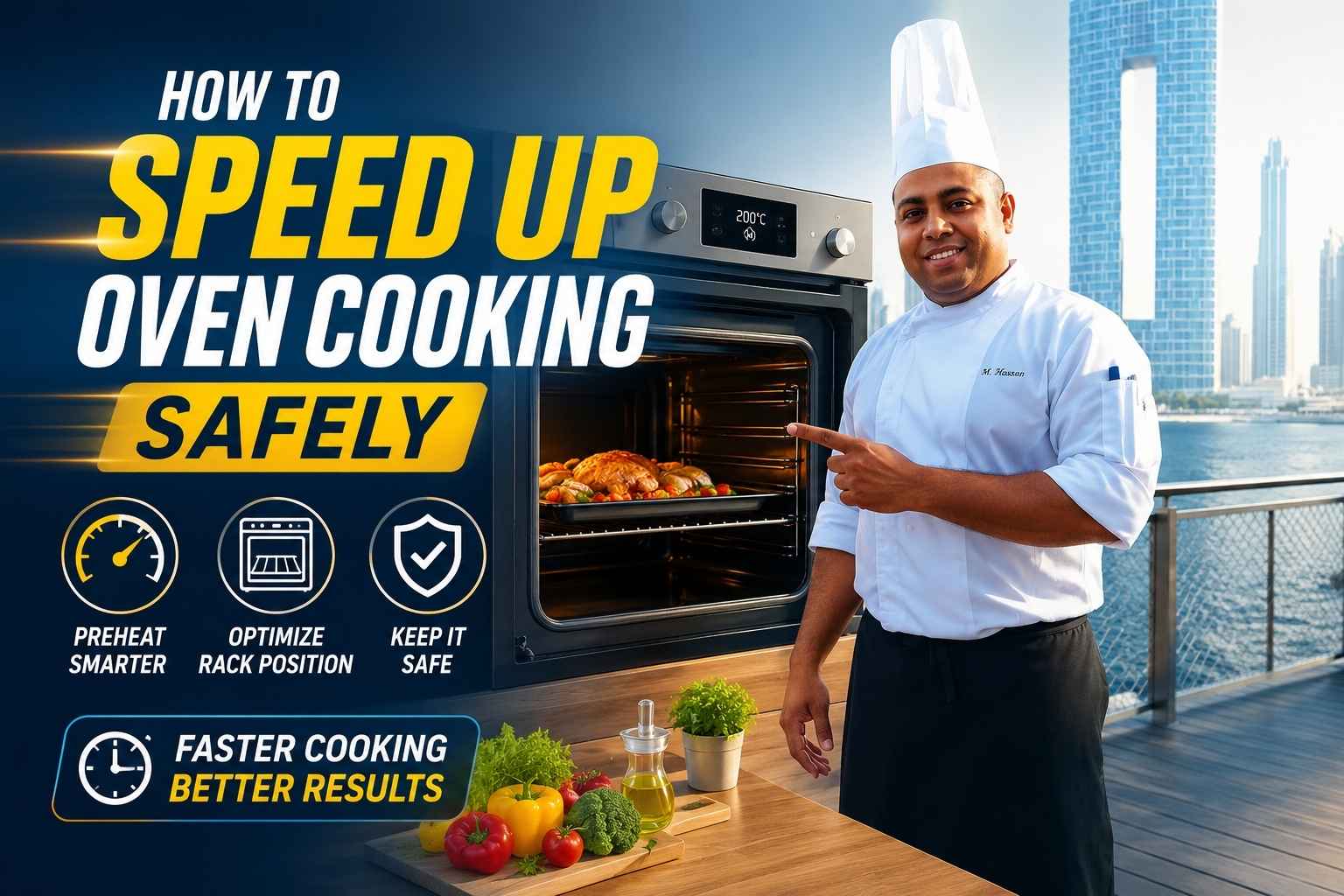
Ever stood in front of your oven, watching the clock, wishing dinner would just hurry up? I get it. Rushed weeknights push all of us to look for ways how to speed up oven cooking safely, without ending up with dry chicken or a raw center. I’ve tested this in my own kitchen more times than I can count, and I know which shortcuts actually work. In this guide, I’ll walk you through simple, tested tricks that save real time. Grab a cup of coffee, and let’s get your oven working faster and smarter today.
Why Home Cooks Get Speed Cooking Wrong
Most home cooks try to cook faster by doing one thing: turning the oven up. That is the wrong move almost every time, and I have seen the results – split roast chickens, burnt crusts over raw bread centers, and salmon that tastes like jerky on the outside and sashimi in the middle.
The real problem is that heat moves through food at a fixed rate. No oven temperature changes that rate much. What you can change is how efficiently heat reaches the food, how the food is shaped, and what it sits in. Those three things are where the actual speed gains live.
I have worked in professional kitchens for over 15 years – from high-volume hotel restaurants to small farm-to-table spots where dinner service ran on 45-minute ticket times. Speed in those kitchens was not about cranking heat. It was about working smarter with the physics of cooking.
This guide covers every method I use. All of them work. None of them involve guesswork.
Standard vs. Speed-Cooking Methods: Quick-Reference Table
| Method | Temperature Adjustment | Time Reduction | Risk Level | Best For |
|---|---|---|---|---|
| Convection mode | -25°F (-14°C) from recipe | 20-25% | Low | Almost everything |
| Higher temp (25°F above recipe) | +25°F (+14°C), no convection | 10-15% | Medium | Vegetables, thin cuts, pizza |
| Higher temp (50°F above recipe) | +50°F (+28°C), no convection | 20-30% | High | Flatbreads, thin fish only |
| Smaller/thinner cuts | No temp change | 25-40% | Low | Any protein or vegetable |
| Covered dish or foil tent | No temp change | 15-20% | Low | Braises, casseroles, root vegetables |
| Preheated cast iron | No temp change | 10-20% on sear side | Low | Steaks, thick fish fillets, chicken thighs |
How Convection Mode Works and When to Use It
Convection is the fastest, safest way to speed up oven cooking. A standard oven heats air that then sits still around your food. A convection oven adds a fan that keeps that hot air moving. Moving air transfers heat to food surfaces faster and more evenly than still air.
The standard rule: lower the recipe temperature by 25°F (14°C) and reduce cook time by 20-25%. If a recipe calls for 375°F for 40 minutes, use convection at 350°F for 30-32 minutes (America’s Test Kitchen, 2023).
You can also keep the same temperature and just watch the clock – food will finish 20-25% faster. I prefer the lower-temperature approach because it gives more margin for error.
When Convection Works Best
Convection excels with:
- Roasted vegetables – they brown faster and stay firmer.
- Sheet pan proteins like chicken thighs, salmon fillets, and pork tenderloin.
- Cookies and pastries – more even browning across the whole pan.
- Pizza on a stone or steel – the crust gets crispier in less time.
When to Turn Convection Off
Skip convection for:
- Custards and soufflés – the fan dries the surface before the center sets.
- Delicate cakes – the moving air can cause uneven rise.
- Bread in the first 15 minutes of baking – you want steam to stay around the loaf, not get blown away (King Arthur Baking, 2024).
Raising Oven Temperature Safely: Which Foods Tolerate It
You can safely raise oven temperature by 25°F above what a recipe calls for with thin cuts and most vegetables. Going 50°F above works only for very thin items. Beyond that, the outside burns before the inside cooks.
The foods that handle higher heat without problems:
- Vegetables cut under 1 inch thick – Broccoli, asparagus, green beans, and sliced peppers can handle 450°F (232°C) easily.
- Fish fillets under 1 inch thick – A 3/4-inch salmon fillet at 425°F cooks through in 8-10 minutes without drying.
- Pizza – Most home ovens should run at their maximum (usually 500-550°F) for pizza. The high heat is what gives you oven spring and char on the crust (Serious Eats, 2022).
- Thin breads – Flatbreads, naan, and pizza dough strips can cook at 500°F+ without burning.
Foods That Cannot Handle Higher Heat
Do not raise the temperature on:
- Whole poultry – A whole chicken at 450°F will have charred skin and raw thighs. The outer layer cooks far faster than the dense meat near the bone.
- Dense roasts over 2 inches thick – The time gap between surface doneness and center doneness grows as oven temp increases.
- Stuffed dishes – Stuffing needs time to come up to a safe temperature (165°F / 74°C per USDA Food Safety and Inspection Service, 2024). Higher heat on the outside does not help the stuffing cook faster.
- Egg-based dishes – Quiche, frittata, and bread pudding will seize and crack at temperatures above 325°F (163°C).
Smaller Cuts and Thinner Portions: The Fastest Speed Method Nobody Uses
This is the method I use more than any other in a weeknight rush. Reshaping food before it goes into the oven cuts more time than anything else on this list, with zero added risk.
The math is simple: heat travels to the center of food at roughly the same rate regardless of oven temperature. A 2-inch-thick chicken breast takes far longer than a 3/4-inch one. Cut it thinner and you solve the problem at the source.
Here is what I do with common proteins:
- Chicken breasts – I butterfly them (slice horizontally almost all the way through, then open flat) or pound them to an even 3/4-inch thickness. Cook time drops from 22-25 minutes to 12-14 minutes at 400°F.
- Pork tenderloin – Cut into 1-inch medallions instead of roasting whole. Roasting a whole tenderloin takes 20-25 minutes. Medallions take 8-10 minutes.
- Root vegetables – Cut parsnips, carrots, and beets into 1/2-inch coins or batons instead of halves. A half-beet takes 45 minutes at 400°F. 1/2-inch slices take 20-25 minutes.
For ground meat dishes – meatloaf being the classic example – shape the mixture into a flatter oval rather than a log. Cook time drops by 20 minutes, and the texture actually improves because the surface-to-interior ratio is better for browning.
The Foil Tent and Covered Dish Method
Covering food with foil or a lid traps steam from the food itself. That steam conducts heat to the food’s surface faster than dry oven air does. It also keeps moisture in, which prevents the exterior from drying out before the interior is done.
I use this method for:
- Braised meats and casseroles – Cover for the first two-thirds of cook time, then uncover to brown and crisp the top.
- Dense root vegetables – Covering beets or carrots for the first 20 minutes speeds cooking and makes them easier to pierce.
- Reheating – A covered dish reheats in 60-70% of the time it takes uncovered, and the food stays far more moist (Cook’s Illustrated, 2021).
Important: Remove the cover for the last 20-30% of cook time. You need dry heat to set a crust, reduce a sauce, or brown the top of a gratin.
Resting Time Is Part of Cook Time – Do Not Skip It
This mistake costs home cooks more than any bad temperature choice. Resting is not optional. It is not just about juice redistribution (though that matters). It is about carryover cooking – the food continues to cook from stored internal heat after you pull it from the oven.
A chicken thigh pulled at 160°F (71°C) internal temperature will reach 165°F (74°C) within 3-5 minutes of resting under loose foil. That is the USDA-safe temperature for poultry (USDA Food Safety and Inspection Service, 2024). If you skip the rest, you either have to cook the thigh longer in the oven, which dries it out, or you serve it below safe temperature.
For a pork roast or beef roast, internal temperature can rise 5-10°F during a 10-15 minute rest. Pull the roast 5-10°F early to account for this.
Standard rest times by protein:
- Chicken breasts and thighs: 5 minutes.
- Pork chops and tenderloin: 5 minutes.
- Whole roast chicken: 10-15 minutes.
- Beef or pork roast over 3 lbs: 15-20 minutes.
If you are trying to cook faster, build the rest time into your plan rather than cutting it. The oven time gets shorter when you account for carryover. You do not save anything by skipping the rest – you just ruin the last 30 minutes of work.
Glass vs. Metal vs. Cast Iron: How Pan Choice Affects Cook Speed
Pan material is one of the most overlooked variables in oven cooking speed. It changes cook time by up to 30% with no other adjustments (Cook’s Illustrated, 2022).
Dark Metal Pans
Dark metal – including anodized aluminum and dark-coated nonstick pans – absorbs radiant heat faster than light-colored or shiny pans. Food in a dark metal pan browns on the bottom 15-20% faster than the same food in a glass dish at the same temperature.
Use dark metal for: cookies, sheet pan dinners, roasted vegetables, anything where bottom browning is part of the goal.
Glass and Ceramic Pans
Glass heats slowly but holds heat well. It is a poor conductor, which means food on the edges cooks faster than food in the center. Glass is not ideal for speed cooking. It is good for braises and casseroles where you want slow, even heat distribution.
If a recipe was written for glass and you use metal, reduce the oven temperature by 25°F to avoid over-browning the bottom (America’s Test Kitchen, 2023).
Cast Iron
Cast iron is the most interesting material for speed cooking. It heats slowly on the stovetop, but once it is hot, it holds and radiates heat far more aggressively than any other material. Preheat your cast iron pan in the oven for 15-20 minutes before adding food. That preheated surface gives you an immediate sear on contact – no waiting for the pan to come up to temperature with the food already in it.
I use a preheated cast iron skillet for chicken thighs, thick fish like halibut, and any protein I want both bottom browning and oven finishing on. The preheated surface cuts the total cook time by 10-20% compared to starting in a cold pan.
When Speed Cooking Is Dangerous: Food Safety You Cannot Skip
Speed cooking creates real food safety risk with specific foods. I have seen home cooks get this wrong, and it is not worth it.
The three highest-risk situations:
Whole poultry and bone-in chicken pieces. The breast meat is done long before the thigh meat when you cook hot and fast. A probe thermometer in the breast reads 165°F (74°C) while the thigh joint is still at 140°F (60°C). Always temp both parts. The only safe shortcut here is spatchcocking (removing the backbone and flattening the bird), which cuts whole chicken cook time from 75-90 minutes to 45-55 minutes while ensuring even cooking (Serious Eats, 2021).
Dense pork and beef roasts over 3 lbs. High heat creates a wide gradient – the outer inch of meat is well-done while the center is still in the danger zone (40-140°F / 4-60°C). The USDA defines the danger zone as temperatures where bacteria multiply rapidly (USDA Food Safety and Inspection Service, 2024). For large roasts, low-and-slow or a reverse sear method is safer and produces better results than cranking the heat.
Any stuffed dish. Stuffed peppers, stuffed chicken breasts, and traditional holiday birds with cavity stuffing all need the stuffing to reach 165°F (74°C) before the dish is safe to eat. The stuffing heats more slowly than the surrounding meat. Do not try to speed up stuffed dishes by raising oven temperature. Cook the stuffing separately if you need to save time.
Use a probe thermometer every time. There is no substitute. Time estimates, color, and feel are not reliable food safety tools. A quality instant-read thermometer like a Thermapen or a probe thermometer you can leave in the oven takes the guesswork out entirely.
Altitude Adjustments for Speed Cooking
Water boils at lower temperatures at high elevation – 202°F (94°C) at 5,000 feet (1,524 meters) versus 212°F (100°C) at sea level. This affects moist cooking methods more than dry oven heat, but there are still things to know.
At elevations above 3,500 feet (1,067 meters):
- Braised and steamed dishes take longer because the steam temperature is lower. You may need to add 10-20% more time.
- Baked goods rise faster because lower air pressure allows gases to expand more. This can cause bread and cakes to over-rise and collapse. Reduce leavening by 25% and add 1-2 tablespoons of extra liquid per cup of flour (King Arthur Baking, 2024).
- Dry oven roasting is largely unaffected – the oven temperature is the same; it is only boiling point that changes.
For altitude-specific speed adjustments: if you are braising or using a covered dish method above 3,500 feet, expect cook times to run 15-20% longer, not shorter. Account for this before you plan a fast weeknight meal.
My Personal Speed-Cooking Routine for Weeknight Meals
On a weeknight, I want dinner on the table in 35-40 minutes from a cold oven. Here is the exact sequence I run.
The moment I walk in the kitchen:
- Turn the oven to 425°F convection right away. That 12-15 minute preheat period is prep time.
- Put my cast iron skillet or dark metal sheet pan in the oven during preheat.
- Choose a protein under 1 inch thick – butterflied chicken thighs, salmon fillets, pork medallions, or shrimp. Nothing thick, nothing whole.
Prep while the oven heats (12-15 minutes):
- Cut all vegetables into pieces no larger than 3/4 inch.
- Season everything simply – salt, pepper, oil. I do not need a marinade for thin cuts because the surface-to-volume ratio means seasoning gets everywhere fast.
- If I have a braise or casserole from the weekend, I cover it with foil and set it next to the sheet pan.
When the oven is ready:
- Pull the preheated sheet pan out, add vegetables and protein in a single layer with space between pieces (crowded pans steam instead of roast).
- Set a timer for 10 minutes. Check internal temperature at 10 minutes.
- Pull the protein when it reads 155°F (68°C) for chicken, 140°F (60°C) for pork or fish. Tent loosely with foil for 5 minutes.
- Serve. Total active time: under 20 minutes. Total elapsed time: 35-40 minutes.
The key is that I never fight the physics. I work with the fastest-cooking shapes, the right pan, and the most efficient heat mode. I do not need tricks. I just remove the slow parts.
Common Mistakes When Trying to Cook Faster – And How to Fix Them
Mistake 1: Turning the Oven Up Instead of Switching to Convection
Raising the temperature is the first instinct and usually the wrong one. The fix is to switch to convection mode first. If your oven has it, use it. You get 20-25% faster cooking with no downside for most dishes.
Mistake 2: Crowding the Pan
When food pieces touch each other, they trap steam instead of letting it escape. The food braises instead of roasts and takes longer to brown. The fix: use two sheet pans if needed. Leave at least 1/2 inch between pieces.
Mistake 3: Starting with a Cold Pan
Putting food on a cold sheet pan adds 5-8 minutes to the effective preheat. The fix: put the pan in the oven during preheat. This is especially important for cast iron.
Mistake 4: Opening the Oven Too Often
Every time you open the oven door, the temperature drops 25-50°F. At convection speeds, that drop is corrected quickly, but in a standard oven it can add 5-10 minutes. The fix: trust your thermometer. Check the food temperature once, not four times.
Mistake 5: Skipping the Thermometer and Using Time as a Proxy
Recipe time estimates are written for average ovens at sea level with average-sized pieces. Your oven may run 25°F hot or cold. Your chicken breast may be thicker or thinner than the one the recipe writer used. The fix: buy a probe thermometer and use it every time. It is the only reliable speed tool there is.
Frequently Asked Questions About Speed Oven Cooking
How do I speed up oven cooking without drying out my food?
The best approach is to combine convection mode with a foil tent or covered dish for the first half of cook time. Convection reduces total time, while the cover traps steam and moisture. Remove the cover for the last 20-30% of cook time to allow browning. This method works well for chicken, pork, casseroles, and root vegetables.
Is it safe to cook chicken faster at a higher temperature?
For whole chicken and bone-in pieces, no. High heat cooks the outside too fast relative to the inside, and the thigh joint near the bone takes far longer to reach a safe temperature than the breast. The safest way to speed up chicken is to spatchcock it (remove the backbone and flatten the bird), which reduces whole-bird cook time by 20-30 minutes and promotes even cooking. Always verify with a probe thermometer at the thickest part of the thigh, away from bone.
What is the convection temperature adjustment rule?
Reduce the recipe’s target temperature by 25°F (14°C) when switching from standard to convection mode, and expect cook time to drop by 20-25%. Alternatively, keep the same temperature and check the food 20-25% earlier than the recipe suggests. Both approaches work; the lower-temperature version gives more margin for error.
Does pan material really change how fast food cooks?
Yes, significantly. Dark metal pans absorb radiant heat faster than glass or light-colored metal, which speeds up bottom browning by 15-20%. Preheated cast iron provides the fastest surface contact heat and can cut initial sear time by 10-20%. Glass pans are the slowest; if you substitute metal for glass in a recipe, reduce the oven temperature by 25°F to compensate (Cook’s Illustrated, 2022).
How do altitude changes affect speed cooking in the oven?
Dry oven roasting is minimally affected by altitude. The oven temperature stays the same. Where altitude matters is with covered dishes, braises, and baked goods. At elevations above 3,500 feet (1,067 meters), steam temperature is lower, so covered dishes may take 15-20% longer. Baked goods rise faster and may need reduced leavening (King Arthur Baking, 2024).
Can I speed up a frozen protein by cooking it from frozen at higher heat?
You can, but only for thin cuts under 3/4 inch, and only with a 50% increase in cook time over fresh at the same temperature. For anything thicker, thaw the protein first. Cooking frozen dense proteins at high heat creates the same problem as thick cuts – the exterior overcooks before the center reaches a safe temperature. The USDA recommends cooking frozen poultry at no less than 325°F (163°C) and always verifying safe internal temperature with a thermometer (USDA Food Safety and Inspection Service, 2024).
Why does my food cook unevenly when I try to speed up cooking?
The most common cause is pan crowding. When food pieces are too close together, moisture cannot escape and the food steams instead of roasting. Steam cooking is slower and produces no browning. Spread food in a single layer with space between pieces, use convection mode to keep air moving, and preheat your pan before adding food. Those three steps solve uneven cooking in most cases.
How do I adjust a standard recipe to cook faster without testing it multiple times?
Start with convection mode and the -25°F temperature rule. Apply the smaller-cut method where possible – cut proteins in half or butterfly them, and cut vegetables no larger than 3/4 inch. Start checking internal temperature at 70% of the original recipe time. Keep notes on your oven’s actual behavior for one month. After four or five rounds with any dish, you will know your oven’s specific offset and the timing becomes second nature.
Key Takeaways
- Switch to convection mode first – it is the safest, most reliable speed gain in oven cooking, cutting time by 20-25% with a simple -25°F temperature adjustment.
- Cut food thinner and smaller before it goes in the oven. This single step beats higher heat for both speed and food safety every time.
- Pan choice matters more than most cooks realize. Preheated dark metal or cast iron speeds up cooking; glass slows it down.
- Resting time is part of cook time, not extra time. Build it into your plan. It allows carryover cooking to finish the job so your oven time can be shorter.
- Use a probe thermometer every time, without exception. Time estimates are approximations. Internal temperature is the only reliable measure of doneness and food safety.
- Never try to speed up whole poultry, dense stuffed dishes, or large roasts by raising oven temperature alone. The safety risk is real, and the results are worse than cooking them at the right pace.

I’m Mossaraof, a trained chef and the founder of OvenInsights.com. I spent years cooking at Larrupin’ Cafe and in kitchens across Chicago and Seattle. Now I test kitchen gear for a living. I moved to North Acton, London, and I test every tool I write about. I use real meals and real heat. No brand deals. No shortcuts. I cover 12 kitchen types and hundreds of recipes. I believe this: the right tools matter as much as the recipe.