
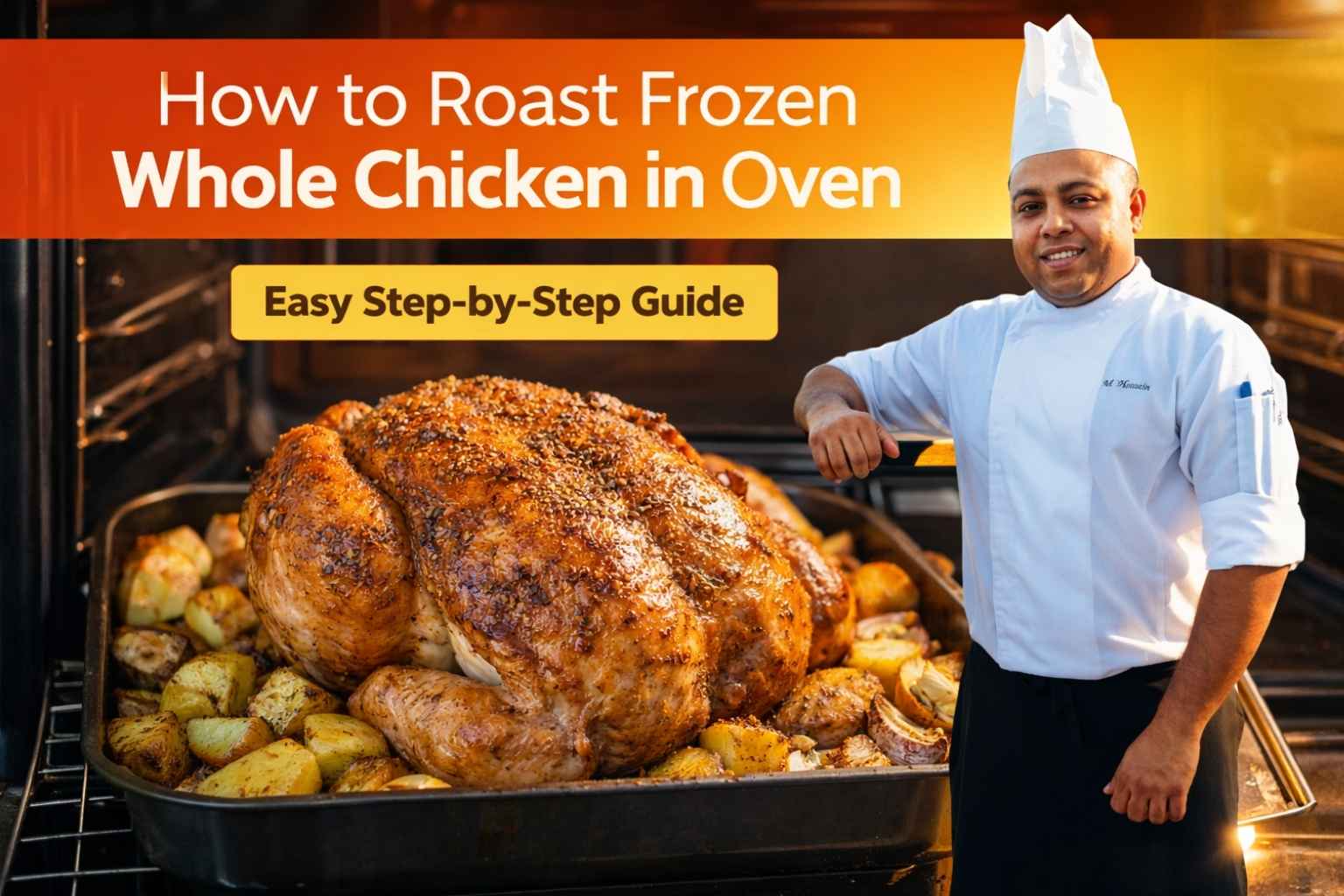
Hey, I’m Mossaraof — a professional cook and food blogger.
We all want a grand, golden bird with juicy meat even when we forgot to pull it from the freezer. I will show you how to roast frozen whole chicken in the oven so you get a safe, tender result with a skin that still has a perfect, salty snap.
My years in a busy Chicago kitchen taught me that a low start followed by a high-heat finish is the true secret to thawing and cooking without drying out the breast. Use my Ultimate Guide to Master Your Oven to find the best rack height for even heat flow around the whole bird. Let’s grab your roasting pan and start this impressive, easy meal together right now!
Why I’ve Roasted a Frozen Chicken More Than Once
Some days, time slips away — and dinner still has to happen. That’s where this frozen bird story begins.
The First Time Was a Total Accident
The first time I cooked a frozen whole chicken in the oven, I hadn’t planned to. It was one of those chaotic weeknights. Work ran late, the fridge was nearly empty, and I had exactly one protein option: a rock-solid bird tucked in the back of my freezer.
I stood there in my socks, holding the frosty chicken like it might offer me a clue.
Takeout crossed my mind. So did cereal. But I thought, “Why not just try it?”
No magic prep. I preheated the oven, plopped the frozen chicken into my roasting pan, and hoped for the best.
Spoiler: It worked. That night changed the way I looked at frozen poultry.
Now I Do It on Purpose
Once I realized I didn’t have to thaw the chicken, it became a go-to trick. Especially during cold Midwest winters when everything outside feels frozen anyway.
Sometimes I even buy whole chickens just to freeze them for later. It’s cheaper, and I like knowing I have a backup dinner option waiting.
Here’s when I usually roast a frozen chicken:
- Busy weekdays when I forgot to plan ahead
- Rainy Sundays when I want something low-effort but cozy
- After grocery store runs when I stock up on sale whole birds
I’ve done this in both old-school ovens and newer convection models. It even worked once in a friend’s tiny apartment oven in Brooklyn — though that took a bit longer and involved a smoke alarm (my fault, not the chicken’s).
It’s Not Just About Saving Time
What I really love is that it still tastes great. Juicy inside, crispy on the outside, and it fills the whole kitchen with that warm, slow-roast smell that makes people peek in and ask, “When’s dinner?”
Cooking frozen whole chicken in the oven isn’t just a shortcut. It’s one of those real-life kitchen wins that actually delivers.
Next, I’ll walk you through the exact setup I use — from oven temp to gear to the tools I don’t bother with anymore.
Oven Setup — What You Need to Get Started
I’ve learned the hard way that the right setup can save you a ton of stress. You don’t need fancy gear, but having a few key tools makes roasting a frozen chicken in the oven a whole lot smoother.
The Oven Itself — It Does Make a Difference
I’ve used both gas and electric ovens over the years. Honestly, both can work just fine. But convection ovens? They’ve been a total game changer for me.
When I used a Whirlpool electric oven in Chicago, I had to bump the cook time up by 15–20 minutes. But my GE convection oven in Florida cooked the same-size bird faster and more evenly.
If you’re using a regular oven without convection, don’t worry. You’ll just need to watch your timing more closely and rotate the pan once or twice so one side doesn’t get too brown.
My Real-World Tool Kit
I keep things simple. Here’s what I actually use — nothing more, nothing less:
- Roasting pan with rack — I use a Lodge cast iron pan or a basic Wilton nonstick sheet with a wire rack. Keeps the bird elevated so it roasts, not steams.
- Meat thermometer — Don’t skip this. I use a ThermoPro, but even the cheap digital ones from Target work. Just make sure it reads fast and clearly.
- Tongs and a silicone brush — For basting once the skin softens mid-roast.
- Aluminum foil — Sometimes I use it to tent the chicken if the skin gets too brown toward the end.
Optional — But Pretty Handy
- Butcher’s twine — Only if your bird is doing the splits. I’ve cooked some where the legs were flailing out, and tying them kept everything compact.
- Oven-safe digital probe — If your oven has one of those built-in jacks (like my friend’s Whirlpool smart oven), go ahead and use it. Set it and forget it.
- Basting bulb — Honestly? I only use this on holidays. Otherwise, a spoon or brush works fine.
What I Don’t Bother With Anymore
- Roasting bags — They trap steam. I’m after crispy skin, not boiled skin.
- Trivets or silicone mats — Good for other things, but not this. The rack in a pan is simpler and better for airflow.
- Frozen veggie bed — Tried it once. Ended up with soggy carrots and chicken juices swimming everywhere. Nope.
Step-by-Step — How to Roast Frozen Whole Chicken in Oven
No guesswork here. This is the exact method I follow, from frozen-solid to golden brown.
Step 1: Preheat the Oven
I always preheat to 350°F if I’m using a standard oven. If I’m using convection, I drop it to 325°F because the fan circulates heat more evenly and cooks faster.
I usually turn the oven on while I’m unwrapping the bird and digging out my pan — it gives me a head start.
In winter, especially in the Midwest, I let it preheat a bit longer. Older ovens can take their sweet time when it’s cold outside.
Step 2: Remove Packaging, But Skip the Rinse
Take the frozen chicken out of its packaging — but do not rinse it. Trust me on this.
Water and frozen poultry equals one thing: slippery chaos. I made that mistake once and ended up with chicken water on my jeans and the floor.
Just pat it dry with a paper towel if there’s any icy residue. No need to go overboard.
Step 3: Set the Bird in the Roasting Pan
- Place the chicken breast-side up on a rack inside your roasting pan.
- No oil or seasoning yet. It’s frozen. It won’t stick anyway.
I like using a rack so the heat can circulate under the bird. This helps keep the skin crisping up, even before it’s fully thawed.
Step 4: Roast Uncovered for 60–90 Minutes
This first chunk of time is all about thawing the bird from the outside in.
- I roast uncovered so the skin begins to dry out and brown.
- At this stage, don’t even think about seasoning. It’ll slide right off.
- Just let it do its thing. I use this time to prep sides or, honestly, catch up on dishes.
Around the 1-hour mark, I usually poke a fork into the leg joint. If I can gently wiggle it, we’re on track.
Step 5: Add Seasoning When the Skin Softens
Once the internal temp hits around 90–100°F and the skin is soft enough to touch, that’s when I jump in with seasoning.
Here’s my go-to mix:
- Olive oil (or melted butter if I’m feeling indulgent)
- Salt and black pepper
- Garlic powder and smoked paprika
- Dried thyme or rosemary if I have it on hand
I brush the oil on first, then sprinkle the spices. It smells amazing as it hits the hot skin — even my neighbor once asked what I was cooking through the hallway.
Step 6: Keep Roasting Until Fully Cooked
Now I roast it the rest of the way. I keep the oven at the same temp and check the internal temperature every 30 minutes or so.
- For a 5–6 lb chicken, it usually takes 2 hours 15 minutes to 2 hours 30 minutes.
- A larger 6–7 lb bird may need 2 hours 45 minutes or more.
What matters most:
- 165°F in the breast
- 175°F in the thickest part of the thigh
I use a digital thermometer and check in two spots before pulling it out. It’s saved me from serving undercooked dinner more than once.
Step 7: Let It Rest Before Carving
Once it hits temp, I pull it out and tent it with foil for 15–20 minutes.
This step matters more than I used to think. It lets the juices settle. If you cut into it too soon, everything leaks out, and you’re left with dry meat.
How Long to Cook Frozen Whole Chicken in Oven
If you’ve ever asked “frozen whole chicken in oven — how long?”, I’ve got answers. And not just the textbook ones.
What I Learned the Hard Way About Time and Temp
I used to just guess — “maybe 2 hours?” — and poke the chicken endlessly. That led to dry meat, raw spots, or both.
Now, I follow a timing baseline depending on weight and oven type — but I still trust the thermometer more than the clock.
Estimated Roasting Times by Chicken Size
These are real-world times that have worked for me, based on roasting at 350°F in a standard oven:
| Weight (Frozen) | Approx. Time | Notes |
|---|---|---|
| 4–5 lbs | 2 hrs – 2 hrs 15 mins | Good for 3–4 people |
| 5–6 lbs | 2 hrs 15 mins – 2 hrs 30 mins | My usual choice |
| 6–7 lbs | 2 hrs 30 mins – 2 hrs 45 mins | Might need extra basting |
| 7–8 lbs | 2 hrs 45 mins – 3 hrs+ | Add 15 mins per extra pound |
For convection ovens, subtract 15–20 minutes — just keep an eye on browning.
Why Oven Type Really Matters
In my Whirlpool electric oven in Illinois, a 6-lb bird took almost 2 hours 40 minutes. But down in Florida, my GE convection oven cooked that same chicken in just over 2 hours 10.
A few notes from my own tests:
- Gas ovens tend to heat unevenly — rotate the pan once halfway.
- Electric ovens usually maintain steady temp, but may brown slower.
- Convection ovens cook faster and give better crispy skin.
Climate & Altitude? Yep, They Affect Roasting Too
I didn’t believe this until I roasted in Denver once — at higher altitude, cooking took longer and dried the edges faster.
Even in humid Florida summers, roasting can behave differently. Moisture in the air slows browning slightly. I often crank the temp up to 375°F for the last 20 minutes to crisp the skin.
Don’t Rely on Time Alone — Use a Thermometer
Let me say it again: the thermometer is your best friend.
- Insert it into the thickest part of the thigh, avoiding bone.
- Then check the center of the breast.
- Don’t stop until both read safe temps:
- 165°F (breast)
- 175°F (thigh)
The first time I got these temps right, the meat was juicy, tender, and the skin crisped just the way I like.
How to Season a Frozen Whole Chicken Mid-Roast
You can’t season it right away — trust me, I’ve watched garlic powder slide off like dust on ice. Timing is everything here.
Why I Don’t Season at the Start
I used to try rubbing spices on the frozen skin before it went in the oven. Total waste.
The seasoning would just sit there, then melt off and burn in the pan. I’d end up with smoky drippings and pale skin.
Now I let the chicken start thawing and warming up first. Once it hits around 90–100°F internally, the skin softens enough for seasoning to actually stick.
Usually that happens after about 60 to 90 minutes of roasting.
My Go-To Flavor Combo
Once I see the skin softening and juices starting to run, I pull the pan out (just briefly) and go to town with:
- Olive oil or melted butter — helps the skin brown and hold seasoning
- Kosher salt — don’t skip this
- Garlic powder — for that deep, roasty aroma
- Smoked paprika — adds color and a little bite
- Dried thyme or rosemary — I use whatever’s in my cabinet
I brush the oil on first, then sprinkle everything over. No measuring — just by feel.
The kitchen always smells incredible at this point. One time, I swear the mailman paused by the door just to take a sniff.
What to Add Inside the Cavity (If You Want)
Once the chicken is thawed enough to open up the cavity — usually halfway through — you can slide in a few flavor boosters:
- Half a lemon
- Garlic cloves (unpeeled is fine)
- Fresh herbs if you’ve got ‘em
- Apple slices (sounds weird, but adds moisture and subtle sweetness)
I do this when I have time or company coming. But on regular nights? I skip it. No shame.
Basting? Here’s How I Do It
After seasoning, I check every 20–30 minutes and give it a quick baste using:
- Pan drippings
- Or melted butter if there’s not enough liquid yet
I tilt the pan slightly and use a spoon or silicone brush — nothing fancy. This helps the skin crisp while building layers of flavor.
Common Seasoning Mistakes I’ve Made
- Too much pepper too early — it can burn and taste bitter
- Forgetting salt — makes a huge difference in the final flavor
- Adding wet marinades to frozen skin — they just pool and steam the chicken instead of roasting it
Safety Tips for Roasting Frozen Chicken
Roasting from frozen works, but only if you follow some basic rules. I learned these through research — and one close call I’ll never forget.
The Thermometer Isn’t Optional
Years ago, I sliced into a roasted chicken and saw pink near the thigh. It looked done. Skin was golden, juices clear-ish. But the temp read only 152°F.
That bird went right back in the oven.
Now I check temp every single time, in two places:
- The thickest part of the breast
- The deepest part of the thigh (not touching bone)
Safe temperatures:
- 165°F for the breast
- 175°F for the thigh
I usually use a digital instant-read thermometer (mine’s from ThermoPro). But when I’m multitasking, I love using my oven probe thermometer — it alerts me when it hits the right temp.
One time, that probe saved dinner. I was outside flipping burgers when the alert beeped. Chicken: perfectly done.
Why Resting Is a Must
Once I hit temp, I pull the chicken out and tent it with foil for 15–20 minutes.
Here’s what I noticed when I used to skip this step:
- The juices ran everywhere the moment I cut in
- The breast meat tasted drier
- The whole thing felt rushed
Letting it rest gives those juices time to settle back in. It also brings the internal temp up a few degrees safely.
Clean-Up Tips (Because Salmonella Is Real)
Even if your chicken goes straight from freezer to oven, you’re still handling raw poultry. Here’s what I do every single time:
- Wash my hands before and after unwrapping
- Sanitize the counter where I opened the chicken
- Use a separate cutting board and knife for carving (not the same ones I prepped sides on)
For cleaning, I use hot soapy water and sometimes vinegar spray for good measure. Especially if I’m cooking in a warm kitchen where bacteria can thrive faster (looking at you, Florida summers).
A Quick Word on Stuffing — Don’t Do It
I’ve roasted frozen chickens dozens of times. Never once did I try stuffing one, and here’s why:
- The cavity stays frozen way longer than the outside
- Stuffing might not reach safe temps, even when the meat does
- It slows everything down and messes with the airflow inside the bird
If I want stuffing, I make it on the side — in a separate dish where I can control the moisture and texture.
Mistakes I’ve Made — So You Don’t Have To
I’ve cooked frozen whole chickens in the oven more times than I can count. Not every time was perfect. Some were straight-up disasters — but that’s how I learned what not to do.
Mistake #1: Seasoning Too Early
The first time I tried this method, I got excited. I slathered the frozen bird in oil, garlic, paprika — the works.
What happened?
- The seasoning slid right off as the chicken thawed
- Everything pooled at the bottom of the pan
- The skin turned soft and steamed instead of crisping
Now I wait until the skin softens mid-roast, then season. It sticks better and browns beautifully.
Mistake #2: Relying on Time Instead of Temperature
I used to go by the “2.5-hour rule” and just hope for the best. Bad idea.
One night, I carved into the thickest part of the thigh — still pink. My heart sank. Dinner was delayed by 30 minutes, and I was stuck reheating sides while the chicken finished.
Now I never trust the clock alone. Thermometer, always.
Mistake #3: Skipping the Rest Time
I’ve been impatient more times than I’d like to admit. I’d pull the chicken out, carve it right away, and watch the juices run straight onto the cutting board.
What’s left? Dry meat. Even the best-seasoned bird can’t survive that.
These days, I tent with foil and wait 15–20 minutes. It’s the difference between “just okay” and “oh wow” juicy.
Mistake #4: Using the Wrong Pan
I once used a high-sided Dutch oven because I thought it would “hold in the heat better.” It did — too well.
The bottom of the chicken steamed. The skin didn’t crisp. And the drippings tasted watery.
Now I stick with a shallow roasting pan with a rack. Keeps the air flowing and the skin dry.
Mistake #5: Trying to Stuff It Frozen
This one I only did once. Keyword: once.
The inside stayed icy way longer than the outside, and by the time the cavity was warm, the skin was almost burnt. Plus, I wasn’t even sure if the stuffing was safe to eat.
Lesson learned: if I want stuffing, I cook it separately. No regrets.
How I Use Leftovers from a Roasted Frozen Chicken
If I’m roasting a whole chicken, you better believe I’m planning for leftovers. That one pan of goodness stretches into two, sometimes three meals — and I don’t waste a scrap.
The First Thing I Do After Dinner
After everyone’s eaten, I let the leftover chicken cool on the counter for 20–30 minutes.
Then I:
- Pull the remaining meat off the bones
- Slice or shred it into chunks (depends on what I plan to make)
- Store it in a quart-size freezer bag or airtight container
- Pour in a little bit of the pan juices to keep it moist
If I’m freezing it, I lay the bag flat so it stacks neatly in the freezer. Future me always appreciates it.
My Favorite Next-Day Meals
Here’s what I usually turn that leftover roast into:
- Chicken Salad Sandwiches
- Mayo, Dijon, celery, and cold chicken = instant lunch
- Sometimes I add diced apple or grapes if I’m feeling fancy
- Weeknight Creamy Pasta
- I toss the meat into cooked egg noodles with a splash of chicken broth and a spoonful of cream cheese
- Quick, comforting, and totally customizable
- Tortilla Dippers
- I shred the chicken and serve it in warm tortillas
- Then pour the leftover pan juices into a ramekin for dipping
- It’s messy. And glorious.
Quick Soup Starter
I’ve even made soup the next day:
- Sauté some garlic, onion, carrots, and celery
- Add the shredded chicken and some broth
- Throw in noodles or rice
- Let it simmer while the kitchen starts to smell like “Sunday dinner” all over again
In winter, this is my go-to when someone in the house is feeling under the weather. It’s comforting and makes the most out of the roast.
Tip: Save the Bones for Broth
If I’m not too tired (or if I’ve got time on Sunday), I toss the carcass into a pot with:
- Onion skins
- Carrot ends
- Garlic
- Bay leaf
- Black peppercorns
I simmer it low and slow for 4–5 hours, then strain and freeze. It’s way better than store-bought broth — richer, deeper, and honestly? Cheaper.
Final Notes from My Kitchen
Look, I’m not here to say roasting a frozen whole chicken is the perfect method. It’s not always pretty. It takes patience. Sometimes the legs brown faster than the breast, or your timer beeps while you’re juggling side dishes.
But it works. And that’s what matters.
You Don’t Need Fancy Tools or a Perfect Plan
I’ve done this with:
- A basic roasting pan
- A $10 thermometer
- A frozen chicken I forgot to thaw (again)
It turned out tender, flavorful, and deeply satisfying. That’s a win in my book.
The Real Secret? Confidence and a Thermometer
If you’ve made it this far, you’ve got everything you need:
- The steps
- The timing
- The safety know-how
- And the seasoning tips I wish someone had told me sooner
Now you just need to trust yourself and check the temp. That’s it.
The first time I nailed this method, I remember cutting into the thigh and seeing steam curl out. The meat was juicy. The skin had just enough crackle. I plated it with some buttered corn and mashed potatoes and thought — “I did this. From frozen.”
For Anyone in a U.S. Kitchen Wondering if It’s Worth It…
Yes. It’s absolutely worth it.
Whether you’re cooking in a tight Chicago apartment, a suburban Florida kitchen with humidity clinging to the walls, or a dry Arizona house where the AC runs nonstop — this method works across ovens and regions.
I’ve tested it coast to coast. And every time, it reminded me that good food doesn’t have to be complicated. It just has to be cooked with care.
Thanks for sticking with me through the whole journey. If you ever find yourself at 4 p.m. with a frozen chicken and no plan — now you’ve got one.
And hey, if you make it through your first frozen roast without setting off the smoke alarm? You’re already ahead of me.
– Mossaraof
FAQs
Can you roast a frozen whole chicken in the oven safely?
Yes, you can roast a frozen whole chicken in the oven. Use a low temp at first, then raise it. Cook it fully to a safe temp. This method is easy and works well at home.
How long does it take to roast a frozen whole chicken in the oven?
It takes about 50% longer than fresh chicken. Most frozen whole chicken needs 2.5 to 3 hours. Time may vary by size, so always check for doneness.
What temperature is best to roast a frozen whole chicken in the oven?
Start at 325°F to thaw and cook evenly. Then raise to 375°F to crisp the skin. This helps you get a juicy inside and a golden outside.
Do you need to thaw chicken before roasting in the oven?
No, you do not need to thaw it first. You can cook it straight from frozen. Just adjust cook time and make sure the center is fully cooked.
How do you season a frozen whole chicken before roasting?
Season after it starts to thaw in the oven. Add salt, oil, and herbs once the skin softens. This helps flavors stick and improves taste.

I’m Mossaraof, a trained chef and the founder of OvenInsights.com. I spent years cooking at Larrupin’ Cafe and in kitchens across Chicago and Seattle. Now I test kitchen gear for a living. I moved to North Acton, London, and I test every tool I write about. I use real meals and real heat. No brand deals. No shortcuts. I cover 12 kitchen types and hundreds of recipes. I believe this: the right tools matter as much as the recipe.