
At A Glance
- Pull tuna from the oven at 110-115°F for medium-rare – that’s the sweet spot where it stays moist and silky
- Pat the steak completely dry before cooking or you’ll steam it instead of roast it
- Sushi-grade tuna is safe to eat rare; store-grade tuna should reach 145°F per FDA guidelines (FDA Food Code, 2022)
- A 275°F oven for 12-15 minutes gives you the most control and the best texture – don’t blast it at 400°F unless you’re finishing a sear
- Always rest tuna for 3-5 minutes after the oven – the carry-over heat adds 5°F and finishes the cook
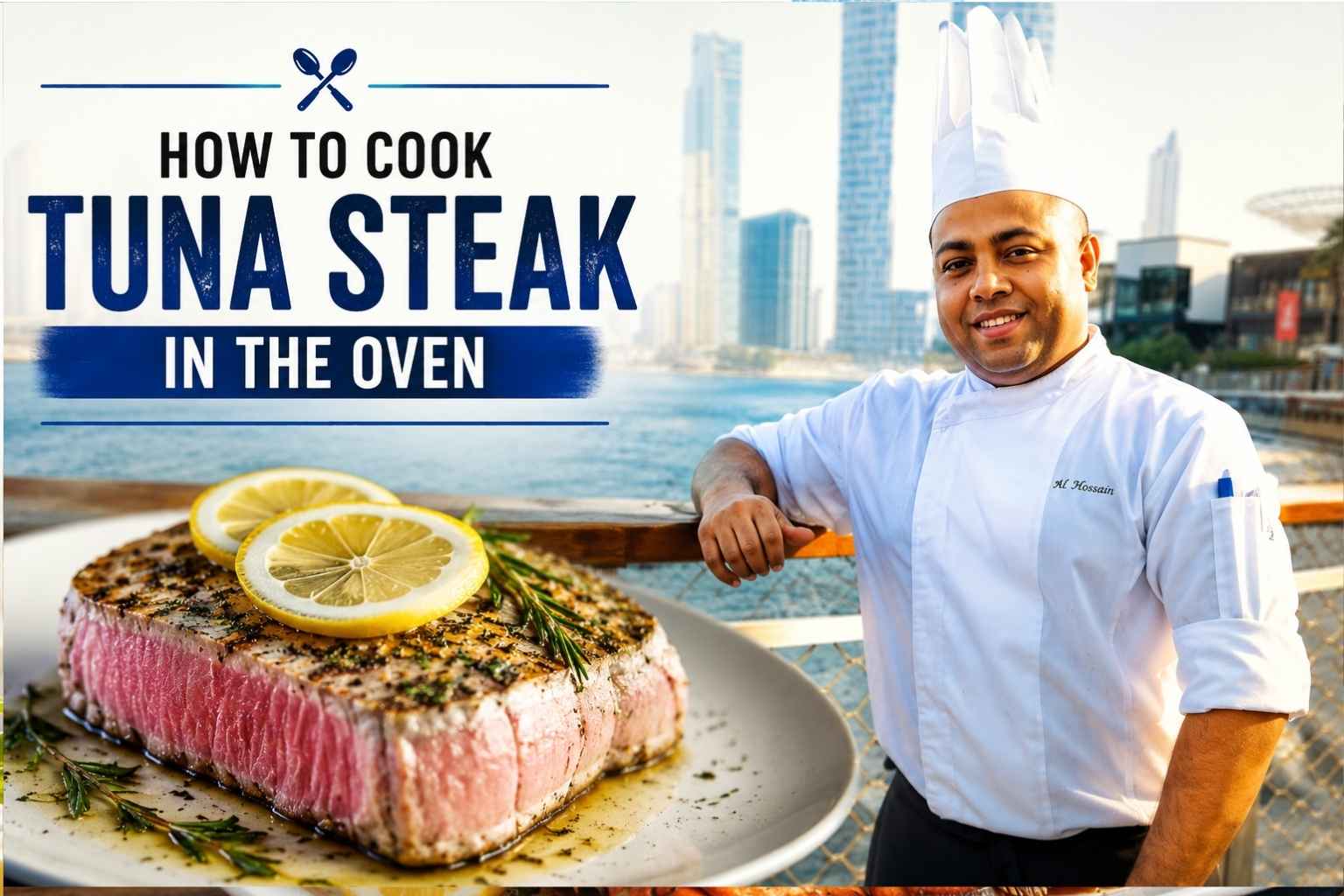
I still remember the first time I made How to Cook Tuna Steak in the Oven. I worried it would turn out dry, but one simple trick changed everything. Now it is one of my favorite quick dinners because it is easy, healthy, and full of flavor.
In this guide, I will show you how to cook tuna steak in the oven so it stays juicy and tender every time. I have tested different baking times, temperatures, and seasonings to find what works best. You will also learn simple tips, common mistakes to avoid, and the best way to get delicious results, even if you are making tuna steak for the first time. Let’s get started and make a perfect oven-baked tuna steak together.
Why Oven-Cooking Tuna Steak Works Better Than You Think
Oven cooking gives you control. That’s the short answer.
Most home cooks default to searing tuna in a pan, which is fast but unforgiving. You get 60-90 seconds per side before the line between perfect and ruined gets razor thin. The oven slows that down. You can pull the steak at exactly the right internal temperature without hovering over a screaming-hot pan.
I’ve cooked tuna in every format over 15 years – restaurant lines, private dinners, catering for 300 people. The oven method beats pan-searing when you need consistency across multiple steaks, when the fish is thick (over 1 inch), or when you want even doneness all the way through rather than a browned crust with a cold raw center.
When oven beats searing:
- Cooking 3+ steaks at once
- Thick cuts over 1.25 inches
- Low-and-slow for silky, uniform texture
- When you want full control without standing at the stove
When searing beats oven:
- Thin steaks under 3/4 inch (they overcook before developing a crust)
- When you want maximum Maillard browning on the outside
- Fast weeknight dinners with one or two portions
The hybrid method – sear first, finish in the oven – is what I use for steakhouse-style presentation. More on that below.
How to Choose the Right Tuna: Grade, Species, and What to Avoid
The best oven-cooked tuna starts at the fish counter, not at your stove.
Species breakdown:
- Yellowfin (ahi): The gold standard for home cooking. Firm texture, mild flavor, deep red color. Holds up well in the oven without falling apart. This is what I use 90% of the time.
- Bigeye: Richer, fattier than yellowfin. More forgiving when you cook it slightly past medium-rare because the fat keeps it moist. More expensive and harder to find.
- Albacore: Lighter color (pale pink to off-white), milder flavor. Lower fat content, so it dries out faster. If you’re using albacore, don’t cook it past medium and pull it at 120°F max.
- Bluefin: The best tuna in the world, full stop. But most of what’s labeled “bluefin” at grocery stores is mislabeled (Oceana, 2022). Treat any claimed bluefin from a regular retailer with skepticism.
Fresh vs. frozen:
Frozen is often better. Most “fresh” tuna at grocery stores was frozen on the boat and thawed at the counter – you just don’t know when. High-quality vacuum-sealed frozen tuna that you thaw yourself gives you full control over freshness. For sushi-grade fish meant to be eaten rare, look for IQF (individually quick-frozen) labels or product frozen to -31°F (-35°C), which kills parasites per FDA guidelines (FDA Food Code, 2022).
What to look for:
- Deep red or ruby color with no browning at the edges
- Firm flesh with no soft spots or slick coating
- Clean ocean smell – not “fishy” or sour
- “Sushi-grade” or “sashimi-grade” labeling if you plan to eat it rare (though these terms have no official legal definition in the U.S.)
What to avoid:
- Brown or grayish edges (oxidized, past its peak)
- Yellowing or bleaching (may signal carbon monoxide treatment to fake freshness)
- Any ammonia smell
The Tuna Doneness Guide: Internal Temperatures and Times
Use this table as your reference every time you cook tuna in the oven.
| Doneness | Internal Temp | Texture | Oven Time at 275°F | Notes |
|---|---|---|---|---|
| Rare | 95-105°F | Very soft, deep red center, near-raw | 8-10 min | Sushi-grade only; not FDA-recommended for at-risk groups |
| Medium-Rare | 110-115°F | Silky, warm pink center, slight resistance | 12-15 min | The chef’s preferred doneness for ahi/yellowfin |
| Medium | 125-130°F | Firmer, light pink center, some moisture loss | 16-20 min | Best for albacore; acceptable for ahi |
| Well-Done | 145°F+ | Firm, opaque, dry – the “cardboard zone” | 22-28 min | FDA-required for regular (non-sushi-grade) tuna |
Times based on a 1-inch thick steak at room temperature. Add 3-4 minutes per additional 1/4 inch of thickness.
Use a probe thermometer, not time alone. (ThermoWorks, 2023)
Step-by-Step Prep: What to Do Before the Tuna Hits the Oven
Prep takes 15 minutes and determines 70% of your result. Don’t skip any of it.
Step 1: Thaw Correctly
If your tuna is frozen, thaw it in the refrigerator overnight – 12 to 24 hours. Never thaw on the counter or in warm water. Quick-thawing at room temp starts the surface cooking unevenly and raises food safety risk (USDA, 2023).
For same-day thawing, seal the tuna in a zip bag and submerge in cold (not warm) water. Change the water every 30 minutes. A 1-inch steak thaws in about 60-90 minutes this way.
Step 2: Pat It Bone Dry
This is the step most home cooks skip and it costs them everything.
Moisture on the surface of the fish turns to steam in the oven. Steam poaches your tuna instead of roasting it. You end up with gray, wet-textured fish with zero surface browning.
Use paper towels and press firmly on both sides and all edges. The surface should feel almost tacky, not wet. Let the steak sit on a wire rack for 5-10 minutes after patting for even more moisture evaporation.
Step 3: Bring It Toward Room Temperature
Pull tuna from the fridge 20-30 minutes before cooking. A cold steak cooks unevenly – the outside overheats before the center warms up. Tempering closes that gap (Serious Eats, 2022).
Don’t go longer than 30 minutes for food safety.
Step 4: Season and Coat
Salt both sides generously – about 1/2 teaspoon kosher salt per inch of thickness. Season at least 10 minutes before cooking so the salt has time to draw out a tiny bit of moisture and then reabsorb it (a mini dry-brine effect).
For oil, brush both sides with a high smoke-point oil: avocado, grapeseed, or refined coconut. Don’t use extra-virgin olive oil at high heat – it burns and turns bitter.
Optional marinade: If you want an Asian-style crust, a 10-15 minute soak in 2 parts soy, 1 part sesame oil, and a splash of rice vinegar works. Do not marinate longer than 20 minutes – the acid starts to denature the protein and changes the texture before it even hits the oven.
Oven Temperature Guide: Which Heat Level to Use and When
Temperature choice depends on what outcome you want. There are three distinct approaches.
Low-and-Slow at 275-300°F
This is the most forgiving and the method I teach first.
At 275°F, a 1-inch tuna steak takes 12-15 minutes to reach medium-rare (110-115°F). The low heat gives you a wide window – the difference between 12 minutes and 15 minutes is only about 5°F. That margin doesn’t exist at 425°F.
The texture result: silky, almost custard-like in the center, with minimal moisture loss. The outside won’t brown, but it sets up nicely. Use this method when texture is the priority and you don’t care about a crust.
Best for: Thick steaks (1.25+ inches), multiple steaks at once, first-timers, citrus-marinated fish.
Moderate Heat at 350-375°F
The middle-ground approach. You get slightly faster cooking (10-12 minutes for medium-rare) with a bit more surface color than low-and-slow.
Texture is still good but less forgiving than 275°F. The window between perfect and overcooked shrinks to about 2 minutes. Use a probe thermometer, not a timer.
Best for: Thinner steaks (3/4 to 1 inch), when you want a lightly set exterior, weeknight cooking.
High-Heat Sear-Finish at 425-450°F + Broiler
This is the steakhouse method. You get a real crust.
Preheat the oven to 450°F with an oven-safe skillet inside. Sear the tuna in the screaming-hot pan for 60-90 seconds per side on the stovetop first (or skip this and rely on the oven heat). Then transfer to the oven for 5-7 minutes, finishing under the broiler for 60-90 seconds to crisp the top.
The result: a dark, caramelized crust with a warm, rare-to-medium-rare center. This is the best presentation. It’s also the least forgiving – overcooking happens in 30-second windows.
Best for: Presentation-first cooking, restaurant-style results, thin steaks where you want crust without overcooking the center.
How to Use a Thermometer – and Why Guessing Will Ruin Your Tuna
A probe thermometer is the single most important tool for cooking tuna. No thermometer means no consistency.
Insert the probe into the thickest part of the steak, parallel to the surface, aiming for the center. Don’t touch the pan or the rack – you’ll get a false reading.
Pull the tuna out 5°F below your target temperature. Carry-over cooking from the residual heat in the fish will finish it off during the rest.
Target pull temperatures:
- Rare: Pull at 95-100°F, rest to 100-105°F
- Medium-rare: Pull at 105-110°F, rest to 110-115°F
- Medium: Pull at 120-125°F, rest to 125-130°F
- Well-done: Pull at 140°F, rest to 145°F
Recommended thermometers: ThermoWorks Thermapen One (fastest, most accurate), ThermoWorks DOT (leave-in probe for oven use), or any instant-read probe accurate to ±1°F (ThermoWorks, 2023).
Searing First vs. Oven-Only: What the Difference Actually Feels Like
Oven-only produces even, wall-to-wall doneness. There’s no gray band from a hot pan. The texture from edge to center is nearly identical. You lose the Maillard crust, but the interior is superior.
Sear-first gives you that dark, crackly exterior most people associate with restaurant tuna. The sear takes 90 seconds per side in a pan heated to smoking. Then the steak goes straight into the oven to finish. This is the method if someone is eating with their eyes first.
Oven-only then broil is the compromise I use most at home. No stovetop, no splatter, no stove-to-oven pan transfer. The broiler at the end gets the surface above 450°F for a Maillard reaction on top without turning the fish.
My honest take: for a weeknight dinner or if you’re serving guests who don’t care about plating, oven-only is cleaner and less stressful. For a dinner party where someone will take a photo, sear-first wins on aesthetics.
Why Resting Tuna Matters – and How Long to Wait
Rest tuna for 3-5 minutes after pulling it from the oven. Tent it loosely with foil.
Two things happen during this rest. First, carry-over cooking raises the internal temperature by 5°F (America’s Test Kitchen, 2021). That’s why you pull early. Second, the muscle fibers relax and reabsorb moisture. Cut too early and that moisture runs straight onto the plate.
Don’t rest longer than 5 minutes. Tuna cools fast and a cold tuna steak at medium-rare is a much worse experience than a warm one.
Food Safety: Sushi-Grade, Store-Grade, and What the FDA Actually Says
This section matters. Don’t skip it.
The FDA standard: The FDA Food Code recommends cooking fish to 145°F internal temperature for the general public (FDA Food Code, 2022). At 145°F, tuna is well-done. Most people who enjoy tuna steak eat it rare or medium-rare – well below that threshold.
Why most restaurants serve it below 145°F: Fish served raw or undercooked in restaurants is covered by a “consumer advisory” – a disclosure on the menu that puts the choice in the customer’s hands. The 145°F rule exists to protect against pathogens and parasites, not to govern how fish tastes best.
Sushi-grade fish: Fish labeled “sushi-grade” or “sashimi-grade” has typically been frozen to -31°F (-35°C) or below for 15 hours, or to -4°F (-20°C) for 7 days – a process that kills anisakis parasites per FDA guidelines (FDA Food Code, 2022). This makes it significantly safer to eat raw or rare, though no fish is 100% risk-free at low temperatures.
At-risk populations – pregnant women, young children, elderly adults, and immunocompromised individuals – should follow the 145°F FDA guideline and eat tuna well-done.
For everyone else: Sushi-grade tuna eaten rare carries low risk for healthy adults when purchased from a reputable supplier and handled correctly.
Common Mistakes and How to Fix Them
These are the errors I see over and over. Each one has a direct fix.
Mistake 1: Not patting the tuna dry The result is steamed, gray, wet-textured fish with no browning. Fix: Use paper towels aggressively on all surfaces. Let the steak air-dry on a rack for 10 minutes after patting.
Mistake 2: Skipping the thermometer Guessing doneness by time or by touch leads to overcooked tuna at least 50% of the time. Tuna goes from perfect to cardboard in 2-3 minutes. Fix: Use a probe thermometer, pull at 5°F below target, and rest every time.
Mistake 3: Not preheating the oven long enough Ovens lie. Most residential ovens take 15-20 minutes to fully stabilize at temperature, and some run 25-50°F hotter or cooler than the dial shows (America’s Test Kitchen, 2021). Fix: Preheat for at least 20 minutes. Buy a $10 oven thermometer to check calibration.
Mistake 4: Cooking straight from the fridge Cold fish cooks unevenly. The center is still near-fridge temperature when the exterior starts to overcook. Fix: Pull tuna from the fridge 20-30 minutes before it goes in the oven.
Mistake 5: Marinating too long Acids in marinades – citrus juice, vinegar, soy sauce – denature protein over time. More than 20-30 minutes in an acidic marinade and you’re essentially “cooking” the tuna before it hits the oven. Fix: Time your marinade to 15-20 minutes max.
Mistake 6: Cutting too early You lose moisture on the plate instead of in the fish. Fix: Rest for 3-5 minutes under foil every time.
Mistake 7: Using the wrong oil Extra-virgin olive oil smokes and burns above 375°F, leaving a bitter taste on the surface. Fix: Use avocado oil (smoke point 520°F), grapeseed oil (420°F), or refined coconut oil (450°F).
My Go-To Method: Low-Slow with a Broiler Finish
Here’s exactly what I do at home when I want a great piece of oven-cooked tuna without the theater of a ripping-hot pan.
What you need: 1-inch thick ahi tuna steak, sushi-grade, kosher salt, avocado oil, an oven-safe wire rack over a sheet pan, a probe thermometer.
- Pull the tuna from the fridge 25 minutes before cooking.
- Pat dry with paper towels – more than you think you need.
- Brush both sides with avocado oil. Season generously with kosher salt and cracked black pepper. Add a thin smear of white miso on the top side if you want depth without a marinade.
- Set oven to 275°F. Preheat for 20 minutes.
- Place tuna on the wire rack over a sheet pan. Insert a leave-in probe thermometer into the thickest point.
- Cook until internal temp hits 105°F. Switch oven to broil on high. Broil 90 seconds – watch it, don’t walk away.
- Pull at 110°F. Tent with foil. Rest 4 minutes.
- Cut across the grain. Serve immediately.
The result: a lightly charred top, silky deep-pink center, clean flavor. No smoke alarm, no splatter, no stress.
Frequently Asked Questions About Cooking Tuna Steak in the Oven
What temperature should I cook tuna steak to in the oven?
For medium-rare, pull tuna at 105-110°F and let it rest to 110-115°F. For medium, pull at 120-125°F. The FDA recommends 145°F for full food safety compliance, which produces a well-done, firm steak. Most healthy adults eating sushi-grade tuna safely eat it at 110-115°F (FDA Food Code, 2022).
How long does tuna steak take to cook in the oven?
At 275°F, a 1-inch steak takes 12-15 minutes to reach medium-rare. At 350°F, it takes 10-12 minutes. At 425°F with a preheat sear, 6-8 minutes in the oven plus a 90-second broil. Always use a thermometer – timing varies by thickness and starting temperature.
Can I cook frozen tuna steak in the oven without thawing?
Yes, but expect 50% longer cook times and uneven results. The exterior will overcook while the frozen center thaws. Thawing overnight in the fridge is always better. For same-day thawing, use the cold-water method (submerge in cold water, change every 30 minutes, thaw in 60-90 minutes).
What’s the difference between oven-baking and broiling tuna?
Baking uses ambient heat from all sides for even, gradual cooking. Broiling hits the top surface with direct, intense heat from above – it’s essentially grilling upside down. Baking gives better control and even doneness. Broiling gives surface color fast. The best results combine both: bake low-and-slow, then broil for 60-90 seconds at the end.
Is it safe to eat pink tuna steak?
For healthy adults eating sushi-grade tuna (frozen to parasite-killing temperatures per FDA protocol), a pink or rare center carries low risk (FDA Food Code, 2022). For regular grocery-store tuna not labeled sushi-grade, the FDA recommends cooking to 145°F – which is well-done. Pregnant women, young children, elderly adults, and immunocompromised individuals should follow the 145°F standard regardless of grade.
Why does my oven-cooked tuna taste dry?
Overcooked tuna is dry tuna. If it tastes like cardboard, the steak hit 145°F+ in the oven. Next time: use a probe thermometer, pull at 5°F below your target, and rest under foil. Also check that you’re patting the fish dry before cooking (wet fish steams) and that you’re using oil with a high enough smoke point (Serious Eats, 2022).
Do I need to flip tuna steak in the oven?
At 275°F with a wire rack, flipping is optional – the elevated rack allows heat circulation underneath. At 350°F+, flip once at the halfway point for more even browning. If using a sheet pan directly (no rack), always flip halfway. If finishing under the broiler, skip the flip and just broil the top.
Can I cook albacore tuna the same way as ahi?
Yes, with one adjustment: albacore has less fat and dries out faster. Use the low-and-slow 275°F method, pull at 120°F max (medium), and don’t attempt rare with albacore – the texture isn’t pleasant. The low fat content that makes albacore mild-tasting also makes it punishing if you overcook it.
Key Takeaways
- Pull temperature is everything. For medium-rare ahi, that means 105-110°F out of the oven, 110-115°F after a 4-minute rest.
- Pat the steak completely dry before seasoning. Surface moisture kills browning and steams the fish.
- 275°F is the most forgiving oven temperature for tuna – it gives you a wide window and the best interior texture.
- Sushi-grade tuna eaten rare is low-risk for healthy adults; regular store-grade tuna should reach 145°F per FDA guidelines (FDA Food Code, 2022).
- A probe thermometer is not optional. It’s the only way to hit your target temperature consistently.
- Rest every time – 3-5 minutes under foil. Carry-over adds 5°F and the fibers reabsorb moisture.
- The best home method: 275°F for 12-15 minutes, then 90 seconds under the broiler. No stovetop, no splatter, consistent results.

I’m Mossaraof, a trained chef and the founder of OvenInsights.com. I spent years cooking at Larrupin’ Cafe and in kitchens across Chicago and Seattle. Now I test kitchen gear for a living. I moved to North Acton, London, and I test every tool I write about. I use real meals and real heat. No brand deals. No shortcuts. I cover 12 kitchen types and hundreds of recipes. I believe this: the right tools matter as much as the recipe.