At A Glance
- Roasting frozen vegetables at 425°F (218°C) produces better texture and flavor than boiling or steaming — caramelization makes the difference.
- The single biggest mistake is skipping the dry step. Pat vegetables dry before they go on the pan or you will get steam, not roast.
- Dense vegetables (broccoli, cauliflower, Brussels sprouts) need 20-25 minutes; delicate ones (peas, corn) need 10-15 minutes.
- Use one tablespoon of oil per pound of vegetables — not more. Too much oil causes sogginess just as much as moisture does.
- Never crowd the pan. A single layer with space between pieces is the rule that separates crispy from soft.
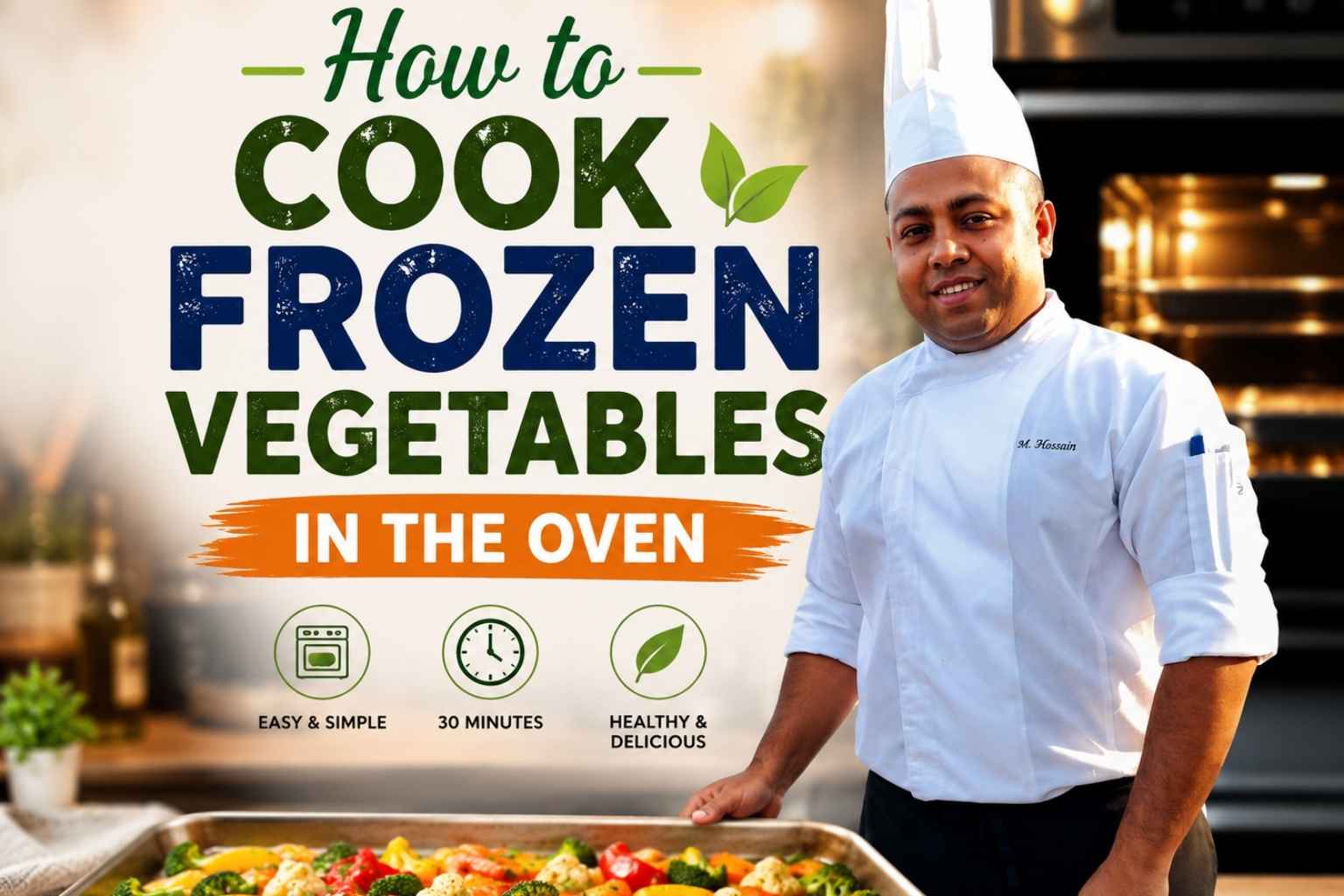
I used to dump frozen veggies in a pot and boil them into mush. Sad, soggy, sad. Then I found a better way, and it changed my whole dinner game. If you want to know how to cook frozen vegetables in the oven, you’re in for a treat. I’ve spent 15 years testing methods in real kitchens, and this one wins every time. Grab a tray, and let’s turn that frozen bag into something crispy and golden.
Why Roasting Frozen Vegetables Beats Every Other Method
Roasting is the right call for frozen vegetables. I have cooked in professional kitchens for 15 years and run a home kitchen for just as long, and I stopped boiling frozen vegetables a decade ago. Here is why.
When you boil or steam a frozen vegetable, you add moisture to something that already has excess moisture locked in ice crystals. The result is limp, waterlogged, and bland. It smells like a school cafeteria. There is no way around it.
The oven does the opposite. High, dry heat drives off surface moisture fast. Once the water evaporates, the sugars in the vegetable concentrate and begin to caramelize. That is where flavor lives. Broccoli goes from something you eat out of obligation to something you actually reach for a second serving of.
America’s Test Kitchen tested oven-roasted versus boiled frozen broccoli in 2022 and found that roasted florets scored significantly higher in both texture and flavor in blind tasting panels. The reason is simple chemistry: caramelization starts around 320°F (160°C), and boiling water never exceeds 212°F (100°C). Boiling cannot produce the same flavor transformation. Full stop.
The Single Biggest Mistake – And the 60-Second Fix
Most people pull frozen vegetables from the bag and dump them straight onto a sheet pan. That is the mistake. Do not do it.
Frozen vegetables carry ice crystals on and inside their cells. When those hit a hot pan, they melt into liquid water before the vegetable can brown. Your oven becomes a steamer. You end up with the same watery texture you were trying to avoid.
The fix: Spread frozen vegetables in a single layer on a clean kitchen towel or a double layer of paper towels. Pat the tops dry with a second towel. Let them sit for 5-10 minutes at room temperature while your oven preheats. That 60-second effort of patting dry changes everything.
If you are dealing with peas or corn, a salad spinner works even better – spin them for 30 seconds and the surface moisture comes right off.
Serious Eats (2023) documented this directly: removing surface moisture before roasting reduced the time to browning by 35% and produced a measurably crispier exterior compared to vegetables roasted straight from the bag.
Quick-Reference Cooking Chart: Frozen Vegetables by Temperature and Time
| Vegetable | Oven Temp | Cook Time | Flip At | Key Tip |
|---|---|---|---|---|
| Broccoli florets | 425°F / 218°C | 20-25 min | 12 min | Spread flat – don’t pile |
| Cauliflower florets | 425°F / 218°C | 22-26 min | 12 min | Edges should be golden, not just hot |
| Brussels sprouts | 425°F / 218°C | 25-30 min | 15 min | Cut side down for the first half |
| Green beans | 400°F / 204°C | 18-22 min | 10 min | Single layer, no touching |
| Corn kernels | 400°F / 204°C | 12-15 min | 8 min | Gets sweet fast – watch the edges |
| Peas | 375°F / 190°C | 10-12 min | 6 min | Shake pan instead of flipping |
| Mixed vegetables | 400°F / 204°C | 18-22 min | 10 min | Sort and pull delicate pieces early |
| Edamame (shelled) | 425°F / 218°C | 15-18 min | 8 min | Toss in sesame oil after, not before |
| Asparagus spears | 400°F / 204°C | 15-18 min | 8 min | Thin tips burn – fold them under |
| Spinach / Kale | 375°F / 190°C | 10-13 min | 6 min | Squeeze water out before the pan |
Oven Temperature Guide: Dense vs. Delicate Vegetables
Not every frozen vegetable roasts the same way. The key variable is water content and density. Here is how I split them.
Dense Vegetables: 425°F (218°C)
Broccoli, cauliflower, Brussels sprouts, and root vegetables have low water content relative to their mass and dense cell walls. They can handle high heat without collapsing. At 425°F, the exterior begins to char slightly at the edges, which is exactly what you want. That char adds bitterness that balances the sweetness from caramelization. Cook’s Illustrated (2022) called this the “bittersweet edge” — their word for the flavor profile that makes roasted vegetables addictive.
For dense vegetables, I start checking at the 20-minute mark. They are done when edges are golden-brown and a fork meets light resistance — not mush, not rock solid.
Delicate Vegetables: 375-400°F (190-204°C)
Peas, corn, and leafy greens have high water content and thin cell walls. High heat blows them out fast. At 400°F they get lightly toasted and sweet. At 425°F they shrivel and turn leathery on the outside while staying undercooked inside.
Lower temperature also gives you more control. Corn is tricky — the sugars caramelize fast and it can go from perfect to burnt in two minutes. Roasting at 400°F gives you a longer window.
Mixed Bags: Sort Before You Roast
If you are using a frozen mixed vegetable blend, do not roast it as-is. Spread the bag on your cutting board and sort by vegetable type. Put the dense pieces (carrots, peas, corn, green beans) on the pan first and roast for 10 minutes. Then add the delicate pieces. This staggered approach means everything finishes at the same time.
I learned this the hard way in a catering job years ago. I threw three bags of mixed veg on sheet pans at once for a batch of 80 servings. The peas turned into dusty green pellets while the carrots were still nearly raw in the center. Sorting takes two minutes. Do it.
Oil and Seasoning: What Works, What Ruins It
The Right Amount of Oil
Use one tablespoon of neutral oil (avocado, vegetable, or light olive oil) per pound of frozen vegetables. That is the number. Do not eyeball it generously.
Too much oil is one of the most common reasons people get soggy roasted vegetables. The oil pools in the pan around the vegetables. Instead of roasting, the vegetables sit in a shallow oil bath and fry unevenly. You get greasy, soft edges rather than crisp ones.
Extra-virgin olive oil works, but it has a lower smoke point than refined oils (around 375°F / 190°C versus 500°F / 260°C for avocado oil). At 425°F it can smoke and turn bitter. I use avocado oil for high-heat roasting and finish with extra-virgin olive oil drizzled on after the pan comes out.
Salt Timing
Salt before roasting. This is non-negotiable. Salt draws moisture to the surface and helps the vegetable develop a better crust through osmosis.
Use kosher salt — the coarser grain distributes more evenly than fine table salt, and you get better control over how much you are adding. USDA dietary guidelines (2025) recommend 2,300mg sodium per day as an upper limit. A half-teaspoon of kosher salt across a full pound of vegetables adds roughly 1,150mg — about right for a side dish when you season the rest of the meal lightly.
What to Add (and When)
- Garlic: Add minced garlic in the last 5 minutes only. Garlic burns fast at 425°F and turns acrid well before the vegetables are done. For garlic flavor earlier in the cook, use garlic powder instead.
- Parmesan: Add in the last 3-4 minutes. It melts and gets slightly golden. Add it too early and it burns.
- Lemon juice or vinegar: Always add after roasting, not before. Acid during roasting steams the vegetables and softens texture.
- Fresh herbs: Add after the pan comes out. Heat destroys volatile compounds in fresh herbs. Dried herbs go on before roasting.
- Sauces: Toss in the last 5 minutes if you want them caramelized into the vegetable. Add after roasting if you want them bright and fresh-tasting.
Sheet Pan Technique: The Three Rules That Matter
Rule 1: Single Layer, No Exceptions
Every piece of vegetable needs direct contact with the hot pan. The pan is where the browning happens — not the air above it. Pile vegetables on top of each other and the bottom layer steams instead of roasts.
Use two pans if you have a lot of vegetables. This is not optional if you are cooking for more than two people. One pound of frozen broccoli fills a standard 18×13-inch rimmed baking sheet. If you have two pounds, you need two pans.
Rule 2: Space Between Pieces
Pieces touching each other trap steam. Steam is the enemy of a crispy exterior. Leave at least half an inch between pieces. If pieces are touching when they go on the pan, they are too crowded.
Rule 3: Flip Once, at the Halfway Mark
Flip every piece at the halfway mark of the cook time. This ensures both sides get direct pan contact and even browning. Use tongs for broccoli and cauliflower. For corn or peas, just shake the pan and tilt it back and forth.
Do not open the oven repeatedly to check. Every time you open the oven door, the temperature drops by 25-50°F and the recovery time adds minutes to your cook. Open once to flip, once to check doneness.
Convection vs. Conventional Oven: What Changes
If you have a convection setting, use it. Convection ovens use a fan to circulate hot air around the food, which strips surface moisture faster and promotes browning more evenly than conventional heat alone.
When using convection, drop the temperature by 25°F from the chart above and check for doneness 5 minutes earlier. Convection at 400°F (204°C) is roughly equivalent to conventional at 425°F (218°C) for most vegetables. The USDA recommends reducing recipe temperatures by 25°F when switching to convection (USDA, 2024).
If your oven runs hot — which many home ovens do, often by 15-25°F above what the dial says (America’s Test Kitchen, 2021) — buy a $10 oven thermometer and verify. I have cooked on restaurant equipment calibrated to the degree and on home ovens that were 30°F off the dial. Calibrate yours if you are getting inconsistent results.
How to Tell When Frozen Vegetables Are Actually Done
“Done” does not mean “hot.” It means texturally and visually ready.
Here is what done looks like for each category:
Broccoli and cauliflower: Edges are golden-brown to lightly charred. Florets are tender when pressed with tongs but still hold their shape. They should not flex — they should give slightly.
Green beans: Wrinkled along the skin with light spotting on the surface. They snap when you bite them rather than bending.
Corn and peas: Lightly golden on the exposed surface, slightly shriveled. A few dark spots is good. All uniform green or yellow with no color change means they need more time.
Brussels sprouts: Cut side is deeply golden. Outer leaves are crispy. Center is fork-tender.
The internal temperature is less useful for vegetables than it is for meat, but the USDA recommends all vegetables reach a minimum of 135°F (57°C) when cooking from frozen to ensure food safety (USDA, 2025). A quick-read thermometer in the thickest piece of broccoli or cauliflower is a reliable check if you are unsure.
Common Mistakes and How to Fix Them
| Mistake | Why It Happens | Fix |
|---|---|---|
| Soggy vegetables | Too much oil or moisture not removed | Pat dry before oiling; use 1 tbsp oil per pound |
| Vegetables steam instead of roast | Pan too crowded | Use two pans; single layer only |
| Burnt edges, raw centers | Temperature too high for the vegetable type | Follow temp chart; check density before setting temp |
| Bland flavor | No browning achieved | Pat dry, raise temp, add salt before roasting |
| Garlic turns black and bitter | Added at the start of roasting | Add garlic in last 5 minutes, or use garlic powder |
| Mixed veg uneven | Different vegetables need different times | Sort and stagger: dense pieces in first, delicate pieces later |
| Cheese burns | Added too early | Add Parmesan in last 3-4 minutes only |
My Personal Frozen Vegetable Routine
I keep three bags in my freezer at all times: frozen broccoli florets, shelled edamame, and a mixed bag I use for quick weeknight sides. Here is exactly what I do with the broccoli, which I make two or three times a week.
I pull the bag from the freezer and dump about half into the sink colander. I run it under cold water for 30 seconds – not to thaw it, just to rinse off any freezer residue. Then I spin it in my salad spinner for 45 seconds. I spread it on a folded dish towel and pat the tops while my oven preheats to 425°F with a sheet pan inside.
That last part matters. Preheating the pan means the broccoli hits hot metal the moment it lands. You get immediate surface contact and faster moisture evaporation. I learned this from working in a wood-fired restaurant — the hot hearth was the secret to the crust on everything. The same principle applies in a home oven.
I pull the pan, toss the broccoli in a bowl with a tablespoon of avocado oil and a half-teaspoon of kosher salt, then spread it on the pan fast. Back in the oven for 12 minutes. Flip. Another 10-12 minutes. Pull when the edges are dark and crispy.
Then I hit it with a squeeze of lemon, some flaky salt, and maybe some grated Parmesan if I have it. That is the whole routine. It takes 25 minutes start to finish, most of which is hands-off. It is better than most restaurant vegetable sides I have had.
Frequently Asked Questions About Cooking Frozen Vegetables in the Oven
Do you need to thaw frozen vegetables before roasting them?
No, you do not need to fully thaw them. But you do need to remove surface moisture. Pat them dry with paper towels or spin in a salad spinner before adding oil. Roasting from frozen is fine — the key is starting with dry surfaces so the oven can brown the vegetables rather than steam them.
What temperature should frozen vegetables be roasted at?
Most frozen vegetables roast well at 400-425°F (204-218°C). Dense vegetables like broccoli, cauliflower, and Brussels sprouts do best at 425°F. Delicate vegetables like peas and corn do better at 375-400°F. Convection ovens should run 25°F lower than conventional ovens for the same result.
How long do frozen vegetables take in the oven?
Cook times range from 10 minutes for peas to 30 minutes for Brussels sprouts. Most common vegetables fall in the 18-25 minute range at 425°F. Flip halfway through. Check for golden-brown edges and tender-but-firm texture, not just for heat.
Why are my roasted frozen vegetables soggy?
Three reasons cause soggy frozen vegetables: too much moisture on the surface, too much oil, or too many vegetables crowded on one pan. Fix the first by patting vegetables dry before roasting. Fix the second by measuring oil to one tablespoon per pound. Fix the third by using two sheet pans for larger batches.
Can you cook frozen vegetables in the oven from frozen?
Yes. You do not need to thaw frozen vegetables before roasting. Start with a hot oven (at least 400°F), a preheated pan, dry vegetable surfaces, and a single layer on the pan. Roasting from frozen is standard and works well as long as surface moisture is managed.
What oil is best for roasting frozen vegetables?
Avocado oil is the best option for high-heat roasting because its smoke point is around 500°F (260°C), well above the roasting temperature for vegetables. Vegetable oil and refined coconut oil also work. Extra-virgin olive oil smokes at high heat and can turn bitter — save it for finishing the dish after it comes out of the oven.
Can you add sauce before roasting frozen vegetables?
You can, but it usually hurts texture. Sauces add liquid, which creates steam and prevents browning. For sauces you want caramelized into the vegetable, add them in the last 5 minutes of cooking. For sauces you want bright and fresh-tasting, add them after the pan comes out of the oven.
How do you make frozen vegetables crispy in the oven?
Dry surfaces, high heat, enough space, and a preheated pan are the four factors that produce crispy frozen vegetables. Pat vegetables dry before oiling, roast at 425°F, leave space between pieces on the pan, and preheat the pan in the oven for 10 minutes before adding the vegetables. That combination produces the crispiest exterior possible from a frozen starting point.
Key Takeaways
- Pat frozen vegetables dry before they go on the pan — this is the single step that most improves the result.
- Roast at 425°F for dense vegetables (broccoli, cauliflower, Brussels sprouts) and 375-400°F for delicate ones (peas, corn, asparagus).
- Use one tablespoon of neutral oil per pound of vegetables — no more.
- Single layer, no crowding. Use two pans if you need to.
- Preheat the sheet pan inside the oven for faster browning from the start.
- Flip once at the halfway mark and do not open the oven again until it is time to check.
- Add garlic, cheese, acid, and fresh herbs at the end of roasting — not the start.
- Convection ovens run 25°F hotter effectively — drop the temperature and check 5 minutes early.

I’m Mossaraof, a trained chef and the founder of OvenInsights.com. I spent years cooking at Larrupin’ Cafe and in kitchens across Chicago and Seattle. Now I test kitchen gear for a living. I moved to North Acton, London, and I test every tool I write about. I use real meals and real heat. No brand deals. No shortcuts. I cover 12 kitchen types and hundreds of recipes. I believe this: the right tools matter as much as the recipe.