At A Glance
- Bake frozen burritos at 375°F (190°C) for 25-35 minutes depending on size – no thawing needed.
- Place burritos seam-side down directly on a wire rack over a baking sheet for the crispiest exterior.
- Use foil for the first 15 minutes to steam the filling, then remove it to crisp the outside.
- The safe internal temperature for a fully cooked frozen burrito is 165°F (74°C), per USDA Food Safety guidelines (USDA, 2024).
- Skip the microwave – the oven gives you even heat throughout, a firm (not soggy) tortilla, and a filling that actually tastes like food.
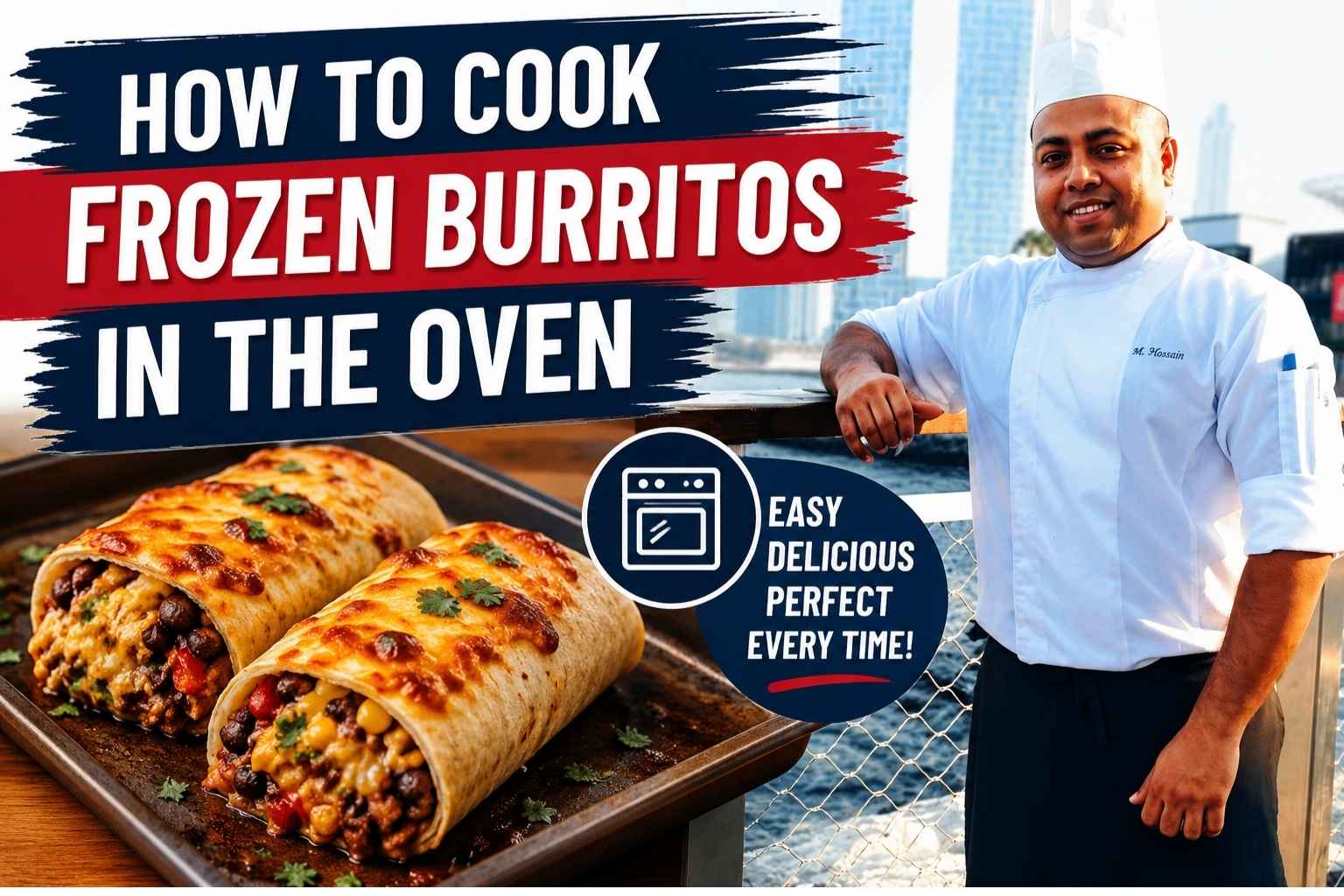
Have you ever wanted a hot meal but did not want to spend much time in the kitchen? How to Cook Frozen Burritos in the Oven is one of my favorite ways to get a crispy outside and a warm, tasty center with very little work.
I have made frozen burritos this way for busy weeknights, quick lunches, and late-night snacks. After many batches, I learned the small tips that help them cook evenly and taste much better than when they come from the microwave.
In this guide, I will show you the best oven temperature, cooking time, easy steps, and simple tricks for perfect results every time. Let’s get started and make your next frozen burrito crisp, hot, and full of flavor.
Why the Oven Beats the Microwave for Frozen Burritos
The oven is the right tool for frozen burritos because it heats from the outside in, which is exactly what a tortilla needs to crisp up. The microwave heats from the inside out – it turns frozen filling to steam fast, but that steam has nowhere to go. It soaks back into the tortilla and turns it soft and rubbery.
I’ve cooked thousands of burritos. Not just frozen ones – handmade ones in restaurant kitchens, too. And the physics is the same. A tortilla needs dry heat against its surface to firm up and develop any texture. You don’t get that in a microwave.
The oven also heats the filling more evenly. Microwaves create hot spots and cold spots. The outside of the filling gets scorching hot while the center stays frozen solid. That uneven cook is the reason people bite into a “done” microwave burrito and hit a frozen core. Dry oven heat surrounds the burrito on all sides and moves through it slowly and steadily.
The Science of Cooking from Frozen: Ice Crystals, Steam, and Crust Development
When a frozen burrito goes into a hot oven, three things happen in sequence. Understanding them tells you exactly how to cook it right.
First: ice crystals melt. The filling in a frozen burrito contains a lot of water. That water is locked in as ice. At temperatures below 32°F (0°C) it’s solid. As the oven warms the burrito, that ice melts and turns to water, then to steam.
Second: the steam cooks the filling. That steam trapped inside the burrito is useful. It heats the beans, the rice, the meat – whatever is in there – far faster than dry heat alone. This is why tenting the burrito loosely with foil for the first half of cooking is so effective. The foil traps some of that steam against the tortilla and speeds up the internal cook.
Third: the crust sets. Once enough moisture has escaped and the surface dries out, the Maillard reaction (the browning that happens when proteins and sugars are exposed to dry heat above 280°F/138°C) starts to happen. The tortilla goes from soft and pale to lightly golden and firm.
Per America’s Test Kitchen’s analysis of frozen food cooking methods (America’s Test Kitchen, 2022), the key to good texture from frozen is managing moisture release – letting steam do the interior work first, then removing that moisture to let the exterior brown.
Quick-Reference Baking Guide by Burrito Size and Brand
| Burrito Type | Weight | Oven Temp | Time (Foil On) | Time (Foil Off) | Target Internal Temp |
|---|---|---|---|---|---|
| Snack size (El Monterey) | 3-4 oz | 375°F / 190°C | 10 min | 10-12 min | 165°F / 74°C |
| Regular size (Don Miguel) | 5-6 oz | 375°F / 190°C | 15 min | 12-15 min | 165°F / 74°C |
| Jumbo size (El Monterey XXL) | 8-10 oz | 350°F / 177°C | 20 min | 15-18 min | 165°F / 74°C |
| Breakfast burrito (Amy’s) | 5-6 oz | 375°F / 190°C | 15 min | 10-12 min | 165°F / 74°C |
| Bean & cheese only | 5-6 oz | 375°F / 190°C | 12 min | 10-12 min | 165°F / 74°C |
| Meat-filled (beef or chicken) | 5-6 oz | 375°F / 190°C | 15 min | 13-15 min | 165°F / 74°C |
Note: These times assume you start from fully frozen, not thawed. Always verify doneness with an instant-read thermometer before serving. Filling temps vary by brand.
Step-by-Step Oven Method for Frozen Burritos
This is the method I use at home. It produces a burrito with a firm, slightly golden outside and a hot, evenly cooked filling every time.
What you need:
- A baking sheet
- A wire rack (optional but recommended)
- Aluminum foil
- An instant-read thermometer
Step 1: Preheat Your Oven to 375°F (190°C)
Preheat fully before the burrito goes in. This matters more than most people realize. A cold oven that heats up around the burrito gives you uneven, slow results. Give your oven a full 15 minutes to reach temperature. Most home ovens overshoot and then settle back down – that settling is what you want before you open the door.
Step 2: Set Up Your Rack and Pan
Place a wire rack on top of a rimmed baking sheet. The wire rack lifts the burrito off the pan surface so hot air can circulate underneath it. Without the rack, the bottom of the burrito sits in any condensation that drips off, and you get a soggy bottom – the most common complaint I hear about oven-baked burritos.
If you don’t have a wire rack, use the oven’s own middle rack directly and line the lower rack with foil to catch drips.
Step 3: Place the Burrito Seam-Side Down
Always put the burrito seam-side down. The seam is where the tortilla was folded and sealed. It’s the weakest point. When the filling heats and expands, pressure builds inside. If the seam is face-up, it can open and spill. Seam-side down holds it closed under its own weight.
Step 4: Tent with Foil for the First Half of Cook Time
Tear a piece of foil and lay it loosely over the burrito. Don’t wrap it tight – you want a loose tent, not a sealed packet. The loose tent traps enough steam to cook the filling from within, but still allows some moisture to escape. A sealed packet keeps too much steam in and you end up with a wet, soft tortilla no matter how long it cooks.
Step 5: Remove the Foil and Finish Bare
Halfway through the total cook time, pull the foil off. This is where the crust development starts. The surface is now hot and moist. The remaining oven time dries it out and crisps it. Keep an eye on it from the 5-minute mark onward. Ovens vary and the difference between lightly golden and overbrowning is about 3 minutes at 375°F.
Step 6: Check the Internal Temperature
Pull the burrito out and insert an instant-read thermometer into the center from the end – not from the top or side. Push it in at least halfway. The USDA minimum safe internal temperature for reheated foods with meat is 165°F (74°C) (USDA Food Safety, 2024). If you’re cooking a bean-and-cheese burrito with no meat, 160°F (71°C) in the center means it’s fully hot throughout.
How to Get a Crispy Exterior Without Drying Out the Filling
The goal is a crispy outside and a moist, fully-cooked inside. Those two outcomes work against each other if you use only heat – more heat to crisp the outside means more moisture lost from the inside.
The fix is a two-stage cook: steam first, then dry heat.
The foil tent in the first half of cooking steams the inside. Once the filling hits around 140-150°F internally, it’s nearly done. You pull the foil off and the last 10-12 minutes of bare heat crisps the tortilla without overcooking the filling underneath.
A light brush of oil or cooking spray on the tortilla surface before the second stage helps a lot. Not a soak – just a light coat. The oil transfers heat faster than dry air does, and it helps the Maillard reaction happen more evenly across the whole surface, not just on the raised edges.
I use a neutral oil – vegetable or avocado. Olive oil works too but its lower smoke point can make the surface taste slightly bitter at 375°F if it goes too long.
Gas vs. Electric Oven: What Changes for Frozen Burritos
Gas and electric ovens heat differently, and that affects frozen food more than most people realize.
Gas ovens produce a moist heat because combustion creates water vapor as a byproduct. That moisture in the air makes it harder to get a crispy exterior. If you have a gas oven, skip the foil tent entirely or reduce the foil time by 5 minutes. The oven’s moisture does the job the foil would do. You’ll also want to increase the temperature by 25°F (about 14°C) – so 400°F instead of 375°F.
Electric ovens produce dry heat. They brown food more aggressively than gas at the same temperature. The foil tent method works exactly as described in a standard electric oven. Stick to 375°F.
Convection ovens (electric fan-forced) circulate hot air around the food. That constant movement strips moisture from the surface faster. For convection, reduce the temperature by 25°F (so 350°F instead of 375°F) and cut the total cook time by 20-25%. A 5-6 oz regular burrito that takes 27 minutes in a standard electric oven takes about 20-22 minutes in convection. Per Serious Eats’ convection cooking guide (Serious Eats, 2023), the general rule for convection conversion is to reduce temperature by 25°F and reduce time by 25%.
How to Tell When a Frozen Burrito Is Fully Cooked
A frozen burrito is fully cooked when the internal temperature reads 165°F (74°C) at the center – that’s the USDA standard. But an instant-read thermometer isn’t always handy. Here are the visual and physical cues I rely on when I’m cooking at home without one.
Visual cues:
- The surface is dry and lightly golden, not pale or glossy with moisture.
- The ends of the burrito look dry and slightly darker than the sides.
- No visible frost or icy patches anywhere on the surface.
Physical cues:
- The burrito feels firm when you press the center lightly. A frozen center feels noticeably harder than the rest.
- Steam rises from the ends when you pull it out – that means the filling is hot enough to vaporize moisture.
- If you give it a gentle squeeze from the ends, the filling should move slightly. A completely rigid burrito still has a frozen core.
If you’re cooking for someone who is immunocompromised, pregnant, elderly, or a young child, always use a thermometer. Visual cues are a good shortcut for healthy adults but are not a substitute for verified temperature.
When to Use Foil and When to Skip It
Foil use depends on the burrito size, filling type, and oven type.
Use foil (tented, not sealed) when:
- Cooking a jumbo burrito (8 oz or more).
- Cooking a burrito with a dense meat filling – beef or chicken takes longer to heat through than beans.
- Using a standard electric oven.
Skip the foil (or shorten foil time) when:
- Cooking in a gas oven – the ambient moisture handles the interior.
- Cooking a snack-size burrito (3-4 oz) – they cook through fast and don’t need the extra steam.
- You want maximum crispiness and the filling type doesn’t require extended internal heating (bean and cheese, for example).
Never seal the foil tightly around the burrito like a packet. A sealed foil packet steams the burrito completely and prevents any browning. You end up with something that tastes boiled. The tent keeps just enough moisture in while still allowing airflow.
Common Mistakes and How to Fix Them
Frozen Center After Full Cook Time
This happens when the oven wasn’t fully preheated, the burrito went in straight from a very cold freezer, or the oven temperature runs low (common in older ovens).
Fix: Add 5-8 more minutes of covered cooking time. If the problem is consistent, get an oven thermometer ($10-15 at any kitchen store) – it will tell you your oven’s actual temperature versus what the dial says.
Soggy Bottom
The burrito sat in condensation that pooled on the pan.
Fix: Use a wire rack. That’s the whole fix. Air circulation underneath stops pooling completely.
Burst Seam
The filling heated faster than the tortilla could handle the pressure.
Fix: Score the top of the burrito with one shallow cut before it goes in. This gives pressure a controlled exit point. It also makes the finished burrito look like you knew what you were doing.
Overbrowning Before the Center Is Hot
The oven is running too hot, or you pulled the foil off too early.
Fix: Keep the foil on longer – 60-65% of total cook time covered instead of 50%. Lower the temp by 25°F. Use a thermometer to pull the burrito exactly when it hits 165°F, not by time alone.
Bland, Watery Filling
The burrito was wrapped too tightly in foil or cooked in too much moisture.
Fix: Use the loose tent method, not a sealed wrap. Let moisture escape during the second half of cooking.
My Personal Frozen Burrito Routine (Specific and Opinionated)
I keep El Monterey Red Hot Beef & Bean burritos in my freezer. They’re about 5 oz each. I’ve cooked hundreds of them. Here’s my exact process.
I preheat to 375°F with a baking sheet inside the oven. A hot pan is already an advantage – it starts the bottom crisping the second the burrito touches it. I skip the wire rack when I use this method because the hot pan substitutes for it.
I pull the pan out, set the burrito seam-side down, and spray the top lightly with avocado oil spray. Then I tent loosely with foil and put it back in for 15 minutes.
After 15 minutes, I pull the foil off. The surface is soft and pale but hot. I put it back in, uncovered, for 12 more minutes. At the 10-minute mark I check it – it’s usually golden at the ends and lightly firm in the center. Two more minutes finishes it.
Total time: 27 minutes. Internal temp usually reads 168-172°F. Texture: firm, slightly crisp outside, hot and moist inside. That’s the target.
I don’t add cheese on top before cooking. If I want melted cheese, I add it in the last 3 minutes uncovered. A single slice of pepper jack directly on top goes soft and starts to bubble right at the end.
Frequently Asked Questions About Cooking Frozen Burritos in the Oven
How long do you cook a frozen burrito in the oven?
Cook a standard 5-6 oz frozen burrito at 375°F for 25-30 minutes total – 15 minutes covered with foil, then 12-15 minutes uncovered. Jumbo burritos (8-10 oz) need 35-38 minutes total. Snack-size burritos (3-4 oz) are done in 20-22 minutes. Always confirm doneness with a thermometer reading of 165°F at the center.
Can you cook frozen burritos directly on the oven rack?
Yes. Placing burritos directly on the middle oven rack lets hot air circulate fully around them, including underneath. Put a piece of foil on the rack below to catch any filling that drips. The bottom of the tortilla will crisp more than it would on a pan, which some people prefer.
Do you need to thaw a frozen burrito before baking it?
No. Bake it straight from frozen. Thawing changes the texture of the tortilla before it hits the oven – it picks up moisture and goes soft. A frozen burrito goes from frozen to oven to table without any prep.
What temperature kills bacteria in a frozen burrito?
The USDA sets 165°F (74°C) as the minimum safe internal temperature for reheated foods that contain poultry or meat (USDA Food Safety, 2024). For bean-and-cheese burritos with no meat, 160°F (71°C) at the center is sufficient, but reaching 165°F eliminates any margin for error.
Why does my frozen burrito always have a cold center?
A cold center after full cook time means the oven wasn’t hot enough or the burrito was too cold going in. Verify your oven temperature with a separate thermometer – many ovens run 25-50°F cooler than the dial indicates. Also check that the foil is tented loosely, not sealed tight, so steam can move around inside the burrito during cooking.
Can you cook a frozen burrito in a convection oven?
Yes – and the results are excellent. Set your convection oven to 350°F instead of 375°F, and reduce total cook time by about 20-25%. A standard 5-6 oz burrito takes about 20-22 minutes in convection: 12 minutes covered, 8-10 minutes uncovered. The fan circulation means better browning and a crispier outside than a standard oven produces.
How do you keep a frozen burrito from getting soggy in the oven?
The key is a wire rack so condensation can’t pool under the burrito. Beyond that: don’t seal the foil tight (use a loose tent), keep the oven hot and fully preheated, and don’t open the oven door during the first half of cooking. Each time you open the door, temperature drops and moisture increases.
Can you reheat a previously cooked frozen burrito in the oven?
Yes. A burrito that was fully cooked and then refrigerated reheats in the oven at 350°F for 15-18 minutes. Use the same foil tent approach for the first 10 minutes, then remove it. The target is still 165°F internal. Don’t reheat a burrito that’s been sitting out for more than 2 hours – that’s the USDA’s two-hour rule for cooked foods left at room temperature (USDA Food Safety, 2024).
Key Takeaways
- 375°F is the right temperature for most frozen burritos in a standard electric oven. Gas ovens need 400°F. Convection needs 350°F.
- Seam-side down, every time. It holds the burrito closed as the filling expands.
- The two-stage method works: foil tent for the first half (steam the inside), then bare heat for the second half (crisp the outside).
- A wire rack stops soggy bottoms by lifting the burrito off the pan and letting air circulate underneath.
- 165°F at the center is the USDA standard for safe internal temperature on cooked-from-frozen burritos with meat filling.
- Gas ovens produce moist heat – reduce or skip the foil tent and raise the temperature by 25°F.
- A light coat of oil on the surface before the bare heat stage speeds up browning and gives a more even crust.

I’m Mossaraof, a trained chef and the founder of OvenInsights.com. I spent years cooking at Larrupin’ Cafe and in kitchens across Chicago and Seattle. Now I test kitchen gear for a living. I moved to North Acton, London, and I test every tool I write about. I use real meals and real heat. No brand deals. No shortcuts. I cover 12 kitchen types and hundreds of recipes. I believe this: the right tools matter as much as the recipe.