At A Glance
- Set your serving time first. Work backward from that one number to find every other start time.
- Pick one “anchor” protein. Build your whole schedule around its cook time and rest time.
- Resting is not optional. A beef joint needs 20 to 30 minutes off heat before you carve it (America’s Test Kitchen, 2023).
- Use a thermometer, not a clock. Carryover heat can raise the internal temp by 5 to 10°F after meat leaves the oven (ThermoWorks, 2025).
- One oven can handle a full roast dinner. Stagger your start times, and use foil to hold finished food warm.
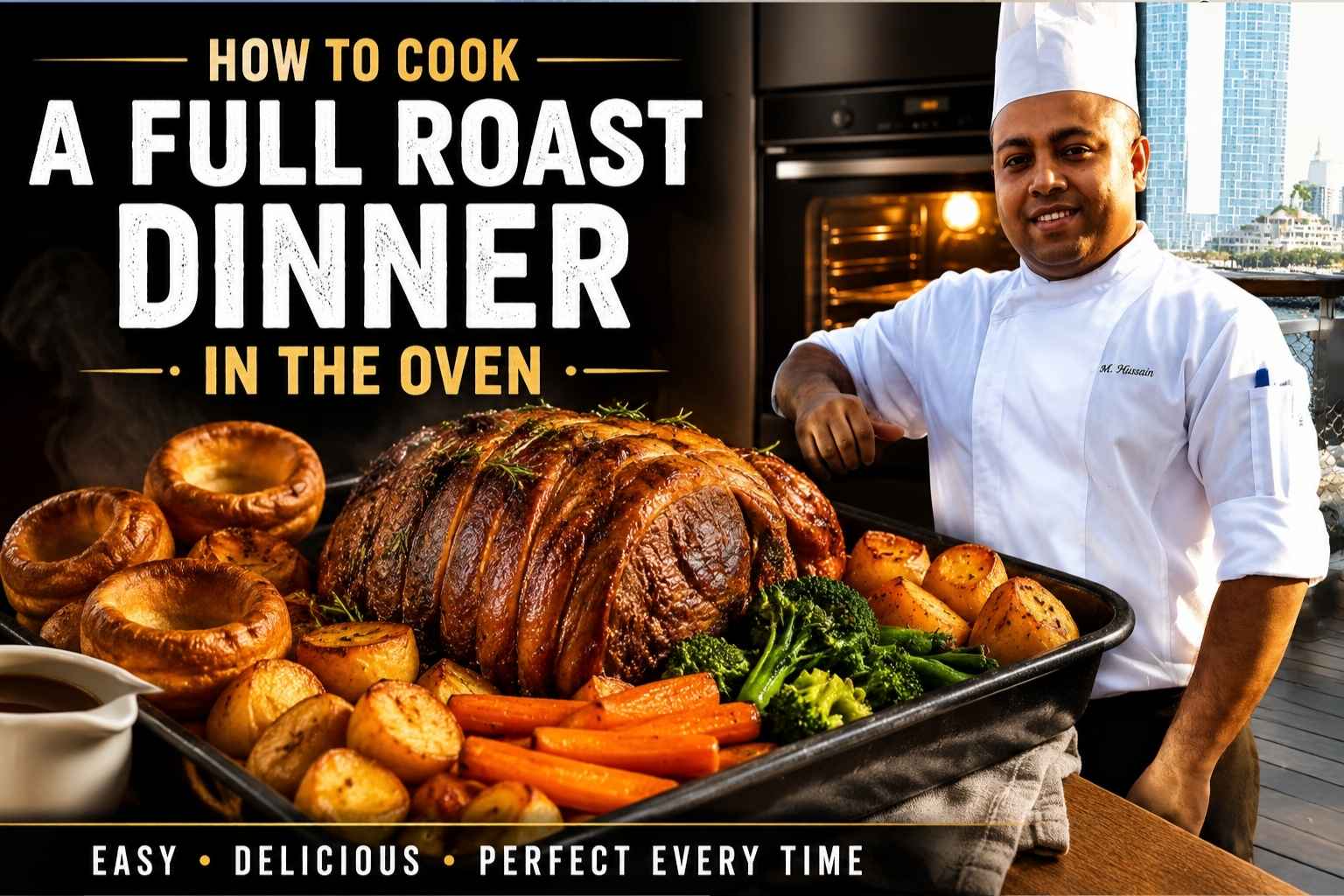
Sunday roast day used to stress me out so much I almost gave up on it. Then I found the trick to nailing a full roast dinner in the oven, and now it’s my favorite meal to cook for family. After 15 years testing ovens in my own kitchen, I know exactly what makes a roast turn out juicy, crisp, and full of flavor. In this guide, I’ll walk you through how to cook a full roast dinner in the oven, step by step, so nothing dries out and nothing burns. Grab your roasting pan, and let’s get that oven working its magic.
Why Roast Dinner Timing Is Really About One Number
A roast dinner has only one fixed point: the time everyone sits down. Every other time in your kitchen flows from that single number.
I learned this the hard way in my first head chef job. We had forty covers booked for 1 pm on a Sunday, and I had timed each dish on its own clock. The lamb hit its mark at 12:40. The potatoes weren’t ready until 1:25. Forty plates of cold lamb later, I never made that mistake again.
The fix is simple. Pick your finish time, then count backward. If dinner is at 1 pm and your beef joint needs 90 minutes in the oven plus a 25-minute rest, it goes in the oven at 11:05 am. Potatoes, veg, and Yorkshire puddings all get slotted in around that one number.
This is reverse planning. It is the one skill that separates a calm kitchen from a stressed one.
The Anchor Protein Method: Pick Your Meat First
Your main protein sets the schedule for everything else. I call this the anchor protein, because once it goes in the oven, it does not move.
Here is why this matters. A turkey takes hours. A pork loin takes under an hour. If you plan your sides first and your protein second, you will either rush the meat or let the sides go cold.
Once you know your protein and its weight, you can work out three numbers:
- Cook time, from the table below.
- Rest time, also below.
- Oven temperature, including any high-heat stage at the start.
Everything else fits into the gaps around those three numbers. The next section shows you exactly how.
Master Roast Timing Table: Every Protein at a Glance
Use this table as your starting point for any roast. Times are for unstuffed cuts. Always confirm with a thermometer, since ovens and cuts vary.
| Protein | Weight | Oven Temp | Time | Target Internal Temp | Rest Time |
|---|---|---|---|---|---|
| Whole chicken | 3-5 lb (1.4-2.3 kg) | 425°F / 220°C | 20 min per lb, plus 20 min | 165°F / 74°C (thigh) | 10-15 min |
| Beef joint (rib or sirloin) | 4-8 lb (1.8-3.6 kg) | 450°F / 230°C for 20 min, then 325°F / 160°C | 13-15 min per lb after the sear | 125-135°F / 52-57°C (rare to medium-rare) | 20-30 min |
| Pork shoulder (bone-in) | 4-8 lb (1.8-3.6 kg) | 300-325°F / 150-160°C | 35-40 min per lb | 195-205°F / 90-96°C | 20-30 min |
| Pork loin | 2-4 lb (1-1.8 kg) | 400°F / 200°C | 20-25 min per lb | 145°F / 63°C | 10 min |
| Lamb leg (bone-in) | 5-8 lb (2.3-3.6 kg) | 450°F / 230°C for 20 min, then 325°F / 160°C | 15-20 min per lb after the sear | 135-145°F / 57-63°C (medium) | 20 min |
| Turkey (whole) | 12-16 lb (5.4-7.3 kg) | 325°F / 160°C | 13-15 min per lb | 165°F / 74°C (thigh) | 30-45 min |
The USDA sets 165°F as the safe minimum for poultry, and 145°F with a 3-minute rest for pork (USDA, 2024). For beef and lamb, doneness is mostly down to taste, but 145°F is the safe minimum if you prefer a well-done roast.
Protein-by-Protein Timing Breakdowns
Roast Chicken: Simple, Fast, and Forgiving
A 4 lb chicken at 425°F takes about 1 hour 40 minutes, plus a 15-minute rest. This is the most forgiving roast on this list, which makes it a smart anchor for your first attempt at a full dinner.
Keep the oven at one steady temperature the whole time. No high-heat stage is needed. Place the bird breast-side up, and baste once at the halfway point if you want deeper color on the skin.
Check the internal temp in the thickest part of the thigh, away from the bone. At 165°F, pull it out. The breast will still be a touch under, but it climbs during the rest (Serious Eats, 2024).
Beef Joint: The High-Low Method
Beef rewards a two-stage oven. Start hot for a crust, then drop the heat to cook the inside gently. This gives you a deep brown outside and an even pink center.
For a 5 lb rib roast: 20 minutes at 450°F, then about 65-75 minutes at 325°F for medium-rare. Pull the joint at 125°F for rare, or 130-135°F for medium-rare. It will rise another 5-10°F as it rests.
Do not skip the sear stage. Without it, you get gray, steamed-looking meat with no crust at all (America’s Test Kitchen, 2023).
Lamb Leg: Treat It Like Beef, With Less Room for Error
Lamb leg follows the same high-low method as beef: 20 minutes at 450°F, then 325°F for the rest of the cook. The difference is the margin for error. Lamb dries out faster than beef if you overshoot the time.
For a 6 lb leg, expect roughly 90-110 minutes at 325°F after the sear, for medium. Pull it at 135°F, and let carryover bring it up to around 140-145°F during the rest.
Bone-in legs cook faster near the bone. Check the thickest meaty part of the leg, not the area close to the bone, for the most accurate reading.
Turkey: Low and Steady Wins
Turkey rewards patience. A steady 325°F for the whole cook, with no high-heat stage, gives you even cooking without a dry, overdone outside.
For a 14 lb bird, that is roughly 3 to 3.5 hours, or about 13-15 minutes per pound. Tent the breast loosely with foil for the first half of the cook if it browns too fast.
Check the thigh, not the breast. The thigh is the slowest part to cook. Pull the bird at 165°F, then rest for 30-45 minutes before carving (USDA, 2024).
One Christmas, early in my career, I trusted the oven dial instead of a thermometer. The dial said 325°F. The oven was actually running 40°F cold, and the turkey needed another hour we did not have. Buy an oven thermometer. They cost less than a side of bacon.
Why Resting Time Is Not Optional
Resting is part of cooking, not a pause before it. While meat sits, the muscle fibers relax, and the juices pushed to the center during cooking spread back out evenly.
Skip the rest, and you will see it on the cutting board: a pool of juice, and a slice of meat that is drier than it should be. Cut into a roast straight from the oven, and most of what made it juicy ends up on the plate instead of in the meat.
Bigger cuts need longer rests. A whole chicken needs 10-15 minutes. A beef joint or lamb leg needs 20-30. A turkey needs 30-45, tented loosely with foil to hold the heat without softening the skin.
This rest time is not dead time, either. It is exactly when your potatoes, veg, and Yorkshire puddings get their turn in a hot oven. More on that next.
Roast Potatoes, Root Vegetables, and Yorkshire Puddings
Sides need a hot oven, usually 425°F or higher, which often clashes with a low-and-slow main. The fix is timing sides around your protein’s high-heat stages, not its low-heat ones.
Roast Potatoes
Par-boil your potatoes for 8-10 minutes, drain them, then shake the pan hard to rough up the edges. This roughed-up surface is what creates the crisp shell (BBC Good Food, 2025). Toss the potatoes in hot fat, then roast at 425°F for 45-50 minutes, turning once halfway through.
Root Vegetables
Carrots and parsnips need less fuss. Cut them into even pieces, toss with oil, and roast at 400-425°F for 35-40 minutes. They can share a shelf with potatoes if your oven has the room.
Yorkshire Puddings
These need the hottest oven you can manage, around 450-475°F, and only 20-25 minutes. The batter must hit screaming-hot fat the moment it is poured, or it will not rise (BBC Good Food, 2025).
Shelf Positioning
Heat is strongest at the top and bottom of most ovens. Put your protein in the middle. Potatoes and Yorkshires do best on a high shelf, where they get direct heat for browning. Root veg is more forgiving and can sit lower down.
Managing One Oven for Multiple Dishes
A single oven can run a full roast dinner. The trick is sequencing. Few dishes actually need the oven at the exact same moment as your protein.
Here is the order that works for me:
- The protein goes in first, often with a high-heat sear stage.
- Once the protein drops to its low-temperature stage, par-boiled potatoes and veg go in on a separate shelf. Accept that they will take 5-10 minutes longer at this lower temperature.
- When the protein comes out to rest, crank the oven to its highest setting.
- Yorkshire puddings go into that blazing-hot oven while the protein rests.
- Finished potatoes and veg come out, get a toss with salt, and sit under foil, draped loosely so they do not turn soggy.
If your oven is small, cook potatoes and veg in batches earlier in the day, then reheat at high heat for the last 10 minutes while the protein rests. They will crisp back up.
Convection vs. Conventional Ovens for Roasting
Convection ovens, also called fan ovens, cook faster and brown more evenly than conventional ovens. A fan moves hot air around the food instead of letting it sit still.
As a rule of thumb, drop the temperature by 25°F (about 15°C), or cut the cook time by 10-15%, when using convection compared with the times in this guide, which assume a conventional oven (ThermoWorks, 2025).
Convection is especially good for potatoes, Yorkshire puddings, and anything where you want crisp, even browning on all sides. For large roasts like turkey, the difference is smaller, but it still helps the skin crisp without drying out the meat underneath.
If you are not sure which oven you have, check the dial or settings menu for a fan symbol. It usually looks like a circle with a small fan blade inside it.
Using a Meat Thermometer Correctly
A thermometer beats a clock every time. Oven temperatures and starting meat temperatures vary too much for time alone to be reliable.
Where to Place the Probe
Push the probe into the thickest part of the meat. Avoid bone and fat, since they heat differently from muscle. For poultry, that is the inner thigh. For a roast, it is the center of the thickest section.
Carryover Cooking
Meat keeps cooking after it leaves the oven, because heat from the outside is still moving inward. A large roast can rise 5-10°F during its rest. A small cut, like a chicken breast, might rise only 2-3°F (ThermoWorks, 2025).
This means you should pull meat from the oven before it hits your target temperature, then let carryover finish the job during the rest.
Why “Done by Time” Fails
Two chickens of the same weight can finish 15-20 minutes apart. The reasons are simple: different starting temperatures, an oven that runs hotter or colder than its dial says (often by 25°F), and how often the door gets opened. Time is a guide. Temperature is the answer.
Common Roast Dinner Timing Mistakes (and How to Fix Them)
| Mistake | Why It Happens | The Fix |
|---|---|---|
| Starting everything at the same time | No reverse plan from the serving time | Pick your anchor protein, then count backward from dinner time |
| Skipping the rest | Wanting to serve food “hot and fresh” right away | Build the rest time into your schedule. It is not optional |
| Opening the oven door too often | Checking on food out of habit | Use a thermometer with an external probe, so you do not need to open the door |
| Not adjusting for altitude | Assuming all ovens behave the same everywhere | Above 3,000 feet, lower air pressure means food cooks slower. Add 10-15% to roasting times, and check doneness with a thermometer (USDA, 2024) |
| Trusting the oven dial | Most home ovens run hot or cold by up to 25°F | Check the real temperature with an oven thermometer once a year |
| Cooking sides at the wrong time | Treating every dish as equally urgent | Sides go in during your protein’s low-heat stage or its rest, not at the start |
My Sunday Roast Routine: A Real Game Plan
Here is the exact routine I use for a 6 lb beef rib roast, aiming for a 1:30 pm table. Adjust the clock for your own protein and serving time using the table above.
- 9:00 am – Take the beef out of the fridge. Salt it all over, and leave it uncovered on a rack. This dries the surface for a better crust.
- 9:30 am – Peel potatoes and root veg. Cover the potatoes in cold water until par-boiling time.
- 11:00 am – Preheat the oven to 450°F. Par-boil the potatoes for 8 minutes, drain, and shake them in the pan.
- 11:15 am – The beef goes in for its 20-minute high-heat sear.
- 11:35 am – Drop the oven to 325°F. The beef keeps cooking. Potatoes and root veg go in on a lower shelf.
- 12:50 pm – The beef comes out at 130°F internal. It rests under foil while the oven cranks back up to 475°F.
- 1:00 pm – Yorkshire puddings go into the now blazing oven for 22 minutes. Potatoes and veg come out, get a final toss with salt, and sit loosely covered.
- 1:25 pm – Yorkshires come out, and the beef gets carved.
- 1:30 pm – Everything hits the table together.
The first time I ran this exact sequence for my own family, my dad timed it on his watch. He said it was the first roast in twenty years where the Yorkshires and the beef arrived at the same time. That is the whole goal.
Frequently Asked Questions
How far in advance can I prep a roast dinner?
You can peel potatoes and veg the night before and store them in cold water in the fridge. Salt your protein up to 24 hours ahead, and leave it uncovered in the fridge. This dries the skin or surface and improves browning.
What if my protein finishes early?
Pull it anyway, and let it rest under foil. A rested roast holds its heat for 30-45 minutes, which gives you a buffer if your sides are running late.
Can I cook a roast dinner without a meat thermometer?
You can, but you are guessing. A basic instant-read thermometer costs less than a single roast joint, and it removes most of the risk of over- or under-cooking.
Do I need to adjust timing for a fan-assisted oven?
Yes. Drop the temperature by about 25°F, or cut the time by 10-15%, compared with the conventional oven times in this guide (ThermoWorks, 2025).
Why does my Yorkshire pudding not rise?
The fat in the tin almost always is not hot enough. It needs to be near-smoking before you pour in the batter (BBC Good Food, 2025).
How long can roast potatoes sit before serving?
Up to 15-20 minutes, loosely covered with foil. Cover them tightly, and the trapped steam will make them go soft.
Should I rest meat under foil or uncovered?
Foil holds in heat but can soften crisp skin. For poultry and pork with crackling, tent the foil loosely so steam can escape. For beef and lamb, a tighter cover is fine.
How do I adjust roast times for high altitude?
Above 3,000 feet, add 10-15% to your roasting times, since lower air pressure means food cooks more slowly. Always confirm with a thermometer rather than the clock (USDA, 2024).
Key Takeaways
- Start with your serving time, then count backward to find every other start time in your kitchen.
- Pick one anchor protein, and build the rest of your schedule around its cook time and rest time.
- Resting is part of cooking, not a delay. Use it to get your sides into a hot oven.
- A thermometer is the only reliable way to know when meat is done, thanks to carryover cooking.
- One oven can handle a full roast dinner if you sequence dishes instead of trying to cook everything at once.

I’m Mossaraof, a trained chef and the founder of OvenInsights.com. I spent years cooking at Larrupin’ Cafe and in kitchens across Chicago and Seattle. Now I test kitchen gear for a living. I moved to North Acton, London, and I test every tool I write about. I use real meals and real heat. No brand deals. No shortcuts. I cover 12 kitchen types and hundreds of recipes. I believe this: the right tools matter as much as the recipe.