Ever burn the edges of your cookies while the centers stay raw? I used to do that all the time until I finally looked into a convection oven vs regular oven. It turns out that a simple fan changes everything about how your food bakes and roasts. After years of trial and error in my own kitchen, I want to help you pick the right one for your next meal. Let’s dive into how they work so you can bake with total confidence.
At A Glance
- A regular oven heats with still air. A convection oven adds a fan that moves hot air around your food.
- Convection cooks food faster and browns it better. It can also dry food out if you don’t watch it.
- Use the 25°F rule: drop the temperature by 25°F (or cut the time by 25%) when you switch a recipe to convection (America’s Test Kitchen, 2023).
- Convection wins for roasted meats, vegetables, cookies on multiple trays, and pizza. A regular oven wins for delicate cakes, custards, and soufflés.
- True convection (with a third heating element) gives more even heat than standard convection, which just adds a fan to a normal oven.
What Happens Inside a Regular Oven vs a Convection Oven
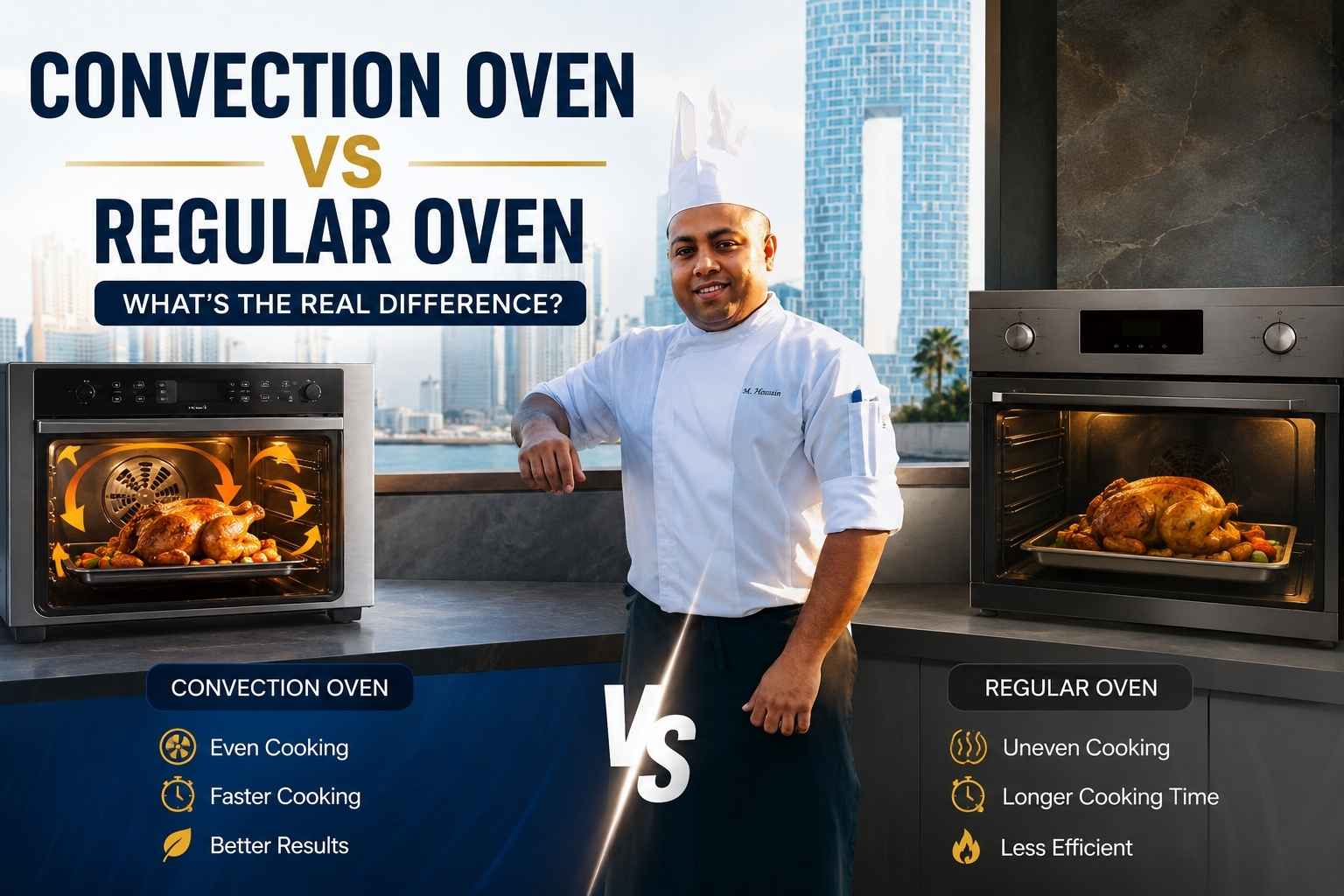
A regular oven heats your food with still, radiant heat. A convection oven adds a fan that blows that heat around. This one change affects almost everything about how your food cooks.
Regular Ovens Use Radiant and Static Heat
In a regular oven, heat comes from elements at the top and bottom. The air near those elements gets hot. Then it slowly rises and spreads.
This creates hot spots. The back of the oven is often hotter than the front. The top shelf is often hotter than the bottom shelf. Cooks have known this for years (King Arthur Baking, 2024).
Food in a regular oven cooks mostly through radiant heat. That’s heat that travels in waves, like sun on your skin. It also cooks through slow air movement, called natural convection. But that movement is weak.
Convection Ovens Add Forced Air
A convection oven has a fan, usually at the back. The fan pulls in hot air and pushes it across your food. Some ovens also have a third heating element near the fan. This is called true convection.
Moving air carries heat to your food much faster than still air. Think of the difference between standing in still air on a hot day versus standing in front of a fan blowing hot air. The fan feels hotter, faster.
This is why convection ovens cook food faster. The moving air strips away the thin layer of cool air that sits on your food’s surface. That layer normally slows down cooking (Serious Eats, 2023).
The Fan Effect: What Moving Air Does to Your Food
The fan in a convection oven does three things at once. It speeds up cooking, it dries the surface of your food, and it browns food faster. Knowing this helps you decide when to use the fan and when to skip it.
Faster cooking happens because moving air transfers heat better than still air. Many recipes finish 25% faster in convection (Consumer Reports, 2023).
Surface drying happens because the fan blows away moisture as it leaves your food. This is great for crispy chicken skin. It’s not great for a moist cake.
Faster browning happens for the same reason fries get crispy in a deep fryer. Dry heat plus moving air equals a golden crust, faster than still heat alone.
Here’s the trade-off in plain terms: convection is a feature when you want crisp, browned, or dry results. It’s a flaw when you want soft, moist, or delicate results. Once you see it this way, the rest of this guide will make sense fast.
The 25°F Rule: How to Convert Any Recipe for Convection
Most ovens follow the same basic rule. Drop the temperature by 25°F when you switch from a regular bake to convection. Or, keep the same temperature and check your food about 25% earlier (Taylor Precision Products, 2024).
This rule exists because convection cooks food faster at the same temperature. Lowering the heat slightly brings the cook time closer to normal, while still getting the faster browning convection gives you.
You don’t always need this rule. Many ovens with a “Convection Bake” setting already adjust the temperature for you. Check your oven’s manual first. If it auto-adjusts, don’t subtract again, or your food will undercook.
Quick Temperature Conversion Table
| Regular Oven Temp | Convection Oven Temp (minus 25°F) |
|---|---|
| 325°F | 300°F |
| 350°F | 325°F |
| 375°F | 350°F |
| 400°F | 375°F |
| 425°F | 400°F |
| 450°F | 425°F |
| 475°F | 450°F |
| 500°F | 475°F |
For roasts and vegetables, I lean on this table almost every time. For baked goods, I often skip it and just lower the time instead. More on that below.
Convection vs Regular Oven: Side-by-Side Comparison
Both ovens can cook a full meal. But they get there in different ways, and that changes how you should plan your cook times, racks, and pans.
| Factor | Regular Oven | Convection Oven |
|---|---|---|
| Heat distribution | Uneven; hot spots near elements | Even; fan spreads heat across racks |
| Preheat speed | Slower, around 10-15 minutes | Faster, often 5-10 minutes |
| Moisture retention | Higher; air stays still | Lower; fan pulls moisture from food |
| Best uses | Cakes, custards, soufflés, breads | Roasts, veggies, cookies, pizza, fries |
| Temperature adjustment | None needed | Lower by 25°F or cut time by 25% |
| Energy use | Slightly higher per dish (longer cook) | Slightly lower per dish (shorter cook) |
If you remember one row from this table, make it “moisture retention.” That single difference explains most of what follows in this article.
How Each Oven Handles Different Foods
Not every dish reacts to a fan the same way. Some foods love convection. Some foods fight it. Here’s how I treat each category in my own kitchen.
Roasted Meats and Vegetables
Convection wins here, almost every time. The fan dries the surface of meat and vegetables, which gives you better browning and crispier skin.
For a whole chicken, convection at 375°F (down from 400°F) gives you crisp skin and juicy meat in less time. For roasted vegetables like carrots or potatoes, the fan stops them from turning soggy, since it carries away the steam they release as they cook.
One note: tent your meat with foil if it starts browning too fast before the inside is done. The fan can brown the outside before the center catches up.
Baked Goods: Cookies, Cakes, Bread, and Pastries
This is where convection gets tricky. Cookies and pastries often do well with convection, but cakes and quick breads can suffer.
Cookies bake more evenly with convection, especially if you’re using two trays at once. The fan keeps both trays at a similar temperature, so you don’t get one burnt tray and one pale tray (King Arthur Baking, 2023).
Cakes can dry out or develop a tough crust if the fan blows directly on the batter before it sets. Many bakers turn convection off for cakes, custards, and cheesecakes, or use a very low fan setting if their oven offers one.
Bread is a mixed bag. The fan helps create a crisp crust, which many bread bakers want. But it can also dry the crumb if you don’t manage steam. More on that in the FAQ.
Pastries like croissants and puff pastry love convection. The fast, even heat helps the layers puff and brown without going soggy in the middle.
Pizza
Convection is close to a must-have for home pizza. A regular oven often leaves the top of a pizza pale while the bottom either burns or stays soft.
The fan in a convection oven gives you a crisper crust and better browning on the cheese and toppings, closer to what a pizza oven does with very high, moving heat (Serious Eats, 2024).
If your crust still seems pale on top, try moving the pizza to a higher rack and turning on the broiler for the last minute or two.
Casseroles and Braises
Regular ovens are often the better choice here. Casseroles and braises rely on slow, even heat and trapped moisture to break down tough cuts of meat and blend flavors.
If you use convection for a covered braise, the fan barely touches the food anyway, since the lid blocks the airflow. So there’s little benefit, and you risk drying out anything left uncovered, like a casserole topping.
For an uncovered casserole topping that you want crisp, like a gratin, a short blast of convection at the end can help. But for the main cook, I stick with regular heat.
Dehydrating and Low-and-Slow Cooking
Convection is the clear winner for dehydrating. Drying fruit, jerky, or herbs depends on moving air pulling moisture away steadily, at a low temperature, over a long time.
A regular oven can dehydrate too, but it takes longer and dries unevenly, since the air near the food barely moves.
For low-and-slow cooking, like a pulled pork shoulder at 225°F, either oven works. But convection can speed things up slightly and give you a better bark, or crust, on the outside of the meat.
Standard Convection vs True (European) Convection
Standard convection adds a fan to a normal oven. The fan moves air that’s still heated by the regular top and bottom elements.
True convection, also called European convection, adds a third heating element right behind the fan. This means the air being moved is heated right at the fan, not just recycled from the main oven cavity.
Why does this matter? True convection gives more even heat across all racks, since the air is reheated as it circulates. Standard convection is better than no fan at all, but it can still have mild hot spots, especially on lower racks (Consumer Reports, 2024).
How to Tell Which One You Have
Check your oven’s control panel and manual. If you see a single “Convection” or “Convect” button with no mention of a third element, you likely have standard convection.
If your manual specifically lists a rear heating element, or uses the term “True Convection” or “European Convection,” you have the upgraded version. Many higher-end ranges from the last five years include this as standard.
If you’re not sure, open the back panel area (with the oven off and cool) and look for a heating coil near the fan. A coil there usually means true convection.
Gas vs Electric: Does It Change the Convection Story?
Yes, but mostly around moisture, not speed. Gas ovens release a small amount of water vapor as a byproduct of burning gas. Electric ovens don’t.
This means a gas oven tends to run slightly more humid than an electric one, even before you add convection. For baked goods, that extra moisture can help breads and pastries from drying out too fast.
When you add convection to a gas oven, the fan still strips moisture from food, but the oven’s base humidity offsets some of that. Electric convection ovens, especially true convection models, tend to run drier overall, which is great for crisping but can be rough on delicate bakes if you’re not careful (Taylor Precision Products, 2023).
Heat consistency is usually better with electric ovens in general, gas or no gas, since electric heating elements hold a steadier temperature than a gas flame cycling on and off.
When I Use Convection (and When I Switch It Off)
I built this into a simple rule for my own kitchen. If I want a crisp, browned, or dry result, I turn convection on. If I want soft, moist, or delicate, I turn it off.
I turn convection ON for:
- Roasted vegetables, chicken, and other meats
- Cookies, especially multiple trays
- Pizza
- Fries, wings, and anything I want crispy
- Dehydrating fruit or making jerky
- Reheating leftovers, since it brings back crispness
I turn convection OFF for:
- Cakes, cupcakes, and cheesecakes
- Custards, flans, and bread puddings
- Soufflés
- Covered braises and stews
- Delicate fish that can dry out fast
This isn’t a hard rule. If a cake recipe calls for convection and gives you adjusted times, follow the recipe. But when in doubt, this list is where I start.
Common Mistakes When Switching Between Modes
I’ve made every one of these mistakes myself, usually during a busy dinner service. Here’s what to watch for.
Mistake 1: Overcrowding the Oven
Convection only works if air can move around your food. If your trays are packed edge to edge, or your pans touch the oven walls, the fan can’t do its job. Leave at least an inch of space around each pan, and on each side.
Mistake 2: Using the Wrong Rack Position
In a regular oven, rack position matters a lot, since heat comes from the top and bottom. In convection, rack position matters less, but it’s not zero. For true convection, the middle rack is usually safe for most foods. For standard convection, avoid the very bottom rack if you can, since it’s still closer to the main heating element.
Mistake 3: Ignoring Hot Spots
Even convection ovens can have a hot spot, often near the fan itself. If you notice one side of your tray browning faster, rotate the pan halfway through cooking. This takes ten seconds and saves a lot of uneven cookies.
Mistake 4: Not Adjusting Time or Temperature
This is the big one. If you switch from regular to convection and use the exact same time and temperature, you’ll likely overcook or over-brown your food. Always apply the 25°F rule, or start checking your food about five minutes earlier than the recipe says.
Mistake 5: Using Convection for Everything
Convection is a tool, not an upgrade for every dish. Using it on a delicate custard or a soufflé just because “it’s the better setting” will give you a dry top and a sunken center. Match the mode to the food, not the other way around.
My Own Routine: How I Actually Use Both Modes
After 15 years in professional kitchens and just as long cooking at home, my routine is pretty simple. Sheet pan dinners, roasted vegetables, and anything I want crispy go in on convection. Cakes, custards, and slow braises go in on regular bake.
Here’s a story that taught me this the hard way. Early in my career, I was working a holiday dinner service and had a dozen cheesecakes going into a convection oven, because it was the only oven free. I didn’t adjust anything. Every single cheesecake cracked across the top and dried out at the edges.
The fan had pulled moisture out of the batter before it could set properly in the center. I switched the rest of the batch to a regular oven, dropped the temperature slightly, and added a pan of water on the rack below for extra steam. The next batch came out smooth and even.
That one mistake changed how I think about ovens for good. Now, before I bake anything, I ask myself one question: does this food want moisture, or does it want to lose moisture? The answer tells me which oven mode to use, every time.
Frequently Asked Questions : Convection Oven vs Regular Oven
Can I convert any recipe for convection?
Most recipes can be converted using the 25°F rule: lower the temperature by 25°F, or keep the temperature the same and check the food about 25% earlier. Delicate bakes like soufflés and custards are the main exception, since they often do better without the fan at all.
Does convection dry out food?
Yes, it can. The fan pulls moisture away from the surface of food, which is great for crisping but can dry out delicate items like cakes, custards, and some fish. Covering food, using a water pan, or simply turning the fan off solves most of these issues.
Is convection worth it for baking bread?
It depends on what you want. Convection can give bread a crisper crust and more even browning, which many home bakers like. But it can also dry the crust before the crumb finishes rising and baking. A common fix is to start the bake without convection, then turn the fan on for the last 10-15 minutes for color.
What about convection microwave combos?
Convection microwave combos use microwave energy to cook food quickly from the inside, plus a fan and heating element to brown the outside. They’re useful for small kitchens or quick meals, but they rarely match the even heat of a full-size convection oven for larger dishes like a whole roast (Consumer Reports, 2023).
Does convection save energy?
Often, yes, but the savings are small. Because convection cooks food faster, often by about 25%, the oven runs for less total time, which uses less energy per dish (Consumer Reports, 2023). The fan itself uses a small amount of extra power, but the shorter cook time usually wins out.
Why does my food brown unevenly even with convection on?
This usually points to overcrowding, a hot spot near the fan, or a standard convection oven with mild temperature differences between racks. Try spacing out your pans, rotating trays halfway through, and checking if your oven has true convection with a third heating element.
Do I need to preheat a convection oven longer than a regular oven?
No, usually shorter. Convection ovens often preheat faster because the fan helps the air reach the set temperature more evenly and quickly. Most convection ovens are ready in 5-10 minutes, compared to 10-15 minutes for many regular ovens (USDA, 2023).
Should I buy a convection oven if I mostly bake cakes and breads?
If cakes and delicate bakes are most of what you cook, a regular oven, or a convection oven with the fan turned off, will serve you well. That said, most modern convection ovens let you switch the fan off entirely, so you get the best of both in one appliance. Look for a model with true convection if you want the option for crisp roasts and pizzas too.
Key Takeaways
- A regular oven uses still, radiant heat. A convection oven adds a fan that moves hot air, cooking food faster and browning it more.
- Apply the 25°F rule when converting a recipe to convection, unless your oven already adjusts the temperature for you.
- Convection is best for roasted meats, vegetables, cookies, pizza, and anything you want crispy. Regular bake is best for cakes, custards, and soufflés.
- True convection, with its own heating element, gives more even results than standard convection across all racks.
- Avoid overcrowding, watch for hot spots, and always adjust your time or temperature when switching modes.

I’m Mossaraof, a trained chef and the founder of OvenInsights.com. I spent years cooking at Larrupin’ Cafe and in kitchens across Chicago and Seattle. Now I test kitchen gear for a living. I moved to North Acton, London, and I test every tool I write about. I use real meals and real heat. No brand deals. No shortcuts. I cover 12 kitchen types and hundreds of recipes. I believe this: the right tools matter as much as the recipe.