
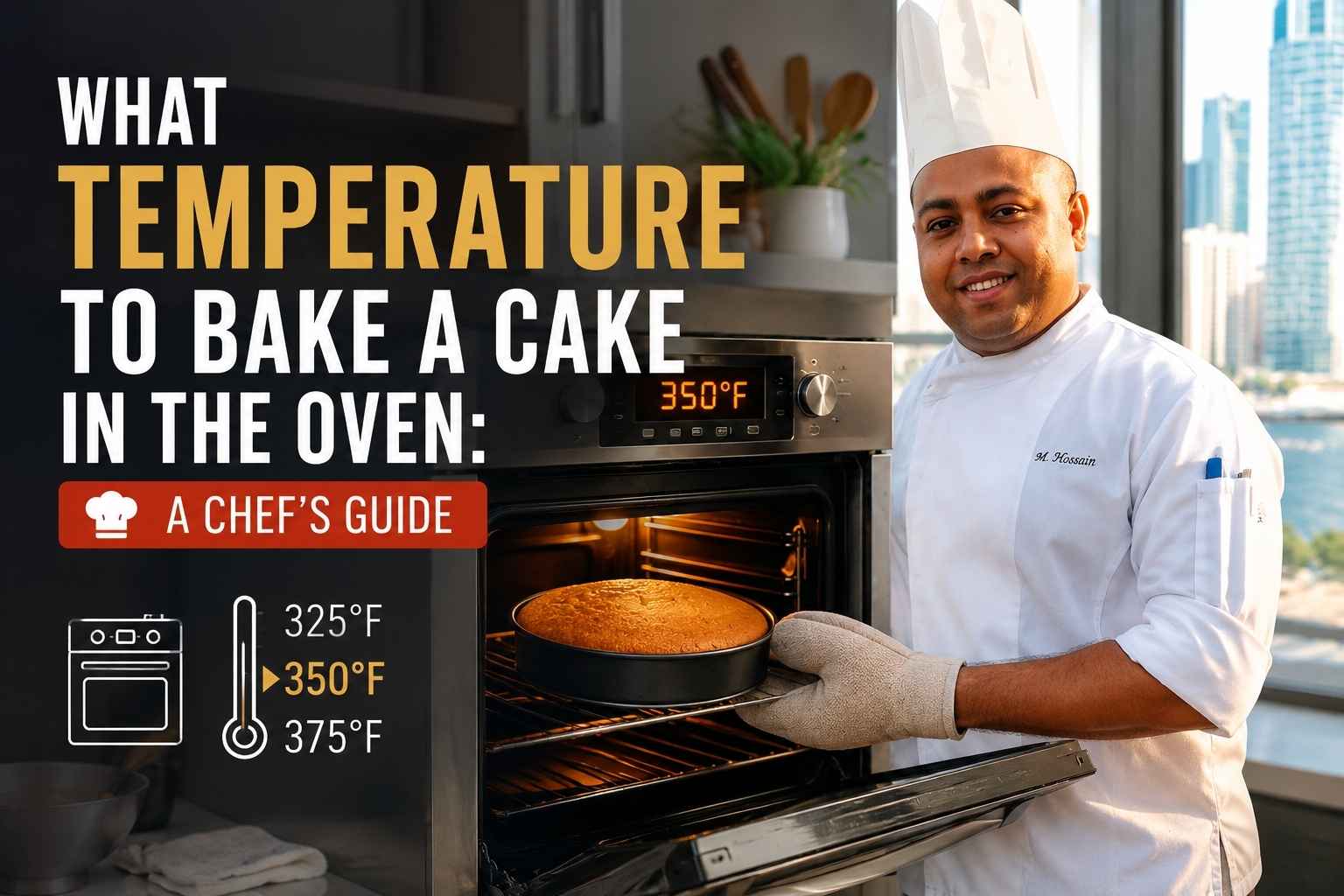
I burned three cakes before I figured this out. Each one came out either raw in the middle or dry as cardboard, and I almost gave up on baking for good. The fix was simpler than I thought: knowing what temperature to bake a cake in the oven changes everything. After years in professional kitchens, I’ve tested this on every oven type out there, from old gas ranges to fancy convection models. Stick with me, and you’ll never guess wrong on oven temp again.
At A Glance
- Most cakes bake best between 325°F and 350°F (163°C–177°C) — lower for dense or delicate cakes, higher for thin sheet cakes and some sponges.
- Your oven’s dial lies. A calibrated oven thermometer is the single most useful tool a home baker can own (Taylor Precision Products, 2024).
- Convection ovens run hotter — reduce your recipe temperature by 25°F or cut bake time by 15–20% when using the convection setting.
- Gas ovens produce more moisture and uneven heat; electric ovens brown more evenly but run drier. Both require different adjustments.
- The right temperature isn’t just about doneness — it controls rise, structure, crumb texture, and crust color all at once.
Why Oven Temperature Controls Everything in Cake Baking
Baking a cake is a chemistry experiment, and oven temperature is the variable that determines whether the experiment succeeds or blows up in your face.
Here’s what’s actually happening inside your batter during the first ten minutes in the oven:
Leavening activation starts immediately. Baking powder releases its first CO2 burst when it hits heat above 120°F. That gas needs to be captured by a developing gluten or starch network before it escapes. If your oven is too hot, the outside sets before the interior can rise — you get a domed, cracked top and a dense center.
Egg proteins coagulate between 140°F and 165°F. Too low a temperature means they take too long to set, and the cake stays wet in the middle. Too high, and they tighten fast, squeezing out moisture and producing a rubbery crumb (King Arthur Baking, 2023).
The Maillard reaction — the browning that gives your cake color and flavor — kicks in above 300°F on the surface. A cake baked at 300°F will be pale and soft-crusted. The same cake at 375°F will brown fast, sometimes before the center is done.
These three processes have to happen in the right order, at the right pace. Temperature is what controls the pace.
The Standard 325°F–350°F Range: When to Use Each
The 325°F–350°F range covers the majority of cake recipes because it allows all three chemical processes — leavening, protein set, and browning — to happen in sync.
350°F (177°C) is the default for most layer cakes, birthday cakes, and carrot cakes. At this temperature, a standard 9-inch round cake takes 28–35 minutes. The crumb stays tender, the top browns evenly, and the structure sets before the CO2 escapes. America’s Test Kitchen recommends 350°F for most butter-based layer cakes because it balances rise speed with structural development (America’s Test Kitchen, 2022).
325°F (163°C) is better when you want a flatter top (easier to stack and frost), a finer crumb, or when your batter is particularly dense. I use 325°F for any cake I’m planning to torte into multiple layers — lower heat means slower, more even rise, so I get a flatter surface with less dome to level off.
The difference between these two temperatures is subtle in a properly calibrated oven. In an oven that runs hot — which most home ovens do by 15°F–25°F — choosing 325°F when the recipe says 350°F can actually get you closer to the intended result (Serious Eats, 2023).
Cake Baking Temperature Reference Table
| Cake Type | Temperature | Bake Time | Notes |
|---|---|---|---|
| Standard layer cake (9-inch round) | 350°F / 177°C | 28–35 min | Check at 28 min with a toothpick |
| Pound cake (loaf pan) | 325°F / 163°C | 60–75 min | Low temp prevents crust from hardening before center sets |
| Sheet cake (9×13-inch) | 350°F–375°F / 177°C–190°C | 25–30 min | Thin batter bakes fast; higher temp ensures even browning |
| Bundt cake | 325°F / 163°C | 50–65 min | Dark pan absorbs heat — use 325°F even if recipe says 350°F |
| Cheesecake | 300°F–325°F / 149°C–163°C | 55–70 min | Water bath recommended; low temp prevents cracking |
| Angel food cake | 350°F / 177°C | 35–45 min | Do NOT grease pan; ungreased sides help cake climb |
| Sponge cake (génoise) | 350°F–375°F / 177°C–190°C | 20–25 min | High heat gives lift fast; thin batter needs it |
| Cupcakes | 350°F / 177°C | 18–22 min | Same batter as layer cake, shorter time due to smaller mass |
| Chiffon cake | 325°F / 163°C | 55–65 min | Tube pan; low temp lets foam structure set slowly |
| Lava cake (individual) | 425°F / 218°C | 10–13 min | High heat sets edges while center stays molten |
Higher Temperatures: When Going Above 375°F Makes Sense
Some cakes actually need higher heat to perform correctly.
Sheet cakes have a thin profile — sometimes under an inch of batter in a 9×13 pan. At 350°F, they bake fine, but at 375°F, you get faster Maillard browning on the surface while the interior still has enough time to set. The result is a better crust-to-crumb contrast and a moister center, because the cake is done before moisture has time to evaporate out.
Génoise and other foam-based sponges also benefit from a hotter oven. These cakes rely on whipped egg structure for their rise — there’s no chemical leavening. Getting them into a 375°F oven fast means the egg foam sets before it deflates. I’ve seen home bakers ruin a génoise by opening a 325°F oven and watching the whole thing sink in real time.
Lava cakes are the extreme case. At 425°F, a small ramekin of chocolate batter sets around the edges in 12 minutes while the center stays completely liquid. Drop to 375°F and you get a fully cooked cake with a slightly soft center — not what you’re after.
Lower Temperatures: When Slow and Steady Wins
Dense, rich, or egg-heavy cakes need time for their structure to develop without the outside browning too fast.
Pound cake is the clearest example. A classic pound cake — equal parts flour, butter, sugar, and eggs — is dense enough that the center takes 60–75 minutes to reach 210°F internally. If you bake it at 350°F, the crust will be thick and dark before the interior is done. At 325°F, you get a thin, golden crust and a moist, tight crumb all the way through.
Cheesecake is in a different category entirely. Technically a custard, it should never be baked above 325°F and benefits from a water bath that keeps oven humidity high. Above 325°F, the egg proteins in the cream cheese filling contract too fast, forcing moisture out and creating cracks. I bake cheesecakes at 300°F with a water bath, then turn off the oven and leave the door cracked for an hour. Zero cracks, every time (Serious Eats, 2022).
Bundt cakes in dark, heavy pans also need the lower end of the range. Dark metal absorbs more radiant heat than light aluminum. A recipe written for a standard 9-inch round at 350°F may need to drop to 325°F in a dark Bundt pan to avoid an overdone exterior.
Gas vs. Electric Ovens: What Changes for Cake Baking
Your oven type changes how a cake bakes in two ways: moisture and heat distribution.
Gas ovens burn natural gas or propane, and combustion produces water vapor as a byproduct. That moisture stays in the oven cavity, which is actually useful for cakes — it slows surface drying and keeps the crumb tender. The downside: gas ovens have a burner at the bottom, which creates hot spots near the floor and cooler zones near the top. Always bake cakes on the center rack in a gas oven, and rotate the pan halfway through.
Electric ovens heat with coils — typically top and bottom — and produce a drier heat. The drier environment can create a slightly thicker, crispier crust on cakes, which is ideal for pound cakes but can dry out a delicate sponge. Electric ovens also tend to have more even heat distribution than gas, so you can often skip the mid-bake rotation (King Arthur Baking, 2024).
Electric ovens also run hot more often than gas. In my experience across dozens of professional and home kitchens, electric ovens are more likely to run 15°F–25°F above their set temperature. Always verify with a thermometer before trusting the dial.
Convection vs. Conventional Baking: The Right Setting for Cakes
Convection uses a fan to circulate hot air. That speeds up heat transfer and removes the cool, moist air layer that forms around food in a still oven.
For cakes, convection has trade-offs. The increased airflow can cause the top of a cake to set and brown before the interior is fully risen — you end up with a flat, dense cake with a dark crust. For tall layer cakes and any cake with a high sugar content (sugar browns fast), I recommend conventional mode at the recipe temperature.
If you use convection anyway, follow these two rules:
- Reduce temperature by 25°F — so a 350°F recipe becomes 325°F in convection mode.
- Reduce bake time by 15–20% — check a 30-minute cake at the 24-minute mark.
Convection works well for sheet cakes and cheesecakes where you want faster, more even browning or faster moisture evaporation off the surface. For anything in a high-sided pan where rise matters, stick to conventional (America’s Test Kitchen, 2023).
Pan placement in convection mode: use the center rack. The fan distributes air evenly enough that rack position matters less than in conventional, but the center still gets the most balanced airflow.
How to Use an Oven Thermometer Correctly
An oven thermometer is the single most impactful tool in cake baking. Your oven’s built-in thermostat is a dial connected to a sensor that was calibrated at the factory — years ago, before the heating element cycled on and off thousands of times.
According to Taylor Precision Products, residential oven temperature can drift 25°F–50°F from the set temperature after just one to two years of regular use (Taylor Precision Products, 2024). That drift is the reason your cakes dome, crack, underbake, or brown too fast — not your recipe.
How to check your oven’s true temperature:
- Place an oven thermometer in the center of the middle rack.
- Set the oven to 350°F and let it preheat for at least 20 minutes — not 10. Most ovens need 15–20 minutes to fully stabilize after the preheat signal.
- Read the thermometer without opening the door if possible. Do this three times over 30 minutes and average the readings.
- Note the difference between your dial setting and the actual temperature. If your oven reads 375°F when set to 350°F, compensate by setting it to 325°F.
How to find hot spots:
Place a layer of white sandwich bread across the entire oven rack. Bake at 375°F for 5 minutes. The darker pieces of toast show your hot spots. Rotate your pans away from those zones, or compensate by rotating mid-bake.
Why Recipe Temperatures Don’t Always Work for Your Oven
A recipe is written by a baker in a specific kitchen, with a specific oven, at a specific altitude. When that recipe reaches you, it has none of that context — just a number.
Three situations where the recipe temperature needs adjustment:
Dark or glass bakeware: Dark metal and glass both absorb more heat than light aluminum. Drop the temperature by 25°F when using dark or glass pans and add 5 minutes to the bake time. Glass also holds heat longer after you remove the cake, which can continue cooking the bottom.
High altitude (above 3,500 feet): At altitude, water boils at a lower temperature and leavening gases expand faster. Cakes rise too quickly, then collapse. Raise the oven temperature by 15°F–25°F to help the structure set before the gas escapes. Also reduce baking powder by 1/4 teaspoon per teaspoon called for (King Arthur Baking, 2023).
Older or commercial recipes: Recipes published before 2000 often assumed ovens ran slightly cooler than modern ones. Some mid-century recipes calling for 375°F may actually perform better at 350°F in a current electric oven.
Common Cake-Baking Temperature Mistakes and How to Fix Them
Mistake 1: Skipping the full preheat
The oven beeps and you slide the cake in. The problem: that beep signals the oven hit the target temperature, not that the oven is stable at that temperature. Internal oven air can cycle 20°F–30°F above and below the set point. Give it 15–20 minutes after the beep.
Fix: Set a timer for 20 minutes after preheat, then put the cake in.
Mistake 2: Baking at a high altitude without adjusting temperature
At 5,000 feet above sea level, atmospheric pressure is low enough that CO2 expands 25–30% faster than at sea level. Your cake rises fast, the structure sets before the crumb can support it, and the top collapses.
Fix: Increase oven temperature by 15°F–25°F. At 7,000 feet or above, increase by 25°F and reduce baking powder by 1/4 tsp per tsp (King Arthur Baking, 2023).
Mistake 3: Trusting a dark Bundt pan at the recipe temperature
Dark pans accelerate surface browning. A Bundt cake that calls for 350°F in a light aluminum pan will over-brown on the outside in a dark or nonstick Bundt before the interior sets.
Fix: Drop to 325°F and add 5–10 minutes to the bake time. Check doneness with a skewer through the thickest part.
Mistake 4: Using convection mode without adjusting
Every week in my cooking classes, someone shows up with a flat, dense cake and says “I used convection because it seemed faster.” It is faster — that’s the problem.
Fix: Either switch to conventional mode, or drop the temperature 25°F and check for doneness 15–20% earlier than the recipe states.
Mistake 5: Opening the oven door in the first 20 minutes
Opening the door drops oven temperature by 25°F–50°F immediately. During the first 20 minutes, the leavening is active and the batter is still liquid. That temperature drop stops the rise mid-bake.
Fix: Use the oven light. If you must check, do it no earlier than the 75% mark of the stated bake time.
My Pre-Bake Oven Setup Routine
After 15 years in professional kitchens, here is exactly what I do before putting any cake in the oven. No shortcuts.
30 minutes before baking: I turn on the oven. Not 20 minutes — 30. The oven may signal ready at 15 minutes, but the walls, racks, and air take longer to reach a stable temperature. A cold oven interior is the number-one reason cakes bake unevenly.
While the oven heats: I hang my oven thermometer from the center rack. I don’t trust the display. I verify.
I remove extra racks: Unless I’m baking multiple layers, I take out every rack except the center one. Racks above or below the cake disrupt airflow and create hot zones.
I set my pan in the center of the rack: Not pushed to the back, not against the side wall. Dead center, where heat is most even.
I check the thermometer one last time before I put the cake in. If the reading isn’t within 5°F of my target, I wait.
I set two timers: One for the minimum bake time. One for the maximum. I don’t open the door until the minimum timer goes off.
This routine adds about five minutes to the process. It also adds about 30% fewer failed cakes — based on nothing scientific, just 15 years of counting.
Frequently Asked Questions About Baking Cake Temperature
What is the best temperature to bake a cake?
Most cakes bake best between 325°F and 350°F (163°C–177°C). Standard layer cakes use 350°F for a balance of rise, set, and browning. Dense cakes like pound cake or cheesecake use 300°F–325°F so the exterior doesn’t overcook before the center is done.
How do I know if my oven temperature is accurate?
Use a standalone oven thermometer placed on the center rack. Preheat to 350°F, wait 20 minutes after the preheat signal, and read the thermometer. If it reads more than 10°F off from your dial setting, adjust your dial accordingly every time you bake. Taylor Precision Products recommends rechecking calibration at least twice a year (Taylor Precision Products, 2024).
Can I bake a cake at 375°F instead of 350°F?
Yes, for certain cakes. Sheet cakes, sponge cakes, and lava cakes do well at 375°F. For standard layer cakes, 375°F will brown the outside too fast before the center sets, producing a domed, cracked top and a denser crumb. Stay at 350°F for most layer cakes.
What happens if I bake a cake at too low a temperature?
The cake will take longer to set, which means more time for moisture to evaporate and leavening gas to escape before the structure is firm. You’ll likely end up with a pale, flat cake with a doughy or dense center. Cheesecakes and pound cakes are intentional exceptions to this.
Does oven temperature affect how moist a cake turns out?
Yes. Higher temperatures accelerate moisture evaporation from the batter. A cake baked at 375°F for 20 minutes can lose more moisture than the same cake at 325°F for 30 minutes, even at the same internal doneness temperature. Lower heat, longer bake = more moisture retention, especially in dense batters.
How do I adjust baking temperature when using a glass pan?
Drop the oven temperature by 25°F when using a glass baking dish. Glass heats more slowly than metal but holds heat longer, which can overcook the bottom and sides after you remove the cake. Also extend the bake time by 5 minutes and check the center with a toothpick or digital probe.
What internal temperature should a cake be when it’s done?
Most fully baked cakes reach an internal temperature of 200°F–210°F (93°C–99°C) at the center. A digital instant-read thermometer is more reliable than a toothpick for dense cakes like pound cake or carrot cake. For cheesecake, pull it at 150°F — it will continue to set as it cools (America’s Test Kitchen, 2022).
Do I need to adjust baking temperature for high altitude?
Yes. At altitudes above 3,500 feet, raise the oven temperature by 15°F–25°F to help the cake structure set before the leavening gases expand too fast and collapse the crumb. Also reduce baking powder slightly — by about 1/4 teaspoon per teaspoon in the recipe (King Arthur Baking, 2023).
Key Takeaways
- 350°F is the default for most layer cakes, cupcakes, and carrot cakes — but it’s a starting point, not a fixed rule.
- 325°F works better for dense cakes like pound cake, chiffon, and Bundt cakes in dark pans.
- 300°F–325°F is the range for cheesecake — slow heat prevents cracking.
- 375°F+ is correct for sheet cakes, génoise sponges, and lava cakes.
- Verify your oven’s actual temperature with a standalone thermometer before every bake.
- Gas ovens run moister; electric ovens run drier — both affect crumb texture and crust color.
- Convection baking requires a 25°F temperature drop and 15–20% less time.
- High altitude bakers need to raise temperature 15°F–25°F and reduce leavening slightly.
- Dark pans and glass pans need a 25°F temperature reduction from the recipe’s stated setting.
- Preheat for at least 20 minutes after the oven signals ready — the beep is not calibration confirmation.

I’m Mossaraof, a trained chef and the founder of OvenInsights.com. I spent years cooking at Larrupin’ Cafe and in kitchens across Chicago and Seattle. Now I test kitchen gear for a living. I moved to North Acton, London, and I test every tool I write about. I use real meals and real heat. No brand deals. No shortcuts. I cover 12 kitchen types and hundreds of recipes. I believe this: the right tools matter as much as the recipe.