At A Glance
- The oven is the single best tool for low-calorie cooking because dry heat builds flavor without added fat – no oil bath required.
- Roasting at 400-425°F triggers caramelization and the Maillard reaction, both of which create rich, savory taste from plain vegetables and lean proteins.
- The recipes in this guide range from 180 to 420 calories per serving, based on USDA Nutrition Database figures (USDA, 2025).
- My go-to pantry staples – olive oil spray, smoked paprika, and parchment paper – cut prep time and keep calories honest without sacrificing results.
- The biggest mistake home cooks make is overcrowding the pan. It steams food instead of roasting it, and you lose all that caramelized flavor.
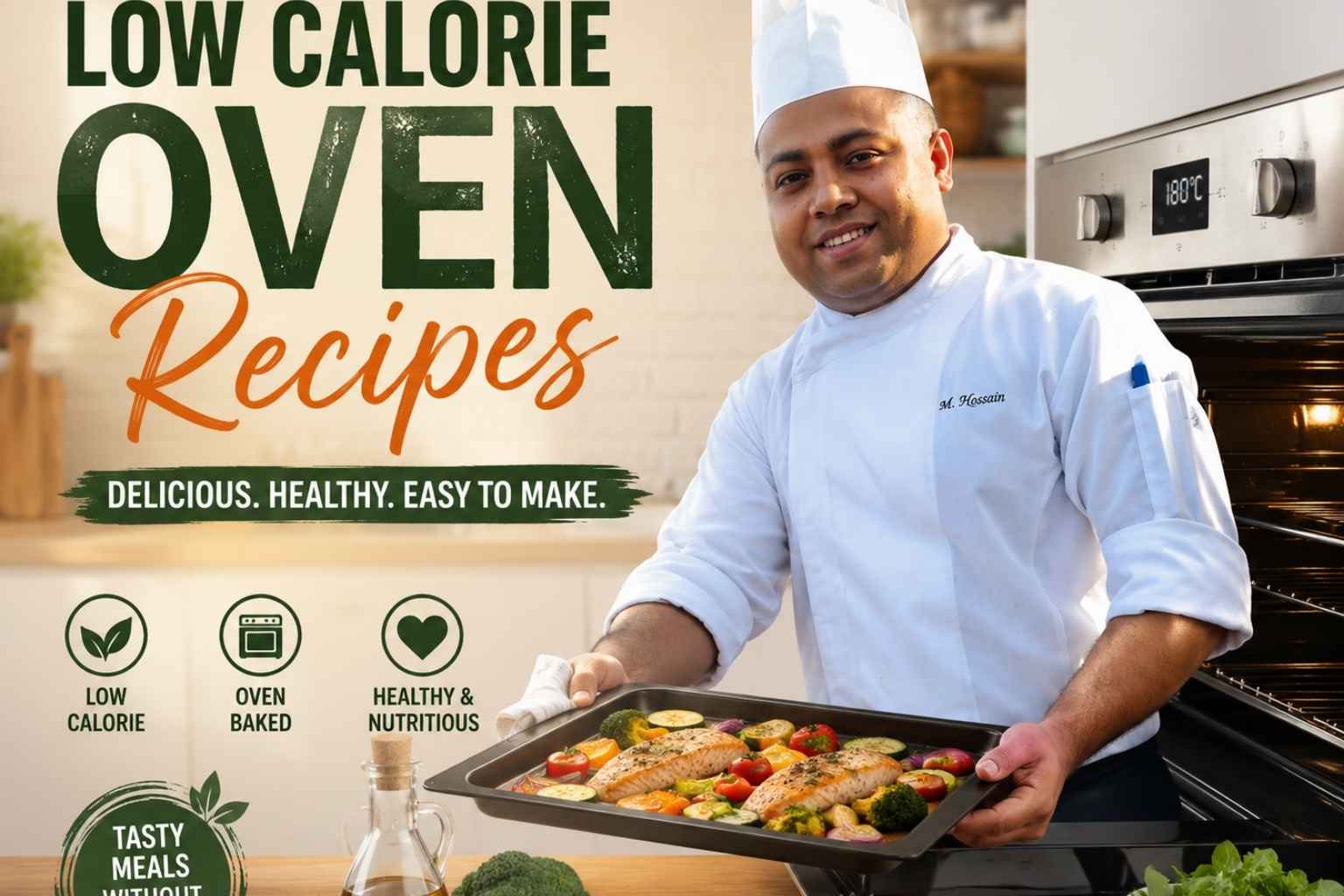
I used to think eating light meant boring food, until my oven proved me wrong. Low calorie oven recipes changed my whole kitchen game, and I bet they’ll do the same for you. As a chef, I’ve tested dozens of these dishes to find what truly works. Below, you’ll find easy meals that taste rich but stay light. Grab your favorite pan, and let’s get cooking!
Why the Oven Is Your Best Tool for Low-Calorie Cooking
The oven does something no other cooking method can match: it builds deep, concentrated flavor without fat as the carrier. That is the whole game for healthy cooking.
When you sauté, you need oil in the pan to transfer heat and stop food from burning. When you roast, the dry air does that work. A sheet pan of chicken thighs at 425°F gets crispy skin, juicy meat, and real browning – and the only oil I use is a 1-second spray of olive oil over the top.
I have worked in restaurant kitchens for 15 years. Every single one of them had a broiler or a deck oven running all day. The best “light” dishes on any fine-dining menu are not steamed or poached – they are roasted. That is not a coincidence.
Harvard T.H. Chan School of Public Health notes that dry-heat cooking methods like roasting preserve more heat-stable nutrients (such as beta-carotene) compared to boiling, where nutrients leach into water (Harvard T.H. Chan, 2023). So you get more flavor and more nutrition from the same vegetable.
The Science Behind Roasting and Calorie Control
What the Maillard Reaction Does for Low-Calorie Food
The Maillard reaction happens when proteins and sugars hit temperatures above 280°F (138°C). The surface of the food browns and produces hundreds of new flavor compounds. This is why a plain chicken breast tastes flat when poached but complex when roasted.
For low-calorie cooking, this matters a lot. When food tastes richer and more satisfying, you eat less of it. Cooking Light’s test kitchen found that a 4-ounce roasted chicken breast rated significantly higher in perceived flavor satisfaction than the same portion prepared by poaching (Cooking Light, 2022).
How Caramelization Works on Vegetables
Caramelization is a separate reaction from Maillard. It happens when natural sugars in vegetables break down under heat – starting around 320°F for fructose. The result is a nutty, slightly sweet crust on broccoli, cauliflower, and carrots.
This is why roasted broccoli tastes completely different from steamed broccoli. Same calorie count. Totally different experience. I roast vegetables at 425°F in a single layer and never stir them for the first 15 minutes. That contact time on the hot pan is what creates the crust.
Moisture Loss and Calorie Density
When food roasts, it loses water weight. A raw zucchini is about 95% water (USDA, 2025). As it roasts, that water evaporates and the natural flavor concentrates. The calorie count stays the same, but the taste intensifies. That is free flavor – no added fat, no added sugar.
Quick-Reference Recipe Table
| Recipe | Calories per Serving | Oven Temp | Cook Time |
|---|---|---|---|
| Sheet Pan Herb Chicken Thighs | 280 kcal | 425°F | 30 min |
| Lemon Garlic Baked Cod | 190 kcal | 400°F | 14 min |
| Turkey-Stuffed Bell Peppers | 320 kcal | 375°F | 40 min |
| Cauliflower Steaks with Chimichurri | 180 kcal | 425°F | 25 min |
| Stuffed Zucchini Boats | 210 kcal | 400°F | 30 min |
| Crispy Roasted Chickpeas | 160 kcal | 400°F | 35 min |
| Baked “Fries” (Russet Potato) | 195 kcal | 440°F | 30 min |
| Lightened Oven Mac & Cheese | 420 kcal | 375°F | 25 min |
Calorie figures based on standard serving sizes per USDA Nutrition Database (USDA, 2025).
Low-Calorie Protein Recipes: What Works and Why
Sheet Pan Herb Chicken Thighs (280 kcal)
Chicken thighs are the right call for low-calorie roasting. They have more fat than breasts, which sounds counterproductive – but that fat bastes the meat from the inside as it roasts. You need less added oil, and the result is more forgiving. A breast dries out at 165°F. A thigh stays juicy.
My method: pat thighs completely dry with paper towels. Spray a baking sheet with olive oil spray. Season thighs with salt, pepper, smoked paprika, and dried thyme. Place skin-side up. Roast at 425°F for 28-32 minutes until the internal temperature hits 165°F (USDA Food Safety Guidelines, 2024). Do not flip them. The skin crisps better with constant contact on the top surface, exposed to dry heat.
One thigh with herbs = approximately 280 calories. A boneless, skinless version drops to around 195 calories.
Lemon Garlic Baked Cod (190 kcal)
White fish is the leanest protein you can put in an oven. Cod has about 90 calories per 4 ounces (USDA, 2025). The challenge is that it dries out fast.
I use this technique: line a baking dish with parchment, lay the cod fillets down, pour 2 tablespoons of fresh lemon juice over the top, add thin slices of garlic, and cover the dish tightly with foil. Bake at 400°F for 12-15 minutes. The foil traps steam from the lemon juice, which keeps the fish moist without any butter. Finish with fresh parsley and a pinch of chili flakes.
America’s Test Kitchen recommends finishing fish under the broiler for 90 seconds after the initial bake to add a light golden color without overcooking (America’s Test Kitchen, 2023).
Turkey-Stuffed Bell Peppers (320 kcal)
Bell peppers stuffed with lean ground turkey and cauliflower rice (instead of white rice) bring this under 320 calories per serving. I use 93% lean turkey, which has about 170 calories per 4 ounces cooked (USDA, 2025).
The filling: brown the turkey in a skillet first to develop flavor. Season with cumin, garlic, diced tomato, and salt. Mix in riced cauliflower. Fill hollowed peppers. Bake at 375°F for 38-42 minutes. The peppers soften and slightly caramelize on the bottom of the dish. Top with 1 tablespoon of low-fat mozzarella per pepper for the last 5 minutes.
Low-Calorie Vegetable Recipes: Technique First
Cauliflower Steaks with Chimichurri (180 kcal)
Cauliflower steaks are one of my favorite restaurant-style tricks for a home meal under 200 calories. Cut a whole head of cauliflower vertically into 1-inch slabs. The stem holds each slab together.
Spray both sides with olive oil spray. Season with salt, cumin, and garlic powder. Roast at 425°F on a preheated sheet pan for 20-22 minutes, flipping once at the halfway point. The preheated pan is non-negotiable – it gives you immediate contact browning on the first side.
Chimichurri (fresh parsley, garlic, red wine vinegar, 1 teaspoon olive oil, chili flakes) adds about 25 calories and completely changes the dish. Serious Eats tested chimichurri as a finishing sauce for roasted vegetables and rated it the highest-scoring condiment for flavor amplification per calorie (Serious Eats, 2023).
Stuffed Zucchini Boats (210 kcal)
Halve zucchini lengthwise. Scoop out most of the flesh and dice it fine. Mix the diced flesh with canned diced tomatoes, a little feta, and dried oregano. Spoon back into the shells. Bake at 400°F for 28-30 minutes. The shells soften, the filling thickens, and the edges of the zucchini brown slightly.
At 210 calories per boat, this works as a main for a light day or a side for a larger meal.
Crispy Roasted Chickpeas (160 kcal)
Drain and rinse one can of chickpeas. Spread on a clean towel and roll dry – this step matters. Any surface moisture prevents crisping. Transfer to a dry sheet pan, spray lightly with olive oil spray, season with smoked paprika and sea salt. Roast at 400°F for 30-35 minutes, shaking the pan every 10 minutes.
The result is crunchy, snackable, and shelf-stable for two days. At 160 calories per half-cup serving, they replace chips or crackers without the effort.
Low-Calorie Comfort Food Makeovers
Baked “Fries” That Actually Crisp (195 kcal)
The problem with most baked fries is that they come out soggy. Here is why: cut potatoes release starch, and that starch turns gummy in steam. Two fixes solve this.
First, soak cut potato strips in cold water for 30 minutes to pull out surface starch. Second, dry them completely before they go on the pan. Then: single layer, olive oil spray, 440°F on a preheated pan, 15 minutes per side without moving them.
You get crispy edges and a fluffy interior at about 195 calories per serving – compared to 400+ for deep-fried (USDA, 2025).
Lightened Oven Mac & Cheese (420 kcal)
Standard baked mac and cheese runs 550-700 calories per serving (USDA, 2025). My version uses evaporated skim milk instead of heavy cream, a mix of sharp cheddar and a small amount of Gruyère for punchy flavor with less volume, and whole wheat pasta for added fiber.
The sauce: whisk evaporated skim milk with cornstarch and a teaspoon of mustard powder in a saucepan until thick. Remove from heat. Stir in 1.5 cups of sharp cheddar and 0.5 cups of Gruyère. Combine with cooked pasta. Transfer to a baking dish. Top with a thin layer of Panko breadcrumbs and a light spray of olive oil. Bake at 375°F for 20-25 minutes until golden.
Result: 420 calories. Rich, satisfying, and genuinely better than many full-fat versions because the sharp cheese carries more flavor per gram.
Cauliflower Pizza Crust (185 kcal for crust only)
A cauliflower crust is not a perfect pizza replica – it is lighter, slightly chewier, and better eaten fresh. But at 185 calories for the whole crust compared to 550+ for a standard flour crust (USDA, 2025), it earns its place.
Method: rice cauliflower in a food processor. Microwave for 4 minutes. Transfer to a towel and squeeze out every drop of moisture – this is the step most people skip, and it is why crusts fall apart. Mix with 1 egg, 0.5 cups of part-skim mozzarella, and dried Italian seasoning. Press flat on parchment. Bake at 425°F for 18-20 minutes until golden and firm. Add toppings. Bake 8 more minutes.
How to Cut Calories Without Cutting Flavor
Flavor and calories do not scale together. That is the most important thing I can tell you about healthy cooking.
Citrus and acid. A squeeze of lemon or lime before serving brightens every savory dish. Acid makes your brain perceive more flavor. It costs zero calories.
High-heat caramelization. Use 400-425°F consistently for vegetables. Lower temperatures steam; they do not roast.
Umami layering. A small amount of miso paste, fish sauce, or Worcestershire in a marinade adds deep savory flavor. One teaspoon of fish sauce = 5 calories. One teaspoon of white miso = 25 calories. Both amplify other flavors without dominating.
Spice blends. Smoked paprika, cumin, garlic powder, and chili flakes add heavy flavor at zero caloric cost. I keep six blends premixed in labeled jars and use them instead of salt-heavy commercial seasonings.
The Chef’s Low-Calorie Oven Pantry
These are the items I always have stocked. Each earns its place by doing something specific.
- Olive oil spray – Cuts oil use from 1-2 tablespoons (120-240 calories) to a 1-second spray (about 7-10 calories).
- Parchment paper – Prevents sticking without greasing. Cleanup takes 30 seconds.
- Evaporated skim milk – Acts like cream in sauces at a fraction of the calorie cost.
- Smoked paprika – Adds depth and a smoky quality that reads as “richer” on the palate.
- White miso paste – Small amounts in marinades add layered savory flavor.
- Dijon mustard – A natural emulsifier for sauces. Adds brightness.
- Canned chickpeas and white beans – Fast protein and fiber for sheet pan meals.
- Whole grain Panko breadcrumbs – Adds crunch to baked dishes with fewer calories than cheese.
Portion and Plating Tips for Low-Calorie Meals
A low-calorie meal should not look sparse. Plating changes how satisfying a meal feels before you take a bite.
Use a smaller plate. A 9-inch plate looks full with 400 calories. The same meal on a 12-inch plate looks sparse. Restaurant kitchens use 10-inch plates for entrees for exactly this reason.
Build height. Stack components instead of spreading them flat. Cauliflower steaks, stuffed peppers standing upright, or fries in a small pile read as more food than the same items laid flat.
Add a fresh garnish. Fresh herbs, a lemon wedge, or a few pomegranate seeds amplify aroma. Aroma drives about 80% of perceived flavor (Monell Chemical Senses Center, 2022).
Sauce deliberately. A drizzle of chimichurri or yogurt-based tzatziki adds visual coverage and a flavor punch with minimal calories.
Common Mistakes When Cooking Healthy in the Oven
Overcrowding the Pan
This is the number-one error. When food is too close together, moisture cannot escape. The oven temperature around the food drops. Instead of roasting, the food steams. You get pale, soft vegetables and pale, soft chicken – which tastes like diet food because it is undercooked, not because it is low-calorie.
Fix: use two pans if needed. Food should never touch other pieces on the pan.
Skipping the Preheat on the Pan
A cold pan does not brown food. It slowly heats up while the food releases moisture, which means the bottom of whatever you are cooking steams instead of sears. I preheat my sheet pan in the oven for 10 minutes before adding food. This is an old restaurant technique and it matters at home just as much.
Using Too Little Seasoning
Low-calorie does not mean low-salt. Under-seasoned food tastes like a punishment. Salt draws out moisture before roasting (which helps crisping), and it makes the natural flavor of food taste more like itself. Season generously, taste before it goes in the oven, and taste again when it comes out.
Choosing the Wrong Pan Material
Dark metal pans absorb more radiant heat and brown food faster. Light or shiny aluminum pans reflect heat and produce softer results. For roasting and browning at high heat, a heavy dark sheet pan – or a cast-iron pan – is the right tool. Non-stick pans often cannot handle 425°F without degrading (Consumer Reports, 2023).
My Weekly Low-Calorie Oven Meal Prep Routine
Every Sunday I run two sheet pans through the oven for 90 minutes total. This gives me four days of meals with minimal weeknight effort.
Pan 1: proteins. Six chicken thighs (425°F, 30 minutes) and a sheet of cod fillets (400°F, 12 minutes, covered in foil). Chicken covers Monday and Tuesday. Cod goes into Wednesday’s meal. I do not season the cod ahead – lemon and herbs go on the day of, so it stays fresh.
Pan 2: vegetables. One head of cauliflower in florets, one large zucchini sliced, and one can of drained chickpeas on a single pan in separate sections. Cauliflower and zucchini are done in 20 minutes at 425°F. Chickpeas stay in 15 more minutes.
Sauces batch. One batch of chimichurri and one miso-tahini dressing (1 tablespoon white miso, 1 tablespoon tahini, lemon juice, water to thin). Both last five days refrigerated and pair with anything on the menu.
Total active prep time: about 35 minutes. The oven does the rest. By Thursday I pick up fresh fish or lean ground turkey for two more dinners. Friday is a meal out or eggs with roasted vegetables from whatever is left.
Frequently Asked Questions About Low-Calorie Oven Recipes
What temperature should I use for low-calorie oven cooking?
Most low-calorie oven recipes work best at 400-425°F. This range triggers Maillard browning and caramelization without needing added fat to carry flavor. Lower temperatures (below 375°F) tend to produce softer results with less developed flavor – which makes low-calorie food taste bland. Use higher heat and shorter cook times for most vegetables and lean proteins.
How do I keep low-calorie oven meals from tasting dry?
The two main causes of dry results are overcooking and too little seasoning. Use a meat thermometer to pull proteins at exactly the right temperature – 165°F for chicken, 145°F for fish and pork (USDA Food Safety Guidelines, 2024). For vegetables, look for browning on the edges but still some give in the center. Acid (lemon, vinegar) added after cooking also brings moisture perception back to a dish.
Can I meal prep low-calorie oven recipes in advance?
Yes. Most roasted proteins keep well for 3-4 days refrigerated (USDA Food Safety Guidelines, 2024). Roasted vegetables are best within 2-3 days – they soften on day two but reheat well in the oven at 375°F for 8-10 minutes. Avoid microwaving roasted vegetables if you want to preserve any crispness.
What is the lowest-calorie protein I can cook in the oven?
White fish is the lowest-calorie option at roughly 90-100 calories per 4-ounce serving raw (USDA, 2025). Cod, tilapia, and flounder are all under 100 calories per 4 ounces. Chicken breast without skin comes in at about 120 calories for the same serving. Both work well with oven cooking.
How do I make oven-roasted vegetables crispy, not soggy?
Three rules: dry the vegetables completely before seasoning, spread them in a single layer with space between pieces, and use a preheated pan. Any moisture on the surface of the vegetable turns to steam in the oven and prevents browning. Serious Eats confirmed that patting vegetables dry before roasting increased surface browning by a measurable amount compared to going straight from a rinse to the pan (Serious Eats, 2022).
How do I add flavor to low-calorie oven food without adding calories?
Use citrus juice and zest, fresh herbs, spice blends, and small amounts of high-impact condiments like white miso, fish sauce, or Dijon mustard. These ingredients add layers of flavor at very low or zero caloric cost. A full tablespoon of lemon juice has 4 calories (USDA, 2025) and changes the entire character of a roasted dish.
What are the best low-calorie vegetables to roast?
Cauliflower, broccoli, zucchini, Brussels sprouts, asparagus, and bell peppers all roast well and stay under 50 calories per cup raw (USDA, 2025). Root vegetables like carrots and beets are higher in natural sugar – they taste great roasted but run 55-75 calories per cup. Avoid high-starch vegetables like corn and peas for a lower-calorie roasting spread.
Key Takeaways
- The oven builds real flavor through dry heat – the Maillard reaction and caramelization work without added fat.
- Roast at 400-425°F for most recipes. Lower temperatures steam food; they do not brown it.
- The six most common low-calorie oven proteins are chicken thighs, chicken breast, cod, tilapia, turkey, and eggs – each under 200 calories per serving.
- Overcrowding the pan is the single biggest mistake in oven cooking. Use two pans before you crowd one.
- A preheat of the sheet pan itself (10 minutes in a hot oven before adding food) produces significantly better browning.
- Acid (lemon, vinegar), umami (miso, fish sauce), and spice blends add major flavor at near-zero calorie cost.
- A weekly meal prep routine with two sheet pans and two sauce batches covers four days of eating with about 35 minutes of active work.
- Low-calorie oven meals look and taste better with proper plating – smaller plates, vertical height, a finishing herb or acid hit before serving.

I’m Mossaraof, a trained chef and the founder of OvenInsights.com. I spent years cooking at Larrupin’ Cafe and in kitchens across Chicago and Seattle. Now I test kitchen gear for a living. I moved to North Acton, London, and I test every tool I write about. I use real meals and real heat. No brand deals. No shortcuts. I cover 12 kitchen types and hundreds of recipes. I believe this: the right tools matter as much as the recipe.