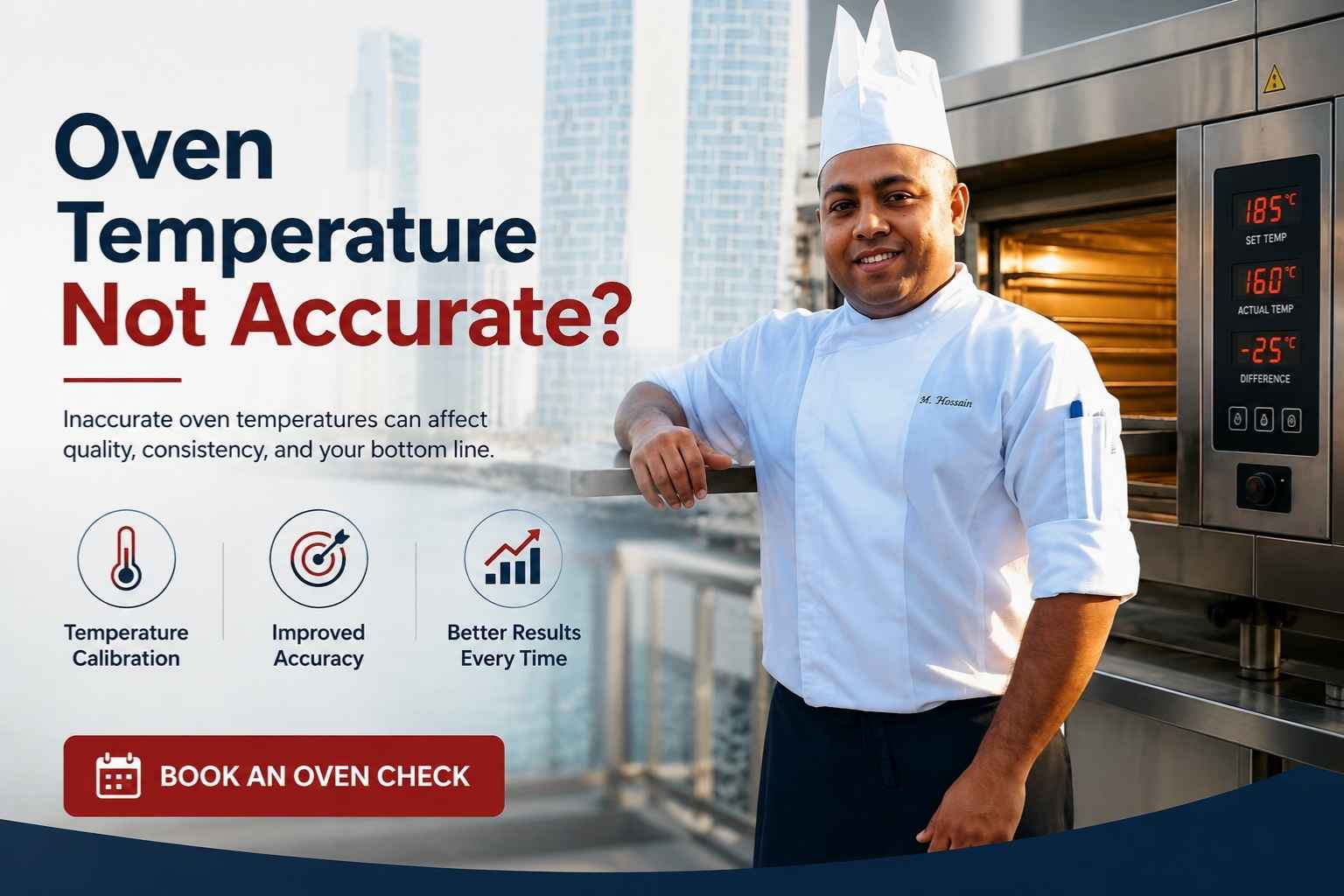
Ever bake a batch of cookies that turned out like hockey pucks? I used to blame my baking skills until I realized my oven temperature not accurate issues were the real culprit. It completely broke my trust in my kitchen, but a quick test with a cheap thermometer saved my dinner. Don’t let a bad dial ruin your hard work. Let’s fix your oven together right now!
At a Glance
- Most home ovens run 25-50°F off from the set temperature – and some run as much as 75°F off after five or more years of use (America’s Test Kitchen, 2024).
- The fastest way to find out: place a quality oven thermometer on the center rack, set your oven to 350°F, wait 20 minutes, and read the actual temperature.
- A variance of ±25°F is normal. A variance of ±50°F or more means you need to recalibrate or call a technician.
- Most modern ovens (GE, Whirlpool, Samsung, LG, Frigidaire) have a built-in calibration offset in their settings menu – no tools needed.
- Gas ovens drift differently than electric ovens, and convection mode often needs a separate calibration pass.
Why Your Oven Lies to You (And When It Started)
Your oven did not drift out of calibration overnight. It happened gradually, over hundreds of heating and cooling cycles, and you probably only noticed when your banana bread started coming out with a raw center or your cookies burned before the timer went off.
I have been cooking professionally for 15 years – in restaurant kitchens, catering operations, and my own home – and I have tested well over 200 ovens. Here is what I know for certain: every oven drifts. The question is how far, how fast, and what you do about it.
How Oven Thermostats Wear Over Time
The temperature sensor in your oven is a metal probe, usually mounted near the top or rear wall of the oven cavity. It reads the air temperature and tells the control board when to fire the heating element or gas burner. Over time, three things happen to that sensor.
First, the metal fatigues from repeated thermal expansion and contraction. A typical oven cycles through this process 3-5 times per hour during use (Thermoworks, 2024). After years of this, the sensor’s resistance changes, which means it reads slightly higher or lower than it should.
Second, grease and food residue build up on the sensor tip. That insulation layer slows the sensor’s response and throws off its readings.
Third, the door seal degrades. A worn door gasket lets heat escape, which forces the burner to run longer cycles to maintain temperature. This puts more stress on the thermostat and creates uneven hot spots.
Age and Usage Patterns Matter
A new oven in a household that bakes twice a week will drift slower than one in a household that roasts at high heat every day. According to GE Appliances (2024), most oven thermostats maintain accuracy within ±25°F for 3-5 years under average home use. After that, drift becomes more likely, and annual calibration checks are worth doing.
Oven Temperature Variance by Oven Type and Age
This table shows typical real-world variance ranges based on testing data and manufacturer guidance. “Set temp” is 350°F in all cases.
| Oven Type | Age | Typical Actual Temp Range | Notes |
|---|---|---|---|
| Electric (standard) | 0-3 years | 335-365°F | Usually accurate out of the box |
| Electric (standard) | 3-7 years | 310-385°F | Drift increases; check annually |
| Electric (standard) | 7+ years | 290-400°F | Likely needs calibration or sensor check |
| Gas (standard) | 0-3 years | 325-370°F | Gas runs hotter at the top by nature |
| Gas (standard) | 3-7 years | 305-395°F | Flame sensors degrade faster than electric |
| Gas (standard) | 7+ years | 280-415°F | Often needs a technician for thermostat work |
| Convection (electric) | 0-5 years | 330-360°F | Fan-assisted; more even but still drifts |
| Convection (electric) | 5+ years | 300-390°F | Calibrate both conventional and convection modes |
| Wall oven (double) | Any age | Varies by cavity | Each cavity may need separate calibration |
Sources: America’s Test Kitchen (2024), Thermoworks (2024), GE Appliances (2024)
The Signs Your Oven Temperature Is Off
You do not need a thermometer to suspect a problem. These are the most common symptoms I see in home kitchens.
Burnt bottoms with raw centers. This is the clearest sign of an oven running hot. The bottom element is overcooking the base of the food before the center temperature catches up. I have seen this destroy countless loaves of bread for home bakers who assumed it was a recipe problem.
Recipes taking longer than stated. If your recipe says 30 minutes and you consistently need 40, your oven is running cold. A 10-minute gap at 350°F often means the actual temperature is around 300-310°F.
Bake times that are inconsistent batch to batch. If the same recipe produces different results each time, your oven thermostat may be cycling unevenly – sometimes overcorrecting high, sometimes low.
Browning only on one side. This is more of a hot spot issue than a calibration issue, but the two often happen together. It can mean a failing heating element or a blocked burner port on a gas model.
Cakes that sink in the middle. An oven that runs cold causes cakes to set too slowly. The structure never firms up before the leavening collapses.
If you are seeing two or more of these signs, stop guessing and start testing.
How to Test Your Oven’s Actual Temperature: Step-by-Step
This is the correct method. I see people rush this all the time and get bad readings. Do it right.
What you need: A quality oven thermometer. I use the ThermoWorks DOT or a Taylor Precision Products dial thermometer (around $15-20). Do not use cheap dial thermometers from dollar stores – they are often off by 30°F themselves (Thermoworks, 2024).
Step 1: Position the Thermometer Correctly
Place the thermometer on the center rack, at the horizontal midpoint of the rack. Do not put it near the back wall (hottest spot), the door (coldest spot), or directly over the heating element. The center of the rack is the best approximation of where your food actually sits.
Step 2: Set the Oven and Wait
Set your oven to 350°F and start timing. Wait a full 20 minutes after the oven signals it has preheated. Most ovens signal preheat completion when they first hit the target temperature, but the oven walls, racks, and air mass are not yet stable. That preheat signal is premature.
Read the thermometer at the 20-minute mark without opening the door. If your oven has a window, read through the glass.
Step 3: Take Multiple Readings
Take one reading at 20 minutes, one at 30 minutes, and one at 40 minutes. Write them down. If they are consistent (within 5°F of each other), you have a stable baseline. If they vary widely, your oven thermostat is cycling incorrectly.
Step 4: Repeat at Different Temperatures
Test at 325°F and 425°F as well. Some ovens are accurate at one temperature but significantly off at another. This is common in older electric models where the heating element behavior changes across the temperature range.
Reading the Results: Normal Variance vs. a Real Problem
±25°F or less: Normal. An oven that reads 335°F when set to 350°F is fine. Just remember to compensate mentally – or use the calibration offset, which I cover below.
±25°F to ±50°F: Needs calibration. Your oven is drifting outside normal tolerance. Use the built-in offset feature (if available) or the manual compensation method. This range will not ruin your food, but it will make baking unreliable.
±50°F or more: Potential hardware issue. At this level, calibration offsets may not be enough. The temperature sensor may be failing, or the thermostat control board may need replacement. Start with calibration – if that does not fix it, call a technician.
Inconsistent readings across the three tests: Cycling problem. If your readings swing by more than 15°F from test to test, your oven is not maintaining temperature steadily. That is a thermostat or control board issue, not a calibration issue.
How to Recalibrate Your Oven Using the Built-In Offset
Most ovens made after 2010 have a calibration offset feature. Here is how to find it by brand. Menu layouts vary by model, so check your manual if these steps do not match exactly.
GE Ovens
- Press and hold the BAKE button for 5 seconds until the display shows the current offset (e.g., “0F” or “-35F”).
- Use the arrow keys to adjust up or down in 5°F increments.
- Press START or BAKE again to confirm.
- Maximum offset: ±35°F (GE Appliances, 2024).
Whirlpool Ovens
- Press BAKE and hold for 5 seconds.
- The display will show a temperature offset or prompt you to enter one.
- Adjust using the number pad or arrows, then press START.
- Maximum offset: ±35°F.
Samsung Ovens
- Go to Settings in the oven’s digital menu (usually accessible via the Settings or Options button).
- Look for Oven Temperature Calibration or Temp Adj.
- Adjust in 5°F increments up to ±35°F.
- Press OK or Start to save.
LG Ovens
- With the oven off, press and hold the Settings or Options button.
- Navigate to Calibration in the menu.
- Adjust in increments of 5°F.
- Maximum offset varies by model but is typically ±35°F.
Frigidaire Ovens
- Press and hold BAKE for 5 seconds.
- Use arrow keys to increase or decrease the offset.
- Press Start to save.
How much to offset: If your oven reads 310°F when set to 350°F, your offset should be +40°F. If it reads 385°F when set to 350°F, your offset should be -35°F. Apply the offset, then re-test with your thermometer to confirm.
What to Do If Your Oven Has No Calibration Setting
Some older or more basic ovens do not have a digital offset feature. There is still a fix – it just requires more awareness from you.
The manual compensation method: If your oven consistently runs 30°F hot, always set it 30°F lower than the recipe calls for. Write this down on a piece of tape and stick it inside your cabinet near your oven mitts. I have clients with ovens that they have cooked on for 20+ years using this exact method.
For gas ovens with a physical thermostat dial (no digital display), some models have a small adjustment screw behind the dial knob. Pulling off the knob reveals a small calibration disc you can rotate to shift the set temperature. Adjust in small increments – no more than a quarter-turn – and re-test each time. This method varies significantly by model, so find your specific manual online before attempting it.
Gas vs. Electric Ovens: Different Problems, Different Solutions
Gas and electric ovens drift for different reasons, and what you can fix yourself differs between them.
Electric ovens are generally more calibration-friendly. The digital control systems on modern electric ovens almost always include a built-in offset. The sensors are also more consistent and easier to replace as a DIY repair.
Gas ovens are more variable by nature. Gas flames are affected by gas pressure, which can vary slightly with your home’s gas supply. The thermostat on a gas oven is often a mechanical bimetallic coil, not a digital sensor, which means it has more inherent variability. It also means the adjustment method is different.
According to King Arthur Baking (2024), gas ovens tend to run hotter at the top and cooler at the bottom, creating a larger temperature gradient than electric ovens. That is why baking bread on the bottom rack in a gas oven often produces better bottom crusts.
For gas ovens that are more than 50°F off: The mechanical thermostat may need physical adjustment or replacement. This is not a DIY job on most gas models. Call a qualified appliance technician – the gas connections require licensed handling in most municipalities.
Calibrating Convection Ovens: Two Modes, Two Tests
If your oven has a convection setting, treat it as a separate oven for calibration purposes. The fan changes the heat dynamics significantly.
Conventional mode calibration: Follow the standard test method above with the fan off. Calibrate this first.
Convection mode calibration: Run the same test with convection on. Many ovens automatically reduce the set temperature by 25°F in convection mode. Some do this automatically; others require you to do it manually. If your oven does the reduction automatically, your 350°F set temp in convection mode is actually firing at 325°F equivalent.
Test both modes and record the results separately. If there is a significant difference between the two (more than 15°F), your convection fan or its sensor may need attention.
King Arthur Baking (2024) recommends converting all oven recipes to convection by reducing temperature by 25°F or time by 25% – not both – as a starting point. After calibration, you will know exactly how your oven’s convection mode actually behaves.
When to Call a Technician Instead of DIYing It
Calibration fixes a sensor reading error. It does not fix a failing sensor or a dying heating element. Call a professional if you see any of these signs.
The oven does not hold temperature. You calibrate, re-test, and the oven still varies by 40°F or more between readings at the same setting. That is a control board issue or a failing sensor, not a calibration problem.
One section of the oven is always much hotter than another. A single failing heating element creates a cold zone. You can verify this by placing thermometers at different rack positions simultaneously.
The oven smells like burning plastic or electrical. Stop using it. This is a wiring or insulation issue.
The oven takes dramatically longer to preheat than it used to. If an oven that used to preheat in 12 minutes now takes 25, the heating element is degrading.
You have a gas oven that is more than 50°F off. As mentioned above, gas thermostat adjustments require a technician.
Common Calibration Mistakes – and How to Fix Them
Mistake 1: Reading the Thermometer Right After Preheat
Wait 20 full minutes past the preheat signal. The oven walls, racks, and the air itself need time to reach a stable temperature. Reading at preheat gives you a false number. I once tested an oven for a client that looked accurate at preheat and ran 45°F hot at the 20-minute mark.
Fix: Set a second timer for 20 minutes after the oven signals preheat. Read then.
Mistake 2: Putting the Thermometer in the Wrong Spot
Back of the oven: too hot. Near the door: too cold. Center is the only reading that matters.
Fix: Lay the thermometer flat on the center rack, in the middle of the rack from front to back.
Mistake 3: Calibrating Once and Forgetting About It
Oven thermostats continue to drift. A calibration done three years ago may be off again by now.
Fix: Test your oven quarterly. It takes 30 minutes and saves you from ruined holiday meals.
Mistake 4: Not Accounting for Altitude
At elevations above 3,500 feet, water boils at a lower temperature and oven behavior changes. You may need to increase temperatures by 15-25°F for baked goods, even with a properly calibrated oven. This is not a calibration problem – it is a recipe adjustment issue (King Arthur Baking, 2024).
Fix: If you live above 3,500 feet, do not try to “fix” this with calibration. Adjust your recipes instead.
Mistake 5: Using a Low-Quality Thermometer
A $3 thermometer that is 25°F off itself will give you completely wrong calibration data.
Fix: Spend $15-20 on a Taylor Precision Products or Thermoworks dial or probe thermometer. Test your thermometer in boiling water first – it should read 212°F at sea level (±2°F is acceptable).
My Personal Oven Maintenance Routine
I check every oven in my kitchen quarterly. Here is exactly what I do.
Every three months: Place two thermometers on the center rack – one at the front-center, one at the back-center. Set the oven to 350°F. Wait 20 minutes past preheat. Record both readings. If either is off by more than 25°F, I recalibrate using the offset feature.
Why two thermometers? The front-to-back temperature gradient tells me whether the oven is cooking evenly. A 30°F difference between front and back means I need to rotate pans halfway through cooking, regardless of calibration.
After any repair: Any time a heating element, sensor, or control board is replaced, I recalibrate from scratch. New parts do not always match the factory calibration of the original.
When I notice a baking problem: I do not wait for the next quarterly check. A cake that sinks, a batch of cookies that burns – those are signals that something changed. I test immediately.
Frequently Asked Questions About Oven Calibration
What does it mean to calibrate an oven?
Calibrating an oven means adjusting the control settings so the actual cavity temperature matches the temperature you set. Most modern ovens have a built-in offset adjustment in the settings menu that lets you raise or lower the oven’s reading by up to 35°F in either direction. Calibration does not fix mechanical problems – it only corrects for sensor drift.
How do I know if my oven temperature is accurate?
Place a quality oven thermometer on the center rack, set the oven to 350°F, wait 20 minutes past the preheat signal, and compare the thermometer reading to the set temperature. A difference of ±25°F is within normal range. A difference of ±50°F or more indicates a calibration problem or a failing sensor.
Can I calibrate my oven without a thermometer?
Not accurately. You can adjust the offset based on baking results – if cakes consistently undercook, add 25°F to the offset – but that is guessing, not calibrating. A $15-20 oven thermometer is the only reliable way to know what your oven is actually doing.
How often should I calibrate my oven?
Test your oven’s accuracy quarterly. If it stays within ±25°F consistently, you do not need to recalibrate. If it drifts further, recalibrate and then check again in one month to make sure the calibration held.
Does calibrating my oven affect the self-clean cycle?
No. The self-clean cycle runs at a separate, very high temperature (around 900°F) and is controlled by a separate thermal fuse, not the calibration offset. Your calibration adjustment only affects regular cooking temperatures.
My gas oven is 60°F off – can I fix this myself?
A 60°F offset is beyond what most built-in calibration features can correct (maximum is usually ±35°F). On a gas oven, this level of drift often means the mechanical thermostat needs physical adjustment or replacement. That job requires a licensed appliance technician, especially for any work near the gas valve or burner assembly.
What is the difference between oven calibration and oven temperature compensation?
Calibration uses the oven’s built-in software offset to correct the sensor reading. Temperature compensation is the manual practice of adjusting your set temperature to account for a known discrepancy – for example, always setting the oven 30°F higher because you know it runs cold. Both approaches work. Calibration is more precise and permanent. Compensation works on ovens that have no offset feature.
Does convection mode need its own calibration?
Yes. Convection mode and conventional mode can read differently because the fan changes how heat is distributed in the oven cavity. Test each mode separately and apply calibration corrections as needed for each. Some ovens allow separate offsets for each mode; others apply one offset to both.
Key Takeaways
- Every oven drifts. Test yours quarterly with a quality thermometer, not just when something goes wrong.
- The correct test method matters. Wait 20 minutes past preheat, thermometer in the center of the rack, three readings over 40 minutes.
- ±25°F is normal. ±50°F or more is a problem. At 50°F+ variance, start with calibration – if that does not work, call a technician.
- Built-in offsets exist on most modern ovens. GE, Whirlpool, Samsung, LG, and Frigidaire all have this feature. Check your manual for the exact steps.
- Gas ovens and electric ovens drift differently. Gas ovens with major drift often need a technician. Electric ovens are more DIY-friendly.
- Convection mode needs its own test. Do not assume your convection calibration matches your conventional calibration.
- Altitude is not a calibration problem. Above 3,500 feet, adjust your recipes – not your oven settings.
- A $15 thermometer prevents a lot of ruined dinners. It is the single best investment you can make for consistent baking.

I’m Mossaraof, a trained chef and the founder of OvenInsights.com. I spent years cooking at Larrupin’ Cafe and in kitchens across Chicago and Seattle. Now I test kitchen gear for a living. I moved to North Acton, London, and I test every tool I write about. I use real meals and real heat. No brand deals. No shortcuts. I cover 12 kitchen types and hundreds of recipes. I believe this: the right tools matter as much as the recipe.