
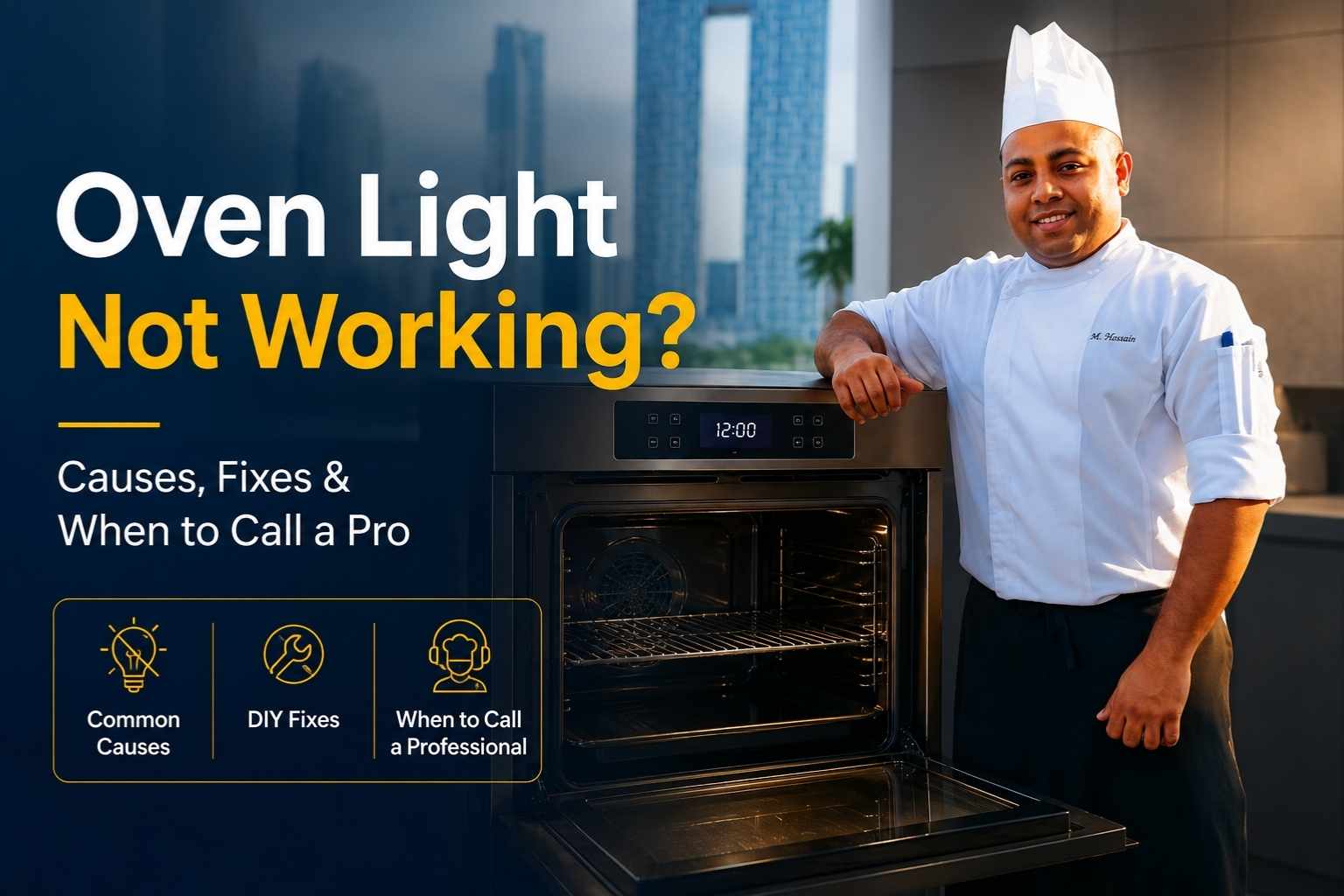
I still remember the absolute panic of baking my first holiday cake, peering through the glass, and realizing my oven light not working meant I was totally in the dark. It is a common, frustrating glitch, but after years of fixing my own kitchen gear, I promise it is usually a quick fix. This short guide will show you how to safely check the bulb and wiring in just a few steps. Grab your flashlight and let’s get that bright glow back right now!
At a Glance
- A dead oven light is almost always a burnt-out bulb — replace it with the correct appliance-rated bulb (usually A15, 40W, 130V) before assuming an electrical problem.
- The second most common cause is a faulty door switch — the small plunger near the door frame that tells the oven the door is open.
- Never touch an oven bulb while the oven is hot. Let it cool for at least 30 minutes, then cut power at the breaker before removing the cover.
- If you’ve replaced the bulb and the light still won’t work, the fix likely involves the socket, the light switch, or the door switch — all DIY-able with basic tools.
- Call a technician if you suspect a wiring fault or control board failure — those are not safe DIY repairs.
Why the Oven Light Matters More Than You Think
The oven light is your best tool for checking food without opening the door. Every time you crack that door, you drop the internal temperature by 25-50°F (GE Appliances, 2024). For something like a soufflé, a custard, or a slow-roasted prime rib, that temperature drop can ruin hours of work.
I’ve been cooking professionally for over 15 years. In restaurant kitchens, oven lights burn out fast — commercial ovens run hard, and the bulbs take a beating from constant heat cycling. Early on, I learned to always have spares on hand. At home, though, most people never think about the oven light until it’s gone dark mid-roast on a Sunday afternoon.
The good news: most oven light problems are simple. The bad news: people often make them harder by skipping the basics and assuming the worst. This guide walks you through every cause, from most likely to least likely, and tells you exactly what to do about each one.
Quick-Diagnosis Reference Table
| Cause | Symptom | How to Check | DIY or Pro? |
|---|---|---|---|
| Burnt-out bulb | Light simply off, no flicker | Remove and inspect bulb — dark spot or broken filament | DIY |
| Wrong bulb installed | Bulb blows repeatedly | Check wattage and voltage rating on old bulb | DIY |
| Faulty bulb socket | New bulb doesn’t work | Inspect socket for burns, corrosion, or damage | DIY (if accessible) |
| Broken light switch | Light doesn’t respond to switch | Test switch continuity with a multimeter | DIY |
| Door switch malfunction | Light stays on or won’t turn on | Locate and test the door plunger switch | DIY |
| Wiring fault | Intermittent light, tripped breaker | Visual inspection only — look for burnt wires | Pro |
| Control board failure | Multiple functions affected | Other oven features misbehaving too | Pro |
First Things to Check Before You Touch Anything
Start here before you buy parts or call anyone. These four checks take less than five minutes and will solve most problems.
1. Is the oven cool? You need the oven at room temperature before removing the bulb cover. Oven glass and bulb covers stay scorching for longer than you’d expect. I wait a minimum of 30 minutes after the last use — longer if the oven was running at high heat.
2. Is the bulb actually the right type? Open the oven and look for any remnant of the old bulb, or check your owner’s manual. Most residential ovens use an A15 appliance bulb, 40 watts, 130 volts. Some newer models use halogen or even LED. Installing a standard household 60W bulb is one of the most common mistakes — it runs too hot, fails early, and can damage the socket (This Old House, 2025).
3. Is the breaker tripped? Check your home’s electrical panel. An oven shares a circuit with the light. A tripped breaker kills everything, not just the light.
4. Is the light switch working? Some ovens have a dedicated light switch on the control panel. Press it a few times. If you hear a click but no light, that narrows things down fast.
How to Safely Replace an Oven Light Bulb
Replacing an oven bulb is a 10-minute job for most people. Follow these steps in order.
Step 1 – Cut the Power
Don’t just turn the oven off. Go to your home’s electrical panel and flip the breaker for the oven circuit. This protects you from any live wires near the socket. If you’re not sure which breaker it is, flip the main breaker.
Step 2 – Let the Oven Cool Completely
30 minutes minimum after your last cooking session. If the oven ran above 400°F (204°C), give it a full hour. A bulb cover that looks like glass is often ceramic or coated glass — it holds heat longer than it appears to.
Step 3 – Locate and Remove the Bulb Cover
The bulb is usually in the rear upper-left or rear upper-right corner of the oven cavity. It sits under a glass or metal cover held in place by either a twist mechanism or a retaining bracket.
- Twist-off cover: Turn counterclockwise to unlock, then pull straight out.
- Screw-on cover: Use a flathead screwdriver wrapped in a cloth — the cloth prevents scratching the glass.
Step 4 – Remove the Old Bulb
Most oven bulbs are standard screw-base (E26) or small screw-base (E17). Turn counterclockwise to remove. If the bulb is fused to the socket — which happens with repeated heat cycling — grip it with a dry rubber glove for better torque. Never use a wet cloth.
Step 5 – Inspect the Bulb
Hold the old bulb up to a light source. Look for:
- A dark smudge near the base (burnt filament)
- A visible broken filament
- Discoloration on the glass near the base
Any of these confirms a dead bulb. If the bulb looks fine — no visible damage — the problem is electrical, not the bulb itself.
Step 6 – Install the Correct Replacement
Match the wattage, voltage, and base type exactly. Do not use a standard household bulb. Oven bulbs are rated for temperatures up to 572°F (300°C) (Whirlpool Support, 2025). A regular A19 household bulb will fail within minutes at those temperatures and can shatter.
Screw the new bulb in firmly — finger tight, then an extra quarter turn. Reattach the cover, restore power at the breaker, and test.
When It’s the Bulb vs. When It’s Something Electrical
A dead bulb is the answer about 70% of the time (Family Handyman, 2024). But there are clear signs that the problem goes deeper.
It’s probably just the bulb if:
- The light went out gradually or flickered before dying
- The oven is more than 3-4 years old and the bulb has never been replaced
- A new bulb lights up the moment you install it
It may be electrical if:
- A brand-new bulb doesn’t light up
- The bulb blew again within days of replacement
- You hear a pop or see a flash when the light fails
- The light flickers inconsistently
Warning sign: If you put in a new bulb and it blows almost immediately, stop. There’s likely a voltage problem — possibly a failing socket or a wiring issue that’s sending inconsistent current (Consumer Reports, 2025). Keep replacing bulbs without fixing the root cause and you’ll damage the socket permanently.
Common Causes Broken Down
Burnt-Out Bulb
The most common cause. Oven bulbs have a shorter life than household bulbs because they cycle through extreme heat repeatedly. Most last 1-3 years with normal use. Replace with an identical-spec appliance bulb and you’re done.
Broken Bulb Socket
The socket — the small receptacle the bulb screws into — can corrode, crack, or develop a broken contact point. If a new bulb doesn’t work, inspect the socket closely. Look for:
- Brown or black burn marks
- Corrosion (white or green residue)
- A center contact that’s been pushed flat (this is fixable — use a small flathead screwdriver to gently lift the contact pin up 1-2mm)
Replacement sockets are available for most major brands for $10-20 and are usually accessible without any special tools.
Faulty Light Switch
The control panel switch that activates the light has contacts inside that can wear out over time. To test it properly, you need a multimeter set to continuity mode.
Disconnect the oven from power. Remove the switch from the control panel (typically 2 screws or a friction clip). Touch the multimeter probes to the switch terminals. Press the switch. If it shows no continuity when pressed, the switch is dead and needs replacing. Replacement switches for common brands like GE, Whirlpool, and Bosch run $15-35 (GE Appliances, 2024).
Door Switch Malfunction
This is the one people miss most often. Every oven has a door switch — a small plunger or microswitch embedded in the door frame. When the door opens, the plunger depresses and signals the light to turn on. When the door closes, it releases and the light turns off.
A stuck or failed door switch creates two possible symptoms: the light never turns on (switch stuck in “closed” position) or the light never turns off (switch stuck in “open” position). Find the switch by running your finger along the oven door frame — you’re looking for a small rubber or plastic plunger. Press it manually. If the light responds, the switch mechanism is fine. If not, the switch needs replacing.
Door switches are among the cheapest oven parts — typically $8-15 (Repair Clinic, 2025).
Wiring or Control Board Issues
If you’ve ruled out the bulb, socket, light switch, and door switch, the problem is deeper in the electrical system. Loose wiring connections, burnt wire insulation, or a failed control board will all kill the oven light.
These are not DIY repairs unless you have experience with appliance electrical work. Incorrect repairs to wiring or control boards create fire and electrocution hazards. Call a certified appliance technician. A standard service call runs $75-150 for diagnosis, with parts additional (Consumer Reports, 2025).
Safety Precautions: What NOT to Do
Never touch a hot bulb. This sounds obvious, but in a rush to diagnose the problem, people reach in right after cooking. Oven bulbs get hot enough to cause burns instantly. Wait the full 30 minutes.
Never bypass a safety switch. Some online tutorials suggest jumping the door switch to test the light. Don’t do it. Safety switches exist for a reason — bypassing them creates real risk of electrical shock or damage to the control board.
Always cut power at the breaker. Turning the oven to “off” does not remove power from the socket or wiring. The breaker does. This is non-negotiable before you remove the bulb cover or touch any wiring.
Never use a metal screwdriver on live components. If you’re not 100% sure the power is off, use plastic-handled tools. Even then, treat every wire as live until you’ve confirmed otherwise with a multimeter.
When to Call a Professional vs. When It’s DIY
DIY-safe:
- Replacing the bulb
- Cleaning or straightening the socket contact
- Replacing the socket (on accessible models)
- Replacing the door switch
- Replacing the control panel light switch
Call a pro:
- Any visible burnt wiring
- Breaker tripping when the oven is in use
- Multiple oven functions failing at the same time
- Any repair that requires removing the oven from the wall or accessing the back panel wiring harness
A good rule I follow in the kitchen: if the fix costs under $25 in parts and doesn’t involve rewiring anything, I do it myself. Beyond that, I call someone who does this daily.
Common Mistakes People Make When Troubleshooting
Buying the wrong bulb. A standard A19 household bulb looks identical to an appliance bulb. Check the spec label on the box — you need a bulb rated for high-temperature use. The packaging will say “appliance” or list a temperature rating.
Skipping the breaker. Turning the oven to “off” is not the same as cutting power. People get shocked this way. Go to the panel.
Replacing the bulb without checking the socket. If the socket contacts are corroded or burnt, a new bulb will fail just as fast as the old one.
Ignoring the door switch. It’s easy to overlook because it’s not obvious. If a new bulb doesn’t fix the problem, check the door switch before assuming anything electrical.
Over-tightening the bulb. Oven bulbs expand and contract with heat. Over-tightening fuses the base to the socket and makes the next removal a nightmare. Finger tight plus a quarter turn is enough.
My Personal Approach After 15 Years in Kitchens
Early in my career, I worked a line at a restaurant that ran four ovens hard, six days a week. We blew through oven bulbs constantly, and the first thing the chef taught me was: always confirm the simple fix before assuming the complicated one.
I’ve watched cooks call for service on a dead oven light that turned out to be a $4 bulb. I’ve also seen a home cook spend an hour replacing bulbs and switches when the real problem was a corroded socket contact that just needed a gentle lift with a screwdriver.
At home, I keep a two-pack of appliance bulbs in my utility drawer at all times — the same way I keep fuses. When the oven light goes dark, I go through the diagnosis in order: bulb, socket, switches, then wiring. In 95% of cases, the answer shows up before I get to step three.
The other 5%? That’s when I pick up the phone.
Frequently Asked Questions About Oven Light Problems
What type of bulb does an oven use?
Most residential ovens use a 40-watt, 130-volt, A15 appliance bulb with an E26 (standard) or E17 (intermediate) screw base. Some high-end ovens use halogen bulbs, and newer models may use LED. Always match the wattage and voltage of the original bulb exactly — check your owner’s manual or the label inside the oven cavity if you’re unsure.
Can I use an LED bulb in my oven?
Only if the oven manufacturer specifies LED as compatible. Standard LED bulbs are not rated for oven temperatures and will fail quickly or shatter. Some oven models are designed for LED from the factory and use special heat-rated LED bulbs — those are safe to use. Check your model’s manual before substituting.
Why does my oven light keep burning out?
If bulbs fail repeatedly within days or weeks, the problem is almost certainly electrical — either a voltage spike in the circuit, a failing socket, or a loose connection causing inconsistent current. A bulb that blows fast is being over-driven. Stop replacing bulbs and diagnose the socket and wiring first (This Old House, 2025).
How do I know if the door switch is bad?
Locate the small plunger on the oven door frame and press it manually while watching the light. If the light doesn’t respond at all, the switch is likely faulty. You can also test it with a multimeter on continuity mode — a good switch shows continuity when pressed and no continuity when released.
Is it safe to use the oven if the light doesn’t work?
Yes. The oven light is a separate circuit from the heating elements. A dead light has no effect on cooking performance or safety. That said, fix it soon — cooking without a light means opening the door more often, which drops temperature and affects results.
How much does it cost to fix an oven light?
A replacement bulb costs $3-8. A new socket runs $10-20. A door switch or light switch costs $8-35 depending on the brand and model. If you need a technician to diagnose a wiring or control board issue, expect to pay $75-150 for the service call plus parts (Consumer Reports, 2025).
Can I replace the oven bulb socket myself?
On most ovens, yes. The socket is accessible from inside the oven cavity after removing the bulb cover. It typically connects with a wire harness plug that pulls straight off. Replacement sockets for common brands — GE, Whirlpool, Samsung, LG, Bosch — are available from appliance parts suppliers online. Always cut power at the breaker before any socket work.
Why does my oven light stay on when the door is closed?
A light that stays on with the door closed almost always points to a stuck or failed door switch. The door switch should release when the door closes, cutting the light circuit. If the switch is stuck in the depressed position, it signals the oven that the door is always open. Replace the door switch — it’s one of the cheaper parts in an oven and a straightforward swap.
Key Takeaways
- Start with the simplest fix: replace the bulb with the correct appliance-rated type before anything else.
- Always cut power at the breaker — not just at the oven control — before removing the bulb or cover.
- A repeatedly blown bulb signals an electrical problem in the socket or wiring, not a bad batch of bulbs.
- The door switch is a frequently overlooked cause — locate the plunger on the door frame and test it manually.
- DIY-safe fixes: bulb, socket, door switch, light switch. Call a pro for wiring faults and control board failures.
- Keep a spare appliance bulb on hand. When the light goes dark mid-cook, you want to fix it in two minutes, not two days.

I’m Mossaraof, a trained chef and the founder of OvenInsights.com. I spent years cooking at Larrupin’ Cafe and in kitchens across Chicago and Seattle. Now I test kitchen gear for a living. I moved to North Acton, London, and I test every tool I write about. I use real meals and real heat. No brand deals. No shortcuts. I cover 12 kitchen types and hundreds of recipes. I believe this: the right tools matter as much as the recipe.