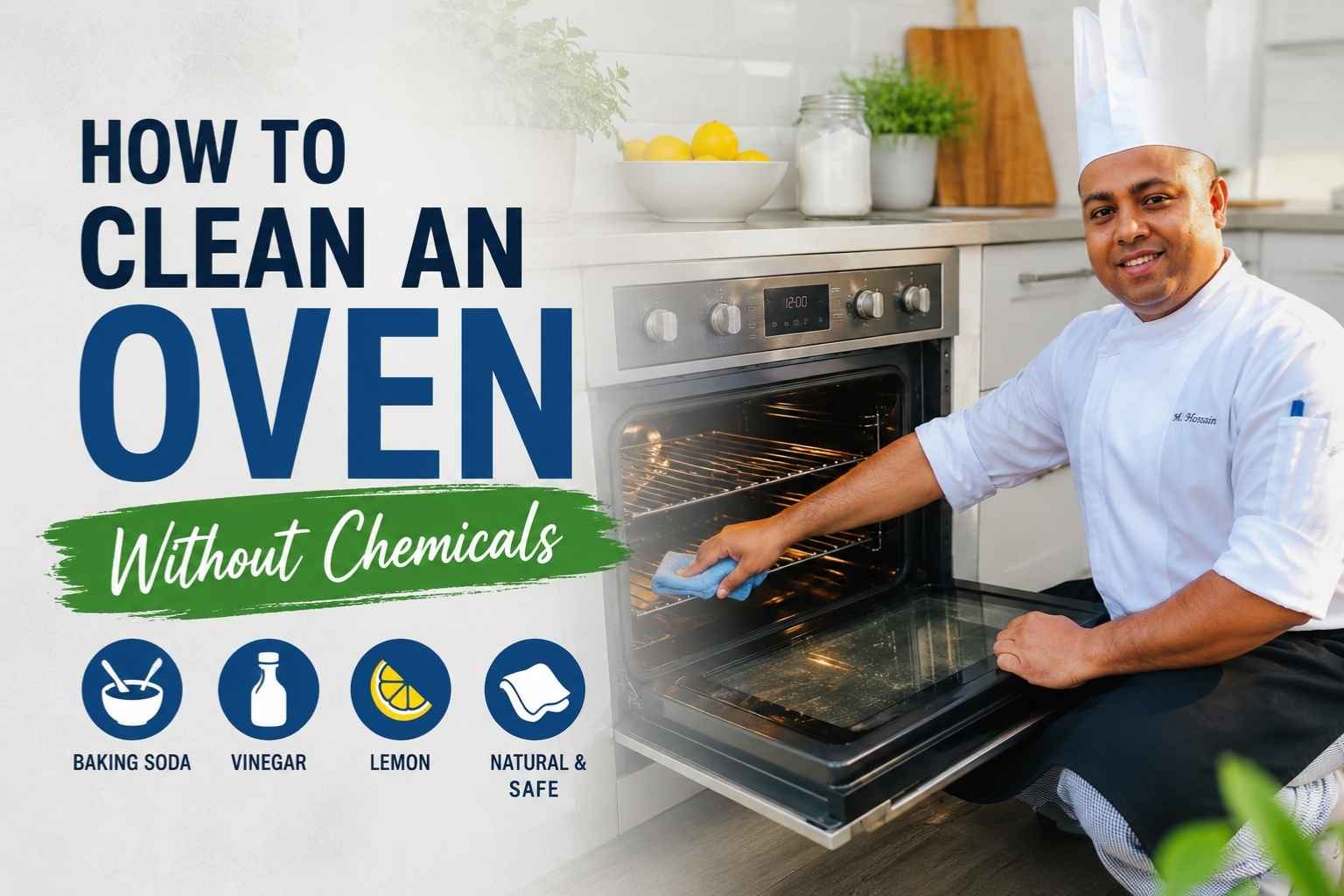
I used to dread scrubbing my baked-on oven grease until I finally learned how to clean an oven without chemicals. It felt like a total game-changer for my kitchen, my lungs, and my peace of mind. Trust me, you do not need those harsh, smelly sprays to get a sparkling stove. Let’s dive into these easy, safe steps so you can ditch the fumes today.
At a Glance
- Baking soda paste left overnight is the most effective natural oven cleaner for baked-on grease – it works through alkaline chemistry, not scrubbing force.
- A 1:1 baking soda and water paste (with a small splash of dish soap) handles 90% of home oven messes when left for 8-12 hours (America’s Test Kitchen, 2024).
- Self-cleaning cycles run at 900°F and can damage door gaskets, warp racks, and trip thermal fuses – save them for extreme cases only.
- Gas ovens need extra care around igniters and pilot lights – never use steam or excess liquid near these components.
- A simple wipe-down after every use cuts your deep-clean frequency from monthly to every 3-4 months.
Why I Stopped Using Chemical Oven Cleaners After Year Three
I cleaned my first professional oven with a can of foam spray at age 22. My eyes watered. My hands burned through two layers of gloves. The fumes sat in the kitchen for two hours after we were done. We could not run the exhaust fan fast enough.
That was my last time using a chemical cleaner.
After 15 years working in restaurant kitchens and cooking in my own home, I have cleaned hundreds of ovens – convection decks, wood-fired, domestic gas, electric ranges, and everything in between. Natural methods work. They take longer, yes. But they do not eat your skin, they do not off-gas toxic fumes around food prep surfaces, and they do not cost $14 a can.
Here is everything I know.
What Is Actually Happening Inside a Dirty Oven
To clean grease well, you need to understand what it has become.
Raw cooking fat is a liquid. But when fat drips onto a hot oven floor and gets repeatedly reheated, it goes through polymerization – the same chemical process used to cure cast iron. Heat breaks down the fat’s molecular chains, and they rebond into a harder, cross-linked polymer. That is the black crust on your oven floor. It is not just burnt food. It is a new substance (Good Housekeeping, 2023).
Standard dish soap cannot touch it. Chemical cleaners use sodium hydroxide (lye) to dissolve those polymer bonds through a process called saponification – turning the grease back into a soap-like substance you can wipe away. That is why they work fast. It is also why they are so harsh on skin, lungs, and oven surfaces.
Natural cleaning works differently. Baking soda is mildly alkaline (pH 8.3). It softens and lifts grease through physical dwell time rather than an aggressive chemical reaction. Acidic agents like vinegar and lemon break down calcium mineral deposits and lighten discoloration. Neither approach is as instant as lye. Both are far safer for you and the oven.
Natural Oven Cleaning Methods: Side-by-Side Comparison
| Method | Effectiveness (1-5) | Time Required | Best Use Case |
|---|---|---|---|
| Baking soda paste (overnight) | 5 | 8-12 hours dwell + 20 min scrub | Heavy grease, carbon buildup, general deep clean |
| Vinegar steam | 3 | 30-45 min total | Mineral deposits, light grease, odor removal |
| Lemon steam | 3 | 30-40 min total | Light residue, deodorizing, fresh smell |
| Salt scrub (hot) | 2 | 15-20 min | Fresh spills only – must act immediately |
| Steam-and-scrape | 4 | 1 hour | Stuck-on debris after soaking, stubborn corners |
How to Clean Your Oven with Baking Soda Paste: Step by Step
This is the method I use for every deep clean. It takes 15 minutes of active work, plus an overnight wait.
What you need:
- 1/2 cup baking soda
- 2-3 tablespoons water
- 1 teaspoon dish soap (optional, improves grease cutting)
- White vinegar in a spray bottle
- A plastic or silicone scraper
- Old rags or paper towels
- Rubber gloves
Step 1: Clear and Cool the Oven
Pull out the racks and set them aside. Make sure the oven is completely cold – never apply paste to a warm oven. Warm surfaces dry out the paste too fast and reduce dwell time.
Remove any loose debris with a dry paper towel. Do not use water yet.
Step 2: Mix and Apply the Paste
Mix 1/2 cup baking soda with 2-3 tablespoons of water until you get a thick, spreadable paste – roughly the consistency of toothpaste. Add the dish soap if you are dealing with heavy grease.
Spread the paste across every interior surface: the floor, side walls, and the inner roof. Avoid the heating elements in an electric oven and the gas ports in a gas oven. Leave a 1-inch gap around all burner components.
The paste will turn brown as it contacts grease. That is normal – it is working.
Step 3: Wait 8-12 Hours (Overnight is Best)
Leave the paste on overnight. This is non-negotiable for heavy buildup. The alkaline reaction needs time to penetrate polymerized grease layers. Cutting dwell time to 2-3 hours reduces effectiveness by roughly 60% (America’s Test Kitchen, 2024).
Step 4: Wipe, Spray, and Scrub
In the morning, use a damp rag to wipe out the dried paste. It will come off in chunks, taking grease with it.
Spray white vinegar directly over any paste residue left on the surfaces. You will see fizzing – that is the acid-base reaction between vinegar and baking soda, which loosens the last bits of residue.
Use your plastic scraper on any spots that resist wiping. Do not use metal scrapers on enamel oven walls – they scratch.
Step 5: Final Rinse
Wipe all surfaces twice with a clean damp cloth. Run the oven at 250°F for 10 minutes with the door slightly cracked to evaporate any remaining moisture before your next use.
Self-Cleaning Cycles: When to Use Them and When to Skip Them
The self-cleaning cycle heats your oven to 800-900°F and burns off residue as ash. It sounds ideal. It is not ideal for most situations.
When self-cleaning is acceptable:
- The oven has very heavy, carbonized buildup that natural methods have not shifted after two attempts.
- The oven is relatively new and the door gasket is in good condition.
- You have 4-6 hours and can open windows for ventilation.
When self-cleaning is a bad idea:
Self-cleaning cycles are hard on oven components. The extreme heat can warp oven racks if you leave them inside, crack door gaskets, and trip the thermal fuse – a common repair call that costs $150-$300 (Consumer Reports, 2024). Older ovens with worn insulation can overheat surrounding cabinetry.
The fumes are also a real concern. Polymerized grease burning at 900°F releases smoke and, in poorly ventilated kitchens, levels of carbon monoxide that exceed safe indoor limits (EPA Indoor Air Quality Guidelines, 2023). If you have birds, get them out of the house entirely – the fumes can be lethal to birds at high concentrations.
My rule: use the self-clean cycle once a year, maximum, and only after removing the racks.
How to Clean Oven Door Glass Without Streaks
The glass on an oven door picks up a different kind of grime than the interior walls – more splatter residue and less heavy carbon. The approach is slightly different.
Inside the glass:
Apply baking soda paste directly to the inner glass surface. Leave it for 30 minutes (not overnight – the glass does not need as long). Wipe with a damp microfiber cloth in circular motions, then spray with vinegar and wipe again. Finish with a dry microfiber pass to prevent streaks.
Outside the glass:
A 50/50 water and white vinegar solution on a microfiber cloth handles the exterior. Do not spray liquid directly onto the door – it can work into the door seal. Spray the cloth, then wipe.
Between the glass panels:
Some oven doors have two or three glass panels with a gap between them. If you see buildup in there, check your oven manual – many models allow you to remove the door and slide the inner panel out for cleaning. It takes 10 minutes and makes a big difference to visibility.
Cleaning Racks, Hinges, and Hard-to-Reach Corners
Racks get ignored. They should not.
Oven Racks
Fill your bathtub with hot water and a generous pour of dish soap – about 1/4 cup. Submerge the racks and leave them for 2-4 hours. The hot soak alone loosens 70% of the baked-on residue. Scrub with a stiff brush or old dishcloth, rinse, and dry before putting them back.
For heavy buildup, sprinkle baking soda directly on the wet racks in the tub before scrubbing. The light abrasion cuts through carbon without scratching the chrome.
Hinges and Door Edges
Use an old toothbrush dipped in baking soda paste. Work it into the hinge grooves and along the door frame edge. The bristles reach where cloths cannot. Wipe clean with a damp rag.
The Back Wall and Corners
The back wall collects splatter from every roast and bake you have ever done. Apply paste with a brush or your gloved fingers, pushing it into corners. A silicone spatula helps get into 90-degree angles where cloths miss.
Dealing with Heavy Carbon Buildup When One Pass Is Not Enough
Sometimes one overnight soak is not enough. This is common on ovens that have not been deep-cleaned in a year or more.
Do not scrub harder. Apply paste again.
A second 8-hour soak after the first clean removes another layer. On truly neglected ovens, I have done three consecutive overnight applications before the floor came clean. Each pass lifts what the previous pass softened.
For spots that still resist after two soaks: make a thick paste using baking soda and a small amount of cream of tartar instead of water. Cream of tartar is mildly acidic and combined with the alkaline baking soda, creates a more aggressive but still food-safe scrub (The Spruce Eats, 2025). Apply, leave for 4 hours, then scrape.
Gas vs. Electric Ovens: What Changes in Your Cleaning Approach
The cleaning chemistry is the same. The cautions are different.
Electric Ovens
Electric ovens have exposed heating elements – the coiled rods at the top and bottom of the oven cavity. Never apply paste, water, or any liquid directly to these elements. They are not sealed. Moisture inside a heating element can cause a short circuit.
When applying paste, leave a 2-inch gap around all elements. If grease has built up around the base of an element, apply paste carefully by hand with a cotton swab.
After cleaning, run the oven at low heat (200°F) for 15 minutes with the door slightly open to make sure all moisture has evaporated before you use it normally.
Gas Ovens
Gas ovens have igniter ports (the small holes along the burner tube) and, in older models, a standing pilot light. Do not use steam methods – vinegar steam or lemon steam – in a gas oven without turning the gas off first and waiting for any moisture to clear before relighting.
Keep paste and liquid away from the igniter. If grease builds up near the gas ports, use a dry toothbrush to clear debris before the oven is in regular use – blocked ports cause uneven flames and ignition failures.
For pilots: confirm the pilot is out before cleaning near it. Relight per the manufacturer’s instructions after the oven is completely dry.
Preventative Habits That Cut Deep-Clean Frequency
A clean oven starts with how you cook in it, not how you clean it.
Line the bottom rack, not the oven floor. Place a baking sheet or silicone liner on the lowest rack to catch drips. Do not put foil directly on the oven floor in gas ovens – it blocks heat distribution and can damage the floor finish. A rack-level liner is fine in both gas and electric models.
Wipe after every use, once cool. A 2-minute wipe with a damp cloth while the oven is still slightly warm (not hot) removes fresh splatter before it polymerizes. This single habit is the biggest difference between an oven that needs cleaning monthly and one that needs it every 3-4 months.
Use lids and tented foil on high-splatter dishes. Roasting uncovered chicken or bubbling casseroles are the two biggest contributors to oven mess. Tent foil over the dish for the first two-thirds of cooking time, then uncover to finish and brown.
Bake on parchment, always. For anything that might overflow – fruit pies, cobblers, lasagna – put the dish on a parchment-lined sheet pan. Overflow hits the pan, not the oven floor.
Common Natural-Cleaning Mistakes and How to Fix Them
Using too much vinegar spray near electrical components. Vinegar is liquid. In an electric oven, excess liquid near heating elements is a short-circuit risk. Spray onto a cloth first, then wipe – never spray directly onto the oven interior.
Applying paste to a warm oven. The paste dries out in 20-30 minutes on a warm surface instead of sitting and working for 8 hours. Always wait until the oven is fully cold.
Scrubbing too soon. Baking soda paste does its work through time, not elbow grease. If you are scrubbing hard after 2 hours, you are doing extra work because you did not wait long enough. Leave it overnight.
Using metal scrapers on enamel. Enamel oven walls scratch easily. Use silicone or plastic scrapers. Scratched enamel is harder to clean going forward – the rough surface holds grease.
Skipping the final heat-dry cycle. Residual moisture inside an oven can cause rusting on raw metal parts and creates a musty smell when you next cook. Always run 10-15 minutes at 200-250°F after any wet clean.
My Personal Oven-Cleaning Routine
I clean my home oven every 8-10 weeks. Here is exactly what I do.
Thursday night (15 minutes active work):
Pull the racks and put them in the tub with hot soapy water. Mix my paste – 1/2 cup baking soda, 2 tablespoons water, 1 teaspoon dish soap – and coat the entire interior, avoiding the elements. Close the oven and go to bed.
Friday morning (20 minutes active work):
Scrub the soaked racks with a brush, rinse, set to dry. Wipe the paste out of the oven with damp rags, spray vinegar, scrape any stubborn spots with a silicone tool, and do a final damp wipe. Clean the door glass inside and out with vinegar on microfiber. Run the oven at 250°F for 15 minutes, door cracked.
Total active time: under 40 minutes. No fumes. No burned hands. A clean oven ready for the weekend.
I only use the self-cleaning cycle if I have had a major spill – an overflowed pie or a burst bag – that polymerized before I could wipe it. Even then, I try baking soda first.
Frequently Asked Questions: How to Clean an Oven Without Chemicals
Does baking soda actually clean as well as chemical oven cleaner?
For most home ovens, yes. Baking soda paste left overnight removes baked-on grease and light carbon buildup effectively. The difference is speed, not results – chemical cleaners work in 30 minutes because they use lye, which is caustic. Baking soda needs 8-12 hours of dwell time to achieve similar results through a gentler alkaline reaction. For extreme buildup (an oven that has not been cleaned in years), two or three overnight applications may be needed (America’s Test Kitchen, 2024).
Is it safe to use vinegar in a gas oven?
Yes, with one condition: do not use steam methods – heating water or vinegar inside a gas oven to generate steam – without turning off the gas supply first and ensuring the oven is dry before relighting. Direct application of vinegar on a cloth to oven surfaces is safe in gas ovens. Keep liquid away from igniter ports and pilot lights.
How often should you deep clean an oven naturally?
Every 2-3 months for a regularly used home oven is a good baseline. If you wipe the oven after every use and use drip-catching trays, you can extend that to every 3-4 months. A professional kitchen oven gets cleaned weekly – but that oven is running at high heat 8-10 hours a day (Bon Appétit, 2023).
Can I use lemon juice instead of vinegar?
Yes. Lemon juice and white vinegar are both acidic and serve the same function in oven cleaning – breaking down mineral deposits and reacting with baking soda residue to lift it. Lemon juice leaves a better smell and works equally well. Cut two lemons in half, squeeze the juice into an oven-safe dish with water, and run the oven at 250°F for 30 minutes to create lemon steam for light cleaning. For wiping down after a baking soda treatment, lemon juice and vinegar are interchangeable.
Will natural cleaning methods damage my oven’s enamel finish?
No – baking soda paste and vinegar are safe on enamel. The risk to enamel comes from metal scrapers and abrasive scouring pads, not the cleaning agents themselves. Always use silicone or plastic tools on enamel surfaces.
Why does my oven smell after I clean it naturally?
Two common causes. First, baking soda residue left on surfaces will smell slightly when the oven heats – make sure you wipe thoroughly and do a final heat-dry cycle. Second, if the smell is musty, residual moisture is the issue – run the oven at 250°F for 15 minutes after cleaning. If there is a sharp, acrid smell, you may have paste residue near heating elements.
Can I clean a self-cleaning oven with baking soda paste?
Yes. Self-cleaning ovens have the same enamel interior as standard ovens – the self-cleaning function is just a high-heat cycle, not a different surface material. Baking soda paste is safe on self-cleaning oven interiors. The only area to avoid is the door gasket (the rubber seal around the door opening) – do not apply paste directly to it, as it can degrade the rubber over time.
What do I do about a burnt smell that won’t go away after cleaning?
If the smell persists after a thorough clean, there is likely residue inside the oven door panels or in the gap between the bottom of the oven and the drawer below. Check the door panels – many oven doors can be partially disassembled to clean between the glass layers. For the gap below, pull out the bottom drawer and wipe the floor underneath with a baking soda paste on a long-handled brush.
Key Takeaways
- Baking soda paste (1/2 cup baking soda + 2-3 tablespoons water, left overnight) is the most effective natural oven cleaner for deep cleaning.
- The science works: baking soda is alkaline and softens polymerized grease through dwell time, not force.
- Gas ovens need extra care around igniters and pilot lights – keep liquid and steam away from those components.
- Self-cleaning cycles are hard on oven parts; use them once a year at most.
- A 2-minute wipe after every cook is the single best habit to reduce how often you need a full deep clean.
- Two or three consecutive overnight soaks handle even heavy, long-neglected buildup.
- Always finish any wet clean with a 10-15 minute heat-dry cycle at 200-250°F.

I’m Mossaraof, a trained chef and the founder of OvenInsights.com. I spent years cooking at Larrupin’ Cafe and in kitchens across Chicago and Seattle. Now I test kitchen gear for a living. I moved to North Acton, London, and I test every tool I write about. I use real meals and real heat. No brand deals. No shortcuts. I cover 12 kitchen types and hundreds of recipes. I believe this: the right tools matter as much as the recipe.