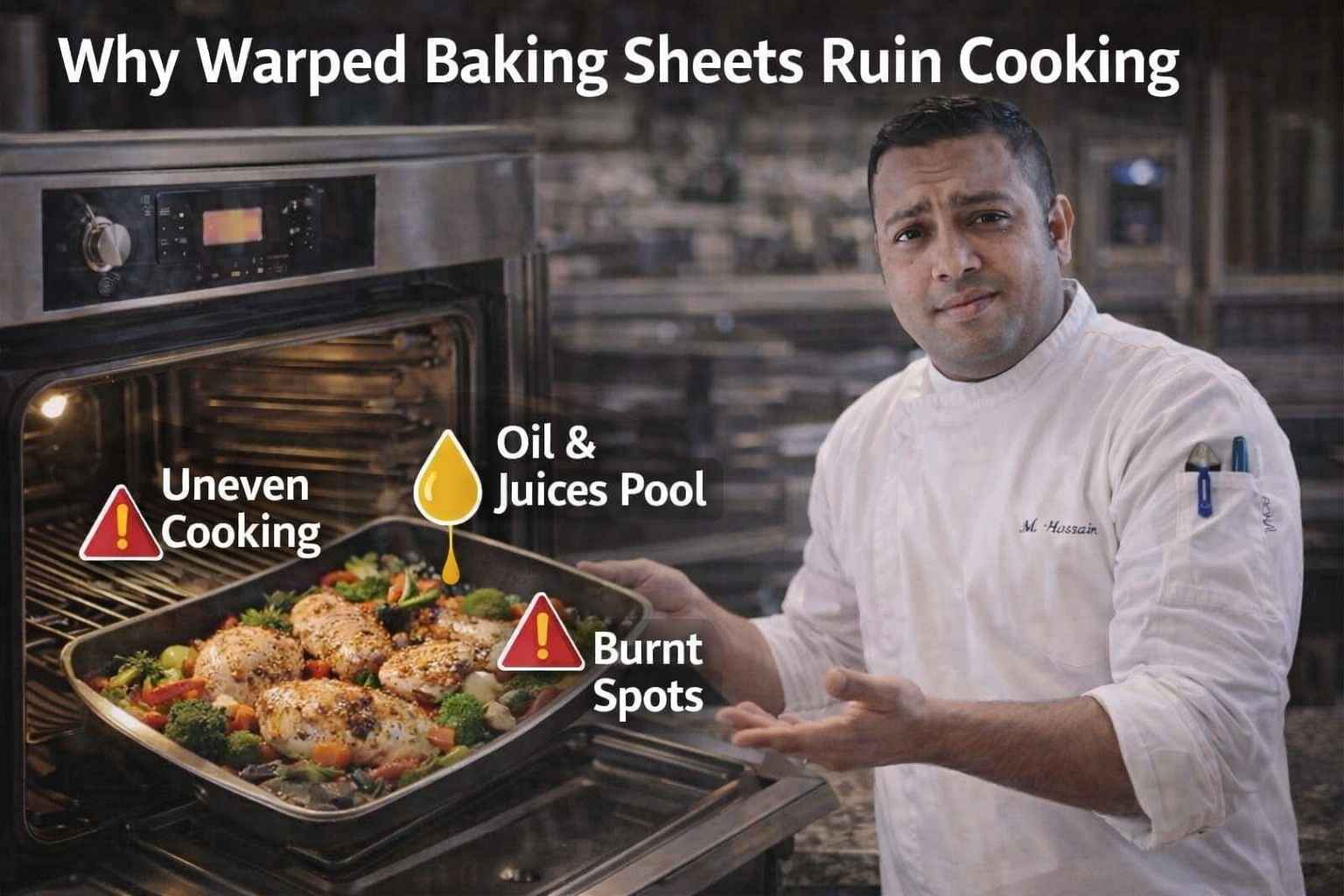
I heard a loud pop in my oven last week. My cheap pan twisted, and my cookies slid into a big mess. That noise taught me exactly Why Warped Baking Sheets Ruin Cooking. As a chef, I know flat pans are key. I talk about heat in The Complete Guide to Using an Oven at Home. Let’s fix your pans today.
The Physics of the “Pop”: Why It Happens
Metal moves when it gets hot. It is a simple fact of nature. It expands. If it is thin, it has nowhere to go but up.
Thermal Shock Explained
Imagine a cold metal sheet. It is sitting at room temperature, maybe 70°F.
Then you slide it into a 400°F oven. That is a massive jump in heat.
The metal reacts instantly. It tries to grow. It expands rapidly.
But here is the catch. It does not heat up evenly.
The edges heat up faster than the center. The rim gets hot first. The middle is still cool, especially if it is covered in cold food.
This creates stress. The metal is fighting itself. One part pulls. The other part pushes.
Eventually, the stress gets too high. The metal has to release that energy.
- The Pop: That loud noise is the release.
- The Twist: The pan buckles to find a new shape.
- The Result: You now have a wobbly pan.
The Role of Material Thickness (Gauge)
In the kitchen, we talk about “gauge.” This is how thick the metal is.
It works backwards. A high number means thin metal. A low number means thick metal.
Cheap pans are usually 20-gauge or 22-gauge. They are very thin. They are weak.
When the heat hits them, they surrender. They warp instantly.
Good pans are 18-gauge or lower. They are thick. They are rigid.
When the heat hits a thick pan, it resists. It has the strength to hold its shape.
I always look for 18-gauge aluminum. It is the sweet spot for home cooks.
The Rim Structure
Look at the edge of your pan. Is it just a cut piece of metal? Or is it rolled?
Cheap pans just end. The edge is sharp or flat. There is no support.
Good pans have a “rolled rim.” The metal is curled over.
Often, there is a steel wire hidden inside that curl. This acts like a girdle.
It holds the pan together. It forces the metal to stay flat.
- Wire Rim: Adds massive strength.
- Open Rim: Prone to twisting.
- Cleaning: Rolled rims can trap water, but they are worth it.
The Culinary Cost: How Warping Destroys Dinner
It is more than just an annoying noise. It changes how your food tastes and looks.
The “Oil Pool” Problem
I love roasting chicken thighs. I toss them in olive oil and herbs.
I lay them out on a sheet pan. I want the skin to get crispy.
If the pan warps, the oil moves. Gravity takes over.
The oil runs away from the center. It pools in the corners.
- The Dry Spot: The chicken in the middle has no oil. It dries out. It burns.
- The Deep Fry: The chicken in the corner is swimming in oil. It doesn’t roast. It boils in grease.
- The Flavor: You get soggy skin and burnt meat on the same tray.
The Cookie Slide
This is the saddest part. You spend hours making cookie dough. You scoop perfect little balls.
You space them two inches apart. You put them in the oven.
Then… CLANG. The pan twists.
The cookies are still soft. They slide downhill. They crash into each other.
- The Unibrow: You end up with one giant, merged cookie.
- Uneven Bake: One side of the cookie is thin. It burns. The other side is thick. It stays raw.
- The Waste: You can’t serve them. You just have to eat the scraps.
Delicate Cakes (Jelly Rolls)
Have you ever tried to make a pumpkin roll? Or a Swiss roll?
You bake a thin sponge cake on a sheet pan.
If the pan is warped, the batter flows. It pools in one corner.
You bake it. You take it out.
One side of the cake is like a cracker. It is thin and brittle.
The other side is thick and spongy.
When you try to roll it up, it cracks. The thin side snaps. The thick side squishes out the filling.
A flat pan is essential for these cakes. You cannot fix it later.
Material Showdown: Aluminum vs. Steel vs. Non-Stick
Not all metals handle the heat the same way. Some are built for abuse, some are not.
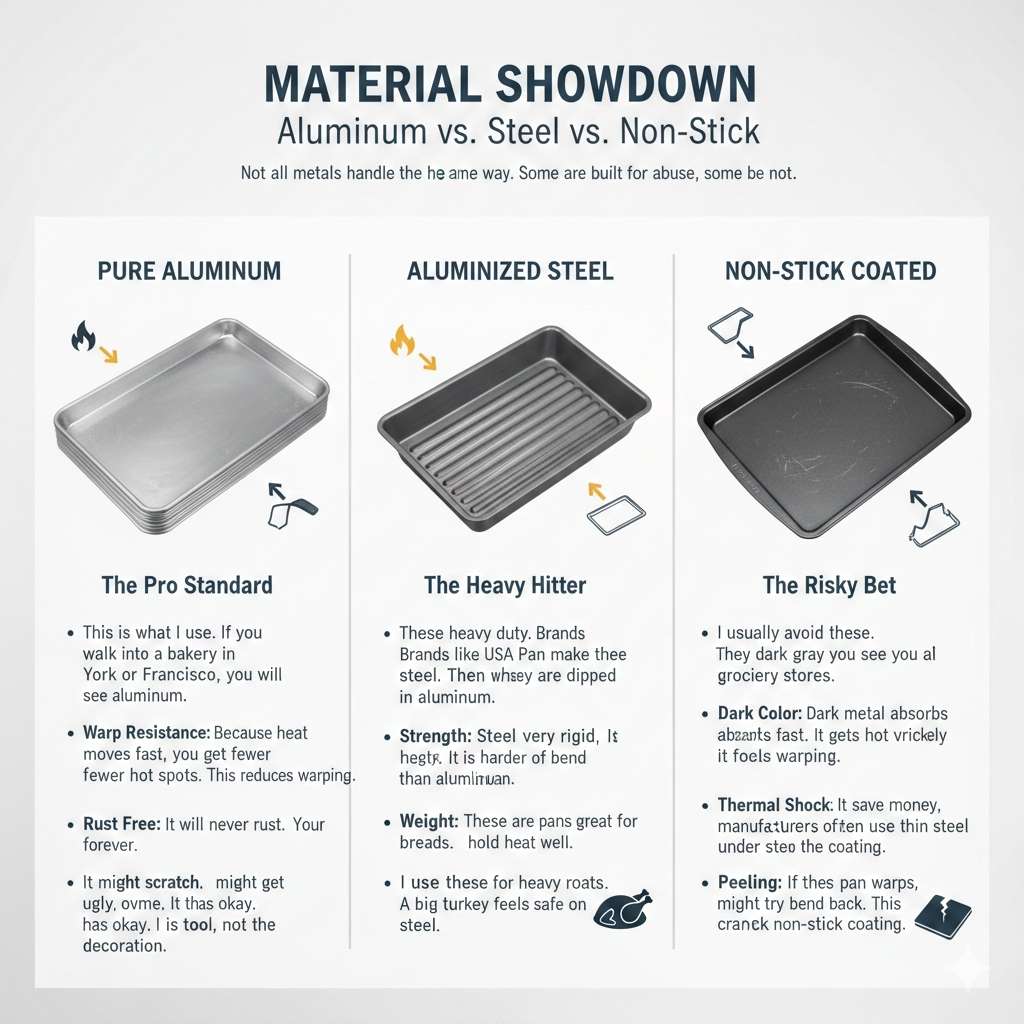
Pure Aluminum (The Pro Standard)
This is what I use. If you walk into a bakery in New York or San Francisco, you will see aluminum.
It is silver. It is dull. It looks industrial.
- Heat Flow: Aluminum conducts heat very well. It heats up evenly.
- Warp Resistance: Because heat moves fast, you get fewer hot spots. This reduces warping.
- Rust Free: It will never rust. You can wash it forever.
It might scratch. It might get ugly over time. That is okay. It is a tool, not a decoration.
Aluminized Steel (The Heavy Hitter)
These are heavy duty. Brands like USA Pan make these.
They have a core of steel. Then they are dipped in aluminum.
- Strength: Steel is very rigid. It is harder to bend than aluminum.
- Weight: These pans are heavy. They feel substantial.
- Baking: They are great for breads. They hold heat well.
I use these for heavy roasts. A big turkey feels safe on steel.
Non-Stick Coated (The Risky Bet)
I usually avoid these. They are the dark gray pans you see in grocery stores.
- Dark Color: Dark metal absorbs heat fast. It gets hot very quickly.
- Thermal Shock: This rapid heating increases the risk of warping.
- Thin Metal: To save money, manufacturers often use thin steel under the coating.
- Peeling: If the pan warps, you might try to bend it back. This can crack the non-stick coating.
Once the coating peels, the pan is trash. You don’t want paint flakes in your food.
Understanding “Gauge” in US Kitchens
The box says “Heavy Duty,” but the numbers tell the truth. Marketing lies. Numbers don’t.
What the Numbers Mean
You need to learn the language of metal thickness. It is called gauge.
Remember the rule: Smaller number = Thicker metal.
- 18-Gauge: This is the gold standard for home cooks. It is thick enough to resist warping. It is light enough to handle.
- 10 to 14 Gauge: This is professional stuff. It is very heavy. It is expensive. It is overkill for cookies, but great for pizza steel.
- 20 to 22 Gauge: This is the cheap stuff. Avoid this. It will warp. It will frustrate you.
If the packaging does not state the gauge, be suspicious. Good brands are proud of their number.
How to Test Your Current Pans
Go to your kitchen cabinet. Pull out your favorite baking sheet.
Let’s do the Twist Test.
Grab the short ends of the pan. One hand on the left, one on the right.
Try to twist it. Pretend you are wringing out a towel.
- Easy Twist: Does it bend easily? Does it feel flimsy? If yes, it will warp in the oven.
- No Twist: Does it feel solid? Does it fight back? If yes, it is a good pan.
Now do the Weight Test.
Hold it in one hand. Does it feel like a frisbee? Or does it feel like a weapon?
A good half-sheet pan should feel substantial. It should have some heft.
Proper Pan Sizes for US Ovens
Buying the wrong size blocks airflow. This causes uneven heating and warping.
The Half-Sheet Pan (13″ x 18″)
This is the standard. If a recipe says “sheet pan,” this is what they mean.
It measures 13 inches by 18 inches.
It fits perfectly in a standard American 30-inch oven.
It leaves about an inch of space on all sides. This lets hot air circulate.
If you only buy one size, buy this one. It fits a dozen cookies. It fits a whole chicken dinner.
The Quarter-Sheet Pan (9″ x 13″)
This is exactly half the size of the big one. It is cute.
I use these for small jobs.
- Reheating: Great for two slices of pizza.
- Small Batch: Perfect for roasting a few chicken breasts.
- Toaster Ovens: They often fit in large toaster ovens.
These rarely warp. Because they are small, the surface area is smaller. There is less metal to expand. They are very rigid.
The Full-Sheet Pan (26″ x 18″)
Be careful here. You might see these online. They are massive.
They are for commercial ovens only. They will not fit in your home oven.
I tried once. I thought I could jam it in.
It touched the walls of the oven. It blocked the heat.
And because it was squeezed in, it warped instantly. It made a huge noise.
Stick to the half-sheet size.
Prevention: How to Stop the Pop
Even good pans can warp if you mistreat them. Treat them with respect.
Even Food Distribution
Think about how you load the pan.
Do not leave big empty spots. Bare metal gets hotter than covered metal.
If you have a chicken breast in one corner and nothing else, the pan heats unevenly.
The empty corner gets screaming hot. The covered corner stays cool.
This temperature difference causes the twist.
Spread your food out. Try to cover the surface evenly. It helps the metal heat up at the same rate.
Avoiding Thermal Shock
This is the most common mistake.
You take a hot pan out of the oven. It is 400°F. You take the cookies off.
Then you throw the pan into the sink. You turn on the water.
SSSSSSST! Steam flies up.
That sound is the sound of metal dying.
You just shocked the pan. You forced it to shrink instantly. It will warp. It might never go flat again.
The Fix: Let the pan cool down naturally. Put it on the stove top. Put it on a wire rack. Wait until you can touch it before washing.
Temperature Limits
Know your oven modes.
The “Bake” setting is gentle. It uses ambient heat.
The “Broil” setting is violent. It uses direct fire from the top.
Broilers can hit 550°F or more.
Only heavy-duty pans can take this. If you put a thin pan under the broiler, it will taco instantly.
I use my heaviest steel pans for broiling. I save the aluminum for baking.
Can You Fix a Warped Pan?
Once it bends, is it trash? Or can we save it?
The Mallet Method
I have tried this. I felt like a blacksmith.
I heated the pan up. I put it on a flat concrete floor. I hit it with a rubber mallet.
It looked flat. I was happy.
But metal has “memory.” The grain of the metal had changed.
The next time I put it in the oven… CLANG. It popped right back to the warped shape.
It is very hard to truly fix a warped pan.
When to Retire It
You don’t have to throw it away immediately. But know its limits.
- Safety Risk: If it wobbles so much that hot grease spills, throw it out. It is dangerous.
- Cooking Risk: If you can’t slide a spatula flat across it, retire it. You will ruin your cookies.
I hate waste. So I find other jobs for them.
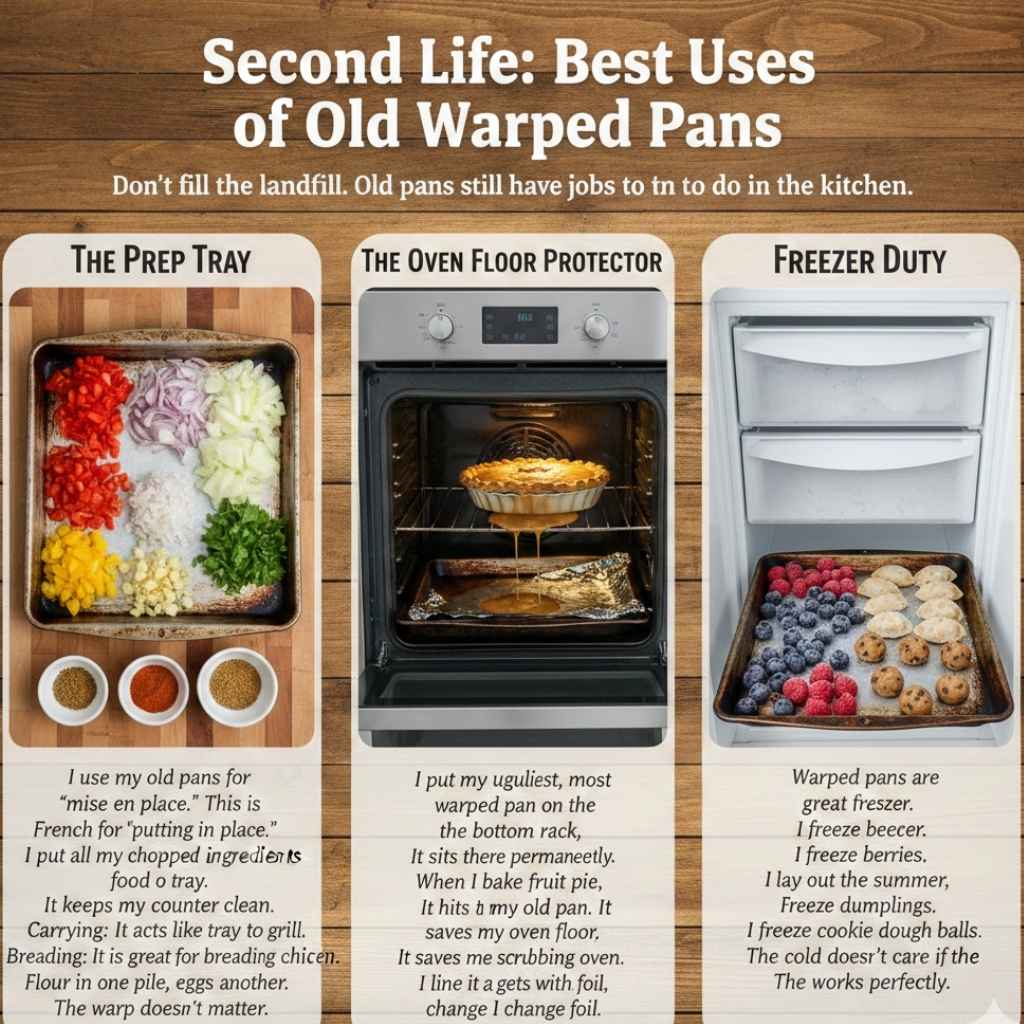
Second Life: Best Uses for Old Warped Pans
Don’t fill the landfill. Old pans still have jobs to do in the kitchen.
The Prep Tray
I use my old pans for “mise en place.” This is French for “putting in place.”
I put all my chopped ingredients on the tray. It keeps my counter clean.
- Carrying: It acts like a tray to carry food to the grill.
- Breading: It is great for breading chicken. Flour in one pile, eggs in another. The warp doesn’t matter.
The Oven Floor Protector
I put my ugliest, most warped pan on the bottom rack of the oven.
It sits there permanently.
When I bake a fruit pie, the juice bubbles over. It hits the old pan.
It saves my oven floor. It saves me from scrubbing the oven.
I line it with foil. When it gets dirty, I change the foil.
Freezer Duty
Warped pans are great for the freezer.
I freeze berries in the summer. I lay them out on the old pan.
I freeze dumplings. I freeze cookie dough balls.
The cold doesn’t care if the pan is flat. It works perfectly.
Cleaning and Maintenance for Longevity
A clean pan heats evenly. A dirty pan gets hot spots.
The Brown Stains (Polymerized Oil)
Look at your pan. Does it have dark brown spots in the corners?
This is old oil. It has cooked onto the metal. We call it polymerization.
These dark spots absorb more heat. They get hotter than the shiny metal.
This causes uneven heating. It encourages warping.
The Fix: Use Bar Keepers Friend. It is a powder cleanser.
Make a paste. Scrub the spots. It takes some elbow grease, but it works.
Or use baking soda and peroxide. Let it sit for an hour. Then scrub.
Dishwasher vs. Hand Wash
I know. The dishwasher is easy. But it ruins aluminum.
Dishwasher detergent is harsh. It is alkaline.
It reacts with the aluminum. It turns the pan gray. It makes the surface rough and pitted.
This weakens the metal over time.
The Rule: Always hand wash your good baking sheets. Use soap and a sponge. It only takes a minute.
Parchment Paper and Silicone Mats
I almost always use a liner.
Parchment paper is cheap. It keeps the pan clean.
It also acts as a tiny insulator. It protects the metal from direct contact with cold food.
Silicone mats (like Silpat) are even better. They are thick.
They reduce thermal shock. They help distribute the heat.
Using a liner helps your pan last longer. It stays shiny and flat.
Buying Guide: Brands I Trust
I have tested them all. From the dollar store to the restaurant supply store. These are the ones that stay flat.
Nordic Ware (The US Classic)
This is my number one pick. They are made in the USA.
Look for the “Naturals” line.
- Material: Pure aluminum.
- Gauge: 18-gauge heavy metal.
- Rim: Reinforced rolled steel rim.
They cost about $15 to $20. They are worth every penny. I have had mine for ten years. They are still flat.
USA Pan
These are unique. They look corrugated. They have ridges on the bottom.
- Strength: The ridges add massive strength. It is like corrugated cardboard. It resists bending.
- Coating: They have a silicone coating. It is non-stick but durable.
- Weight: They are heavy aluminized steel.
These are fantastic for roasting vegetables. The air flows under the food.
Vollrath (The Commercial Choice)
If you have a restaurant supply store nearby, look for Vollrath.
Specifically the “Wear-Ever” line.
This is what pros use. They are simple. They are tough. They are no-nonsense.
They don’t have fancy packaging. They just work.
Conclusion: Flat is Flavor
Investing in a good sheet is investing in your sanity.
The ROI of a $20 Pan
Think about the cost of ingredients.
Butter is expensive. Vanilla is expensive. Good chocolate is expensive.
If a $5 pan ruins $30 worth of ingredients, you lost money.
A $20 Nordic Ware pan saves your food. It pays for itself in a few batches.
It is the cheapest upgrade you can make in your kitchen.
Final Thought
Cooking should be fun. It shouldn’t be startling.
You shouldn’t have to fear the “CLANG” every time you roast veggies.
Action: Go to your kitchen right now. Take out your pans.
Do the wobble test. Do the twist test.
If they fail, retire them. Use them for prep.
Treat yourself to a heavy-gauge pan. You will feel the difference the moment you pick it up.
And your cookies will finally be round.
FAQs: Why Warped Baking Sheets Ruin Cooking
Why do warped baking sheets cause uneven cooking?
A warped pan creates hot spots. Food in the low areas gets too much heat. This leads to burnt edges while the middle stays raw. Consistent flat surfaces ensure your meals cook at the same rate.
Can a warped baking sheet ruin my cookies?
Yes, it can. Dough slides into the low spots of a bent pan. Your cookies will merge into one big mess. Using flat pans keeps your treats the right shape and helps them bake evenly.
Is it safe to use a pan that pops in the oven?
It is usually safe, but it is annoying. That loud pop means the metal is under stress. This sudden movement can spill hot oil or toss food. It is a sign your pan may soon ruin your cooking.
Does pan thickness prevent warping?
Thick pans handle heat better than thin ones. Look for heavy-gauge rimmed sheets to avoid a twist. High-quality metal stays flat. This helps you avoid the common ways warped baking sheets ruin cooking.
How can I fix a bent baking sheet?
You can try to bend it back, but it rarely stays flat. Once the metal warps, it likes to pop back to that shape. Buying a professional-grade pan is the best way to ensure your food cooks perfectly every time.