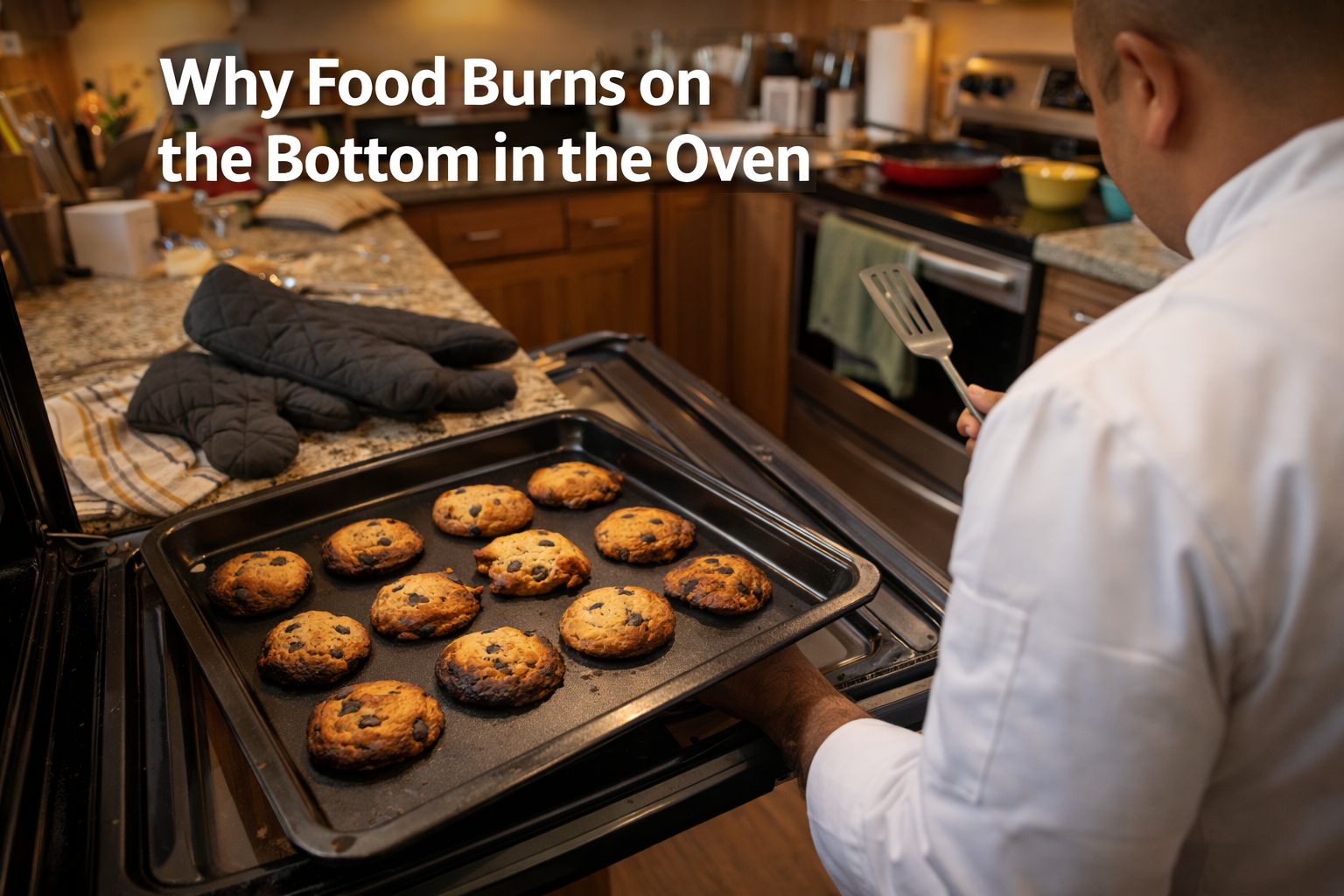
Hey, I’m Mossaraof — a cook and food blogger. One day, I baked pizza. The top looked great, but the bottom was black. That’s why food burns on the bottom in the oven — and trust me, it’s not always your fault. I’ve cooked in all kinds of ovens, and I’ve learned what really causes this. Let’s fix it together so your meals come out right.
To really understand how ovens heat and how things like rack position and bake settings affect your results, check out The Complete Guide to Using an Oven at Home — that’s where I break down the basics before we dive into troubleshooting.
🔥 Understanding How Heat Moves Inside Your Oven
Before I could fix the problem, I had to understand how my oven actually works.
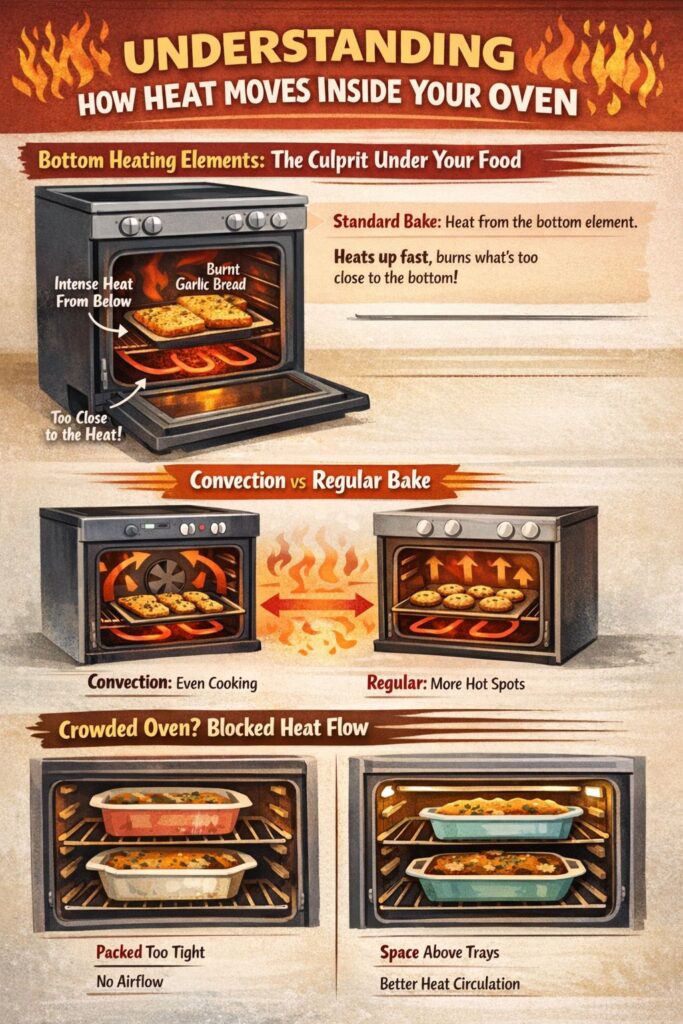
🔧 Bottom Heating Elements — The Culprit Hiding in Plain Sight
Most ovens, especially older U.S. electric models, heat from the bottom first. That heating coil under the floor of your oven? That’s the one that scorched my garlic bread.
- When you use the regular “Bake” setting, only the bottom element kicks in.
- It gets much hotter than the air inside — especially when preheating.
- That direct heat blasts whatever’s closest to the oven floor.
In my case, I placed the tray on the lower-middle rack. Rookie mistake. The bottom crust cooked twice as fast as the top.
🌬️ Convection vs Regular Bake — A Big Difference
Now, in my Arizona kitchen, I use a convection oven. It has a fan that circulates hot air — which helps cook more evenly.
But not everyone has one. Many older U.S. homes, especially apartments, have standard ovens with no fan at all.
- Convection = better air movement = fewer hot spots.
- Standard = radiant heat from the bottom = more chance of burning.
I didn’t realize this until I tested both side by side. In my old Chicago apartment, cookies would always burn underneath. But when I baked the same tray in my new convection oven? They came out even.
🌡️ Hot Air Rises — But Only If It Can Flow
One Thanksgiving, I crammed two casserole dishes into the oven — one above the other. Both on low racks. Bad move.
There was no room for the heat to rise and circulate. The bottom dish burned before the top even warmed up.
- Blocked airflow traps heat near the base.
- Crowded trays = uneven cooking.
- U.S. ovens aren’t always built wide enough for two full pans on one shelf.
Now I always leave space above and around my food — especially when baking.
🔥 Why the Bottom Burns Before the Top Cooks
A few inches in oven height can make all the difference. I learned this the hard way.
🧯 Rack Position — Why the Middle Is Your Best Friend
Back when I started out, I always baked on the lower rack. It felt right. But I ruined more muffins that way than I care to admit.
- Lower racks are closer to the heat.
- Middle rack = balanced airflow and temperature.
Now, for anything that needs even cooking — like pizza, cookies, or bread — I use the middle rack by default. If I need a crustier top, I’ll move it up for the last 5 minutes.
🍕 Dark or Thin Pans Absorb More Heat
One evening, I baked a frozen pizza on a flimsy black tray I bought at a dollar store. Looked fine going in. Came out with a burned crust and soggy cheese.
Turns out, dark metal pans:
- Absorb more heat than light or shiny ones.
- Cook the bottom faster than the top.
- Burn food easier if they’re too thin or warped.
These days, I mostly use thick aluminum trays or ceramic bakeware. Nordic Ware (made in the USA) makes great insulated pans. They help avoid hotspots.
🥵 Oven Thermostats Lie More Than You Think
Here’s something most folks don’t know — your oven lies to you.
I ran a test once. Set the oven to 350°F. Then placed thermometers on the top and bottom racks.
- Top rack hit 330°F.
- Bottom? A scorching 395°F.
No wonder my brownies were dry on the base and undercooked on top. It’s worse in some gas ovens — especially older ones in cold-weather cities like Minneapolis or Buffalo.
When your kitchen is cold, the oven has to work harder — and it often overcompensates.
🔥 Climate, Kitchen Habits, and U.S. Brands Matter
I’ve cooked in all kinds of places — a steamy Florida kitchen where even the walls felt sticky… a Chicago apartment with drafty windows in January… and a dry Arizona home that baked bread faster than I could shape it.
Climate changes how your oven behaves. It’s not just the thermostat.
🌴 Humid Climates Like Florida Make Ovens Lag
When the air is heavy with moisture, your food behaves differently. I noticed this especially with baking.
- Steam rises fast and gets trapped.
- That steam cools down the top half of your dish.
- The bottom still bakes hot — especially on metal trays.
So I’d get muffins that were wet on top, but scorched underneath. I had to bake a little longer, then broil just for a minute to get the tops to brown.
🧊 Cold Kitchens Like Midwest Winters Trigger Overheating
In Chicago, I learned something funny — ovens often overheat when your kitchen is cold. The thermostat senses the cold air and goes into overdrive.
That means the bottom element may stay on too long. I once baked cinnamon rolls on a winter morning — perfect smell, but the bottoms turned black.
That’s when I started keeping a second thermometer in the oven — not to test the air, but to test location. The lower rack always ran hotter.
🏜️ Dry, Hot Places Like Arizona Can Bake Unevenly
Now in Arizona, I face a different issue. Dry air pulls moisture out of food fast. In this climate:
- Roasts dry faster.
- Crusts overcook on the bottom.
- Bread hardens before it rises fully.
I’ve learned to use a water pan in the bottom of the oven during long bakes — especially with sourdough. A little steam slows things down.
🔥 Common Foods That Burn on the Bottom (and Why)
Some dishes are just more prone to burning. And I’ve burned almost all of them.
🍪 Cookies
I don’t know how many batches of cookies I’ve ruined before figuring this out.
- Thin dough cooks fast.
- The sugar caramelizes quickly.
- If you use dark baking sheets — it’s a recipe for burned bottoms.
Now I use parchment paper or silicone mats for every tray. And I rotate the pan halfway.
🥖 Bread and Pizza
Bread and pizza like to sit close to the heat. That’s what gives you those crisp bottoms — until it turns into charcoal.
- Frozen pizzas are the worst offenders.
- Thin crusts burn before the cheese even melts.
- Same goes for crusty artisan loaves — especially in ceramic dishes.
That’s why I switched to a baking stone. It holds heat but distributes it more evenly.
🧀 Casseroles and Cheese Dishes
I once made baked ziti for a potluck in Minnesota. Looked great from the top. But the cheesy edges at the bottom were a nightmare to clean — totally burnt.
Heavy dishes like lasagna or mac and cheese:
- Sit long in the oven.
- Radiate heat downward.
- Let cheese settle and overcook.
Now I place a thin baking sheet under my ceramic dish — kind of like a heat cushion.
🔥 How to Stop the Burning — Real Fixes I Use
Over time, I found some tricks that work in almost any oven. They’re not fancy — just practical.
🪜 Move the Rack Higher
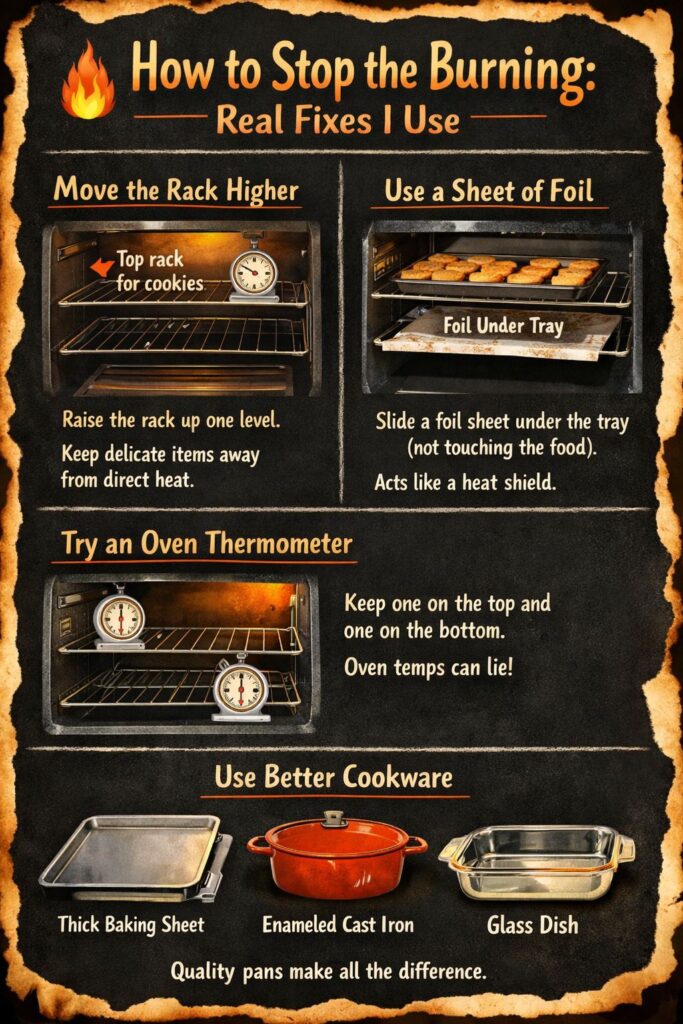
This one’s easy. Just move the rack up one level.
- It puts space between the food and the heating element.
- I use the top-third for delicate cookies or rolls.
- For sheet pan meals, I stay near the middle.
One time I forgot and roasted veggies on the bottom rack — they crisped too fast and got bitter. Never again.
🧻 Use a Sheet of Foil (Carefully)
If a dish keeps burning, I slide a piece of foil under the tray — not touching the food. Just enough to block the direct heat blast.
It acts like a heat shield.
Just don’t cover the oven floor. That messes with airflow and heat balance.
🧪 Try an Oven Thermometer
My oven says 375°F, but the thermometer on the bottom rack says 410°F. That’s a big deal.
Now I keep two thermometers inside:
- One near the top.
- One on the lower rack.
It’s the only way to know what’s really happening in there.
🪵 Use Better Cookware
Cheap pans warp. Warped pans cook unevenly. I tossed most of mine after I noticed my biscuits leaned downhill.
Here’s what I use now:
- Thick aluminum baking sheets (Nordic Ware is a solid U.S. brand).
- Enameled cast iron for slow bakes.
- Glass for casseroles (takes longer to heat, but doesn’t burn bottoms).
🔥 When the Problem Might Be Your Oven (Not You)
Sometimes, it’s not the recipe or your pan. It’s the oven itself acting up.
🧯 Faulty Thermostat or Sensor
I had an oven once that kept burning everything. Chicken, cookies, even frozen meals. Turns out, the sensor was shot.
- Oven kept running hotter than it should.
- Replacing the sensor fixed it overnight.
- Part cost me $18 and 15 minutes with a screwdriver.
Most U.S. electric ovens — especially older GE or Whirlpool models — have sensors that drift over time.
⚡ Broken Convection Fan
If only one side of your pan is burning, check the fan.
- It should spin freely when off.
- You’ll hear it kick in if it’s working right.
I had a Frigidaire oven where the fan looked fine — but the motor was dead. Replaced it, and suddenly, no more lopsided brownies.
🪟 Poor Insulation or Leaky Door
One rental apartment had an oven door that wouldn’t close tight. Heat leaked from the front, and the oven kept overcompensating at the bottom.
- Stick a flashlight inside and close the door.
- If you see light peeking through — the seal is bad.
A new gasket can make a huge difference.
🔥 Real-Life Cooking Habits That Make It Worse
Even with a good oven, some habits just make things worse. I’m guilty of all of these.
🧼 Preheating Shortcuts
I used to toss food in as soon as I turned the oven on. Especially when hungry.
But that’s when the bottom element is going full blast. You’re basically grilling your food from underneath.
Now I wait 10–15 minutes, even if the oven says it’s ready.
🔁 Not Rotating Trays
Some ovens — even brand new ones — have hot zones. If you don’t rotate your tray, you’ll get one side crisp, the other side raw.
I set a timer to flip halfway through, especially with cookies and roasted veggies.
💡 Using “Bake” When “Convection” Would Help
If your oven has convection mode — use it.
- It balances heat better.
- Reduces overcooking on the bottom.
- Cuts 5–10 minutes off bake time.
I switched over almost fully. Only use “Bake” for delicate items now, like soufflés or custards.
🔥 Tools I Use to Keep Food from Burning on the Bottom
Here’s what I keep in my kitchen now — simple tools, nothing fancy.
🪞 Oven Thermometer (2 of Them)
- One on top, one near the bottom.
- Shows how uneven the heat is.
- Makes you smarter than your oven.
🧻 Silicone Mats or Parchment Paper
- Keeps baked goods from sticking or burning.
- Also makes cleanup easier.
I go through a lot of parchment during holiday baking season — worth every penny.
🍕 Pizza Stone or Baking Steel
This one’s a game changer.
- Absorbs and distributes heat evenly.
- Crisp crusts without burning.
- Works great for bread, pies, frozen pizza.
I leave my stone on the bottom rack all the time now — acts like a buffer too.
🔥 Final Checks Before You Blame the Recipe
When things go wrong, we tend to blame the recipe. But sometimes it’s us. Or our setup.
🧂 Are You Using the Right Pan?
- Glass pans heat slowly, cool evenly.
- Dark metal pans get hot fast.
- Thin trays warp and twist in the heat.
Choose the right one for your dish. A heavy-duty sheet for cookies. A ceramic dish for baked pasta.
🕰️ Are You Checking Early?
Burnt food smells before it looks burnt.
Now, I trust my nose more than my timer.
- If I smell browning at 18 minutes, I open the oven.
- Even if the recipe says 22.
Some days, I open the oven five times. Some days, once. That’s cooking.
✅ FAQs
Why does my oven burn food on the bottom?
Most ovens use bottom heating elements that overheat, especially if the rack is too low or airflow is blocked.
How can I stop food from burning underneath in the oven?
Raise the rack, use parchment paper, rotate pans, and try a pizza stone to buffer heat from the bottom.
Does rack position affect food burning in the oven?
Yes — the lower the rack, the closer to the heat. Use the middle rack to reduce bottom scorching.
Are dark pans more likely to burn food?
Yes, dark and thin pans absorb heat faster, making the bottoms of baked goods more likely to burn.
Can oven temperature be wrong even if the display is correct?
Absolutely. Many ovens run hotter than their setting. Use a thermometer to check actual rack temperatures.