Hey, I’m Mossaraof — a professional cook and food blogger. One night, my roast was raw in the middle, even though the oven said 375°F. That’s when I had to learn how to tell if your oven temperature is accurate. I’ve worked in all kinds of kitchens, and trust me — oven dials aren’t always honest. If you’re still getting the hang of yours, The Complete Guide to Using an Oven at Home can help you master the basics.
Why Your Oven Temperature Actually Matters for Home Cooks
Small heat changes can ruin your hard work and waste your money on expensive groceries.
In a professional kitchen, we call this “heat drift.” If your oven is too cold, your bread won’t rise. If it is too hot, your cookies burn on the bottom while the top stays pale.
- Better Crusts: High heat creates steam that makes bread light and airy.
- Juicy Meat: Low and slow roasting keeps the moisture inside your roast.
- Saving Money: An accurate oven uses less power because it doesn’t overwork the heating element.
- Food Safety: You need a steady heat to kill germs in chicken and pork.
I’ve noticed that US kitchens vary a lot. A drafty house in New England affects oven heat differently than a humid home in Florida. Your oven has to fight the air around it. If your kitchen is freezing, your oven works twice as hard to stay hot.
The Dead Giveaways Your Oven is Lying to You
Your food acts as a natural sensor that tells you when the calibration is off.
Last Tuesday, I tried to bake a simple batch of biscuits. The left side was dark brown, but the right side was white. That is a classic sign of a “hot spot.” Your oven isn’t just a box of hot air; it has currents like a river.
- The 20-Minute Cake: If a recipe says 30 minutes but your cake is done in 20, your oven is running hot.
- Sunken Centers: If your muffins collapse, the heat might be dropping too fast mid-cycle.
- The Visual Check: Look at your heating elements. If they are flaky or gray, they are dying.
I once worked with an old Frigidaire that clicked every thirty seconds. That click was the relay struggling to keep up. If you hear loud pops or clicks, your oven is likely fighting to stay at the right temperature.
The Sugar Test: A Chef’s “Old School” Trick
Sugar is a cheap and honest way to see if your oven hits the right mark.
This is my favorite “lazy” trick because it costs about ten cents. White sugar melts at a very specific temperature: 366°F (186°C). It does not care what your digital screen says.
- Put a piece of foil on a baking sheet.
- Add a spoonful of sugar in each corner and one in the middle.
- Set your oven to 360°F
- Wait 15 minutes. The sugar should stay solid.
- Turn it up to 375°F
If the sugar in the back left melts first, you have a hot spot there. If none of it melts at 375°F, your oven is running way too cold. It’s a simple, sweet way to find the truth. I use this whenever I move into a new apartment or rent a vacation home.
Choosing the Right Tool: Analog vs. Digital Thermometers
A good tool takes the guesswork out of cooking and gives you peace of mind.
I have a drawer full of gadgets, but only two really matter for heat. Most people in the US use the cheap hanging thermometers from Taylor or Rubbermaid. They are fine, but they can be hard to read through a dirty glass door.
- Analog Pro: No batteries, very cheap, and can stay in the oven forever.
- Analog Con: The needles can get stuck over time due to grease buildup.
- Digital Pro: Very fast, very accurate, and usually has an alarm.
- Digital Con: The wires can get pinched in the oven door and break.
I personally use a digital probe. I can sit on my couch and watch the temp on my phone. It’s a lifesaver during a long Sunday roast. If you are on a budget, just get a $7 stainless steel one. It’s better than nothing.
How to Tell If Your Oven Temperature Is Accurate (The Official Test)
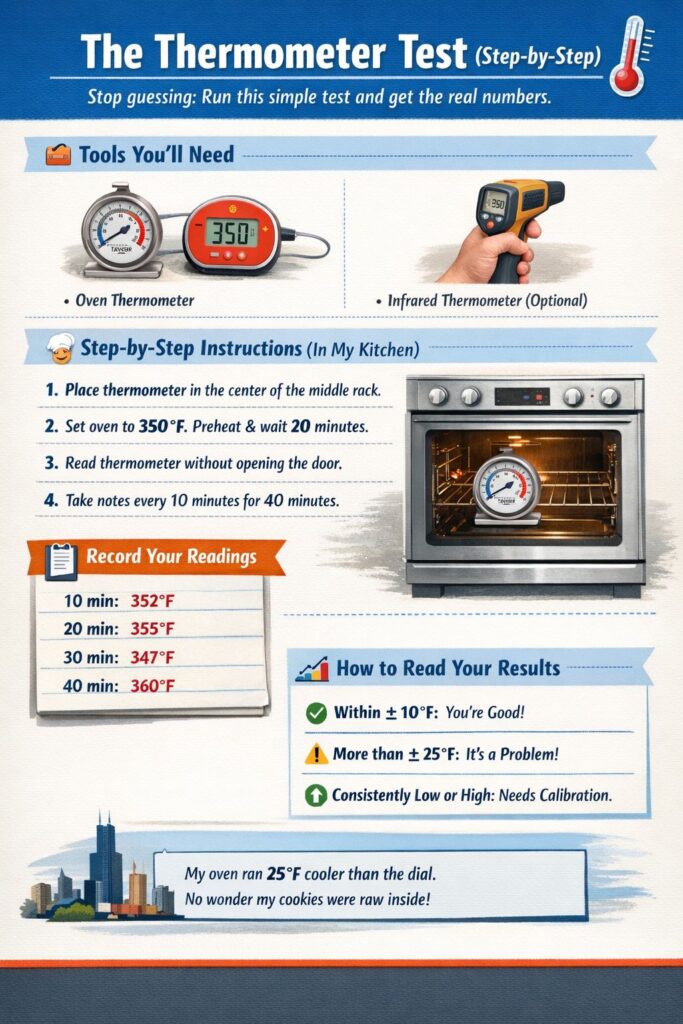
This is what I call the “Saturday Morning Truth Session.” It’s how I calibrate every new kitchen I work in before I ever crack an egg.
To do this right, you need about an hour of quiet time and a digital probe thermometer. Don’t trust the “ready” beep. Most ovens beep when the sensor near the heating element gets hot, but the air in the middle of the oven is still cold.
- Step 1: Place your thermometer probe exactly in the center of the middle rack.
- Step 2: Set your oven to 350°F and wait for it to “preheat.”
- Step 3: Once it beeps, do nothing. Wait another 20 minutes for the walls to soak up the heat.
- Step 4: Record the temperature every 10 minutes for a full hour.
Why an hour? Ovens work in cycles. They turn on, get too hot, turn off, and get too cold. It’s a constant wave. By taking six readings, you can find the true average. If your average is 340°F when you set it to 350°F, you know you have a 10-degree “cold” offset.
Regional Factors: Altitude, Humidity, and Power Grids
I’ve cooked in high-rise condos in Denver and beach houses in Miami. The air outside your house actually changes how your oven behaves.
If you live in a high-altitude state like Colorado or Utah, the air is thinner. This means moisture evaporates faster. I’ve noticed my cakes dry out quickly there. You might need to bump your temp up by 15 degrees to get that gold-brown crust before the inside turns into sawdust.
- Humidity: In the South, heavy air can make electric ovens feel “sluggish” to reach temp.
- Old Wiring: If you live in a beautiful historic home in New Orleans, your voltage might sag during peak hours.
- The Winter Effect: In Minnesota, a cold kitchen wall can “steal” heat from a poorly insulated oven.
I once stayed in an old farmhouse where the oven took 40 minutes just to hit 300°F. The wiring just couldn’t pull enough juice. If you notice your lights dim when you turn on the broiler, you aren’t crazy—your house is just working hard.
How to Calibrate Your Oven (The DIY Fix)
You don’t always need a repairman to fix a lying oven. Most modern brands like Whirlpool, LG, and GE have a secret “Calibration Mode.”
I remember helping a friend who thought her oven was broken. She was about to spend $800 on a new one. I sat on her kitchen floor, held two buttons down, and adjusted the offset by 20 degrees. It took two minutes. She saved $800, and I got a free steak dinner out of it.
- Check the Manual: Look for “Temperature Offset” or “Calibration.”
- The Secret Combo: Usually, you hold “Bake” and “Settings” together for 5 seconds.
- The Adjustment: Use the arrows to tell the computer, “Hey, when I say 350°F, I really mean 365°F.”
- Test Again: Always run a 20-minute check after you save the settings.
If you have an older gas oven with a manual dial, you can sometimes pull the knob off. Look for a tiny screw on the back of the knob. Turning it slightly can shift where the pointer sits. It’s tactile, old-school, and very satisfying to fix with your own hands.
Maximizing Heat Retention and Stability
Once you know the truth, you have to keep that heat where it belongs—inside the oven box.
I have a bad habit. I like to “peek.” I open the door just an inch to smell the bread. In a professional kitchen, my head chef would yell at me for that. Every time you open that door, you can lose 25 to 50 degrees in three seconds.
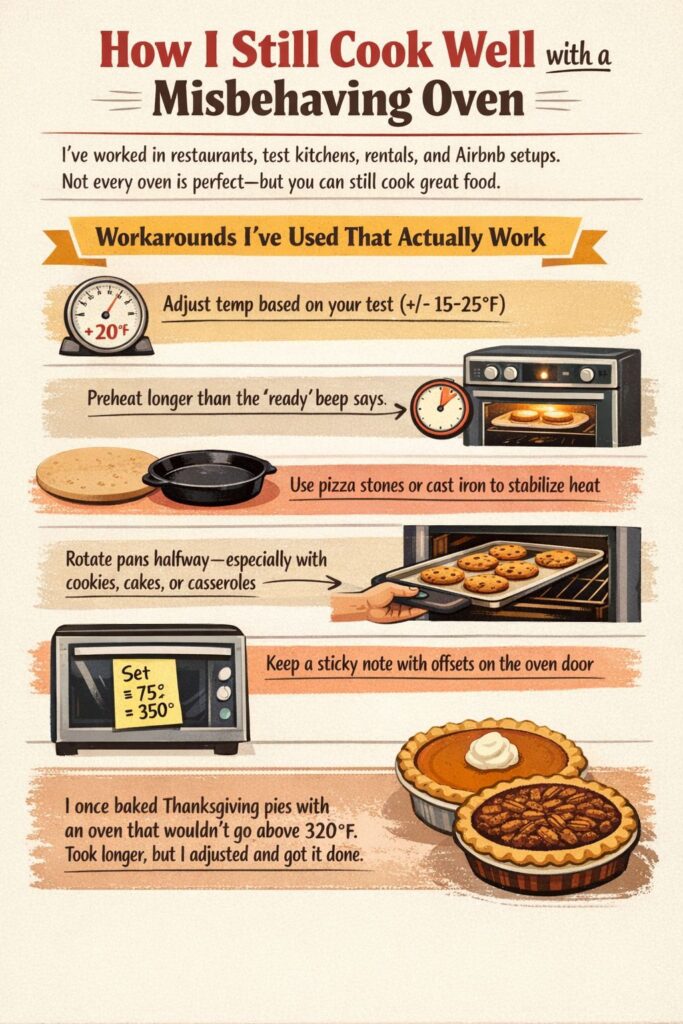
- Use a Pizza Stone: Leave a stone on the bottom rack. It acts like a battery for heat.
- Cast Iron Power: Even an empty cast iron skillet helps keep the air temp steady.
- Seal the Deal: Take a damp rag and wipe your door gasket. If it’s crusty with old food, it won’t seal right.
- Rack Logic: If you’re roasting a big US-style prime rib, keep it low. If you’re browning mac and cheese, go high.
I’ve found that placing a heavy baking sheet on the rack below your food can also block direct “scorch” heat from the bottom element. It’s like giving your cookies a little umbrella so they don’t burn.
Troubleshooting Common US Oven Brands
Every brand has its own “personality.” After years of working in different kitchens, I’ve learned that a Samsung doesn’t act like a Viking.
In the US, most of us have one of the “Big Five” brands. I’ve noticed that Samsung and LG ovens love their technology. They have beautiful screens, but those sensors can be very sensitive. If you use the self-clean mode too often, the high heat can actually fry the calibration sensor. I learned that the hard way after a “clean” cycle left my oven 50 degrees cold.
- GE and Whirlpool: These are the workhorses. They usually stay accurate, but their heating elements (the coils) can wear out after 5 or 6 years.
- Viking and Wolf: These are pro-grade. They get very hot, very fast. If you aren’t used to high-BTU gas, you will burn your toast.
- KitchenAid: Often runs a bit hot in the back-right corner near the convection fan.
I once worked in a house with a brand-new smart oven. It tried to tell me when the chicken was done via an app. The app said “Ready,” but my hand-held thermometer said “Wait.” Always trust a physical tool over a WiFi signal. Technology is great until it ruins your Sunday dinner.
The Sensory Guide: Using Your Eyes and Ears
You can often hear or see an inaccurate oven before you even taste the food.
I like to sit on a stool in the kitchen and just listen sometimes. A healthy oven has a rhythmic “click” and a steady hum from the fan. If the fan sounds like a bird trapped in a box, it’s not moving air correctly. Without airflow, your temperature readings will be all over the place.
- The Orange Glow: Your bottom element should be a bright, even orange. If there are dark spots, that part of the coil is dead.
- The Door “Wobble”: Give your oven door a little shake. If it feels loose, you are losing heat through the top gap.
- The Smell of Gas: In gas ovens, a faint smell is normal at the start. A strong smell means your igniter is weak and taking too long to light.
I remember a client who complained her cookies were always raw on one side. I looked at her oven door and saw a tiny piece of dried pasta stuck in the hinge. It kept the door open just a fraction of an inch. That tiny gap was dropping her temp by 30 degrees.
Pro Chef Maintenance: The 10-Minute Tune-Up
You don’t need a toolbox to keep your oven honest; you just need a little bit of care.
I treat my oven like my car. I don’t wait for it to break down on the highway. Once a month, I do a quick “health check.” This keeps my oveninsights sharp and my food consistent. It’s much easier to clean a small spill now than to scrape off a carbonized mountain later.
- Clean the Sensor: That little metal rod in the back? Wipe it with a damp cloth. Grease on the sensor makes it think the oven is hotter than it is.
- Tighten the Hinges: Use a screwdriver to snug up the door screws. It makes a world of difference.
- Check the Lightbulb: It sounds silly, but if you can’t see the food, you’ll keep opening the door. Peek through the glass, not the air.
Last month, I found a layer of burnt cheese at the bottom of my oven. Every time I turned it on, the smoke made me think the oven was overheating. It wasn’t the temp; it was just the mess. A clean oven is an accurate oven.
Summary of Actionable Steps
If you feel overwhelmed, just take it one step at a time. You can do this today.
Knowing how to tell if your oven temperature is accurate isn’t just for chefs. It’s for anyone who wants to enjoy their time in the kitchen. Start with the sugar test tonight. It’s fun, it’s cheap, and it’s a great science experiment for the kids.
- Buy a cheap thermometer (the $7 hang-type is fine).
- Run the hour-long test to find your average offset.
- Adjust your settings using the manual or the secret button combo.
- Stop peeking! Trust your tools and keep the door closed.
I’ve spent thousands of hours in front of these hot boxes. The most important thing I’ve learned is that every oven has a “soul.” Once you understand how yours breathes and heats, you stop fighting it. You start cooking with confidence. And that makes every meal taste better.icago—I’ve lived through it all. This guide? It’s everything I wish I’d known sooner.
Convection vs. Conventional: The Great Airflow Debate
In most American kitchens, you have to choose between a standard “Bake” setting and the “Convection” button. It’s a choice that trips up even some of the pro cooks I’ve hired over the years.
A conventional oven is like a still pond; the heat just sits there in layers. Convection is like a rushing river. A fan in the back blows that hot air around your food. This matters because moving air is much more efficient at transferring heat. If you turn on convection, your oven isn’t just “accurate”—it’s aggressive.
- The 25/25 Rule: Generally, if you use convection, you should lower the temp by 25°F and check the food 25% sooner.
- The “Cold Pocket” Problem: In a standard oven, the corners are often colder than the center. Convection fixes this.
- Crisping Power: If you want that perfect, shatter-crisp skin on a Thanksgiving turkey, convection is your best friend.
I once forgot to hit the convection button while roasting four trays of potatoes for a big brunch in Philly. Because the air wasn’t moving, the bottom tray was burnt and the top tray was barely cooked. I had to learn the hard way that “accurate” heat doesn’t mean “even” heat. You need both to win.
Common Baking Failures and Their Heat Causes
Sometimes the cake tells you exactly what is wrong with your calibration before you even buy a thermometer.
I’ve had days where I felt like I forgot how to bake. My cookies would spread out into one giant, flat “puddle” on the pan. I thought I messed up the butter. I checked my recipe three times. Then, I realized my oven was running 30°F too cold. The butter was melting before the flour could set.
- The “Burnt Bottom, Raw Top” Syndrome: This usually means your rack is too low or your bottom heating element is working too hard.
- Leaning Cakes: If your cake rises more on one side, your oven isn’t level. Heat rises straight up, so a tilted oven creates a lopsided bake.
- Pale Crusts: If your bread looks like a ghost after 40 minutes, your oven isn’t hitting the “searing” temps needed for browning.
I remember a guy who told me his oven was “perfect” because the screen said 350°F. But his pizza crust was like wet cardboard. We did the sugar test, and it turned out his oven peaked at 350°F but then dropped to 290°F for ten minutes before kicking back on. That “swing” is a silent killer for crispy food.
The “Real World” Impact of Gas vs. Electric Heat
In the US, we are pretty split on gas ranges versus electric coils, and each one lies to you in a different language.
I grew up using gas. I love the flame. It feels real. But gas ovens are naturally more humid because burning gas releases water vapor. This is great for bread but can be tricky for crispy cookies. Electric ovens are very dry, which is why your toast gets so crunchy so fast in them.
- Electric Consistency: Electric elements usually hold a more stable temperature once they finally get hot.
- Gas Recovery: Gas ovens heat back up much faster after you open the door to baste a roast.
- The “Hot Start”: Some electric ovens “pulse” the broiler to help preheat. If you put food in too early, the broiler might scorch the top of your dish.
I worked in a studio once with a very old electric coil oven. Every time I turned it on, it smelled like a dusty attic. That dust was actually insulating the coils, making it run cold. A quick vacuum (once it was cool, of course!) made it run 15 degrees hotter the next day.
Final Thoughts from the Kitchen Floor
At the end of a long shift, I don’t care about the brand or the price tag of the stove. I care about the results.
Knowing how to tell if your oven temperature is accurate is about taking back control. It’s about not letting a $20 piece of digital hardware ruin your $50 Sunday roast. You don’t need to be a scientist. You just need to be a little bit curious and a little bit skeptical of that “ready” beep.
I still keep a cheap $7 thermometer in my oven at home. Even after twenty years in the industry, I don’t trust the dial. It gives me peace of mind. It lets me relax and enjoy a glass of wine while the kitchen smells like heaven. And isn’t that why we cook in the first place?
- Trust your nose. If it smells like it’s burning, it probably is—even if the timer says 10 minutes left.
- Trust your eyes. If it looks pale, give it more heat.
- Trust your tools. A $10 thermometer is more honest than a $2,000 computer.
I hope this helps you feel more at home in your kitchen. Cooking should be fun, not a guessing game. Now, go grab some sugar or a thermometer and find out what your oven is really thinking. You might be surprised by what you find.
The “Apartment Dweller” Special: Dealing with Older Manual Dials
I know many of you aren’t working with a $5,000 smart range. Maybe you’re in a cozy apartment in Brooklyn or a rental in Chicago with a white stove that looks like it’s from 1985. These manual dials are the trickiest of all because the “line” on the knob is thick and vague.
On these old-school units, the temperature can vary depending on how fast you turn the knob. If you “overshoot” 350°F and turn it back, the internal spring might sit differently than if you turned it up slowly. It sounds crazy, but I’ve tested it.
- The Mark Method: Once you find the true 350°F with your thermometer, use a silver sharpie to make a tiny dot on the control panel.
- The “Slow Turn”: Always approach your target temperature from the bottom (turning up) to keep the tension on the gas valve consistent.
- Knob Play: If the knob feels wiggly, the plastic inside might be cracked, causing the pointer to be off by 10 or 20 degrees.
I once lived in a place where “350” on the dial was actually “325,” and “400” was “425.” I spent a whole month wondering why my frozen pizzas were burnt on the edges and raw in the middle. A tiny silver dot on the stove saved my sanity—and my dinner.
Final Wisdom: You Are the Head Chef
At the end of the day, you are the most important sensor in the kitchen. No matter how much you spend on a Wolf or a Thermador, your intuition is your best asset.
Learning how to tell if your oven temperature is accurate is really about building a relationship with your tools. You’ve seen me talk about sugar melts, digital probes, and the way a fan sounds when it’s struggling. These aren’t just technical chores; they are the “secret sauce” that makes a home cook look like a professional.
- Consistency is Queen: Even if your oven is “wrong,” as long as it is consistently wrong, you can win. If it’s always 25 degrees cold, just set it 25 degrees higher.
- Don’t Stress the Swing: Remember, the air temp will always go up and down. Focus on the average, not the moment.
- Keep it Clean: A clean oven reflects heat better and smells a lot nicer.
I’m glad you stuck with me through this deep dive. I know it’s a lot of talk about hot air, but as someone who spends every day in the heat, I promise it’s worth the effort. Your next batch of chocolate chip cookies will thank you. Your Thanksgiving turkey will definitely thank you.
I’ll be back in the kitchen tomorrow, probably fighting with a different oven, but today, mine is dialed in perfectly. I think that deserves a celebratory tray of roasted potatoes. Go check your temp, stay curious, and happy cooking!
✅ FAQs
How can I tell if my oven temperature is accurate at home?
Place an oven thermometer on the middle rack and preheat to 350°F. Check the reading after 20 minutes. If it’s off by more than 10–15°F, your oven may need calibration.
Is it normal for oven temperature to fluctuate while cooking?
Yes, ovens cycle on and off to hold an average heat. Small swings are normal. Big swings can cause uneven baking and slow cooking, so testing helps you cook with confidence.
Can wrong oven temperature affect baking results?
Yes, wrong heat can burn tops and leave centers raw. Cakes may sink and cookies may spread too fast. Accurate heat gives steady, repeatable results every time.
Do gas and electric ovens have different accuracy issues?
Gas ovens often have hot and cool spots. Electric ovens heat more evenly but can still drift over time. Both types should be tested with a thermometer for best results.
When should I recalibrate or repair my oven temperature?
If your oven is always too hot or too cool by over 20°F, recalibration helps. If temps still swing a lot, a sensor or door seal may need repair.