Hey, I’m Mossaraof. I’m a cook and food blogger. One night, I baked cookies. Half were raw. Half were burnt. That made me ask, why does my oven cook unevenly? I’ve tested ovens for years. In this guide, I’ll show you what’s really going on — and how to fix it.
If you’re still getting used to how your oven works, this also helps to read my full walkthrough in The Complete Guide to Using an Oven at Home, where I break down heat, racks, settings, and safety in plain, real-life terms.
The Hidden Science of Oven Airflow
If air does not move, food does not cook right. Heat needs to flow like water around your pans to reach every corner.
When I am in the zone, I tend to slide pans in fast. I don’t always think about the gaps. If you block the heat, you get “cold spots” and “hot zones” that ruin your meal.
- The Foil Trap: Many of us use foil to catch drips. It seems smart. But foil blocks the vents. Heat gets stuck at the bottom and burns the base of your food.
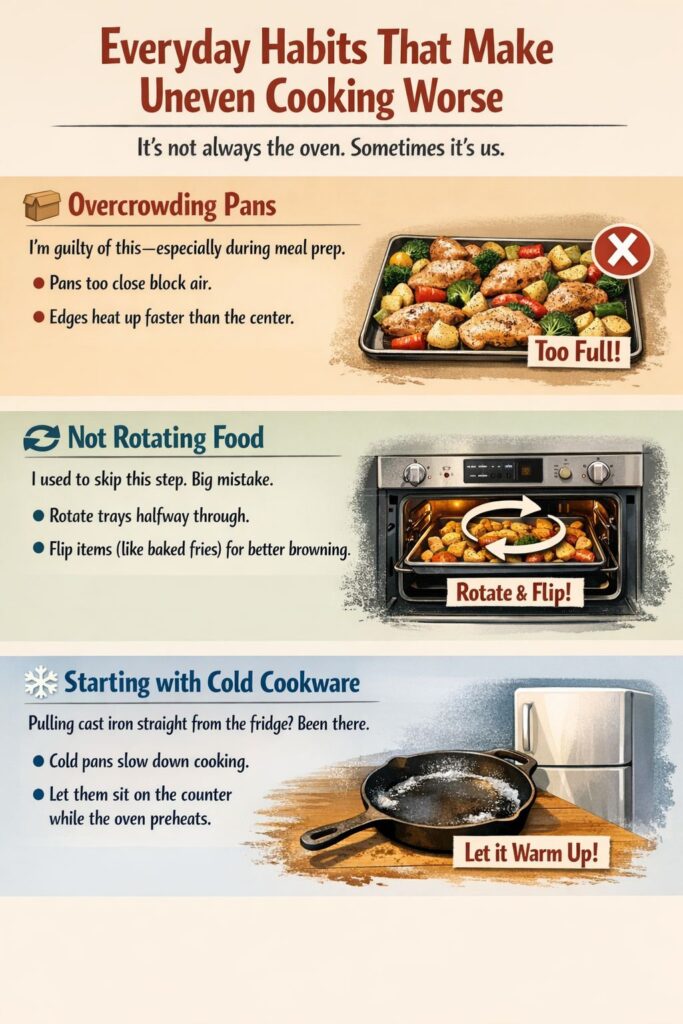
- Crowded Racks: On Sundays, I try to cook everything at once. I cram in the meat, the roots, and the rolls. This stops air from moving.
- Wall Contact: If your pan touches the back wall, it picks up direct heat from the metal. This leads to those scorched edges we all hate.
Why Does My Oven Cook Unevenly and Burn Food? The Hot Spot Mystery
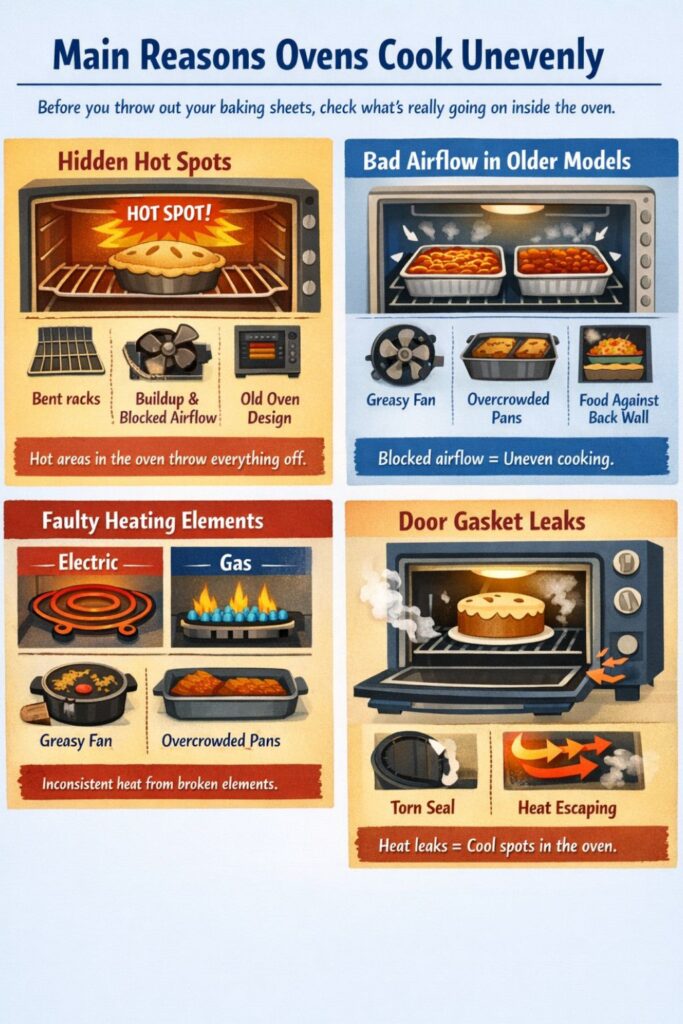
Every oven has a soul. Some are warm and kind. Others have a mean streak in the back left corner that burns everything it touches.
I once worked with an old GE range that had a mind of its own. It would stay cool for ten minutes and then spike like a fever. You need to know your oven’s “map” to win this game.
Finding Your Oven’s Secret Maps
You can’t see heat, but you can see bread. I use the “Toast Test” to find out where the fire hides in my kitchen.
- The Bread Method: Lay cheap white bread slices across the middle rack. Turn the oven to 350°F.
- Watch the Color: After five minutes, pull the rack out. See which slices are dark brown and which are still white.
- The Results: This shows you exactly where your oven is “hot.” Now you know why your cookies burn on the left side but stay gooey on the right.
The Problem with Thin Pans
In the U.S., we love our big sheet pans. But the cheap, thin ones warp. You hear that bang sound? That is the metal twisting.
When a pan warps, the oil runs to one side. The food on the “low” side fries in oil. The food on the “high” side burns in dry air. Invest in a heavy-duty rimmed baking sheet. It stays flat and spreads heat like a pro.
Dealing with Altitude and Humidity
Our weather in the U.S. is wild. What works in a dry Denver kitchen won’t work in a humid Florida home.
If you live high up, air is thin. It does not hold heat well. Your oven might say it is hot, but the food takes forever. Then, the outside burns before the inside is safe to eat.
- Humidity Issues: Moist air can make your oven feel “heavy.” Crusts don’t get crisp. You might over-bake things just to get a crunch, which leads to burnt bottoms.
- Temperature Swings: In cold states, a drafty kitchen pulls heat out of the oven door. The front stays cool while the back stays hot.
The Great Thermostat Lie: Why 350°F Isn’t Always 350°F
Most of us trust that digital beep. We hear it and think the oven is ready. But usually, that beep is just a guess made by a cheap sensor.
I once tested a brand-new range in a friend’s kitchen in Ohio. The screen said 350°F, but my hand felt like it was in a blast furnace. I put a real thermometer inside and it read 410°F! No wonder her biscuits looked like hockey pucks.
- The Sensor Lag: That little metal rod in the back gets coated in grease. It stops “feeling” the heat correctly.
- Calibration Drifts: Over a few years, the control board just gets tired. It might run 20 degrees hot or cold.
- The Recovery Time: Every time you peek inside, you lose 25 degrees of heat. The oven then over-fires to catch up, which scorches your food.
Why Does My Oven Cook Unevenly and Burn Food? The Rack Position Trap
Where you put your pan is just as big as the temperature you set. It’s like picking a seat at a concert; too close to the speakers and your ears ring.
In most U.S. homes, we just leave the racks where they are. We never move them. I used to be lazy about this too, until I realized my bottom rack was a “scorched earth” zone.
- The Bottom Rack: This is closest to the heating element or the gas flame. It is great for pizza but a death sentence for delicate cookies.
- The Top Rack: Heat rises and gets trapped at the ceiling. Use this for browning the cheese on your lasagna, not for baking a whole chicken.
- The Middle Path: This is the safe zone. It allows air to flow above and below the pan equally. If you have two racks in, stagger your pans so they aren’t directly on top of each other.
The Power of the Rotation: A Chef’s Secret Weapon
In the professional world, we don’t just “set it and forget it.” We engage with the heat. We move things around to keep them safe.
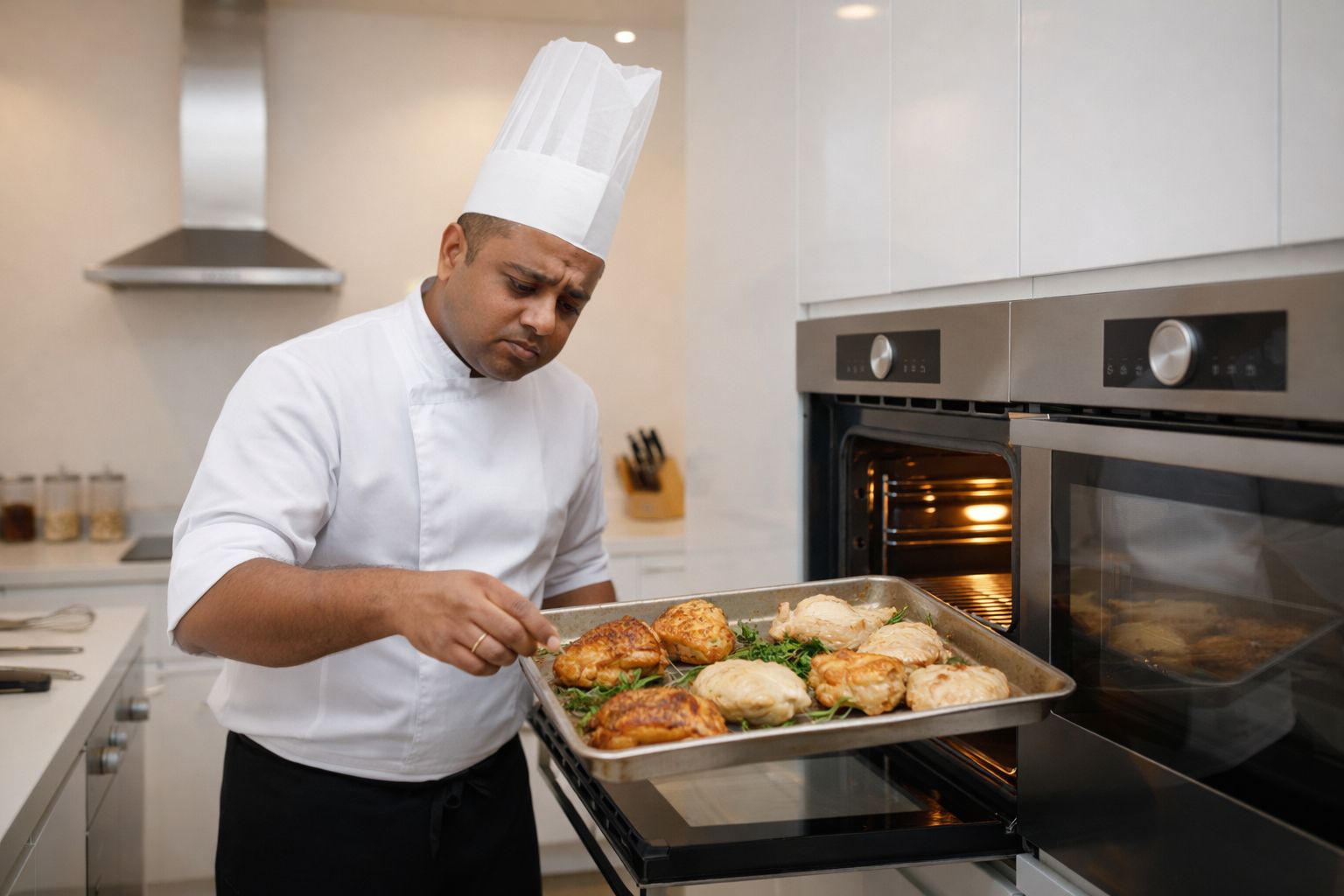
I have a habit now. I set my timer for half the cook time. When it beeps, I open the door fast. I grab the pan and spin it 180 degrees. This fixes almost every “why does my oven cook unevenly” problem instantly.
Why Rotating Works
Most ovens have a “hot side.” Usually, it is the back because it’s further from the door’s draft. By spinning the pan, you give both sides of your chicken a turn in the “hot seat.”
- Be Quick: Don’t leave the door open too long. You want to keep that heat trapped inside.
- Use Good Mitts: I like the heavy silicone ones. They give you a better grip when you’re moving hot, heavy trays fast.
- Don’t Jostle: If you are baking a cake, wait until it is “set” before you spin it. If you move a wobbly batter too soon, it will collapse.
The Hidden Impact of American Kitchen Brands
We have a lot of choices in the U.S. when it comes to appliances. But each brand has its own quirks that can lead to burnt dinners.
I’ve cooked on old Frigidaires and fancy new Bosch units. They all have a “personality” you have to learn. Some are built for speed, others for steady heat.
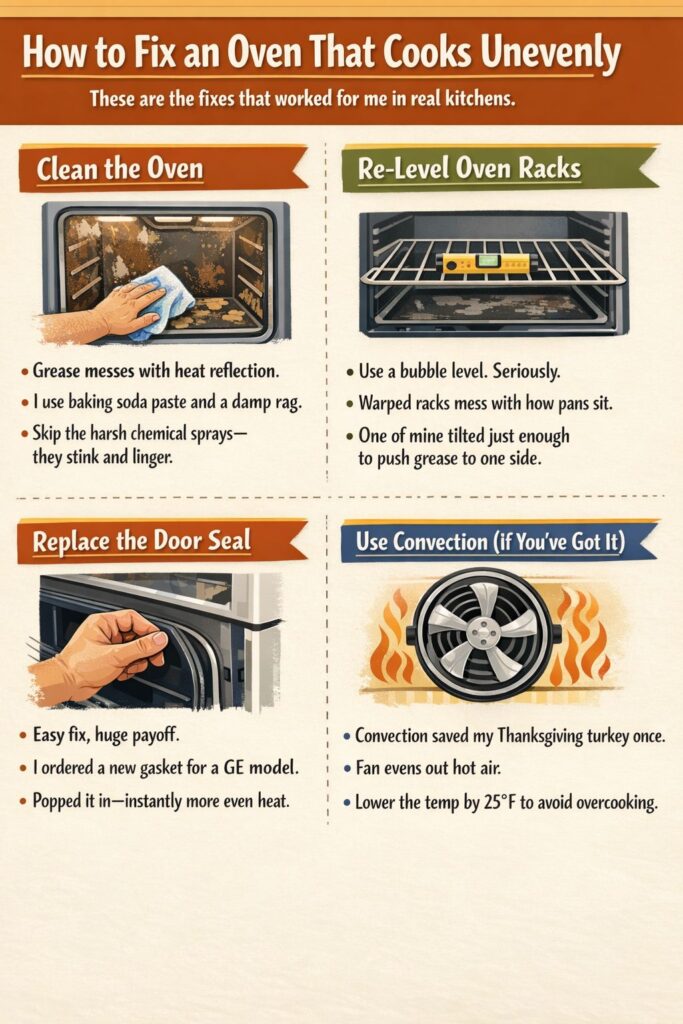
Convection Settings: Many modern U.S. ovens have a “Convection” button. It’s a fan that moves air. It’s great, but it cooks 25% faster. If you don’t lower your temp, you will burn everything.
Electric Coil Ranges: These are common in older rentals. The coils can tilt. If your coil is crooked, your pan is crooked. That means one side of your food is closer to the red-hot metal.
Gas Ranges with Baffles: Some gas ovens have a metal plate over the flame. If that plate is thin, it gets “hot spots” right in the center. Your muffins will burn in the middle and stay raw on the edges.
The Battle of the Pans: Glass vs. Metal in Your Oven
What you bake in is just as vital as the heat itself. I learned this the hard way during a busy Sunday brunch. I used a glass dish for brownies and a metal one for cake. One came out like a brick, the other was a dream.
In the U.S., our cupboards are full of Pyrex and heavy aluminum sheets. But these materials don’t treat heat the same way. Why does my oven cook unevenly and burn food? Sometimes it is the pan’s fault, not the oven’s.
- Dark Metal Pans: These are heat magnets. They get hot fast and stay hot. If you bake cookies on a dark pan, the bottoms will burn before the tops are set.
- Shiny Aluminum: These reflect heat. They are the gold standard for even browning. Most pros use Nordic Ware or similar brands for a reason.
- Glass and Ceramic: These are “insulators.” They take a long time to get hot. But once they are hot, they don’t stop. They keep cooking your food even after you pull it out.
The “Pizza Stone” Hack for Thermal Mass
If your oven temperature jumps up and down, you need a stabilizer. Think of it like a heavy anchor for a small boat in a choppy sea.
I keep a heavy baking stone on my bottom rack at all times. It is stained and ugly, but it is my best friend. It holds onto heat and shares it slowly with the air around it.
- Steady Heat: When you open the door to check your roast, cold air rushes in. A stone keeps the “floor” of the oven hot so the temp doesn’t crash.
- Better Crusts: If you struggle with soggy bottoms on your pies or pizzas, the stone is the fix. It gives that instant “pop” of heat to the dough.
- Where to Put It: Keep it on the very bottom rack or the floor of an electric oven. Just don’t let it block the actual heating elements.
Deep Cleaning for Heat Consistency
A dirty oven is a moody oven. I know, cleaning the oven is the worst chore in the kitchen. But those burnt bits of cheese and grease at the bottom are doing more than just smelling bad.
I once ignored a spill for a month. Every time I turned the oven on, it smoked. That smoke coated the temperature sensor. My oven thought it was 400°F when it was barely 300°F.
- Carbon Buildup: Those black spots on the walls absorb heat instead of reflecting it. This creates “cold zones” in your oven.
- The Sensor Rod: Find that little copper-colored stick in the back. If it is covered in grime, wipe it gently with a damp cloth. It needs to “feel” the air to work.
- Avoid the “Self-Clean”: Many U.S. repair pros hate the self-clean button. It gets so hot it can fry the wires or the control board. Use a good old-fashioned scrub instead.
Why Does My Oven Cook Unevenly and Burn Food? The Door Gasket Leak
Heat is like a ghost; it wants to escape through any crack it can find. Your oven door has a rubber or fiber seal called a gasket. Over time, it gets brittle.
I noticed my front-facing food was always pale. I felt a tiny breeze near the handle. My seal was shot. The oven was working overtime to stay hot, which meant the back of the oven was a furnace.
- The Paper Test: Close the door on a piece of paper. If you can pull it out easily, your seal is loose.
- Replacing the Seal: Most U.S. brands like Whirlpool or Maytag make it easy to buy a new one. It usually just snaps into a track.
- A Simple Fix: A new seal can save you 10-15% on your energy bill. More importantly, it stops your food from burning in the back while staying raw in the front.
Gas vs. Electric: The Great American Kitchen Debate
Whether you are cooking in a gas-fired kitchen or using a standard electric coil, your fuel source changes how heat moves. I’ve lived in apartments with both, and you have to adjust your “chef brain” for each one.
In the U.S., many of us swear by gas because it feels more “real.” But gas ovens are actually much more prone to hot spots. Why does my oven cook unevenly and burn food when it’s gas? It’s often because the flame is a very intense, central heat source.
- Electric Heat: These ovens use large coils. They take a while to heat up, but they provide a very steady, dry heat. This is great for crispy cookies.
- Gas Heat: Burning gas creates moisture. This is amazing for roasting a juicy chicken, but it can make your bread crusts a bit soft if you aren’t careful.
- The Venting Factor: Gas ovens need to “breathe.” They have vents that let air in and out. If you push your pans too close to these vents, you disrupt the flame and get uneven results.
Using a Manual Thermometer: The Truth Teller
I never trust the digital display on my oven anymore. It’s like a car speedometer that’s off by ten miles per hour—eventually, you’re going to get a ticket (or a burnt cake).
I keep a small, stainless steel thermometer hanging right on the middle rack. It cost me about seven dollars at a local hardware store, and it saved my sanity. It’s the only way to truly answer “why does my oven cook unevenly.”
- The Delta: I’ve found that many home ovens are off by 25 degrees. If I want 350°F, I might have to set my dial to 375°F.
- Visual Checks: Place the thermometer where you can see it through the glass door. Don’t open the door just to read it, or you’ll lose the very heat you’re trying to measure!
- Multiple Zones: Every now and then, move the thermometer to the left side, then the right. This confirms what your “Toast Test” already told you.
The “Day in the Life” Fix: My Personal Routine
When I’m planning a big meal, I don’t just turn the oven on and start. I have a ritual. This ritual ensures that even if my oven is being “fussy,” my food comes out looking like a magazine cover.
Last Thanksgiving, I was working in a tiny kitchen with a very old range. I had to be smart. I didn’t want the turkey to be a disaster.
- The Long Preheat: I turn my oven on at least 30 minutes before I need it. Even if the beep goes off after 10 minutes, the walls of the oven are still cold.
- The Center Shift: I try to cook one thing at a time in the dead center. If I have to cook two things, I swap their spots halfway through.
- The Sensory Check: I use my nose. If I smell “sugar” or “toast” too early, I know the oven is running hot. I don’t wait for the timer; I act right then.
Actionable Checklist for Your Next Bake
Before you put your next tray in, go through this list. It sounds simple, but these small steps stop the burn before it starts.
We all want that perfect golden brown. We want the “snap” of a good crust. Here is how I make sure that happens every single time I cook.
Timer Prep: Did I set my timer for 10 minutes early so I can check for hot spots?ecause I’ve been there. And now? My cookies come out golden. Every time.
Rack Check: Is the rack in the middle? Is it level?
Pan Quality: Am I using a heavy pan or a flimsy one? (Go heavy!)
Space Out: Is there at least two inches of space between my pan and the oven walls?
Why Specific U.S. Favorites Burn: Troubleshooting Your Classics
I’ve had my fair share of “kitchen fails” with American staples. Sometimes it is the oven, but sometimes it is the way we prep our favorite dishes.
The stuff we love to cook—frozen pizzas, heavy casseroles, and sheet-pan dinners—all react differently to heat. Why does my oven cook unevenly and burn food when I’m just trying to make a quick Tuesday night dinner? Usually, it’s a mismatch between the food’s density and the oven’s airflow.
- The Frozen Pizza Trap: These are designed for high heat. If you put them on a cold baking sheet, the cheese burns before the crust is crisp. I slide mine right onto the rack (or a preheated stone) for the best snap.
- The Casserole Cold-Core: Dense dishes like lasagna or mac and cheese are heat sinks. The edges bubble and burn while the middle stays like ice. I always tent the top with foil for the first 20 minutes to let the middle catch up.
- Sheet-Pan Chickens: We love the one-pan meal. But if you put watery veggies like zucchini next to the meat, the steam keeps the chicken from browning. I give the meat its own “island” on the tray so the air can reach it.
The “Cold Door” Effect in Winter
If you live in a place like Minnesota or Maine, your kitchen gets cold. That thin piece of glass on your oven door is the only thing between 400°F and a drafty 60°F room.
I noticed during a winter in Chicago that my cakes were always lopsided. The side near the door was shorter than the side in the back. The glass was letting too much heat escape.
- The Window Loss: Even a double-pane oven door loses heat. This is why the front of your tray is often undercooked compared to the back.
- The Solution: If it’s freezing outside, don’t leave your kitchen window open while you bake. It creates a “micro-draft” that pulls heat right out of the oven seals.
- Use the Light: Every time you open the door to “peek,” you drop the temp. Use the oven light and the window. If the window is too dirty to see through, that’s your sign to give it a scrub!
When to Face the Music: Is it Time for a New Oven?
I hate to be the bearer of bad news, but sometimes the “why” behind the burn is just old age. Appliances in the U.S. are built to last a long time, but they aren’t immortal.
If you’ve calibrated, cleaned, and rotated, and your food still looks like a disaster, your heating elements might be failing. It happens to the best of us.
- Checking the Coils: Turn your electric oven on. Are the coils glowing a bright, even red? If there are dark spots or “blisters” on the metal, the element is dying.
- The Gas Igniter Click: Does your gas oven click for a long time before it lights? That “poof” sound of a late ignition means the igniter is weak. This causes huge temperature spikes that burn food.
- The Cost of Repair: Often, a new element or igniter is only $30 to $50. It’s a cheap DIY fix that can save a $2,000 range. I always try the cheap fix first!
My Final “Chef’s Secret” for Perfect Results
If you want to stop the “Why does my oven cook unevenly and burn food” cycle for good, you need to be the boss of the box. Don’t let the machine tell you when the food is done.
I rely on my senses more than any digital timer. I use my nose, my eyes, and a simple meat thermometer.
- The Smell Test: About five minutes before the timer goes off, walk into the kitchen. If it smells like “baked goods,” it’s close. If it smells “sharp,” it’s starting to burn.
- The Finger Poke: For cakes and breads, a quick poke should result in a springy feel. If it leaves a dent, it needs more time.
- Trust the Internal Temp: I use a digital probe for meats. It doesn’t matter what the oven says the temp is; it only matters what the chicken says.
FAQs
Why does my oven cook unevenly even after preheating
Because heat does not spread the same in all spots. Hot areas form near walls or racks. This can cause some food to burn while other parts stay pale.
Why does my oven cook unevenly on the bottom
Bottom heat is often stronger in many ovens. If the rack is too low, food can burn under while the top stays soft. Moving the rack can help.
Why does my oven cook unevenly when baking cookies
Cookies sit flat and feel heat fast. If hot spots are there, some bake fast and others stay soft. Turning the pan halfway helps even things out.
Why does my oven cook unevenly in gas and electric models
Both types can have hot spots. Gas ovens may heat in waves. Electric ovens may cycle on and off. Both can cause uneven baking at times.
Why does my oven cook unevenly and how can I fix it
Try moving racks to the middle and turning pans during baking. Clean spills that block heat. An oven thermometer can also show heat issues.