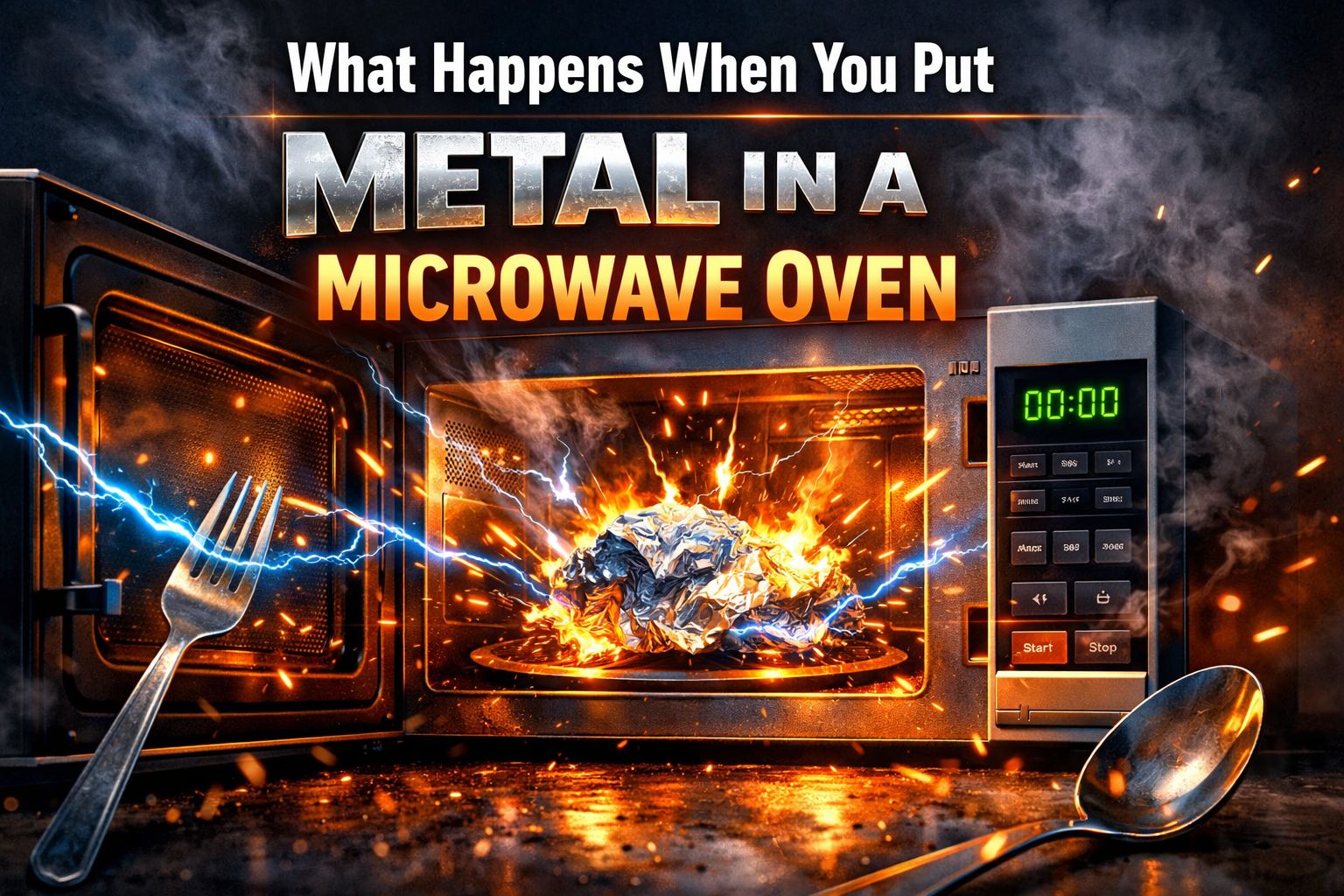
Hey, I’m Mossaraof — a professional cook and food blogger. One night, I tried to heat leftovers on a foil plate, and sparks flew. That’s when I learned what happens when you put metal in a microwave oven. It’s not just about safety — it’s about knowing what’s okay and what’s not. If you’re just starting out, The Complete Guide to Using an Oven at Home can help you master the basics before things go sideways.
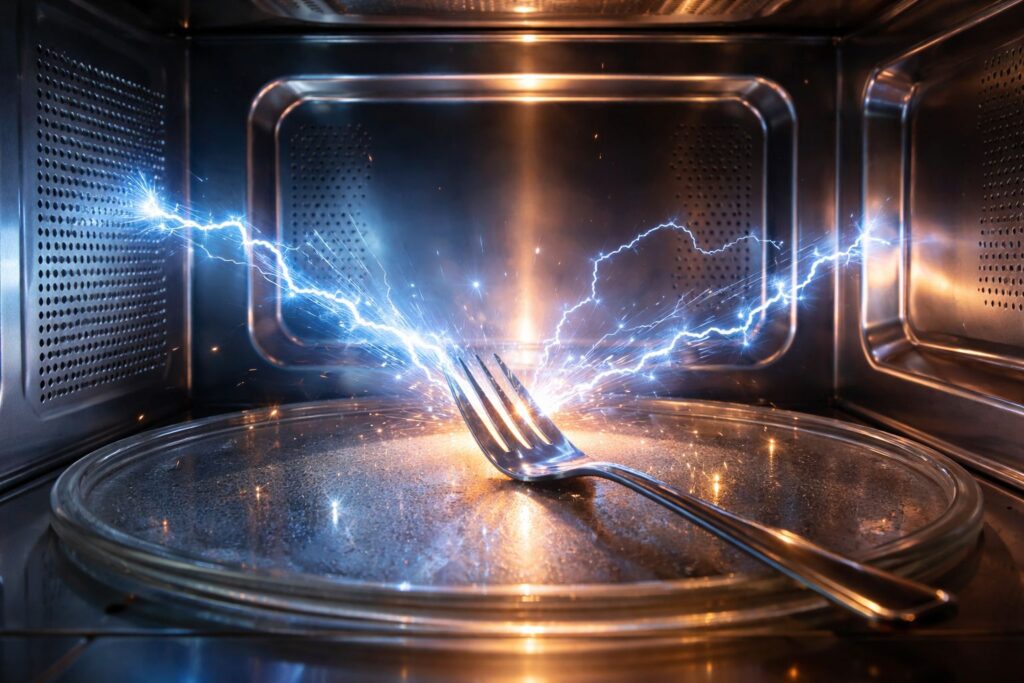
The Science of the Spark: How Microwaves Interact with Metal
This section breaks down the invisible dance between electromagnetic waves and conductive materials to explain the “why” behind the sizzle.
It was a rainy Tuesday in my test kitchen when I first really looked at how these waves work. I had a cup of coffee and a curious mind, wondering why my Panasonic microwave didn’t like my foil-wrapped burrito.
- Magnetrons: These are the heart of your microwave. They create short radio waves that bounce around the metal walls.
- Water Molecules: The waves hit your food and make water molecules flip back and forth fast. This creates heat.
- Conductors: Metal is a great conductor. Instead of letting waves pass through, metal reflects them or absorbs them.
In a normal US kitchen, we use glass or ceramic. These materials are like “windows” for microwaves. The waves go right through them to reach your soup or leftovers. Metal is more like a “mirror.” It sends the energy right back where it came from.
What Happens When You Put Metal in a Microwave Oven?
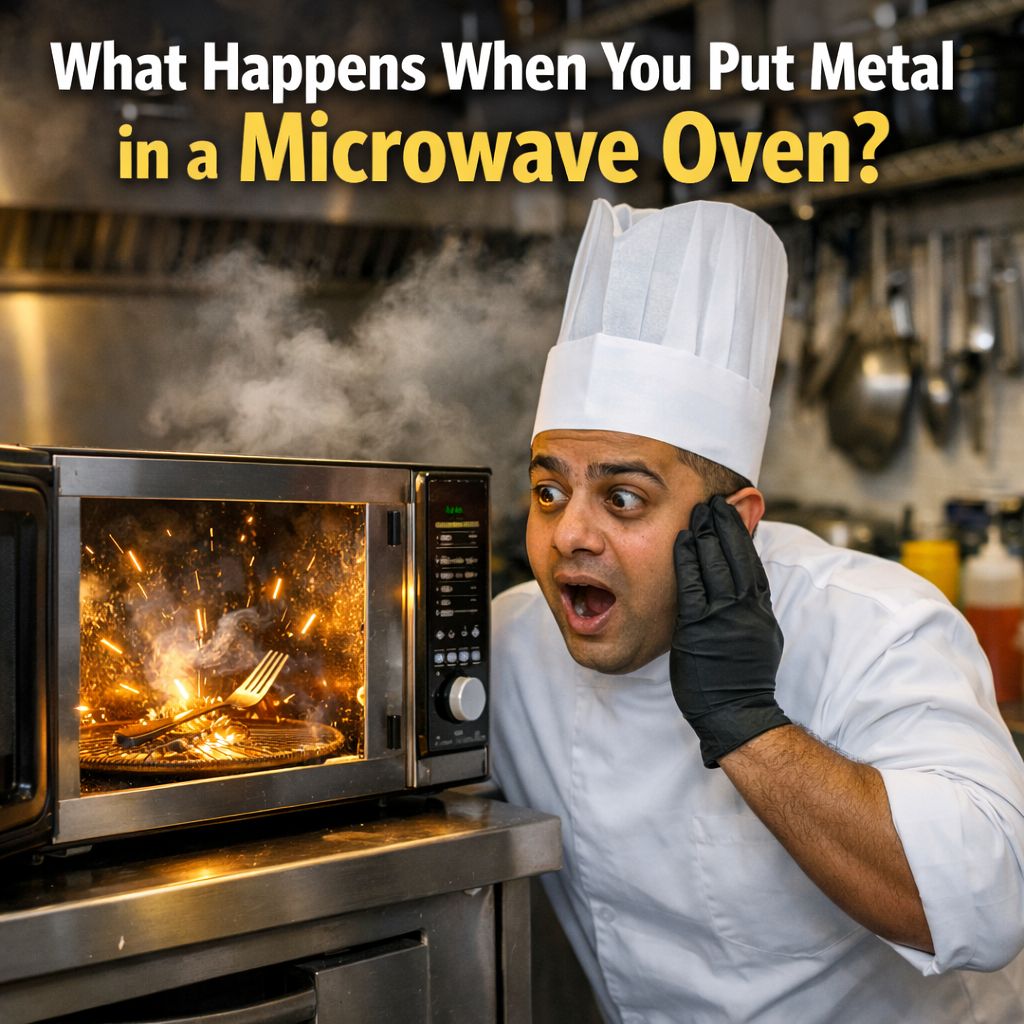
When metal enters the chamber, it acts like an antenna, catching waves and concentrating energy into a high-voltage flow.
I remember my first week in a professional kitchen. A young cook put a foil-lined tray in the unit, and the sound it made was like a bug zapper on steroids.
- Electron Flow: Metals have many free electrons. Microwaves push these electrons around very quickly.
- Voltage Build-up: If the metal is thin or has sharp points, the electricity builds up. It has nowhere to go.
- The Big Spark: The electricity eventually jumps through the air to reach the microwave wall. This is called arcing.
What happens when you put metal in a microwave oven is a fast chain reaction. The air around the metal gets so hot it turns into plasma. This is the bright light or “lightning” you see. It can happen in a split second, long before you can hit the “stop” button.
I once saw a microwave interior get scorched because of a single twist tie. These tiny wires get red hot instantly. Most US home insurance claims for kitchen fires start with simple mistakes like this. It’s not just about a ruined snack; it’s about your safety.
Not All Metal is Created Equal: Shapes and Thickness
I once accidentally left a heavy cast iron spoon in a bowl—nothing happened. Why? It’s all about the geometry of the object.
Thickness and shape change everything. Think of a lightning rod on top of a building in the Midwest. It’s designed to catch sparks because it’s pointy.
- Pointy Ends: Forks are the worst. The tines act like lightning rods. Electricity bunches up at the tips.
- Smooth Surfaces: A thick, smooth spoon might not spark at all. The electrons have plenty of room to move around.
- Wrinkles and Folds: Crumpled aluminum foil is a nightmare. Every little fold is a spot where a spark can jump.
I’ve tested this with high-end brands like Breville. Even the best sensors can’t stop physics. If you have a smooth metal bowl, it might just stay cool while the food inside stays cold. This is because the metal reflects the waves away from your lunch.
But don’t try this at home. Even if it doesn’t spark, it can reflect energy back into the magnetron. This can burn out your expensive appliance. It’s like throwing a ball at a wall—eventually, something is going to break.
Common Kitchen Culprits: What to Keep Out
From my years in the kitchen, these are the most common “accidental” metal items that cause $500 repairs.
It was a Tuesday morning when a friend called me in a panic. Her vintage Corelle plates were literally sparkling in her Samsung microwave. I had to explain that the “pretty” gold rim was actually real metal.
- Gold and Silver Accents: These thin layers of leaf vaporize instantly. They leave a permanent black “burn” on the plate.
- Takeout Boxes: Many US Chinese food boxes still use a small wire handle. It’s a tiny antenna for a massive spark.
- Travel Mugs: A YETI or Stanley cup is built to keep heat in. If you put it in a microwave, the waves just bounce off.
- Butter Wrappers: Some brands use paper lined with thin foil. It looks like paper, but it acts like a fire starter.
I once saw a “microwave-safe” bag that wasn’t. The small metal staple at the top turned red in five seconds. Most American kitchens are full of these hidden dangers. We think because it’s “food grade,” it’s safe. But a professional cook knows: if it reflects light like a mirror, it stays out of the box.
The Exceptions: When Metal is Actually Allowed
Believe it or not, some metal is designed for the microwave. You just have to know which ones and how to use them.
I remember unboxing my first high-end KitchenAid convection microwave. It came with a metal rack! I was terrified to use it at first. But the engineers design these to sit on plastic clips so they don’t touch the walls.
- Convection Racks: These are thick and smooth. They are spaced away from the oven floor.
- Susceptors: Think of a Hot Pocket sleeve. That gray material inside is actually a thin layer of metal.
- Frozen Meal Lids: Some “TV dinners” use a very thin foil lid. You have to peel it back exactly as the box says.
- Shielding: If you’re defrosting a large turkey, a tiny bit of foil on the wings can stop them from overcooking.
The trick is the “One Inch Rule.” Any metal must be at least one inch away from the oven walls. If the metal touches the side, it completes a circuit. That is when the damage starts. Most US brands like GE and Whirlpool have sensors now, but they can’t stop a physical arc.
Real-World Risks for the U.S. Homeowner
Safety isn’t just about the oven; it’s about your home insurance, your smoke detectors, and your peace of mind.
In the US, we love our “Quick Start” buttons. We hit “+30 seconds” and walk away to check our phones. I did this once with a bowl of soup that had a stray foil bit. By the time the beep went off, the kitchen smelled like burnt ozone.
- Fire Hazards: A spark can ignite the paper towel you put over your food.
- Appliance Death: The “Magnetron” is the most expensive part. One bad spark can fry its electronics forever.
- Interior Damage: Arcing burns off the white paint inside. Once the paint is gone, the metal underneath is exposed to rust.
What happens when you put metal in a microwave oven is a risk to your wallet too. A new built-in microwave can cost $400 to $800 to install in a modern American kitchen. It’s a high price to pay for forgetting to take a spoon out of the oatmeal.
I always tell my readers to check their smoke detector batteries. If a microwave fire starts, it’s fast. It’s smoky. And it’s loud. Most of us have our microwaves built into the cabinetry. If that catches fire, it spreads to the wood in minutes.
Professional Chef Tips: Keeping Your Kitchen Safe
I’ve trained dozens of line cooks; here is the checklist I give them to ensure the microwave doesn’t end up in the dumpster.
In my years at the restaurant, we used the microwave for quick tasks like melting butter or warming chocolate. One day, a new hire tossed a foil-wrapped stick of butter in our heavy-duty Amana. I caught it just as the first blue bolt hit the door.
- The Tap Test: Use your fingernail. If it makes a “clink” instead of a “thud,” it might have metal inside.
- Check the Bottom: Look for the squiggly lines symbol. If it’s not there, don’t risk it.
- Plastic-Free Zone: Even if it’s not metal, some US plastic brands like Ziploc have specific “Microwave Safe” versions. Others will melt into your food.
- Transfer Everything: I make it a rule. Take the food out of the takeout box and put it on a plain glass plate. It takes ten seconds and saves your kitchen.
I personally love using Pyrex glass. It’s a staple in American homes for a reason. It handles the heat without any drama. If you’re unsure about a bowl, heat it for 20 seconds next to a cup of water. If the bowl gets hot but the water stays cold, that bowl isn’t microwave-safe.
What to Do if You Accidentally Put Metal in the Microwave
If you hear that “bzzzt” and see blue light, your reaction time matters more than your brand of oven.
It happened to me once with a “fast food” burger wrapper. I thought it was just paper. Suddenly, my kitchen looked like a disco. I didn’t wait for the timer. I acted fast, and you should too.
- Hit the Stop Button: Don’t try to open the door while it’s arcing. Stop the power first.
- Unplug the Unit: If the sparks don’t stop, pull the plug from the wall. This is why I like countertop models like Black+Decker—the plug is easy to reach.
- Let It Cool: Don’t grab the metal object right away. It will be incredibly hot—hotter than the food.
- Check the Walls: Look for a small burnt hole or a black smudge on the side. This is usually on the “Waveguide Cover.”
If the damage is just a small black mark, you can often wipe it away with a damp cloth. But if the metal wall of the oven is actually pitted or melted, it’s time for a new one. Using a microwave with a hole in the interior wall is dangerous. It can leak radiation or cause more fires.
Long-Term Damage: What You Can’t See
Sometimes the sparks stop, and you think you’re in the clear. I’ve made that mistake before. I once ignored a small pop in my old Kenmore, only for it to die a month later during a big dinner party.
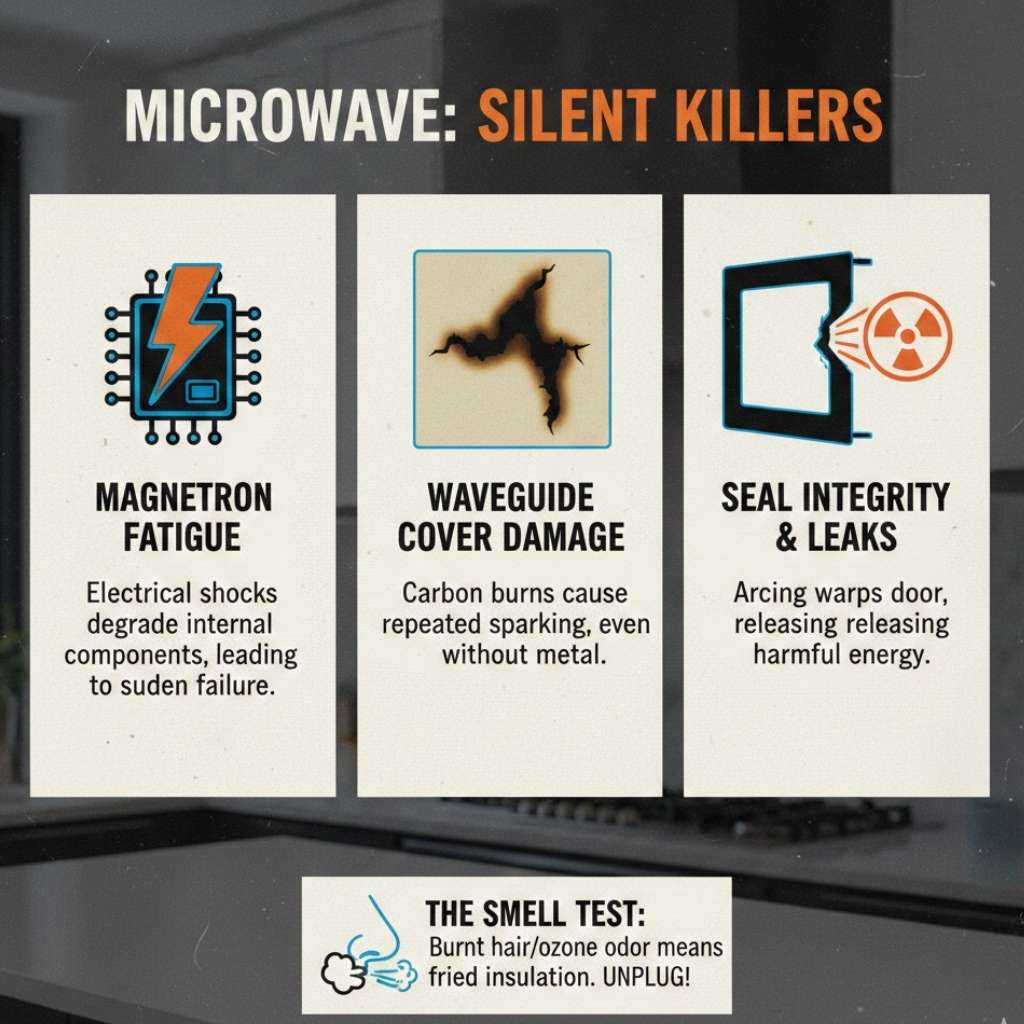
- Magnetron Fatigue: Every time your microwave arcs, it sends a shock back to the power source. This wears down the internal components faster.
- The Waveguide Cover: That little cardboard-looking square on the side? It’s crucial. If it gets a carbon burn (a black spot), it will start to spark even when there is no metal in the oven.
- Seal Integrity: Massive arcs can warp the door or the mesh screen. In the US, we have strict safety standards, but a warped door can leak microwave energy into your room.
I always tell my readers to do a “Smell Test.” If you’ve had a metal incident, and your microwave smells like burnt hair or ozone every time you turn it on, the insulation is likely fried. At that point, it’s a ticking time bomb for an electrical short.
Choosing Microwave-Safe Tools for the American Kitchen
Shopping for kitchen gear in the US can be overwhelming. From Target to Williams-Sonoma, the shelves are packed. But “dishwasher safe” does not mean “microwave safe.”
It took me years of melting plastic lids and ruining plates to finally build a safe collection. Now, my kitchen is a metal-free zone when it comes to the microwave shelf.
- The Glass Standard: Brands like Anchor Hocking or Pyrex are kings. They don’t react to the waves, so all the energy goes into your leftovers.
- Silicone over Plastic: I’ve switched to silicone lids. They don’t have BPA, and they won’t spark or melt like thin “microwave-safe” plastic wraps often do.
- Ceramic Checks: Most modern mugs are fine, but watch out for hand-painted stuff from craft fairs. Sometimes the glaze has lead or metallic bits that get incredibly hot.
I remember a client who bought a set of “stone” plates that got so hot in the microwave they cracked in half. The plates had high iron content. If you’re buying new dishes at IKEA or Walmart, look for the specific “Microwave Safe” stamp on the bottom. If it’s not there, it’s just a serving dish.
Final Thoughts from the Chef’s Counter
At the end of the day, your microwave is a tool of convenience. We use it because we’re busy, we’re tired, and we want that leftover pizza now.
I’ve spent my career around fire and heat. I’ve learned that the best way to avoid a disaster is to respect the equipment. What happens when you put metal in a microwave oven isn’t just a science experiment. It’s a fast way to lose a kitchen essential.
- Slow down: Take the extra five seconds to check for foil.
- Listen: If your microwave sounds like a buzzing bee, hit stop.
- Safety First: Keep a small fire extinguisher in your kitchen. Most US homes keep one under the sink—make sure yours isn’t expired.
I hope this guide helps you keep your kitchen running smooth and spark-free. I’m Mossaraof, and I’ve seen enough kitchen “fireworks” to last a lifetime. Let’s keep the heat in the food and out of the wiring.
❓ FAQ: What Happens When You Put Metal in a Microwave Oven
Can you put any kind of metal in a microwave?
No. Metal reflects microwaves, causing sparks that can damage your appliance or start fires.
Is aluminum foil safe in the microwave?
Only if flat and used exactly as directed. Crumpled foil sparks and is unsafe.
What should I do if I accidentally microwaved metal?
Stop the microwave, check for damage, and test it with water before using again.
Why did my coffee mug spark in the microwave?
It likely had metallic paint or a hidden steel layer, which causes arcing.
What are safe alternatives to metal in the microwave?
Use glass, ceramic, or microwave-safe plastic with no metallic trims or linings.