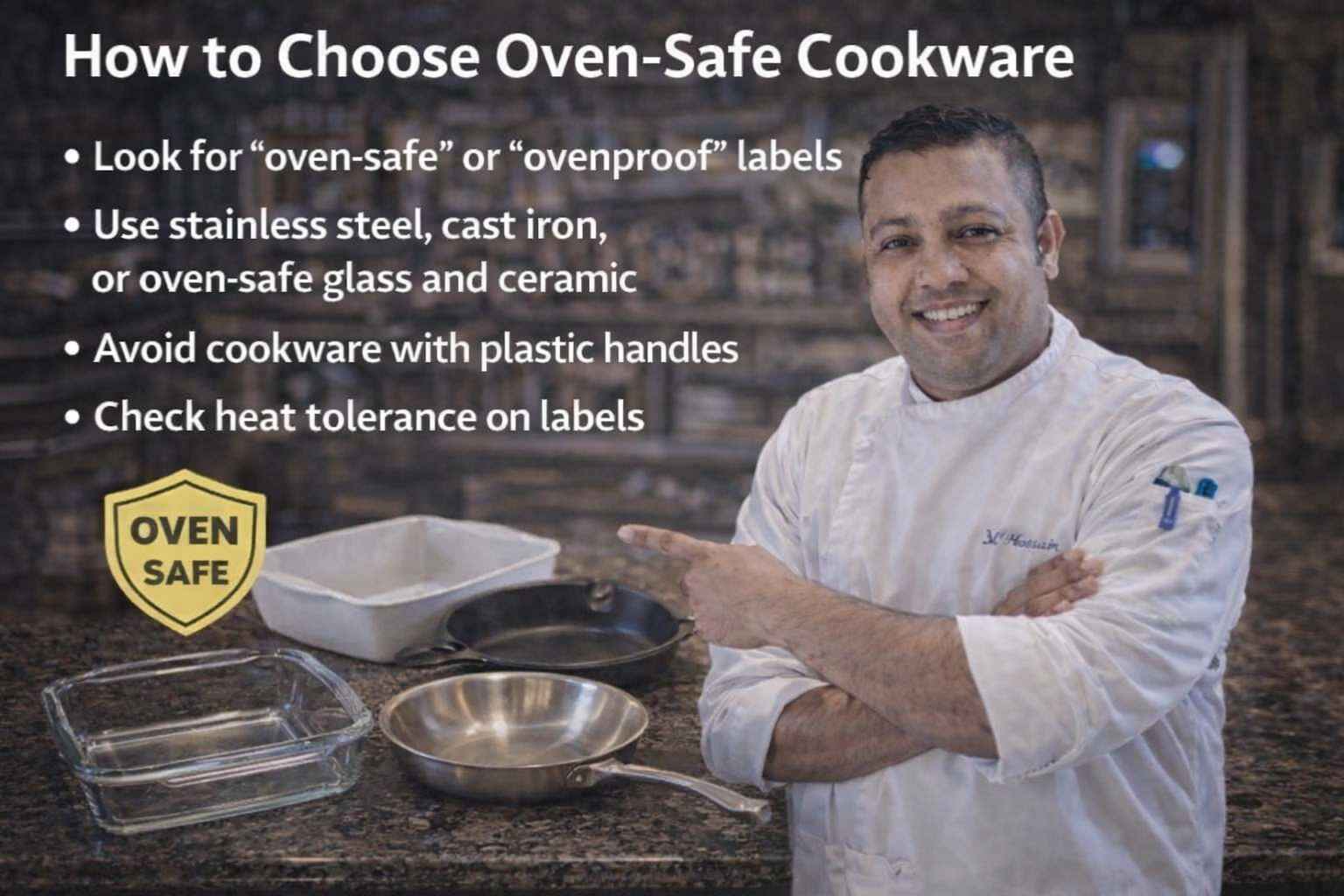
I once melted a pan handle during a busy dinner. The smell was awful. That mess taught me exactly How to Choose Oven-Safe Cookware. As a chef, I know safety comes first. I explain heat in The Complete Guide to Using an Oven at Home. Let’s find the best gear for you.
Table of Contents
ToggleThe Quick Check: Decoding the Bottom of the Pan
Flip your pan over. There is a secret language stamped into the metal. It tells you everything.
Understanding the Symbols
Look for the little icons. Manufacturers stamp them on the bottom.
You might see a little picture of an oven. It looks like a square with a door.
This is the golden ticket. It means the pan is oven safe.
Sometimes you see a number. It might say “350°F” or “500°F.”
This number is the law. Do not cross it.
Also, watch out for the coil symbol. That squiggly line means “induction.” It does not mean oven safe. Do not confuse them.
When There Are No Markings
Many old pans have no stamp. My grandmother’s pans have nothing on them.
What do you do then? You have to be a detective.
Use the “Google It” rule. Look up the brand and model.
If you can’t find it, play it safe. Assume it is NOT safe.
It is better to use a different pan. It is not worth the risk of a fire.
The Safe Bets: Metals You Can Trust
Metal is usually safe. But there are rules. Let’s look at the heavy hitters in American kitchens.
Cast Iron (The King of the Oven)
I love cast iron. It is heavy, black, and tough. Brands like Lodge are a staple here.
Raw cast iron is safe to any temp. Your oven cannot hurt it.
You can bake at 400°F. You can broil at 500°F. It does not care.
It holds heat very well. This makes it perfect for cornbread. The crust gets golden and crispy.
High heat is actually good for it. It helps bake the oil into the metal. This is called seasoning.
Enameled Cast Iron (The Dutch Oven)
This is the fancy pot. It is heavy metal covered in glass.
Le Creuset is the famous brand. You see them in every bridal registry.
The coating is tough. It is usually safe up to 500°F.
But watch out for the knob. The black knob on the lid is tricky.
On older pots, it is plastic (phenolic). It melts at 375°F.
If you have an old pot, check the knob. You might need to swap it for a steel one.
Also, be careful with thermal shock. Do not put a cold pot in a hot oven. The glass can crack.
Stainless Steel (The Workhorse)
This is what pro chefs use. It is shiny and silver.
Look at the construction. Is it all metal? If the handle is steel too, you are good.
Good pans are “tri-ply.” This means they have layers.
- Inner Layer: Steel.
- Middle Layer: Aluminum.
- Outer Layer: Steel.
This handles heat very well. It spreads the heat out.
Sometimes high heat makes rainbows. You might see blue or purple spots on the steel.
This is normal. It is just heat tint. It does not hurt the pan.
Carbon Steel (The Pro Choice)
This is a chef secret. It is lighter than cast iron. But it is tougher than non-stick.
It acts like cast iron. It needs seasoning. It loves the oven.
I use this for roasting vegetables. They get a nice char.
But watch out for warping. Thin pans can bend.
If you put a thin sheet at 500°F, it might twist. It creates a loud “bang” sound.
Buy a thick pan. It stays flat.
The Tricky Zone: Glass and Ceramics
I have seen a glass dish explode. It sounded like a gunshot. It scared everyone in the kitchen.
The “Pyrex” Confusion
We all have Pyrex dishes. They are classic for casseroles.
But there is a change you should know. Old Pyrex (written in ALL CAPS) was made of borosilicate. It handled heat shock well.
New Pyrex (lowercase) in the US is soda lime glass. It is tougher if you drop it. But it is weaker to heat shock.
- The Risk: Hot glass on cold stone.
- The Scenario: You take a hot dish out. You set it on a wet towel.
- The Boom: The glass shatters instantly.
Always use a dry pot holder. Set hot glass on a wooden board. Never on a cold counter.
Stoneware and Casserole Dishes
These are the pretty ceramic dishes. They come in nice colors.
Check the glaze. Look closely at the surface.
Is it cracked? We call this “crazing.” It looks like a spiderweb.
If it is cracked, grease gets inside. It can burn.
Also, avoid the broiler. Most ceramics cannot handle the broiler.
The direct fire is too intense. It heats one spot too fast. The dish will crack down the middle.
Brands like CorningWare are great. Just read the bottom.
Non-Stick: Know Your Limits
We all love easy cleanup. Eggs slide right off. But high heat kills these pans fast.
Traditional PTFE (Teflon)
This is the standard dark grey coating. It works well for eggs.
But it has a hard limit. That limit is 500°F.
Above this temp, the coating breaks down. It turns into chemical fumes.
These fumes are bad for you. They can give you flu-like symptoms.
They are deadly to pet birds. If you have a parrot, be very careful.
Use these pans for warming. Keep them under 350°F. Do not roast a chicken in them.
Ceramic Non-Stick
These pans are popular now. They come in bright colors.
The coating is made from sand. It is not plastic.
It can take higher heat. Often up to 600°F. It won’t release toxic fumes.
But heat still hurts it. High heat wears out the slick surface.
I had a great pan once. I used it for high heat searing.
In six months, everything stuck to it. The “non-stick” was gone.
Use low heat. It makes the pan last longer.
The Handle Factor: Where Most People Fail
The pan body might be safe. But what about the part you hold? This is the weak link.
Plastic and Phenolic Handles
These are common on cheap pans. The black hard plastic handles.
They have a melting point. It is usually around 350°F.
This is fine for a slow braise. It is bad for a hot sear.
I once put one in at 400°F. The handle got soft. It got sticky.
Once you burn them, the smell never leaves. Every time you cook, you smell burnt plastic.
Silicone Grips
Some stainless pans have grips. They wrap the metal handle in silicone.
This is for comfort. It stays cool on the stove.
But in the oven, it gets hot.
- Rating: Usually good to 400°F.
- Check: Read the box.
- Age: Old silicone gets brittle.
High heat changes the color. Bright red silicone can turn dull brown. It looks ugly, but it usually still works.
Detachable Handles
I see these more in small apartments. Brands like T-fal make them.
You snap the handle on. You cook on the stove.
Then you take the handle OFF. You put the pan in the oven.
This is genius. It saves space. It solves the melting problem.
Just don’t lose the handle. And remember to click it off before you close the door.
Lids: The Forgotten Piece
You checked the pot. It is steel. It is safe. Did you check the lid?
Glass Lids with Metal Rims
These let you see the food. They are tempered glass.
They are usually oven safe. But they have a lower limit.
Usually 350°F or 400°F is the max.
The glass is under tension. High heat can push it too far.
Steam vents are fine. They let pressure out.
Knob Materials
This is the sneaky part. The lid is glass. The rim is steel.
But the knob is plastic. Why do they do this? To save money.
If you bake it, the knob melts. It ruins the lid.
I upgrade my cheap lids. I go to the hardware store.
I buy a steel cabinet knob. I unscrew the plastic one. I screw on the steel one.
Now I have a pro lid for five dollars.
How to Test Your Current Gear
Don’t just guess. Here is how I audit my own kitchen cabinets.
The Magnet Test (For Induction/Oven overlap)
This is a quick trick. Take a magnet from the fridge.
Stick it to the bottom of the pan. Does it stick firmly?
If yes, it has a steel core. It is likely magnetic stainless steel or cast iron.
This usually indicates better quality. High quality pans are often oven safe.
The “Thumbnail” Test on Handles
Press your thumbnail into the handle.
Does it feel soft? Does it have a rubbery give?
If yes, be careful. That is soft touch plastic or silicone. Keep it under 350°F.
If it is hard like a rock, it is likely phenolic. It is safer, but still has limits.
If it is cold and hard, it is metal. You are safe.
The Manufacturer Search
When in doubt, look it up.
Flip the pan. Find the brand name. Find the model number.
Type it into your phone. “T-fal C51705 Oven Safe Temp.”
The answer takes ten seconds. It is worth it.
Care and Maintenance After Oven Use
Oven cooking is messy. Baked-on grease is tough to clean.
Cooling Down Safely
This is the most important rule.
You take a hot pan out. It is 400°F. Do not put it in the sink.
Do not run cold water on it.
Metal expands when hot. Cold water shrinks it instantly.
You will hear a “tink” sound. That is the sound of your pan warping.
The bottom will bow out. It will never sit flat on the stove again.
Let it cool on the stove. Wait until you can touch it.
Scrubbing Baked-On Grease
Oven spills turn into brown glue. It is hard to remove.
I use baking soda. It is my favorite trick.
- Make Paste: Mix soda and water.
- Apply: Rub it on the brown spots.
- Wait: Let it sit for an hour.
Then scrub. The spots lift off.
For stainless steel, I use Bar Keepers Friend. It is a powder.
It polishes the steel. It makes it look brand new.
Soaking
Glass dishes need to soak. Baked lasagna is like cement.
Fill the dish with warm soapy water. Let it sit overnight.
But never soak cast iron. It will rust.
Scrub cast iron while it is warm. Use coarse salt. Then dry it immediately.
Buying Guide: What I Recommend
If I was starting my kitchen from scratch today, this is what I would buy.
The “One Pan” Solution
Get a 12-Inch Cast Iron Skillet.
It costs about thirty dollars. It is indestructible.
You can bake a pie in it. You can roast a chicken. You can sear a steak.
It is safe forever. You will give it to your grandkids.
The “Fancy Dinner” Pan
Get a Stainless Steel Sauté Pan.
Look for one with a steel handle. No plastic.
This is for sauces. You can sear meat, add wine, and put it in the oven.
It is lighter than cast iron. It cleans up shiny.
The Roaster
Get an Enameled Rectangular Dish.
This is for lasagna. It is for roasting veggies.
The enamel is easy to clean. It looks nice on the table.
Pick a neutral color. Red or blue looks great.
Next Steps
Go to your kitchen right now. Open the cabinet.
Flip your pans over. Read the stamps.
Separate them. Make a “Stove Only” pile. Make an “Oven Safe” pile.
Knowing your gear is the first step to better cooking.
FAQs: How to Choose Oven-Safe Cookware
How do you know if cookware is oven-safe?
Check the label or base for an oven-safe mark and max heat limit. Metal, cast iron, and some glass pans work well. Knowing this helps you choose oven-safe cookware with confidence.
What materials are best when learning how to choose oven-safe cookware?
Cast iron, stainless steel, and oven-safe glass are top choices. They handle high heat and cook food evenly. These materials make it easier to choose oven-safe cookware for baking or roasting.
Can nonstick pans be used in the oven safely?
Some nonstick pans are oven-safe, but heat limits vary. Many work up to about 350–500°F. Always check the maker’s guide when you choose oven-safe cookware.
Are plastic or silicone handles safe in the oven?
Many plastic handles are not oven-safe and may melt. Some silicone handles can handle heat. Check the heat rating before you choose oven-safe cookware.
Why is heat rating important when choosing oven-safe cookware?
Heat ratings show the max oven temp a pan can handle. This helps prevent damage and keeps cooking safe. Always check this detail when you choose oven-safe cookware.